Suunto Garmin Patent Dispute: US Sales Ban Looms
A patent dispute between Suunto and Garmin has escalated dramatically, raising the possibility that Garmin sports watches could be blocked from sale in the United States.
The conflict began in September 2025, when Suunto and its parent company, Dongguan Liesheng Electronic Co., Ltd., sued Garmin over five patents covering wearable features, including respiration tracking, golf swing detection, and antenna designs.
Garmin’s response has reversed the dispute into a significant commercial threat to Suunto. In December 2025, the company filed a 218-page countersuit asserting that Suunto devices infringe Garmin’s intellectual property across GPS hardware, physiological analytics and smartwatch design.
For background on the original complaint, see this October 2025 detailed analysis from the5krunner on this site.
What is at stake for Suunto and the wearable market?
At heart, the case concerns control over key technologies in modern sports watches. High-performance GPS watches combine multiple engineering disciplines: satellite reception, physiological analytics, sensor fusion, embedded software and radio antenna design. Many of these capabilities are protected by patents.
If Garmin succeeds in its countersuit, Suunto could face:
- licensing requirements for core watch technologies
- pressure to redesign hardware or software features
Suunto is seeking a permanent injunction blocking Garmin from selling products found to infringe its patents — a remedy that, if granted, could affect Garmin’s entire core watch range in the United States.
For the wider industry, the case highlights how intellectual property increasingly defines competition in endurance sports technology.
Companies may release similar features, but the patents behind them determine who can legally ship them.
The legal timeline: How a 20-year partnership collapsed

The lawsuit is unusual because Garmin and Suunto were historically not direct adversaries.
For decades, the two companies coexisted within the outdoor and endurance sports market. Suunto was particularly strong in mountaineering and with niche adventure watches, while Garmin dominated sports GPS and navigation.
Garmin’s legal filings claim that the two companies maintained technology licensing and cooperation agreements dating back to the early 2000s.
That historical relationship now forms part of Garmin’s defence strategy. The company argues that several technologies referenced in Suunto’s patents originate from earlier Garmin innovations or joint technical work.
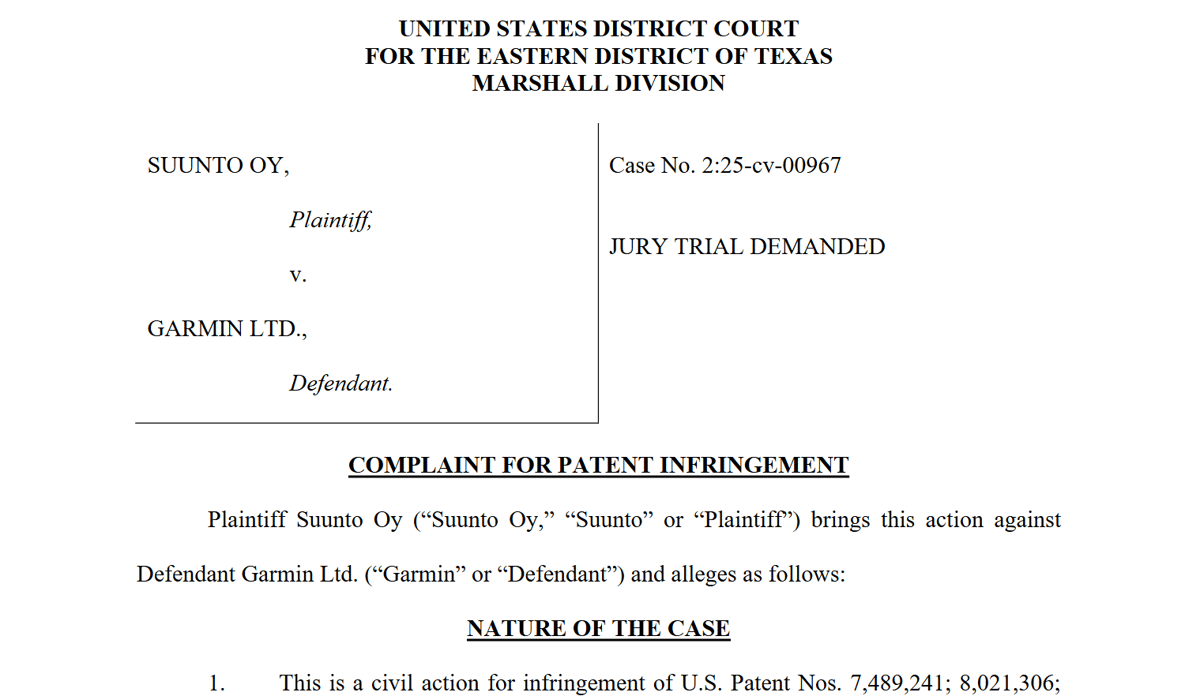
The dispute formally began when Suunto filed a 56-page complaint in the Eastern District of Texas in September 2025. : Case 2.25-cv-00967-JRG Suunto Oy vs Garmin Limited
Garmin responded three months later with a far more aggressive legal counterattack.
Breaking down Garmin’s 218-page legal counter-strike
Garmin’s subsequent countersuit asserts infringement of five patents that cover core elements of modern sports watch architecture:
- US Patent 10,271,299 – GPS antenna architecture for wearable devices
- US Patent 10,276,925 – multi-band antenna integration
- US Patent 10,856,794 – physiological training metrics derived from heart-rate data
- US Patent 11,318,351 – performance analytics algorithms
- US Patent 11,956,874 – integrated smartwatch flashlight design
The filing also contains extensive technical comparisons between Garmin devices and Suunto hardware.
One line in the filing starkly summarises the company’s position, accusing Suunto of “copying Garmin’s GPS technology” as it fell behind in the competitive race. (DC Rainmaker)
The countersuit significantly raises the stakes for Suunto.
The permanent injunction threat: What Suunto is really asking for
Federal courts can award monetary damages or require licensing settlements. However, Suunto is asking for more than money.
The company is seeking a permanent injunction — a court order prohibiting Garmin from continuing to sell products found to infringe Suunto’s patents.
Courts grant permanent injunctions only where monetary damages are judged insufficient to remedy the harm. They are rare, but the request signals that Suunto is not limiting its ambitions to a financial settlement.
For Garmin, whose Fenix and Forerunner lines would be among the products affected, the stakes of losing are substantial.
The patent power gap: Garmin’s massive portfolio advantage
Another factor shaping the case is the disparity in intellectual property portfolios.
Garmin has spent decades building patents across:
- GPS navigation systems
- wearable antenna designs
- physiological analytics algorithms
- smartwatch hardware integration
The company holds thousands of patents spanning both hardware and software.
Suunto’s patent portfolio is far smaller and historically focused on specialised outdoor watch features.
In litigation, this imbalance matters.
Garmin’s 218-page filing appears designed to emphasise exactly that advantage.
Technical deep dive: The five patents Garmin claims were stolen
The most technical aspects of the dispute involve how modern GPS watches function internally.
Two of Garmin’s patents cover antenna architecture used to receive satellite signals inside compact watch casings. This is a difficult engineering problem because metal watch bodies can interfere with radio signals. Garmin’s patents describe antenna placement and structural configurations that preserve signal quality without increasing watch size.
Two additional patents relate to physiological analytics derived from heart-rate variability. These technologies underpin metrics such as:
- recovery time
- training readiness
- stress tracking
- respiratory rate estimation
Garmin’s analytics stack draws heavily on technology originally developed by Firstbeat Analytics, which Garmin acquired in June 2020.
The fifth patent concerns the integrated flashlight feature found in recent Garmin watches, and now adopted by competitors across the wearables market. Garmin claims its patent covers a specific configuration: LEDs embedded in the sidewall of a smartwatch housing with configurable brightness and colour modes.
The Dongguan Liesheng factor: How new ownership changed the game
Ownership changes may also play a role in the dispute. Suunto was acquired by Dongguan Liesheng in 2022, bringing the historic Finnish brand under the control of a Chinese consumer electronics manufacturer. Garmin’s filings frequently reference this shift.
The company suggests the lawsuit reflects the strategy of Suunto’s new parent rather than its traditional engineering culture.
Garmin even separates the two entities rhetorically in its filing, emphasising that the legal battle is directed at the parent company rather than Suunto’s legacy staff. The implication is that the dispute represents a broader competitive move by Dongguan Liesheng.
The prior art trap: Did Suunto sue Garmin for Garmin’s own tech?
One of Garmin’s central arguments revolves around “prior art”. In patent law, prior art refers to evidence that an invention existed before a patent was filed. If proven, it can invalidate the patent.
Garmin argues that several technologies referenced in Suunto’s claims were already developed within Garmin’s ecosystem before Suunto filed its patents. In other words, Garmin is claiming that Suunto’s lawsuit may rely on technology Garmin created first.
If a court agrees, parts of Suunto’s case could collapse.
Industry fallout: What this means for the future of GPS watches
The outcome may take years to resolve. Patent cases often involve lengthy discovery phases, technical expert testimony and appeals. A Markman hearing — where the judge determines how patent terms are interpreted — is scheduled for February 2027, with jury selection pencilled in for August 2027.
For the wearable industry, the dispute highlights the growing importance of intellectual property in sports technology.
Behind every smartwatch feature — from satellite navigation to training readiness — lies a dense web of patents. And when those patents collide, the consequences can reshape an entire market.
How will this end?
The merits of Suunto’s original complaint may never be fully tested in court. Whatever the strength of its five patents, Suunto appears to have underestimated the response it would provoke.
This is a dispute between unequal players. Garmin holds a vastly larger patent portfolio across GPS hardware, physiological analytics and smartwatch design, along with the financial capacity to sustain long litigation. Dongguan Liesheng Electronic Co., Ltd. does not.
Suunto’s best chance is a swift win on one of its claims to force a licensing settlement. But even that would only resolve the opening case.
Garmin’s counterclaims would remain active. By filing first, Suunto may have triggered a patent conflict it ultimately cannot afford to finish.
Citations
- DC Rainmaker analysis of Garmin countersuit: https://www.dcrainmaker.com/2026/03/garmin-suunto-lawsuit-countersues.html
- Earlier background analysis of Suunto’s original lawsuit: https://the5krunner.com/2025/10/03/suunto-sues-garmin-5-core-watch-features-allegedly-stolen/
- Case docket, Suunto Oy v. Garmin Ltd., No. 2:25-cv-00967-JRG (E.D. Tex.): https://www.pacermonitor.com/public/case/60259454/Suunto_Oy_v_Garmin_Ltd
- Garmin acquisition of Firstbeat Analytics, June 2020: https://www.garmin.com/en-US/newsroom/press-release/corporate/2020-garmin-acquires-firstbeat-analytics-a-leading-provider-of-physiological-analytics-for-health-fitness-and-performance/
Last Updated on 9 March 2026 by the5krunner
Reader-Powered Content

This content is not sponsored. It’s mostly me behind the labour of love, which is this site, and I appreciate everyone who supports it.
Support the site: Follow (free, fewer ads) · Subscribe (paid, ad-free) · Buy Me A Coffee ❤️
All articles are written by real people, fact-checked, and verified for originality. See the Editorial Policy. FTC: Affiliate Disclosure — some links pay commission. As an Amazon Associate, I earn from qualifying purchases.
tfk is the founder and author of the5krunner, an independent endurance sports technology publication. With 20 years of hands-on testing of GPS watches and wearables, and competing in triathlons at an international age-group level, tfk provides in-depth expert analysis of fitness technology for serious athletes and endurance sport competitors.
