How Much Does It Cost to Make a Fitbit Air?
The $99 Fitbit Air breaks even on hardware at 8 to 12 million units per year, depending on the sales channel mix and how aggressively year-one fixed costs are loaded. Below that, it loses money. Above it, a modest profit. The interesting question is not whether the hardware pays for itself. It is what Google buys with the customer at that price.
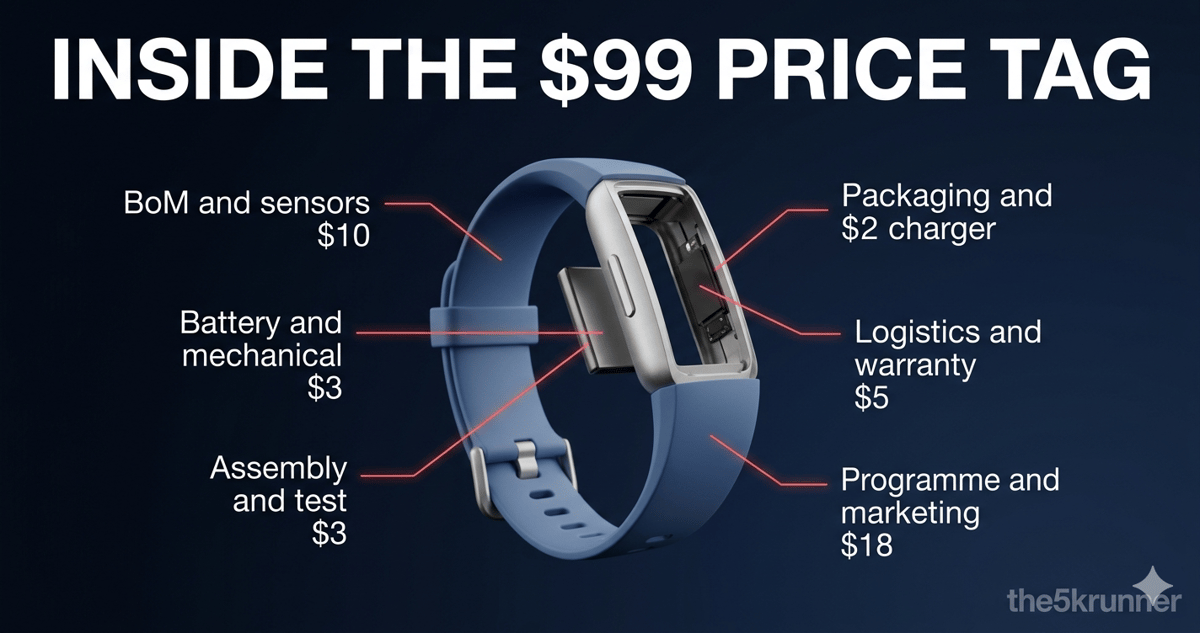
The Factory Gate Cost
- BoM electronics and sensors, including the optical heart rate sensor, accelerometer, BLE 5.0 radio, memory, supporting components, and a yield-loss buffer: $11 to $12
- Battery and mechanical parts, including the lithium-polymer cell, enclosure, and silicone band: $3 to $4
- Assembly, test, and supplier quality margin: $3 to $4
- Packaging and the magnetic charging puck: around $2
Total factory gate cost per unit: $20 to $22
For context, an IHS Markit teardown of the original Fitbit Flex 13 years ago put landed manufacturing cost at $17.36 against the same $99.95 retail price. Inflation alone would put that figure at around $25 to $26 in 2026 dollars. Component price compression and supplier scale have offset some of the inflation. The $20 to $22 factory gate estimate assumes Google’s procurement scale and reflects ex-works pricing in the country of manufacture.
Everything Else
Cost build:
- Post-factory logistics, covering ocean freight from China and Vietnam, US Section 301 tariffs (standard elsewhere), warranty reserves, returns processing, and customer support: $5 to $6 per unit
- Landed cost per unit: $25 to $28
- Amortised programme cost over a 3-year development cycle, covering hardware engineering, firmware, AI integration for the Gemini Health Coach, industrial design, tooling, validation, and certification, with a portion of the platform R&D shared across other Fitbit and Pixel Watch SKUs: $7 to $8 per unit at year-one volume
- Attributable go-to-market, covering launch marketing, retail support, and the Steph Curry endorsement, but excluding broader Pixel and Gemini ecosystem advertising and acknowledging that endorsement deals amortise across multiple products: $5 to $7 per unit
Total cost per unit, fully loaded, excluding strategic attribution: $37 to $43, with a central case around $40
Unit economics:
- Channel-only net revenue (Google receives wholesale after retailer margin of 38 to 42 per cent): $58 to $62
- Direct-only net revenue (after payment processing and fulfilment): around $87
- Blended net revenue at 80 per cent channel and 20 per cent direct: $63 to $67
- Contribution margin per unit, blended: $20 to $27
- Fixed costs per year: $200 to $250 million
- Breakeven volume: 8 to 12 million units per year
Fully loaded cost per unit (around $40) sits just below channel wholesale revenue (around $60). That leaves a slim margin of around $20 on each channel-sold unit. During the launch period, when direct sales are relatively high, the blended margin is healthier. Once channel sales account for the dominant share, which happens for most consumer hardware launches within the first 6 months, the per-unit margin thins, and the product is loss-making or marginally profitable.
The $2.1 billion Google paid to acquire Fitbit in 2021, corporate overhead, and broader ecosystem investments are excluded as non-causal product costs. They sit in the strategic attribution layer, which is the subject of a separate piece.
So, why $99?
Below 8 to 12 million units a year, it loses money. Above that, the margins are thin, particularly once channel sales become the dominant share post-launch. Google has not built the Fitbit Air to make hardware profit.
The recoupment is downstream. Premium subscription conversion at $79 per year. Pixel and Android ecosystem retention. And the population-level health dataset that feeds Gemini’s health intelligence. That last item is the prize. The hardware is the cost of acquiring the customer who produces the data.
Same playbook as Gmail and Photos. Different product. Different decade. Same logic. And one of the most significant wearable launches in over a decade. For the full picture of the Google Fitbit ecosystem: Google Fitbit and Wear OS hub.

Quick answers
How much does it actually cost Google to make a Fitbit Air?
Around $20 to $22 at the factory gate, rising to $25 to $28 once US tariffs on Chinese-made units, freight, warranty reserves, and customer support are included. Fully loaded with amortised research and development and attributable marketing, the total cost per unit is around $37-$43, with a central case near $40.
Does Google lose money on the Fitbit Air?
It depends on volume and sales mix. Below 8 to 12 million units per year, the hardware loses money. Above that, it clears a modest contribution margin. Once channel sales account for the dominant share post-launch, the per-unit margin thins. Google has not built the Air to make hardware profit. The recoupment is downstream through subscription conversion, Pixel ecosystem retention, and data feeding to Gemini.
Why is the Fitbit Air priced at $99?
To acquire customers at scale. The $99 price point undercuts Whoop’s $200 to $359 annual subscription model and the expected $200 plus pricing of the Garmin Cirqa. The cost of acquiring a user who will produce continuous health data, deepen Android engagement, and potentially subscribe to Google Health Premium at $79 per year.
Last Updated on 29 June 2026 by the5krunner
My favourite kit and nutrition
- Garmin Fenix 9 Pro — I’ve just bought one.
- Injinji – Runners protect your toes. Avoid discomfort and minor injury. Run more. Run faster. I use them.
- Garmin 90-degree charging adapter — A small keyring adapter you can use anywhere. Essential when away. I use one.
- Garmin charging puck — the fastest and most reliable way to top up your Garmin before a session. I use one.
- Ravemen FR300 — Front light that mounts directly under your Garmin or Wahoo head unit. Keeps your bars clean and your beam pointed where it matters. I use one.
- Body Glide – The blue anti-chafe stick that all swimmers and many runners use. I use it.
- Maurten — The race nutrition trusted by elite athletes. Gels and drink mixes engineered to be easy on the stomach. I use them.
- Garmin Varia RTL515 — A radar rear light that alerts you to vehicles approaching from behind. Pairs with your Edge or Wahoo. I use this model.
- Favero Assioma Pro RS2 — The power-meter pedals most serious cyclists choose. Accurate, easy to move between bikes. I use this model.
- Garmin Forerunner 970 — A serious choice for a pro-grade triathlon watch. I use this.
- Polar H10 — My daily driver for accurate, waking HRV readings.
- Wahoo ELEMNT Roam 3 — The bike computer that has the feature Garmin lacks: usability. I use mine on most rides.
Reader-Powered Content

This content is not sponsored. It’s mostly me behind the labour of love, which is this site, and I appreciate everyone who supports it.
Support the site: Follow (free, fewer ads) · Subscribe (paid, ad-free) · Buy Me A Coffee ❤️
All articles are written by real people, fact-checked, and verified for originality. See the Editorial Policy. FTC: Affiliate Disclosure — some links pay commission. As an Amazon Associate, I earn from qualifying purchases.
tfk is the founder and author of the5krunner, an independent endurance sports technology publication. With 20 years of hands-on testing of GPS watches and wearables, and competing in triathlons at an international age-group level, tfk provides in-depth expert analysis of fitness technology for serious athletes and endurance sport competitors. ID

Must be cheaper to make than the Fitbit inspire 3 which is also 99 bucks and has a screen. This is probably the same sensor with updated firmware and algorithms.
Fair. Removing the screen knocks $3-5 off the BoM – launched 2022 pre tariffs