Ride with GPS Waivers Addresses What Strava’s Club-Level System Left Open
Ride with GPS launched its Waivers feature on 28 July 2026, five months after Strava rolled out club-level waiver collection in February. Both solve the same underlying problem: clubs and event organisers have spent years juggling clipboards, spreadsheets, and third-party waiver services that never spoke to their member lists and race entrants. Both platforms now provide built-in tooling to capture signatures and store records alongside membership lists.
Strava applies one set of waivers at the club level; every event under that club banner requires members to accept the same paperwork. Ride with GPS allows waivers to live at multiple trigger points: one for club membership, separate ones for individual events, and different waivers for event series. This handles a Tuesday social spin and a multi-day supported tour; each carries different liability considerations.
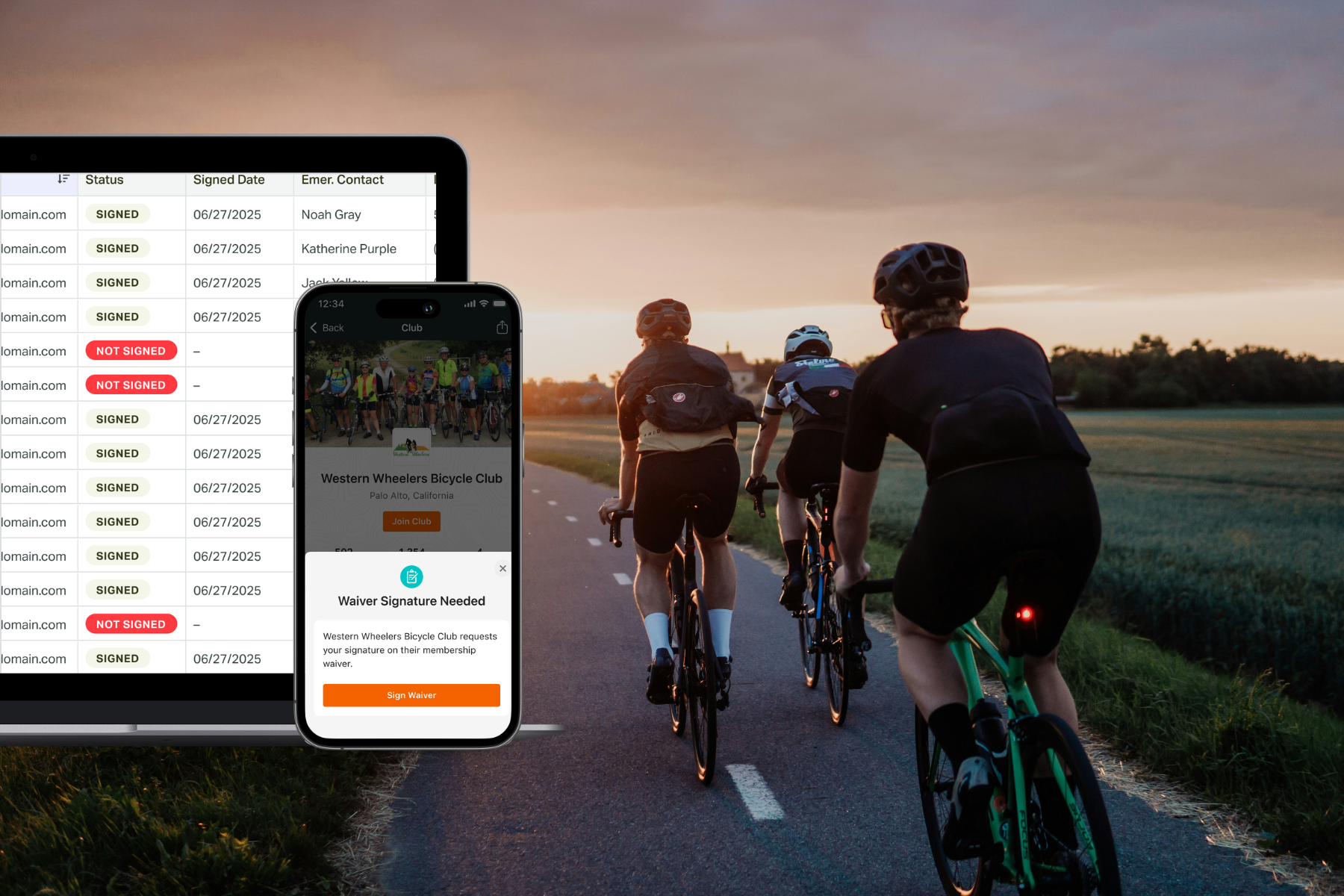
Emergency contact collection
Ride with GPS collects emergency contact details during signing; Strava does not. Members enter the information once, and admins pull it up in the app on the ride. Kevin Prentice at Ride with GPS said organisation partners ranked this capture nearly as high as the waivers themselves. Strava’s own documentation advises clubs whose activities vary between events, or who need event-specific waivers, to consult a lawyer about whether club-level waivers suffice: a caveat that names its own limitation.
Scope: club level vs multi-trigger
Strava waivers apply at the club level only. Once a member accepts a club’s waiver, they may RSVP for any event under that club without re-signing. If the club updates or adds a waiver, members must re-accept before their next RSVP.
Ride with GPS waivers can attach to club membership, to individual events, to event series, or to standalone group rides. An organisation can require one waiver for new members joining the club, then a different waiver when those same members register for a gravel series or a supported century. Strava’s documentation tells clubs to seek separate event waivers where activities differ materially, then gives them no way to attach one.
Onboarding automation
Ride with GPS pairs waiver collection with member import. An admin uploads a member list, sends a single auto-approval link, and new riders move from prospect to signed-and-joined without the admin touching a form. Strava’s waiver flow requires members to accept during the RSVP process; there is no bulk onboarding mechanism.
Geographic availability
Strava expanded club organiser waivers to the UK and USA in April 2026, later extending to Canada and Australia. Ride with GPS waivers launched globally to all Club, Event, and Shop organisation partners.
Signature records and data scope
Both platforms store waiver text, timestamp, member name, and acceptance date, and both export signatures to CSV from the web dashboard. Strava additionally holds email address and Athlete ID but shows admins only name and acceptance date in the interface. Ride with GPS shows emergency contacts in the app.
Concurrent waivers
Strava allows up to five active waivers at once, 50 in total. Ride with GPS publishes no formal limit and carries multiple waivers across different trigger points by design.
Age restrictions
Both platforms restrict waiver acceptance to members 18 and older. Clubs with younger members handle parental consent and sign-up outside the platform.
Legal responsibility
Neither platform reviews, approves, or advises on waiver content. Both explicitly state that organisations are solely responsible for ensuring their waivers comply with applicable law. Strava and Ride with GPS provide the mechanism; the liability and legality rest with the club or event organiser.
Quick answers
Do I need to choose between Strava and Ride with GPS for waivers?
No. The platforms serve different purposes. Strava is a social network for activity tracking; Ride with GPS is a route planning and club management platform. Many organisations use both. Your choice depends on whether you plan to use the broader platform features—activity sharing on Strava, route discovery and navigation on Ride with GPS.
Which platform is better for clubs with events that vary in risk?
Ride with GPS. If your club runs a mix of casual social rides and high-risk activities (supported centuries, backcountry gravel, adventure racing), the ability to attach separate waivers to different event types eliminates legal ambiguity. Strava’s club-level approach forces all events under a single waiver, which most lawyers would advise is inadequate if your activities materially differ.
Can I access emergency contact information on Strava?
No. Strava’s waiver system does not collect emergency contacts. Ride with GPS collects them during signing and makes them available in the mobile app without requiring a separate form or spreadsheet.
Do waivers signed on Strava count on Ride with GPS, or vice versa?
No. Each platform maintains its own waiver records. A member who signed a Strava club waiver has not signed a Ride with GPS event waiver and vice versa. Waivers are not portable between platforms.
What happens if I update a waiver on either platform?
On Strava, members must re-accept the updated waiver before their next RSVP. On Ride with GPS, the behaviour depends on the trigger point: club membership waivers update the record for future joiners; event waivers update for future participants in that event or series.
Are these waivers legally binding?
Legality depends entirely on your jurisdiction, the activities involved, and the waiver text itself. Neither platform provides legal advice or review. Both platforms require you to consult a qualified lawyer in your jurisdiction to confirm your waiver is valid. A platform’s ability to collect signatures does not make those signatures defensible in court.
Support resources
Ride with GPS:
- Organisation Waivers overview
- Waivers for Organisation Admins
- Waivers for Participants
- Email: or***********@*********ps.com
Strava:
Last Updated on 29 July 2026 by the5krunner
My favourite kit and nutrition
- Injinji – Runners protect your toes. Avoid discomfort and minor injury. Run more. Run faster. I use them.
- Garmin 90-degree charging adapter — The small adapter that keeps your charging cables tidy. Essential for race day. I use one.
- Garmin charging puck — the fastest and most reliable way to top up your Garmin before a session. I use one.
- Ravemen FR300 — Front light that mounts directly under your Garmin or Wahoo head unit. Keeps your bars clean and your beam pointed where it matters. I use one.
- Body Glide – The blue anti-chafe stick that all swimmers and many runners use. I use it.
- Maurten — The race nutrition trusted by elite athletes. Gels and drink mixes engineered to be easy on the stomach. I use them.
- Garmin Varia RTL515 — A radar rear light that alerts you to vehicles approaching from behind. Pairs with your Edge or Garmin watch. I use this model.
- Favero Assioma Pro RS2 — The power-meter pedals most serious cyclists choose. Accurate, easy to move between bikes. I use this model.
- Garmin Forerunner 970 — A serious choice for a pro-grade triathlon watch. I use this.
- Polar H10 — My daily driver for accurate, waking HRV readings.
- Wahoo ELEMNT Roam 3 — The bike computer that has the feature Garmin lacks: usability. I use mine on most rides.
Reader-Powered Content

This content is not sponsored. It’s mostly me behind the labour of love, which is this site, and I appreciate everyone who supports it.
Support the site: Follow (free, fewer ads) · Subscribe (paid, ad-free) · Buy Me A Coffee ❤️
All articles are written by real people, fact-checked, and verified for originality. See the Editorial Policy. FTC: Affiliate Disclosure — some links pay commission. As an Amazon Associate, I earn from qualifying purchases.

tfk is the founder and author of the5krunner, an independent endurance sports technology publication. With 20 years of hands-on testing of GPS watches and wearables, and competing in triathlons at an international age-group level, tfk provides in-depth expert analysis of fitness technology for serious athletes and endurance sport competitors. ID
