Garmin CIRQA Smart Band – First Test Accuracy Fail – Open Water Swim
This is one test session from a six-session accuracy series. Read the full review for the complete picture, including where CIRQA excelled.
A beautifully warm evening cried out for open-water swimming and my first test of CIRQA Smart Band. I was wearing it on the wrist and expected the worst. I wasn’t disappointed.
Test conditions
There were two 15-minute efforts at a bit below threshold recorded by Apple Watch Ultra 3 (full specifications, left wrist), Garmin CIRQA (right wrist, configured as such), Polar Sense (right biceps), WHOOP MG (left biceps) and HRM 600.
Problems
I had two problems. Firstly, the HRM 600 didn’t record the session even though I specifically started and remembered stopping it at the end. Whether Connect was getting confused between two caching devices simultaneously recording a workout, I don’t know. Maybe I made a mistake.
The second problem was that I wasn’t quite sure if CIRQA was recording or not. It was very hot and bright, and I couldn’t see the tiny light. After the first 15-minute effort, I stopped CIRQA to check the vibration was signalling the end of a saved workout (it was). So I started a second workout. Consequently, the CIRQA results are split into two files as you can see from the test results. That makes zero difference, as the results were awful.
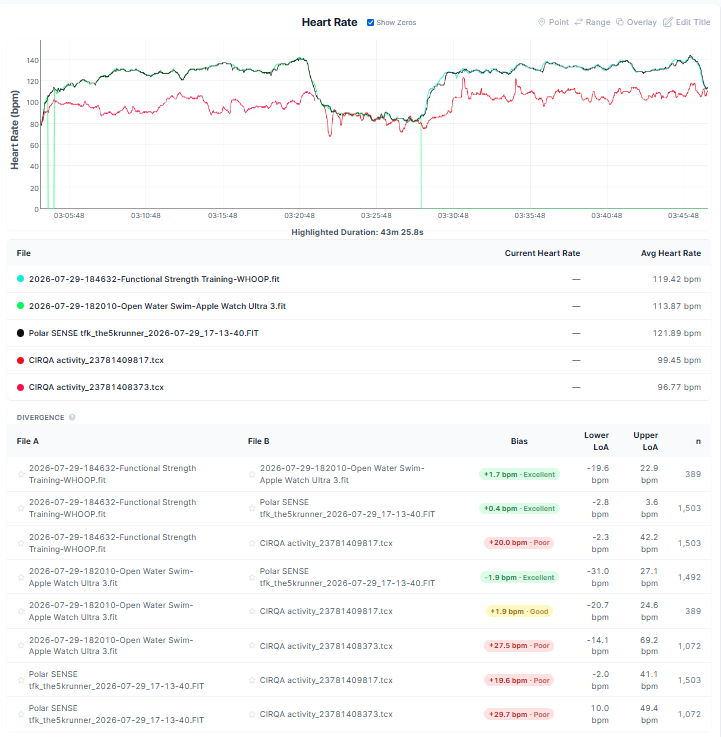
Test interpretation
In this open-water swim test, CIRQA under-read heart rate substantially compared with the competing devices. Polar Sense (121.89 bpm), WHOOP (119.42 bpm) and Apple Watch Ultra 3 (113.87 bpm) agreed closely with one another (excellent bias and tight limits of agreement), whereas the two split CIRQA files averaged only 99.45 bpm and 96.77 bpm. Pairwise comparisons showed large positive biases of roughly +20 to +30 bpm for WHOOP and Polar versus both CIRQA segments (rated Poor), confirming a clear systematic under-reading by CIRQA relative to the other devices on this swim.
Take out
CIRQA was worn correctly. I even suffered wearing a wetsuit to ensure it was firmly held in place during the swim.
I was wholly unsurprised that I got bad heart rate tracks on the wrist from a prior gen sensor (Elevate 4.1). I am going to put myself through misery over multiple tests with CIRQA on the wrist. I fully expect it to be wrong much of the time. I hope I’m wrong. I want to say that I’m pretty sure it will be accurate on the biceps, as most devices are, but you’ll likely be risking your chances with it on the wrist. I’m pulling one for the team here and getting the bad results out of the way.
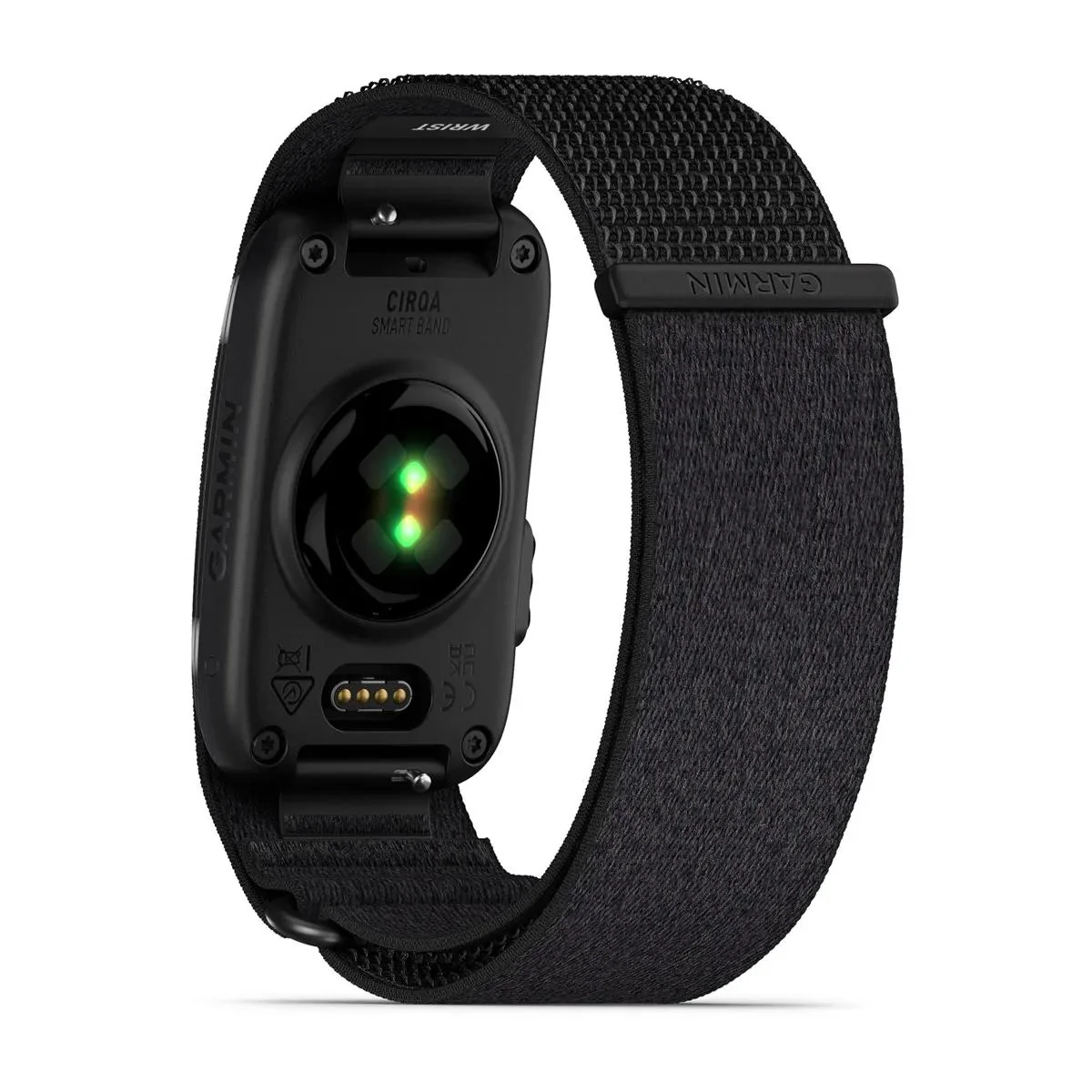
Garmin CIRQA Smart Band
Screenless health and fitness band (no subscription required)
 +other retailers
Quick answers
Is the Garmin CIRQA accurate for heart rate on the wrist?
In this open-water swim test, the wrist-worn CIRQA under-read heart rate by roughly 20 to 30 bpm against Polar Sense, WHOOP MG and Apple Watch Ultra 3. Wrist optical sensors struggle in open water, and this early result is consistent with that pattern. Further testing will follow.
Which heart rate sensor does the Garmin CIRQA use?
The CIRQA uses Garmin’s Gen 4 optical sensor (Elevate) with skin temperature added, which this site labels 4.1. It reads heart rate, HRV, SpO2, respiration and skin temperature.
Is the CIRQA more accurate on the upper arm than the wrist?
Optical sensors are generally more accurate on the upper arm than the wrist because the arm moves less and offers steadier blood flow. The CIRQA supports upper arm wear with a dedicated band, and arm placement is the more reliable option for heart rate during hard efforts.
Last Updated on 19 August 2026 by the5krunner
My favourite kit and nutrition
- Garmin Fenix 9 Pro — I’ve just bought one.
- Injinji – Runners protect your toes. Avoid discomfort and minor injury. Run more. Run faster. I use them.
- Garmin 90-degree charging adapter — A small keyring adapter you can use anywhere. Essential when away. I use one.
- Garmin charging puck — the fastest and most reliable way to top up your Garmin before a session. I use one.
- Ravemen FR300 — Front light that mounts directly under your Garmin or Wahoo head unit. Keeps your bars clean and your beam pointed where it matters. I use one.
- Body Glide – The blue anti-chafe stick that all swimmers and many runners use. I use it.
- Maurten — The race nutrition trusted by elite athletes. Gels and drink mixes engineered to be easy on the stomach. I use them.
- Garmin Varia RTL515 — A radar rear light that alerts you to vehicles approaching from behind. Pairs with your Edge or Wahoo. I use this model.
- Favero Assioma Pro RS2 — The power-meter pedals most serious cyclists choose. Accurate, easy to move between bikes. I use this model.
- Garmin Forerunner 970 — A serious choice for a pro-grade triathlon watch. I use this.
- Polar H10 — My daily driver for accurate, waking HRV readings.
- Wahoo ELEMNT Roam 3 — The bike computer that has the feature Garmin lacks: usability. I use mine on most rides.
Reader-Powered Content

This content is not sponsored. It’s mostly me behind the labour of love, which is this site, and I appreciate everyone who supports it.
Support the site: Follow (free, fewer ads) · Subscribe (paid, ad-free) · Buy Me A Coffee ❤️
All articles are written by real people, fact-checked, and verified for originality. See the Editorial Policy. FTC: Affiliate Disclosure — some links pay commission. As an Amazon Associate, I earn from qualifying purchases.
tfk is the founder and author of the5krunner, an independent endurance sports technology publication. With 20 years of hands-on testing of GPS watches and wearables, and competing in triathlons at an international age-group level, tfk provides in-depth expert analysis of fitness technology for serious athletes and endurance sport competitors. ID

Hi.
I would mark this test as inconclusive.
Running two Garmin devices at the same time can potentially cause interference. In theory, they should work fine together, but as we both know, it usually takes Garmin about six months to get their software completely stable.
they wont cause interference.
there could be a bug in connect
the test is conclusive about the conditions/devices described