Garmin Q2 2026 Earnings: Record Revenue, Fitness Up 25%, Share Price Jumps 17%
Garmin’s share price skyrocketed on a day when the wider market was flat. Why? Mainly, the previous analyst expectations were well and truly trounced due in part to technical reasons (tariff refunds, higher margins) but also to a whopping rise in the performance of the fitness division, which includes the Forerunner watches. Even better, Garmin’s execs confirmed that CIRQA had effectively sold out at launch, hence exceeding expectations. There was, of course, more good news for the future with heavy hints of new Outdoor Division products later this year. That likely means Fenix 9.
Garmin reported record second-quarter revenue of $2.02 billion, up 11% year-on-year, with gross and operating margins expanding across every segment. The market agreed with the numbers this time. GRMN jumped as much as 17% in premarket trading to $296.76, and the gain extended through the session toward a new closing high near $302. That is a sharp turnaround from the tepid reaction that followed Garmin’s Q1 release three months earlier.
Every division expanded gross margin against the prior-year quarter. Pro forma EPS of $2.81 rose 29% year on year. Analysts had forecast revenue of $1.94 billion and EPS of $2.30. Garmin beat the revenue forecast by about 4% and the EPS forecast by about 22%, so profit grew faster than sales, pointing to better margins and cost control rather than just higher volume.
Garmin’s second quarter delivered another record on both lines. Consolidated revenue rose 11% to $2.02 billion, with margin gains across the business driven mostly by a richer product mix rather than price increases. Operating income increased 30% to $616 million, and pro forma EPS climbed 29% to $2.81. Pemble said the strength of the first half gave the company “confidence to raise our full year 2026 guidance.” [Pemble, CEO]
Fitness: Revenue increased 25% to $757 million, a new second-quarter record, with growth across every product category led by continued demand for advanced wearables. Gross and operating margins expanded to 64% and 37%, respectively, producing $277 million of operating income. The quarter included the launches of the Forerunner 70 and Forerunner 170 and the announcement of the CIRQA Smart Band, a screenless wearable that adds wellness and readiness tracking without requiring a subscription. Garmin continues to expect Fitness will be the strongest contributor to full-year 2026 growth.
Outdoor: Revenue fell 2% to $483 million, with the decline concentrated in the consumer auto and adventure watch product categories. Gross and operating margins still expanded, to 69% and 34% respectively, delivering $164 million of operating income despite the softer top line. Garmin expects a stronger back half for Outdoor as new products reach the market, improving full-year growth against 2025.
Geographically, Q2 growth was led by EMEA at 13%, followed by the Americas at 12% and APAC at 7%. All three regions grew, a broader spread than Q1, when APAC led at 25% on favourable currency effects that have since faded from the year-on-year comparison.
Garmin’s cash position held broadly steady, ending Q2 with cash and marketable securities of approximately $4.4 billion. Free cash flow for the quarter was $276 million, up $148 million on Q1. The company paid $202 million in dividends and bought back $43 million of stock during the quarter, with $448 million remaining on the share repurchase programme through December 2028. Capital expenditure rose to $128 million, reflecting the build-out of the new Thailand manufacturing site.
Against Expectations
Q1 showed readers of this site that a strong Garmin quarter does not guarantee a strong share price reaction. Q2 reversed that. Pro forma EPS of $2.81 beat consensus by more than 20%, a wider margin than the revenue beat of roughly 4%. Management also raised full-year guidance, to about $8.05 billion in revenue and $10.00 in EPS, up from $7.9 billion and $9.35.
After Q1, management held guidance flat, leaving investors unsure whether the strong quarter would continue. This time the guidance raise answered that question directly, and it already accounts for the higher memory costs expected in the second half rather than leaving that as a risk.
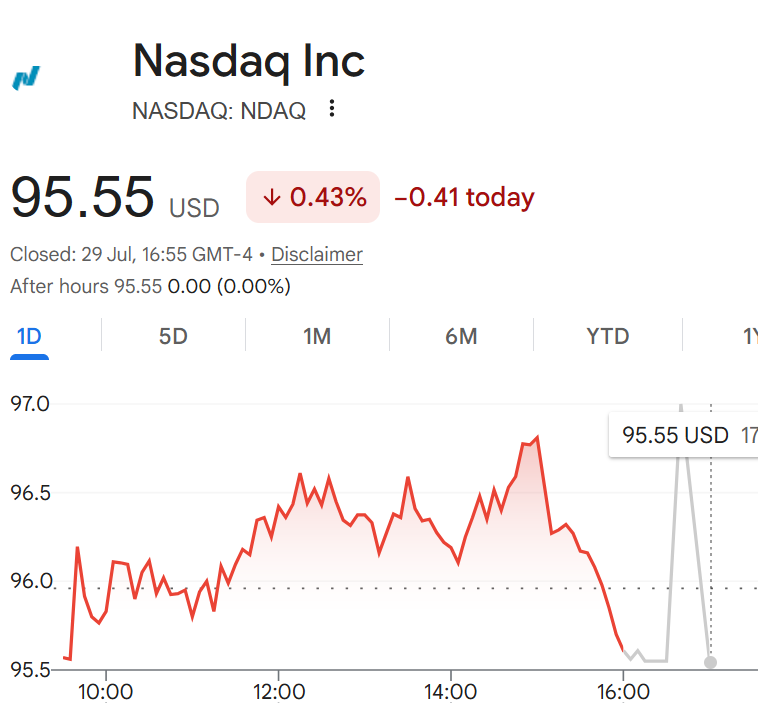
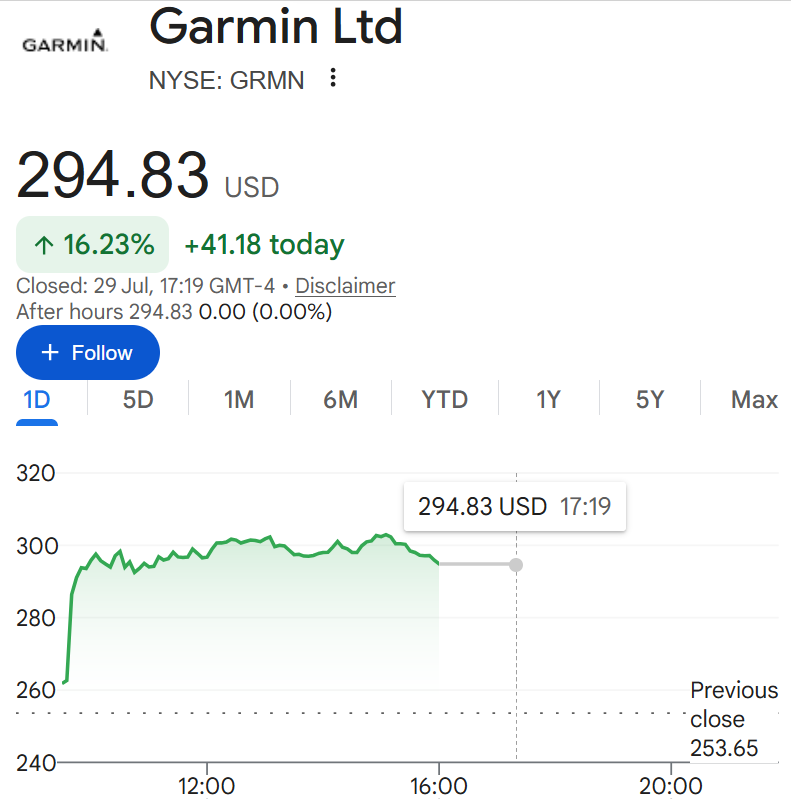
These figures were captured on results day.
My Personal Take: Almost everything seemed to go right for Garmin this quarter, but even the one area for concern, Outdoor, held the tantalising prospect of Fenix 9 mere months away (expectations of this site). Garmin’s long-run trajectory looks solid.
Fitness as the Engine: Every Category Contributes
Fitness revenue of $757 million represents 25% growth, a step down from Q1’s 42% but still the fastest-growing segment by a wide margin and the one Garmin expects to carry 2026’s consolidated growth. Every product category within Fitness contributed to the quarter, and margin expansion to 64% gross and 37% operating reflects a mix increasingly weighted toward advanced wearables rather than entry-level devices.
CIRQA launched during the quarter at the confirmed $199.99 price and has already sold through its initial production run, with Garmin quoting five- to eight-week shipping delays on new orders. The company said demand outran its own expectations.
The TrainingPeaks and TrainHeroic acquisitions, completed earlier in July, now sit inside the Fitness segment. Pemble described the rationale in product terms rather than cost terms: devices record training data, TrainingPeaks routes it to a coach, and the coach’s guidance feeds back into the athlete’s plan. That closes a loop Garmin has been assembling piece by piece since the Firstbeat and MYLAPS acquisitions.
What’s Coming Next
Garmin’s Thailand manufacturing facility is on track for completion by the end of 2026, with an initial phase of around 400,000 square feet that management says has the potential to double the company’s total manufacturing capacity over time. Utilisation begins in early 2027. Management described the facility as a step toward manufacturing diversification and additional capacity options, not tied to any single product programme.
Garmin has also flagged higher memory component costs as a second-half headwind, one it says is already reflected in the raised guidance rather than a risk to it. Management described its approach to memory costs as a repeat of the playbook used against tariffs earlier in the year: absorb what can be absorbed, and protect margin rather than chase volume at any cost.
Outdoor: A Narrower Decline
Outdoor revenue fell 2% to $483 million, an improvement on Q1’s 5% decline though still the segment’s third negative quarter in the past four. Along with consumer auto, Garmin named the adventure watch category as the specific drag, language that points at the Fenix and Instinct lines rather than the golf or dog-tracking businesses that also sit inside Outdoor. Margins held up regardless: gross margin at 69% and operating margin at 34% are both higher than Fitness, and operating income of $164 million was down only modestly against a stronger prior-year comparable.
Garmin expects Outdoor to strengthen in the back half of the year as new products reach the market, language that echoes the same forward guidance the company gave after Q1, when Outdoor also fell short. Whatever the specific launches turn out to be, the second half is now carrying the weight of the segment’s full-year recovery for a second consecutive quarter running.
Positive Note: If ever it were needed, this is the impetus for Garmin to give us the best possible Fenix 9 they can. Roll on Q3!
Key Takeaways for Garmin’s Future
Fitness remains the growth engine. A quarter of 25% growth, with every product category contributing, keeps Fitness as the segment carrying Garmin’s consolidated growth story for 2026.
The market believed the raise. A guidance increase of this size, delivered alongside an EPS beat that outran the revenue beat, is the combination that moved the share price where three prior quarters of strong results did not.
Outdoor is stabilising, not yet recovering. A narrower decline than Q1 is progress, but Garmin has now pointed to back-half product launches as the fix for two consecutive quarters.
Memory costs are the next test. Management says the headwind is already priced into guidance, but the second half will be the first quarter where it actually shows up in the numbers.
Auto OEM has a gap to cross. Revenue and operating income are expected to fall in the back half as BMW volumes peak, with the Mercedes-Benz programme not due to ramp until early 2027.
TrainingPeaks closes a data loop. Management framed the acquisition around linking device, coach and athlete data rather than around cost synergies, consistent with the site’s earlier analysis of the deal.
Insights From the Analyst Briefing
A handful of exchanges from the call raise these insights
Wearables beyond the wrist. Asked directly whether Garmin intends to expand into wearable form factors beyond the wrist, Pemble declined to comment on the roadmap but did not rule it out, and Boessen added that further new products should be expected. Neither exec named a category, but the question itself signals that analysts are now pricing in the possibility. Possibly this could refer to a muscle oxygen sensor as reported on this site. This site would expect such a sensor to have good appeal to a tight market segment.
The golf data report. Garmin’s own Trends in Golf Data Report, released alongside the results, found that participation in the sport is up and that players are improving across nearly every shot category. The report has not been covered on this site and stands as its own short data piece independent of the earnings themselves.
Sources & Resources
Garmin Share Price
Nasdaq
Garmin Q2 2026 Earnings Press Release
Garmin Official Site
Garmin Q3 2025 Earnings: Fitness Explodes, Fenix 8 Pro Underwhelms
explosive Garmin Q2 Earnings – significant Forerunner 970 contribution (2025)
For the complete Garmin Fenix series guide, covering all current models, history and buying advice, see the Garmin Fenix hub. For a current buying recommendation across the Fenix 8 lineup including whether to wait for Fenix 9, see the best Garmin Fenix guide. For the full Forerunner lineup comparison see the best Garmin for running guide.
Explore the full resource library
This site covers endurance sport technology across a range of dedicated reference sections. Each one collects the most relevant articles, tests, and analysis on its topic in one place.
Buyer guides
- Best sports watch — tested recommendations by sport and athlete type: triathlon, running, marathon, cycling, hiking, and women
- Best Garmin watch — Forerunner versus Fenix by series, sport, and budget
- Best wearables — recovery trackers, heart rate monitors, running power meters, and female athlete tech
- Best cycling products — computers, smart trainers, power meters, and cycling heart rate monitors
Brand and product guides
- Amazfit — the full Amazfit range from Balance to Cheetah to T-Rex, accuracy tests, HYROX partnership, and Zepp Health analysis
- Apple Watch — athlete-first coverage of Apple Watch across running, cycling, and triathlon
- COROS — watches, features, and firmware across the full COROS range
- Garmin — the company, the platform and the full range, and the starting point for choosing across every Garmin product line
- Garmin Edge — bike computers from entry-level navigation to flagship endurance and mountain biking
- Garmin Fenix — every model, feature, and firmware development for Garmin's flagship outdoor watch
- Garmin Fenix 8 Series — which variant to buy, upgrade advice, accuracy data, and the full Fenix 8 review and firmware coverage
- Garmin Forerunner — the full Forerunner line covered from entry level to triathlon flagship
- Garmin Instinct — rugged GPS watches for endurance and adventure athletes
- Garmin Features Explained — how Garmin's metrics work, from Training Load and Body Battery to Race Predictor and HRV Status
- Google Fitbit — Fitbit Air, Google Health, Pixel Watch and the Wear OS platform
- Polar — watches, sensors, Polar Flow and training science across the full Polar range
- Suunto — Race, Vertical, Run and the SuuntoPlus ecosystem
- Strava — features, privacy, segments, and how Strava fits into a serious training setup
- Wahoo — KICKR trainers, ELEMNT bike computers, and the Wahoo ecosystem
- WHOOP — strain, recovery, sleep and the full WHOOP ecosystem
Specifications database
- Full Specifications Database — detailed spec sheets, battery life, sensor lists and generation-on-generation comparisons for current Garmin, COROS, Amazfit, Samsung, Google Fitbit, Huawei, Polar, Suunto, Wahoo and Apple Watch models
Glossary
- Sports Technology Glossary — non-branded terminology across running, cycling, swimming, triathlon, hiking, strength training, HYROX, sensors, ecosystems, and brands
Sport and topic guides
- Running Watches — how to choose by discipline: road racing, trail, track, beginner, and multisport
- Triathlon and Multisport Technology — watches, sensors, and race-day tools for swimmers, cyclists, and runners
- HYROX — training science, race analysis, and technology for the functional fitness race format
- parkrun — technology, training, and performance for the weekly 5K
- Hiking Technology — navigation, safety, and trail tech for walkers and hikers
- Heart Rate Monitoring — optical sensors, chest straps, accuracy comparisons, and how to set training zones
- GPS Accuracy — how satellite systems perform across brands, terrains, and conditions
- Sports Watch Battery Life — battery claims, real-world tests, and how to manage battery life across Garmin, Apple, Amazfit and Coros
- Recovery Trackers — WHOOP, Oura, and the science of readiness scoring
- Female Athlete Tech — wearables, physiology, and performance for female endurance athletes, covering cycle-synced training, RED-S, HR accuracy, and VO2max
- Sports Science — peer-reviewed research on HRV, VO2max, lactate threshold, running power, wearable accuracy, and supplementation
- Testing Methodology — how this site tests GPS accuracy, heart rate, battery life, and other performance claims
Content series
- Release Radar — confirmed launches, leaks, and rumours across Garmin, Apple, COROS, Polar, Suunto, and Wahoo
- Deep Dive Feature Files — weekly firmware feature updates across all brands (bug fixes excluded)
- Fix Files — weekly firmware bug fix tracking across all brands
Last Updated on 11 August 2026 by the5krunner
My favourite kit and nutrition
- Garmin Fenix 9 Pro — I’ve just bought one.
- Injinji – Runners protect your toes. Avoid discomfort and minor injury. Run more. Run faster. I use them.
- Garmin 90-degree charging adapter — A small keyring adapter you can use anywhere. Essential when away. I use one.
- Garmin charging puck — the fastest and most reliable way to top up your Garmin before a session. I use one.
- Ravemen FR300 — Front light that mounts directly under your Garmin or Wahoo head unit. Keeps your bars clean and your beam pointed where it matters. I use one.
- Body Glide – The blue anti-chafe stick that all swimmers and many runners use. I use it.
- Maurten — The race nutrition trusted by elite athletes. Gels and drink mixes engineered to be easy on the stomach. I use them.
- Garmin Varia RTL515 — A radar rear light that alerts you to vehicles approaching from behind. Pairs with your Edge or Wahoo. I use this model.
- Favero Assioma Pro RS2 — The power-meter pedals most serious cyclists choose. Accurate, easy to move between bikes. I use this model.
- Garmin Forerunner 970 — A serious choice for a pro-grade triathlon watch. I use this.
- Polar H10 — My daily driver for accurate, waking HRV readings.
- Wahoo ELEMNT Roam 3 — The bike computer that has the feature Garmin lacks: usability. I use mine on most rides.
Reader-Powered Content

This content is not sponsored. It’s mostly me behind the labour of love, which is this site, and I appreciate everyone who supports it.
Support the site: Follow (free, fewer ads) · Subscribe (paid, ad-free) · Buy Me A Coffee ❤️
All articles are written by real people, fact-checked, and verified for originality. See the Editorial Policy. FTC: Affiliate Disclosure — some links pay commission. As an Amazon Associate, I earn from qualifying purchases.
tfk is the founder and author of the5krunner, an independent endurance sports technology publication. With 20 years of hands-on testing of GPS watches and wearables, and competing in triathlons at an international age-group level, tfk provides in-depth expert analysis of fitness technology for serious athletes and endurance sport competitors. ID

Small correction: “Garmin’s cash position weakened slightly” is incorrect. The cash position actually stayed the same – and improved by $87m when taking into account marketable securities:
Cash and cash equivalents $ 2,072,208 $ 2,079,468
Marketable securities 515,038 421,270
The table/exhibit you posted is not cash position (which is a balance sheet item) but rather for (free) cash _flow_ during the period. And even then, the decline in free cash flow is quite benign because it is mostly due to a significant (> $200m) net increase in inventories – no doubt connected to the new device launches and in order to avoid OOS situations, like noted for the FR970.
If you go to Garmin Forums and compare the comment sections of the 570 and 970, it’s staggering….either the 570 is perfect out of the box with no bugs whatsoever…or no one is buying it….I suppose the latter.
But it seems the the Sleep Index Band has been delivered to the early adopters, because the first complain are coming in…Did you get one? I wonder how much the band data will deviate from the watch data.
in the context of this artcile i dont know how garmin books its revenue
it could invoice trade buyers of Index as it ships bulk volumes
i dont plan to get one. but i might eventally. if it was designed for sport i would
Could be that there’s no shortage of people who owned Fenix 6 and 7 series, as well as the Epix, ditching Garmin for other manufacturers thanks to their antisocial update policy.
Hilarious. They think that locking more features behind a subscription paywall connect + is a good way forward. I will literally buy a Coros watch the moment I feel they have crossed the line. Consumers have had enough of the endless subscription services and are scaling back. Build it into the price of the device but NO MORE SUBSCRIPTIONS.
It IS built into the (premium) price of the device, we all know that. Yet Garmin has to have a decent base subscription revenu stream to survive in the very long term – as this article argues: https://the5krunner.com/2026/05/05/garmin-empire-crumble-when/
It has to walk a precarious tightrope that is wobbling quite a bit
I think Garmin has found the price demand elasticity. The f970 is very similar in capability and finish to a Fenix 8 47mm. It leaves out the dive capability but costs 2/3. The Fenix 8 pro has worse battery life in exchange for new LTE and satellite features at an even greater premium and subscription.
The forerunner 970 sales volume seems to more than make up for the (presumably) lower margin per unit.
maybe but there will be different elasticity curves for runners and adventurers
Or it could just be that those are excellent watches and that people don’t yet see a reason to upgrade and are hanging onto them? I’m certainly in that camp.