Cortisol+ puts Apple Health stress signals in context
Developer supplied Indie Spotlight by Mikah Albertson of Elevated Systems LLC. This is not an independent review.
An Apple Watch can fill Apple Health with heart rate variability, sleep and activity records. The harder part is understanding what a change means: whether a reading differs from a personal pattern, whether a sensor has supplied fresh data, and how much confidence belongs in an app’s interpretation.
Cortisol+ brings those signals into a wellness dashboard. Despite its name, Cortisol+ does not measure cortisol. Its score has not been validated against laboratory cortisol testing and cannot establish that hormone levels are high, low or normal.
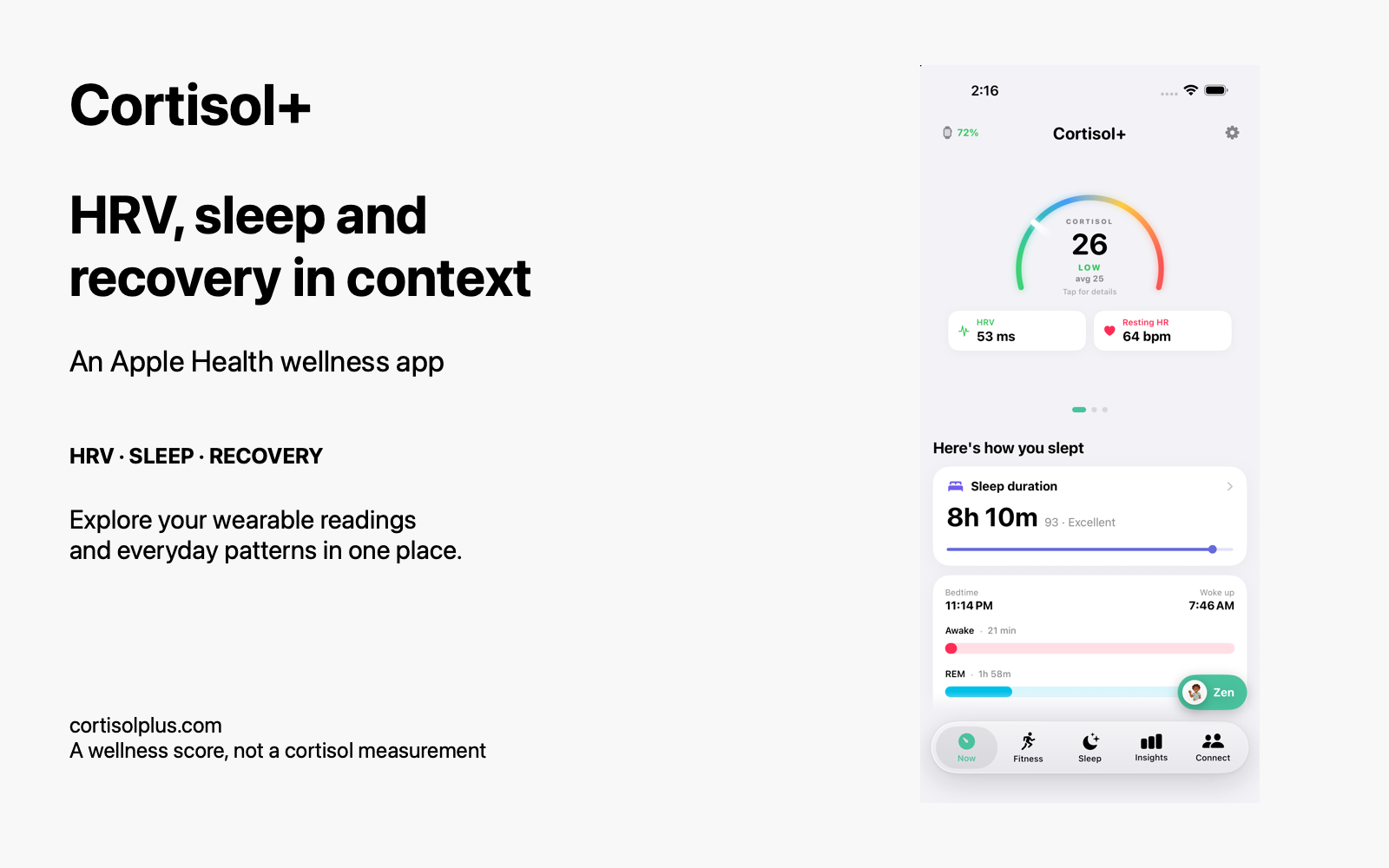
What Cortisol+ is designed to show
Cortisol+, published by Elevated Systems LLC with Mikah Albertson as product lead, helps people inspect HRV, sleep and recovery patterns together. Its dashboard places a wellness score alongside individual readings, with further views for sleep and trends. The intended use is to observe everyday patterns, not to diagnose or prove that a particular routine changed a hormone level.
The interface can call the number a cortisol score. That label should be read as the app’s model output, not as a concentration from blood, saliva or urine. Lower values reflect less strain according to the model; they do not establish healthier cortisol levels.
How it works
TL;DR: Cortisol+ combines available biometric factors into a 0-100 wellness score, compares relevant signals with baselines and applies model adjustments. It does not estimate laboratory cortisol concentration. Missing data and the age of a reading matter when interpreting the output.
| Input | Starting weight |
|---|---|
| Heart rate variability (HRV) | 20% |
| Sleep | 20% |
| Resting heart rate | 18% |
| Respiratory rate | 9% |
| Activity | 8% |
| Blood oxygen | 5% |
| Cardio fitness estimate (VO2 max) | 5% |
| Walking heart rate | 5% |
| Heart rate recovery | 5% |
| Workout recovery | 5% |
These published base weights are software design choices, not clinically established contributions to cortisol production.
The published method begins with population defaults and uses weighted history from the preceding 30 days. Personal blending begins after 10 stored readings and reaches full personal weighting at 28 readings. Reading counts do not match calendar days. Available factors, freshness, recent trends and time-of-day assumptions can also affect the result.
The complete methodology, including input weights, baseline behaviour and limitations, is available at cortisolplus.com/how-it-works.
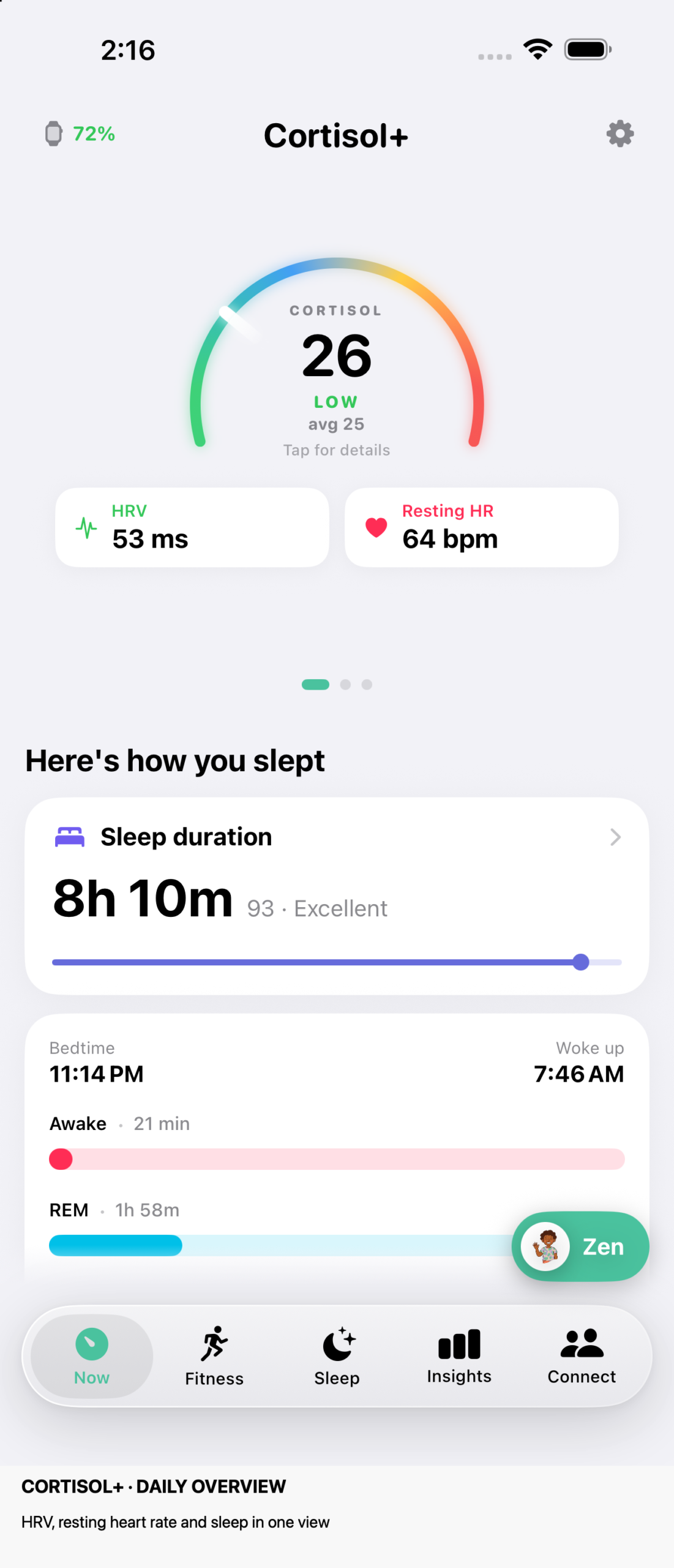
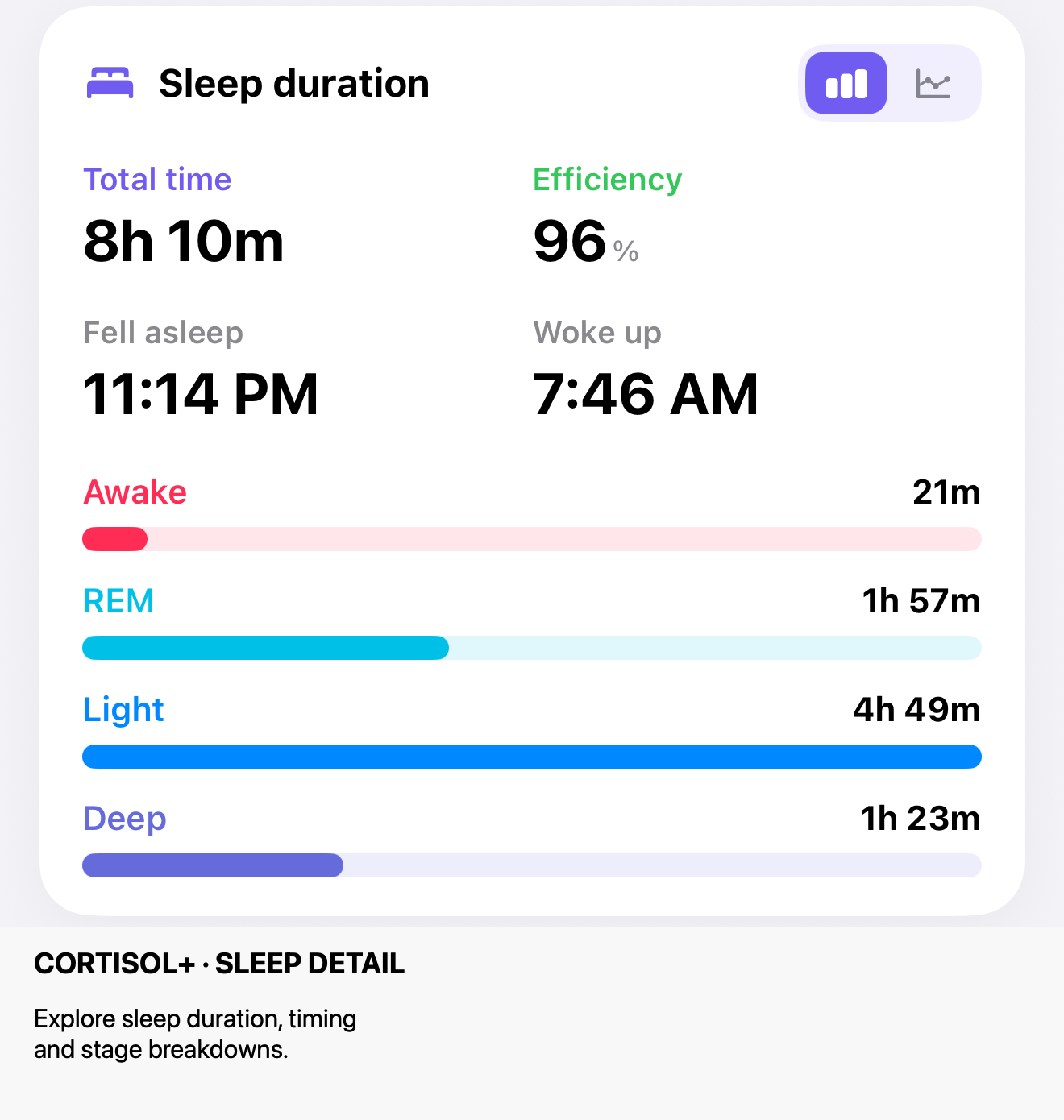
The supplied screenshots below use illustrative figures rather than a real person’s recorded data: HRV 53 ms, resting heart rate 64 bpm, sleep 8 hours 10 minutes, wellness score 26. They demonstrate the interface rather than a working test of the algorithm.
Data sources and integrations
The Apple Watch pathway reads permitted records through Apple Health and HealthKit. The score’s inputs cover HRV, sleep, resting heart rate, respiratory rate, steps and active energy, blood oxygen, VO2 max, walking heart rate, heart rate recovery and workout context. The app can also read heart rate and wrist temperature; the latter is not a separate weighted factor in the published ten-factor score.
The Apple Watch workflow described here uses Apple Health and HealthKit on iPhone. Available measurements depend on the watch model, permissions, recording history and wear time. Apple Watch HRV (watchOS 26) uses SDNN where many other apps use rMSSD.
Availability and pricing
The iPhone version supports iOS 17 or later. Cortisol+ is free to download, while analysis requires a subscription or an eligible trial. Current prices, eligibility and renewal terms appear in the App Store listing and purchase screen. Cortisol+ is also available for Android on Google Play; the Apple Watch workflow described in this article is specific to iPhone.
- Website: cortisolplus.com
- App Store: Cortisol+ Stress & HRV Monitor
- Android: Cortisol+ on Google Play
- Product information: cortisolplus.com/press
Quick answers
Does Cortisol+ measure actual cortisol?
No, it calculates a wellness score from biometric signals and model assumptions rather than measuring cortisol directly. The score has not been validated against laboratory cortisol testing and is not a diagnostic measurement.
Why can the score change without a new HRV reading?
HRV is one input, not the entire calculation, so other available factors and model adjustments can change the output on their own. Background sampling and synchronisation are also intermittent, so a refreshed screen doesn’t necessarily include a new sensor measurement.
Does a lower score prove that better sleep lowered cortisol?
No, sleep can influence the model, but a change in the app’s score is not evidence of an actual hormone change or proof of cause and effect.
Author: Mikah Albertson, product lead of Cortisol+, edited by the5krunner.
Last Updated on 21 September 2026 by the5krunner
My favourite kit and nutrition
- Garmin Fenix 9 Pro — I’ve just bought one.
- Injinji – Runners protect your toes. Avoid discomfort and minor injury. Run more. Run faster. I use them.
- Garmin 90-degree charging adapter — A small keyring adapter you can use anywhere. Essential when away. I use one.
- Garmin charging puck — the fastest and most reliable way to top up your Garmin before a session. I use one.
- Ravemen FR300 — Front light that mounts directly under your Garmin or Wahoo head unit. Keeps your bars clean and your beam pointed where it matters. I use one.
- Body Glide – The blue anti-chafe stick that all swimmers and many runners use. I use it.
- Maurten — The race nutrition trusted by elite athletes. Gels and drink mixes engineered to be easy on the stomach. I use them.
- Garmin Varia RTL515 — A radar rear light that alerts you to vehicles approaching from behind. Pairs with your Edge or Wahoo. I use this model.
- Favero Assioma Pro RS2 — The power-meter pedals most serious cyclists choose. Accurate, easy to move between bikes. I use this model.
- Garmin Forerunner 970 — A serious choice for a pro-grade triathlon watch. I use this.
- Polar H10 — My daily driver for accurate, waking HRV readings.
- Wahoo ELEMNT Roam 3 — The bike computer that has the feature Garmin lacks: usability. I use mine on most rides.
Reader-Powered Content

This content is not sponsored. It’s mostly me behind the labour of love, which is this site, and I appreciate everyone who supports it.
Support the site: Follow (free, fewer ads) · Subscribe (paid, ad-free) · Buy Me A Coffee ❤️
All articles are written by real people, fact-checked, and verified for originality. See the Editorial Policy. FTC: Affiliate Disclosure — some links pay commission. As an Amazon Associate, I earn from qualifying purchases.
tfk is the founder and author of the5krunner, an independent endurance sports technology publication. With 20 years of hands-on testing of GPS watches and wearables, and competing in triathlons at an international age-group level, tfk provides in-depth expert analysis of fitness technology for serious athletes and endurance sport competitors. ID
