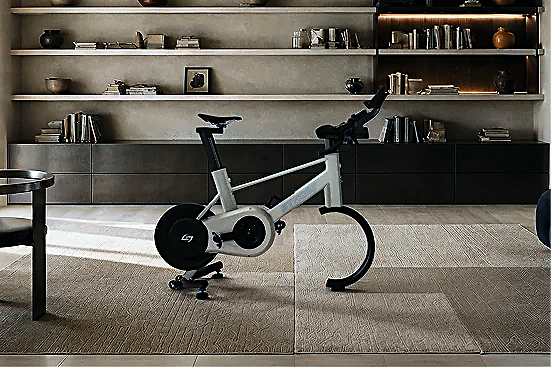
Stages SB200 is about 25kg lighter than SB20, it moves under the rider, and it adds Wi-Fi, lever shifters and a display. It launched on 5 October 2026 at £2,199.99 / $2,399, which is $500 less than SB20’s launch price of $2,899. Two things have gone backwards for some athletes: power is now calculated at the brake instead of measured at the cranks, and the fore-aft seat post is an optional extra.
The two bikes share a family name and very little else. This post lists what has changed and what each change means in training. Full figures are on the Stages SB200 specifications page.

Stages SB200
Indoor smart bike that sways like a road bike, fits riders from 147cm to 208cm and works with Zwift and every major training app. No subscription.
SB200 vs SB20 at a glance
| Feature | SB200 | SB20 |
|---|---|---|
| Launch price | £2,199.99 / $2,399 / €2,399 | $2,899 |
| Weight | 32.3kg | About 57kg |
| Movement | Side-to-side sway of about 2 degrees | None |
| Drive | Two-stage belt drive with freewheel | Single belt |
| Power | Calculated at the brake, +/- 1% claimed | Measured at the cranks, coin-cell batteries |
| Shifting | Lever shifters, 10 programmable buttons | Buttons |
| Display | 2.23-inch display | None |
| Wi-Fi | Yes, 2.4GHz and 5GHz | No |
| ANT+ | No | Yes |
| Saddle fore-aft seat post | Optional accessory | Included |
| On/off switch | Yes | No |
SB200 figures come from Stages. SB20 figures and the list of changes come from DC Rainmaker’s SB200 review and GPLama’s SB200 video.
A lighter bike that moves
SB20 was built like a gym bike and weighed about 57kg. SB200 weighs 32.3kg and has roller wheels at the rear, so one person can move it between rooms. The shipping weight has fallen from 72.5kg to 46.7kg, according to DC Rainmaker, who assembled his bike in about 25 minutes while filming.
The frame now rocks slightly from side to side on two foot pads. Stages fits a soft pad and includes a hard one for a firmer feel. A little movement eases pressure on the saddle and hips during long sessions, and Stages says it added the movement after feedback from SB20 owners.
The lighter front end has a cost. DC Rainmaker found that repeated hard sprints shuffled his bike forward on its mat. Stages will sell a RigidRide front stabiliser that removes the rocking.
A new drive and a different ride feel
SB200 uses a two-stage belt drive, and Stages claims five times the flywheel inertia of SB20. GPLama and DC Rainmaker both describe the pedalling as very smooth, and GPLama found the bike at its best on flat and rolling virtual roads.
The new drive has a freewheel that clicks when coasting, which SB20 did not. Both testers call it clearly audible. Stages told GPLama that the layout allowed a slightly narrower stance, with a Q-factor of 153mm.
GPLama found steep virtual climbs of 14% to 16% felt easier to spin up than the same gradients outdoors, even in the lowest 0.5:1 gear.
Power moves from the cranks to the brake
SB20 measured power with strain gauges in the cranks. SB200 calculates power from the brake, so there are no coin-cell batteries to change. Stages claims +/- 1% accuracy.
Early test bikes needed updates before they met that claim. DC Rainmaker’s bike read 5W to 8W high at 200W to 350W until Stages supplied a corrected calibration value, and it then stayed within about 1.5% of his power meter pedals. GPLama found steady efforts accurate up to about 450W to 480W, with sustained sprints reading 4% to 6% below his pedals. He showed an SB20 sprint from six years ago that tracked more closely.
ERG mode also behaves differently. Both testers saw power wander around the target more than on other trainers during structured workouts. Stages has promised selectable ERG smoothing in a firmware update.
An athlete who races on Zwift and sprints above 1,000W should wait for further test results. An athlete who trains mostly below threshold has less to worry about.
Shifters, buttons and a display
SB20 shifted with buttons. SB200 has shift levers that can copy Shimano or SRAM, or run Stages Dream Drive as a simple sequential gearbox across ratios from 0.5:1 to 7.0:1. Five buttons on each hood can steer, navigate menus and trigger in-game actions.
The 2.23-inch display shows gear, power and cadence. Its most useful job is choosing one of five gearing profiles at power-on, which helps when two riders share the bike. A phone holder, a tablet holder, two USB-C ports and Garmin and Wahoo computer mounts are all included.
Wi-Fi arrives and ANT+ goes
SB200 adds Wi-Fi on the 2.4GHz and 5GHz bands. Over Wi-Fi it sends power 10 times a second for racing, and over Bluetooth it sends power four times a second. It supports Bluetooth FTMS, Zwift Protocol and OpenBikeControl, an open standard for trainer control and buttons that TrainingPeaks Virtual and MyWhoosh already use.
ANT+ has been dropped. A bike computer that records indoor rides will need Bluetooth, and it will use one of the bike’s four Bluetooth connections. The bike can relay a heart rate strap alongside its own data, which saves a channel on Apple TV.
Fit: a wider range, fewer adjustments
SB200 fits riders from 147cm to 208cm and up to 136kg. The adjustment tool lives in the frame, and the seat post is marked with real saddle heights. Crank lengths are 165mm, 170mm, 172.5mm and 175mm on a new slotted crank. DC Rainmaker reports that SB20’s bear-claw crank could fail when over-tightened or corroded by sweat.
SB20 had a fore-aft seat post. SB200 adjusts fore-aft on the saddle rails only, and Stages says its offset seat tube changes reach with saddle height. A fore-aft seat post will be sold separately. Several commenters on DC Rainmaker’s review wanted cranks shorter than 165mm.
A free app
The Stages app sets up the bike and also works as a free training platform, with structured workouts, manual control and TrainingPeaks workout sync. Stages charges no subscription.
What SB20 owners should do
An SB20 that works does not need replacing. Stages has made SB20 spare parts again and reopened support under Giant, according to DC Rainmaker. SB20 keeps crank-based power, ANT+ and a fore-aft seat post.
SB200 is the better choice for an athlete who wants in-game steering and buttons, Wi-Fi race data, a bike that moves, or a bike that can be carried upstairs. SB20 owners asked in the comments on DC Rainmaker’s review whether SB20 will gain button mapping or gear display in Zwift, and the review does not answer that.
Giant’s acquisition of Stages explains the company’s return, and the Stages specifications index lists its products. The nearest rival with gradient tilt is Wahoo KICKR Bike Pro, and the best smart trainer guide covers cheaper options.
Stages SB200
Indoor smart bike that sways like a road bike, fits riders from 147cm to 208cm and works with Zwift and every major training app. No subscription.
Quick answers
Is Stages SB200 lighter than SB20?
Yes. Stages says the SB200 weighs 32.3kg. SB20 weighed about 57kg according to DC Rainmaker.
Does Stages SB200 still measure power at the cranks?
No. SB200 calculates power at the brake, with a claimed accuracy of +/- 1%. SB20 measured power at the cranks.
Does Stages SB200 have ANT+ like SB20?
No. SB200 uses Bluetooth and Wi-Fi only.
Can I still get parts for Stages SB20?
Yes. DC Rainmaker reports that Stages has manufactured SB20 parts again and reopened its support lines under Giant’s ownership.
Sources
- Stages Cycling: SB200 product page and SB200 overview
- DC Rainmaker: Stages SB200 in-depth review, by Ray Maker
- GPLama: Stages SB200 review video, by Shane Miller
Last Updated on 6 October 2026 by tfk the5krunner
Small things I always use
- Garmin 90-degree charging adapter: Charges your Garmin from any USB-C cable. Essential when travelling. I use one.
- Body Glide: The blue anti-chafe stick swimmers and runners carry. I use it.
- Speedo earplugs: Fewer ear infections and no cold-water dizziness. I use them.
- Dryrobe Advance: My winter changing robe for open-water swims. I use one. A cheaper option is the AONYIYI changing robe.
- Maurten: Race fuel that stays easy on the stomach. I use them.
- Garmin charging puck: The quickest way to top up before a session. I use one.
- Injinji: Toe socks that stop rubbing, so you run more. I use them.
- Ultimate toe protectors: Stop black toenails on long runs. They work. I use them.
- Compressport R2 v2 calf sleeves: My calf sleeves of choice. I use them.
- Cellucor C4: My pre-workout before hard sessions.
- TPU tubes: Schwalbe Aerothan, Tubolito and Pirelli SmarTube. Light, tiny spares. I use all three.
- G8 insoles: Adjustable insoles that are good. I use them.
- Cycplus Cube: A 97g electric pump that gets a road tyre rideable in two minutes. I carry one. 5% off with code THE5KRUNNER.
Watches and sensors
- Polar H10: My daily driver for waking HRV.
- Polar Verity Sense: My backup arm-worn HR sensor.
- Nomad bedside charger: Charges my iPhone and Apple Watch overnight. I use it, and many of their bands.
- Train.Red: The best muscle oxygen sensor I’ve used.
- Tymewear: Accurate heart rate and reliable ventilatory zones. I use it to pace endurance rides over an hour.
- Garmin Forerunner 970: A pro-grade triathlon watch. I use this.
- Apple Watch Ultra 4: My daily smartwatch. No phone needed on rides.
- Garmin Fenix 9 Pro: I’ve just bought one.
On the bike
- Continental GP5000 for everyday riding, and Aero 111 on the front for special occasions.
- Helmets: Specialized S-Works Evade 3 for road riding, and Rudy Project Wing for TT-style races. I use both.
- Ravemen FR300: A front light that mounts under your Garmin or Wahoo. I use one.
- Wahoo TRACKR Radar: I use it on one bike and Varia on the other. They perform the same.
- Garmin Varia RTL515: Radar that warns you of cars from behind. I use this model.
- Wahoo ELEMNT Roam 3: The bike computer that’s easy to use. I use mine on most rides.
- Favero Assioma Pro RS2: Accurate power pedals that swap easily between bikes. I use this model.
Home and indoor training
- NPE Runn: Makes my basic treadmill smart, sending more accurate speed and distance to my watch and Zwift. I use it.
- Google Wifi: Keeps Zwift connected in my pain cave. I use it.
- Apple TV 4K: Zwift on the big screen. I use two.
- Google Nest Doorbell (wired, 2nd gen): My video doorbell, running in both Google Home and Apple Home. I use it.
Health, recovery and sleep
- FreeStyle Libre 3 Plus: Shows how my blood sugar responds to diet.
- hDrop: Measures my sweat loss in summer and indoors.
- Fourth Frontier Zone: Checks my heart under load in hard sessions.
- Oura Ring 5: My partner’s recovery tracker of choice.
- Kineon MOVE+: Red light therapy for niggles. It works.
- Eight Sleep: A cooling mattress cover my partner and I use nightly.
Reader-Powered Content

This content is not sponsored. It’s mostly me behind the labour of love, which is this site, and I appreciate everyone who supports it.
Support the site: Follow (free, fewer ads) · Subscribe (paid, ad-free) · Buy Me A Coffee ❤️
Written by real people, with AI assistance. Fact-checked and verified for originality. See the Editorial Policy. FTC: Affiliate Disclosure — some links pay commission. As an Amazon Associate, I earn from qualifying purchases.
tfk is the founder and author of the5krunner, an independent endurance sports technology publication. With 20 years of hands-on testing of GPS watches and wearables, and competing in triathlons at an international age-group level, tfk provides in-depth expert analysis of fitness technology for serious athletes and endurance sport competitors. ID
