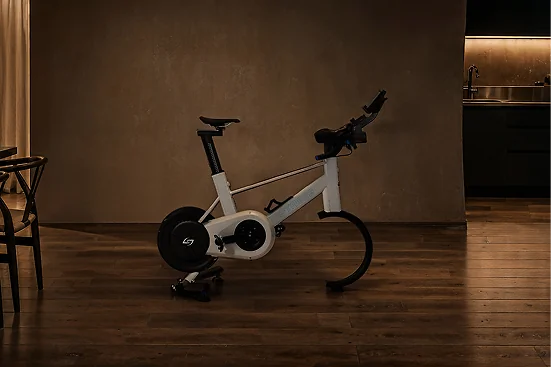
Stages SB200 costs £2,199.99 / $2,399, and Wahoo KICKR Bike Pro costs £3,499.99 / $3,999.99. The extra £1,300 buys a bike that physically tilts to match climbs and descents, plus ANT+ and a wired network option. SB200 answers with a wider fit range, side-to-side movement, a built-in display and a free training app.
I have tested KICKR Bike Pro at length, and the full review is here. I haven’t ridden the SB200, so my side of this comparison rests on Stages’ published specifications and independent testing by DC Rainmaker and GPLama.
SB200 vs KICKR Bike Pro at a glance
| Feature | Stages SB200 | Wahoo KICKR Bike Pro |
|---|---|---|
| Price | £2,199.99 / $2,399 / €2,399 | £3,499.99 / $3,999.99 |
| Gradient tilt | None | +20% to -15% |
| Side-to-side movement | About 2 degrees, adjustable | None |
| Maximum power | 2,500W | 2,500W |
| Claimed power accuracy | +/- 1% | +/- 1% |
| Weight | 32.3kg | About 42kg (93lb) |
| Rider height | 147cm to 208cm | 152cm to 193cm |
| Maximum rider weight | 136kg | 113kg |
| Crank lengths | 165, 170, 172.5, 175mm | 165, 167.5, 170, 172.5, 175mm |
| Fit changes | Tool stored in the frame | Quick-release levers |
| Wireless | Bluetooth, Wi-Fi (2.4GHz and 5GHz) | Bluetooth, Wi-Fi (2.4GHz), ANT+ |
| Wired network | No | Yes, with the optional Direct Connect adapter |
| Race data rate | 10 times a second over Wi-Fi | Up to 10 times a second over Wi-Fi |
| Display | 2.23-inch display for gear, power and profiles | LEDs and a dot-matrix gear indicator |
| Phone and tablet holders | Included | Not included |
| Maker’s app | Free, with structured workouts | Structured workouts need a Wahoo subscription |
Wahoo figures come from Wahoo’s product page and the KICKR Bike Pro specifications page.
Tilt or sway
The two bikes move differently, and that is the biggest difference in how they feel.
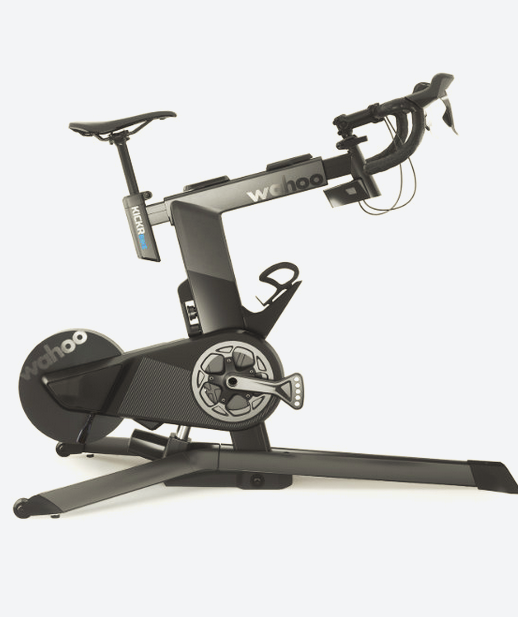
KICKR Bike Pro raises and lowers its front end to match the virtual road, from a 20% climb to a 15% descent. In my testing, the tilt was smooth and immediate, and it changes body position on long climbs in the way a real hill does. It has no side-to-side movement at all, which I missed after months on Wahoo’s KICKR Move.
SB200 does the opposite. It rocks about 2 degrees from side to side on replaceable foot pads, and it stays level on climbs. DC Rainmaker found the movement natural and stable. GPLama found steep virtual gradients of 14% to 16% easier to spin up than the same climbs outdoors.
An athlete training for long alpine climbs gets more from the Wahoo. An athlete who gets sore hips or a numb saddle area on a rigid indoor bike gets more from the Stages.
Sharing the bike
SB200 fits riders from 147cm to 208cm and up to 136kg. Wahoo lists 152cm to 193cm and up to 113kg for the KICKR Bike Pro. Only the Stages covers taller, shorter and heavier athletes.
KICKR Bike Pro adjusts with levers and has five adjustment points, including saddle setback. I found the levers quick, but the positions slipped as I tightened them, and resetting the bike after another rider meant reading millimetre scales each time.
SB200 needs a tool, which is stored in the frame. DC Rainmaker, who is 188cm, shared his bike with his wife, who is 158cm, and found the changes quick and the settings secure. The seat post is marked with real saddle heights. The SB200 has no fore-aft seat post as standard, and Stages will sell one as an accessory.
SB200 stores five gearing profiles and asks which to use at power-on. KICKR Bike Pro saves gearing profiles in the Wahoo app, and I had to switch them manually.
Power accuracy
Both makers claim +/- 1%. Neither bike has matched that cleanly in independent tests.
My KICKR Bike Pro read 2.5% to 3% higher than Favero Assioma Pro RS and Magene P715 pedals across more than 15 hours of riding (and since). The offset was consistent, so training zones stay usable, but the numbers will not match an outdoor power meter.
SB200’s early test bikes needed calibration and firmware updates. After those, DC Rainmaker’s bike stayed within about 1.5% of his pedals. GPLama found steady efforts accurate up to about 450W to 480W, and sustained sprints read 4% to 6% low. Both testers found ERG mode wandered more than usual, and Stages has promised selectable smoothing. My KICKR Bike Pro held ERG targets smoothly.
The Wahoo is the safer choice today for an athlete who relies on ERG workouts. SB200’s results may improve as firmware matures.
Apps, connections and controls
Both bikes work with Zwift, Rouvy, MyWhoosh and TrainingPeaks Virtual, and both put steering and menu buttons on the hoods. SB200 has 10 buttons that can be mapped per app.
KICKR Bike Pro keeps ANT+, so any bike computer can record the ride. It also takes a wired network connection through the optional Direct Connect adapter, which removed dropouts completely in my setup. SB200 has neither. It adds 5GHz Wi-Fi and OpenBikeControl, an open control standard that TrainingPeaks Virtual and MyWhoosh already support.
SB200 includes a phone holder, a tablet holder, two USB-C ports and a small display. KICKR Bike Pro has status LEDs and a dot-matrix gear indicator.
The Stages app is free and includes structured workouts. Wahoo’s app controls the bike for free, and its structured workouts and route simulation need a subscription.
Noise and living with the bike
Neither bike is silent. KICKR Bike Pro’s motor makes a metallic whistle under acceleration. SB200 is quiet while pedalling and has a freewheel that clicks audibly when coasting, according to both testers.
SB200 weighs 32.3kg and has roller wheels, so one person can move it. KICKR Bike Pro weighs about 42kg, and I needed help to carry it.
The company behind each bike
Stages collapsed in 2024 and left SB20 owners without support until Giant bought the business. Support and parts have since returned, and Giant’s acquisition of Stages explains the background. Wahoo cleared its debt in 2023 and sells a wider indoor range, covered on the Wahoo hub. Wahoo gives a two-year warranty on KICKR Bike Pro in the UK.
Which to buy
- Buy Wahoo KICKR Bike Pro for gradient tilt, steady ERG workouts, ANT+ or a wired connection.
- Buy Stages SB200 to save £1,300, if you’re under 152cm, over 193cm, or over 113kg, or to avoid any subscription.
- Wait for more SB200 test results if sprint power accuracy decides your races.

Stages SB200
Indoor smart bike that sways like a road bike, fits riders from 147cm to 208cm and works with Zwift and every major training app. No subscription.

Quick answers
Is Stages SB200 cheaper than Wahoo KICKR Bike Pro?
Yes. Stages lists the SB200 at £2,199.99, and Wahoo lists the KICKR Bike Pro at £3,499.99.
Does Stages SB200 tilt like Wahoo KICKR Bike Pro?
No. KICKR Bike Pro tilts from +20% to -15%. SB200 sways about 2 degrees from side to side and does not tilt.
Which bike fits taller or heavier riders?
Stages SB200 fits riders from 147cm to 208cm and up to 136kg. Wahoo lists 152cm to 193cm and up to 113kg for the KICKR Bike Pro.
Do both bikes have ANT+?
No. KICKR Bike Pro has ANT+ and ANT+ FE-C. SB200 has Bluetooth and Wi-Fi only.
Sources
- Stages Cycling: SB200 product page
- Wahoo: KICKR Bike Pro product page
- DC Rainmaker: Stages SB200 in-depth review, by Ray Maker
- GPLama: Stages SB200 review video, by Shane Miller
- Stages SB200 specifications and Wahoo KICKR Bike Pro specifications
Last Updated on 6 October 2026 by tfk the5krunner
Small things I always use
- Garmin 90-degree charging adapter: Charges your Garmin from any USB-C cable. Essential when travelling. I use one.
- Body Glide: The blue anti-chafe stick swimmers and runners carry. I use it.
- Speedo earplugs: Fewer ear infections and no cold-water dizziness. I use them.
- Dryrobe Advance: My winter changing robe for open-water swims. I use one. A cheaper option is the AONYIYI changing robe.
- Maurten: Race fuel that stays easy on the stomach. I use them.
- Garmin charging puck: The quickest way to top up before a session. I use one.
- Injinji: Toe socks that stop rubbing, so you run more. I use them.
- Ultimate toe protectors: Stop black toenails on long runs. They work. I use them.
- Compressport R2 v2 calf sleeves: My calf sleeves of choice. I use them.
- Cellucor C4: My pre-workout before hard sessions.
- TPU tubes: Schwalbe Aerothan, Tubolito and Pirelli SmarTube. Light, tiny spares. I use all three.
- G8 insoles: Adjustable insoles that are good. I use them.
- Cycplus Cube: A 97g electric pump that gets a road tyre rideable in two minutes. I carry one. 5% off with code THE5KRUNNER.
Watches and sensors
- Polar H10: My daily driver for waking HRV.
- Polar Verity Sense: My backup arm-worn HR sensor.
- Nomad bedside charger: Charges my iPhone and Apple Watch overnight. I use it, and many of their bands.
- Train.Red: The best muscle oxygen sensor I’ve used.
- Tymewear: Accurate heart rate and reliable ventilatory zones. I use it to pace endurance rides over an hour.
- Garmin Forerunner 970: A pro-grade triathlon watch. I use this.
- Apple Watch Ultra 4: My daily smartwatch. No phone needed on rides.
- Garmin Fenix 9 Pro: I’ve just bought one.
On the bike
- Continental GP5000 for everyday riding, and Aero 111 on the front for special occasions.
- Helmets: Specialized S-Works Evade 3 for road riding, and Rudy Project Wing for TT-style races. I use both.
- Ravemen FR300: A front light that mounts under your Garmin or Wahoo. I use one.
- Wahoo TRACKR Radar: I use it on one bike and Varia on the other. They perform the same.
- Garmin Varia RTL515: Radar that warns you of cars from behind. I use this model.
- Wahoo ELEMNT Roam 3: The bike computer that’s easy to use. I use mine on most rides.
- Favero Assioma Pro RS2: Accurate power pedals that swap easily between bikes. I use this model.
Home and indoor training
- NPE Runn: Makes my basic treadmill smart, sending more accurate speed and distance to my watch and Zwift. I use it.
- Google Wifi: Keeps Zwift connected in my pain cave. I use it.
- Apple TV 4K: Zwift on the big screen. I use two.
- Google Nest Doorbell (wired, 2nd gen): My video doorbell, running in both Google Home and Apple Home. I use it.
Health, recovery and sleep
- FreeStyle Libre 3 Plus: Shows how my blood sugar responds to diet.
- hDrop: Measures my sweat loss in summer and indoors.
- Fourth Frontier Zone: Checks my heart under load in hard sessions.
- Oura Ring 5: My partner’s recovery tracker of choice.
- Kineon MOVE+: Red light therapy for niggles. It works.
- Eight Sleep: A cooling mattress cover my partner and I use nightly.
Reader-Powered Content

This content is not sponsored. It’s mostly me behind the labour of love, which is this site, and I appreciate everyone who supports it.
Support the site: Follow (free, fewer ads) · Subscribe (paid, ad-free) · Buy Me A Coffee ❤️
Written by real people, with AI assistance. Fact-checked and verified for originality. See the Editorial Policy. FTC: Affiliate Disclosure — some links pay commission. As an Amazon Associate, I earn from qualifying purchases.
tfk is the founder and author of the5krunner, an independent endurance sports technology publication. With 20 years of hands-on testing of GPS watches and wearables, and competing in triathlons at an international age-group level, tfk provides in-depth expert analysis of fitness technology for serious athletes and endurance sport competitors. ID
