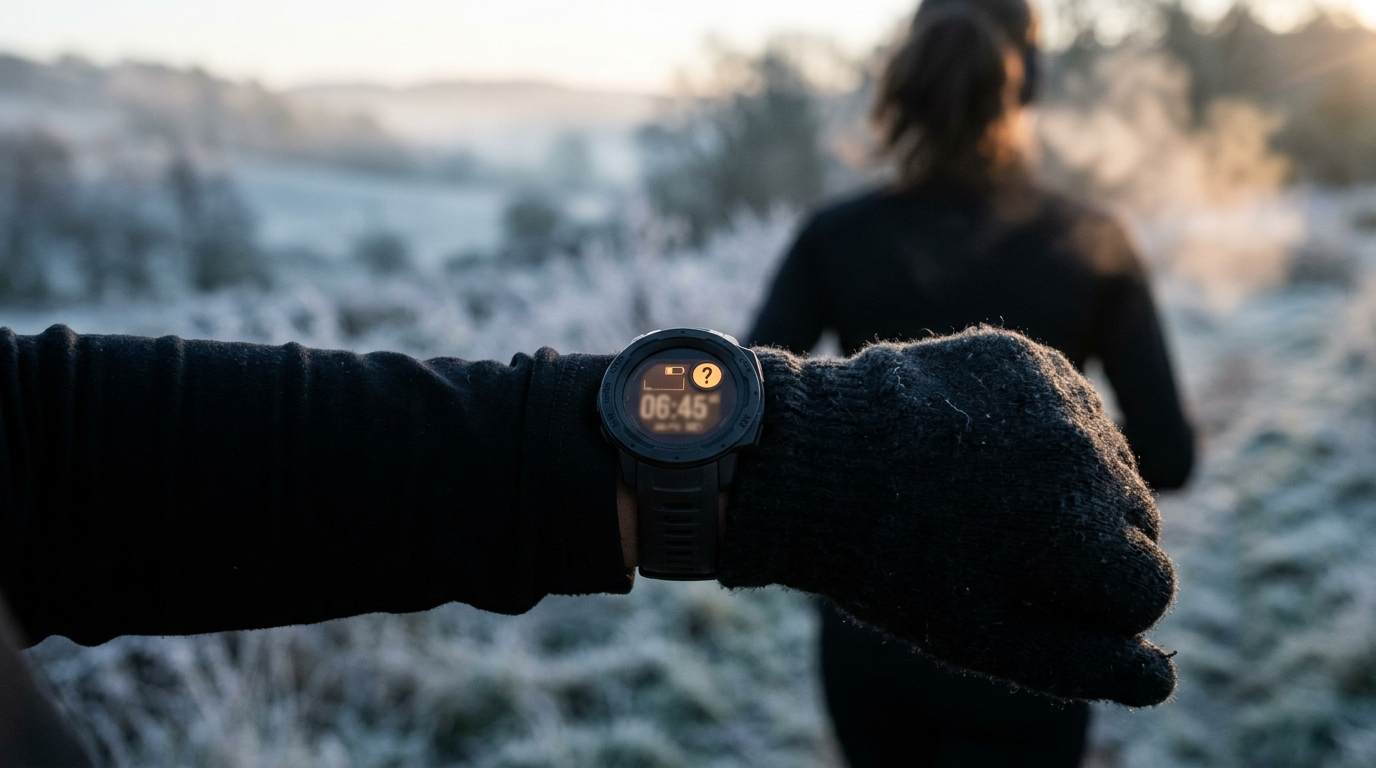
The battery percentage on a sports watch is an estimate produced by a small chip, and the habits most athletes follow to protect that battery are approximations of something more complicated. Richard Nicholson, Co-Founder and CEO of Overlord Labs, a San Jose company that designs battery management chips for wearables, kindly answered the questions I get asked most often about watch battery life. His answers below are lightly edited for length. He spent 25 years designing battery management systems at Maxim, Texas Instruments, and Fairchild before founding Overlord, so this is the view from the people who build the gauge, not the people who market the watch.
Will silicon anodes give watches more battery life?
Yes, and the first products are already on wrists. WHOOP 4.0 was the first consumer device to ship with a silicon anode, from Sila, which gave it about 17% more energy density and let WHOOP shrink the strap by a third while adding sensors. LeydenJar, a Dutch anode maker, claims at least 50% more energy density than graphite and is now sampling cells with tracker brands for athletes, meaning more hours from the same case size, or the same hours from a slimmer watch.
Nicholson cautions that the gain is a cell, and a cell on its own is only half the job.
Emerging battery chemistries, including silicon-rich anodes, create opportunities to put more energy into compact wearables. From a battery management perspective, the challenge is understanding how those cells behave across charging, temperature and different workloads. A new cell may need different models and control strategies.
Silicon also swells heavily as it charges, which is why cycle life rather than capacity has held it back. LeydenJar’s own figure for its prototype cells is 500 cycles in lab testing, which is modest against a conventional graphite cell. A watch that gains a fifth more runtime and loses some working life is a trade, and the brands adopting silicon have yet to publish both sides.
Does 100 hours of long rides wear the battery more than 100 hours of short runs?
This is the question I most wanted answered, because the folk rule is that battery wear is counted in full cycles. Ten runs that each use 10% add up to one equivalent full cycle, and an athlete who rides for ten hours a week and one who runs for ten hours a week are assumed to age their watches at the same rate.
Activity time alone won’t tell you the degradation rate. You need the specific cell, power consumption, temperature, discharge depth and charging history. Ten sessions using 10% each represent roughly one equivalent full discharge, but equal throughput doesn’t necessarily mean equal wear. Long rides may involve deeper discharges, while short runs followed by immediate top-ups may keep the battery nearly full for longer. Assigning a capacity loss percentage to either pattern requires cell-specific testing under representative conditions.
The practical reading is that the two patterns stress the cell in opposite ways. The long ride takes the battery deep, which strains the electrodes mechanically. The short run followed by a charge keeps the battery sitting near full, which is the chemical stress he describes next. Neither is free, and nobody outside the manufacturer’s lab can tell you which costs more on your watch. That is one reason published battery life comparisons describe a new watch rather than the one you will own in three years.
Is the 20 to 80% rule real?
It is a useful habit built on real chemistry, but the numbers themselves are not special.
The 20 to 80% guidance is a practical way to reduce exposure to conditions that can accelerate ageing. Near full charge, electrode potentials encourage unwanted reactions that gradually consume usable lithium and increase resistance, particularly at higher temperatures. Shallower discharges can also reduce cycling stress. But 20 and 80% aren’t universal chemical boundaries. For manufacturers, the task is balancing those effects against the runtime users need. Charging fully before an endurance event is different from leaving a device fully charged and warm for several days.
That last sentence is the one to keep. Charging to 100% the night before an ultra or an Ironman costs almost nothing, because the watch drains within hours. Leaving a watch on its charger on a sunny windowsill for a week between races is the combination that does the damage, since heat and a full cell multiply each other. Independent research agrees: in one study of commercial pouch cells, cells cycled below 30% state of charge lasted more than three times as long as cells run at a high state of charge, and high charge combined with heat was the worst case of all. Athletes who want a simple rule can use this: top up before you need it, and don’t store it full and warm.
Does draining the watch to zero recalibrate the battery?
Every forum thread about battery drain recommends running a watch flat and recharging it fully. Nicholson’s answer starts with what the percentage actually is.
A fuel gauge estimates remaining charge using current, voltage, temperature and a model of the cell. Measurement errors can accumulate, and capacity and resistance change as the battery ages. Depending on the design, recognised charging conditions and rest periods help the gauge update its estimates. Calibration improves the accuracy of the display; it doesn’t restore lost capacity. Repeatedly draining a watch to zero is therefore not a general remedy. Follow the manufacturer’s calibration instructions.
So a full drain can tidy up a gauge that has drifted, which is why it sometimes appears to work. It gives the chip a known empty point to count from. It does nothing to the cell itself, and a deep discharge is one of the stresses described above, so doing it monthly as a ritual costs more than it returns. If a watch that used to last a week now lasts four days, the cell has lost capacity, and no amount of recalibrating will bring it back. If a watch drops from 40% to dead in an hour, the gauge has lost track and a single full cycle, done once, may fix the display. The two faults look similar on the wrist, which is why overnight battery-drain reports after every major firmware release are so hard to diagnose from the outside.
Why does a watch die in the cold with charge still showing?
Every winter runner has seen it. The watch says 20%, the temperature drops below freezing, and the screen goes black at the far end of the run. The charge was there; the watch just couldn’t get at it.
Cold weather shows why this matters. Higher internal resistance causes a larger voltage drop under load, so a watch can reach its shutdown threshold while charge remains in the cell. Some usable capacity may return when it warms up. A useful battery management system needs to account for those conditions, rather than treat a percentage as a fixed promise of runtime.
The mechanism is simple once stated. A cold cell resists current flow more, so when the GPS and screen draw power, the voltage sags further than it would at room temperature. The watch has a voltage below which it must shut down to protect itself, and in the cold it hits that line early. The energy is still in the cell, which is why a watch that died on a frozen summit often shows 15% again once it has been in a warm pocket for ten minutes. For winter hiking and mountain running, the fix is to start fuller than you think you need and keep the watch under a sleeve rather than over it, since skin warmth is enough to hold the cell above the threshold for longer.
What the manufacturers should take from this
Nicholson’s company sells chips, so his conclusion naturally points at better chips. The underlying point stands regardless of who supplies them.
At Overlord Labs, we’re focused on giving manufacturers better information and programmable control so their devices can respond to the battery’s capabilities as workloads and conditions change.
Watch brands quote battery life as a single number measured at room temperature on a new cell, and the wrist gauge then has to keep that promise through a cold race, a hot car, and three years of ageing. Garmin’s battery claims are the most detailed in the industry, yet they still say nothing about how the figure changes with age or temperature. Until a brand publishes a capacity-retention figure, the percentage on your watch remains what Nicholson says it is: a well-informed guess.
Quick answers
Should I charge my sports watch to 100% before a race?
Yes. Charging fully before an endurance event does little harm, because the watch drains within hours of starting. The damage comes from leaving a watch fully charged and warm for days between races.
Does running a watch battery down to zero fix battery drain?
Rarely. A full discharge can give the fuel gauge a fresh reference point, which sometimes makes the percentage display more accurate, but it does not restore lost capacity and deep discharges add wear. Do it once if the display is clearly wrong, and follow the manufacturer’s calibration instructions rather than making it a routine.
Why does my watch turn off in the cold when it still shows 20%?
Cold raises the cell’s internal resistance, so the voltage drops further under load, and the watch hits its protective shutdown threshold while charge remains. The energy is still there, and the watch will often turn back on with charge showing once it warms up in a pocket.
Do long rides wear a watch battery faster than short runs for the same total hours?
Nobody can say without testing that specific cell. Long rides discharge the battery deeper, which strains it mechanically, while short runs followed by immediate charging keep it near full for longer, which stresses it chemically. According to Overlord Labs CEO Richard Nicholson, equal hours do not mean equal wear.
Last Updated on 23 October 2026 by tfk the5krunner
Small things I always use
- Garmin 90-degree charging adapter: Charges your Garmin from any USB-C cable. Essential when travelling. I use one.
- Body Glide: The blue anti-chafe stick swimmers and runners carry. I use it.
- Speedo earplugs: Fewer ear infections and no cold-water dizziness. I use them.
- Dryrobe Advance: My winter changing robe for open-water swims. I use one. A cheaper option is the AONYIYI changing robe.
- Maurten: Race fuel that stays easy on the stomach. I use them.
- Beet It Sport nitrate shots: Beetroot shots I take in the days before a race. I use them.
- Garmin charging puck: The quickest way to top up before a session. I use one.
- Injinji: Toe socks that stop rubbing, so you run more. I use them.
- Ultimate toe protectors: Stop black toenails on long runs. They work. I use them.
- Compressport R2 v2 calf sleeves: My calf sleeves of choice. I use them.
- Cellucor C4: My pre-workout before hard sessions.
- TPU tubes: Schwalbe Aerothan, Tubolito and Pirelli SmarTube. Light, tiny spares. I use all three.
- G8 insoles: Adjustable insoles that are good. I use them.
- Cycplus Cube: A 97g electric pump that gets a road tyre rideable in two minutes. I carry one. 5% off with code THE5KRUNNER.
Watches and sensors
- Polar H10: My daily driver for waking HRV.
- Polar Verity Sense: My backup arm-worn HR sensor.
- Nomad bedside charger: Charges my iPhone and Apple Watch overnight. I use it, and many of their bands.
- Train.Red: The best muscle oxygen sensor I’ve used.
- Tymewear: Accurate heart rate and reliable ventilatory zones. I use it to pace endurance rides over an hour.
- Garmin Forerunner 970: A pro-grade triathlon watch. I use this.
- Apple Watch Ultra 4: My daily smartwatch. No phone needed on rides.
- Garmin Fenix 9 Pro: I’ve just bought one.
On the bike
- Continental GP5000 for everyday riding, and Aero 111 on the front for special occasions.
- Helmets: Specialized S-Works Evade 3 for road riding, and Rudy Project Wing for TT-style races. I use both.
- Ravemen FR300: A front light that mounts under your Garmin or Wahoo. I use one.
- Wahoo TRACKR Radar: I use it on one bike and Varia on the other. They perform the same.
- Garmin Varia RTL515: Radar that warns you of cars from behind. I use this model.
- Wahoo ELEMNT Roam 3: The bike computer that’s easy to use. I use mine on most rides.
- Favero Assioma Pro RS2: Accurate power pedals that swap easily between bikes. I use this model.
Home and indoor training
- NPE Runn: Makes my basic treadmill smart, sending more accurate speed and distance to my watch and Zwift. I use it.
- Google Wifi: Keeps Zwift connected in my pain cave. I use it.
- Apple TV 4K: Zwift on the big screen. I use two.
- Google Nest Doorbell (wired, 2nd gen): My video doorbell, running in both Google Home and Apple Home. I use it.
Health, recovery and sleep
- FreeStyle Libre 3 Plus: Shows how my blood sugar responds to diet.
- hDrop: Measures my sweat loss in summer and indoors.
- Fourth Frontier Zone: Checks my heart under load in hard sessions.
- Oura Ring 5: My partner’s recovery tracker of choice.
- Eight Sleep: A cooling mattress cover my partner and I use nightly.
Reader-Powered Content

This content is not sponsored. It’s mostly me behind the labour of love, which is this site, and I appreciate everyone who supports it.
Support the site: Follow (free, fewer ads) · Subscribe (paid, ad-free) · Buy Me A Coffee
Written by real people, with AI assistance. Fact-checked and verified for originality. See the Editorial Policy. FTC: Affiliate Disclosure — some links pay commission. As an Amazon Associate, I earn from qualifying purchases.

tfk is the founder and author of the5krunner, an independent endurance sports technology publication. With 20 years of hands-on testing of GPS watches and wearables, and competing in triathlons at an international age-group level, tfk provides in-depth expert analysis of fitness technology for serious athletes and endurance sport competitors. See the gear tfk uses. ID
