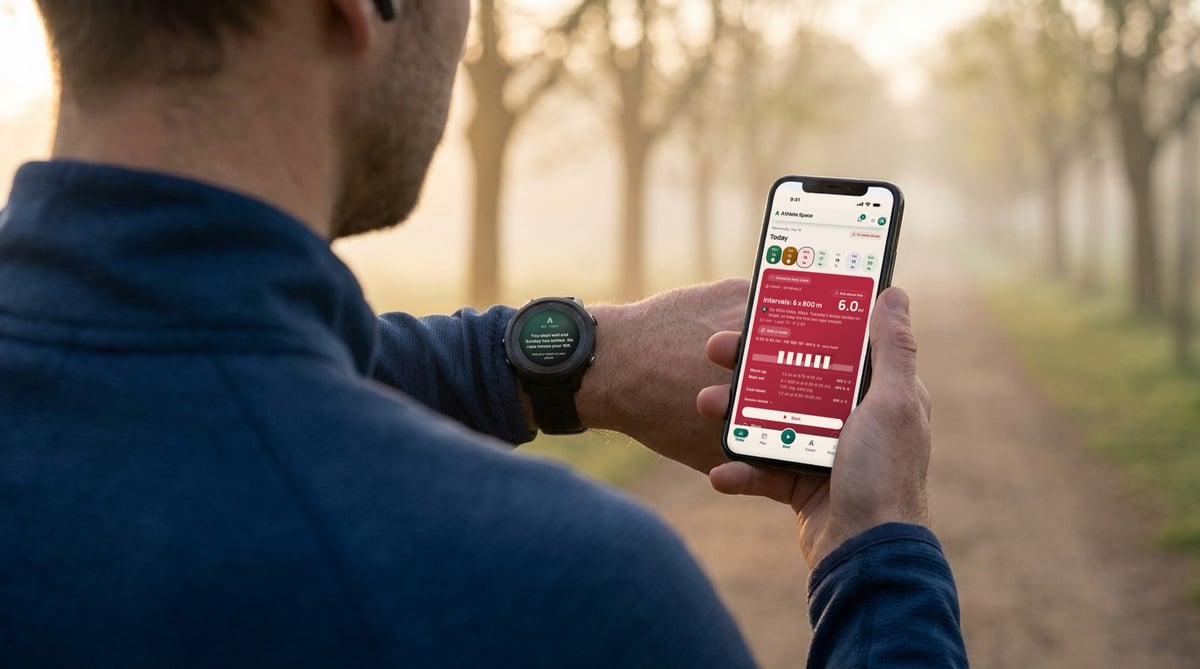
Every training plan looks good on the day it’s written. Then a child brings a cold home from nursery, a work trip lands on a long-run weekend, and the plan falls apart. Most apps carry on as if nothing happened, and the athlete is left rebuilding the week by hand.
Athlete Space is a free AI coach for runners, cyclists, swimmers, triathletes and HYROX athletes, built to handle what happens next. It follows workouts, weighs recovery, adjusts upcoming sessions around changing schedules and explains each decision. Athletes can ask it questions, challenge its recommendations and tell it what is going on in their lives, and it can also guide them through a session with cues in their headphones.
A coach that follows the training
Setup takes a few minutes. The athlete says what they want to achieve, how much time they have and which days they can train, whether the goal is a first 5K, a Boston qualifier, a faster Ironman, a HYROX race or simply getting fitter. The coach builds a programme around that, and training starts straight away rather than the following Monday.
TL;DR: Athlete Space runs three coaching cycles every day.
- After training, it compares what the athlete actually did with what was planned.
- Overnight, it reviews the training week and adjusts upcoming sessions.
- Every morning, it weighs sleep and recovery data, where connected, before setting the day’s workout.
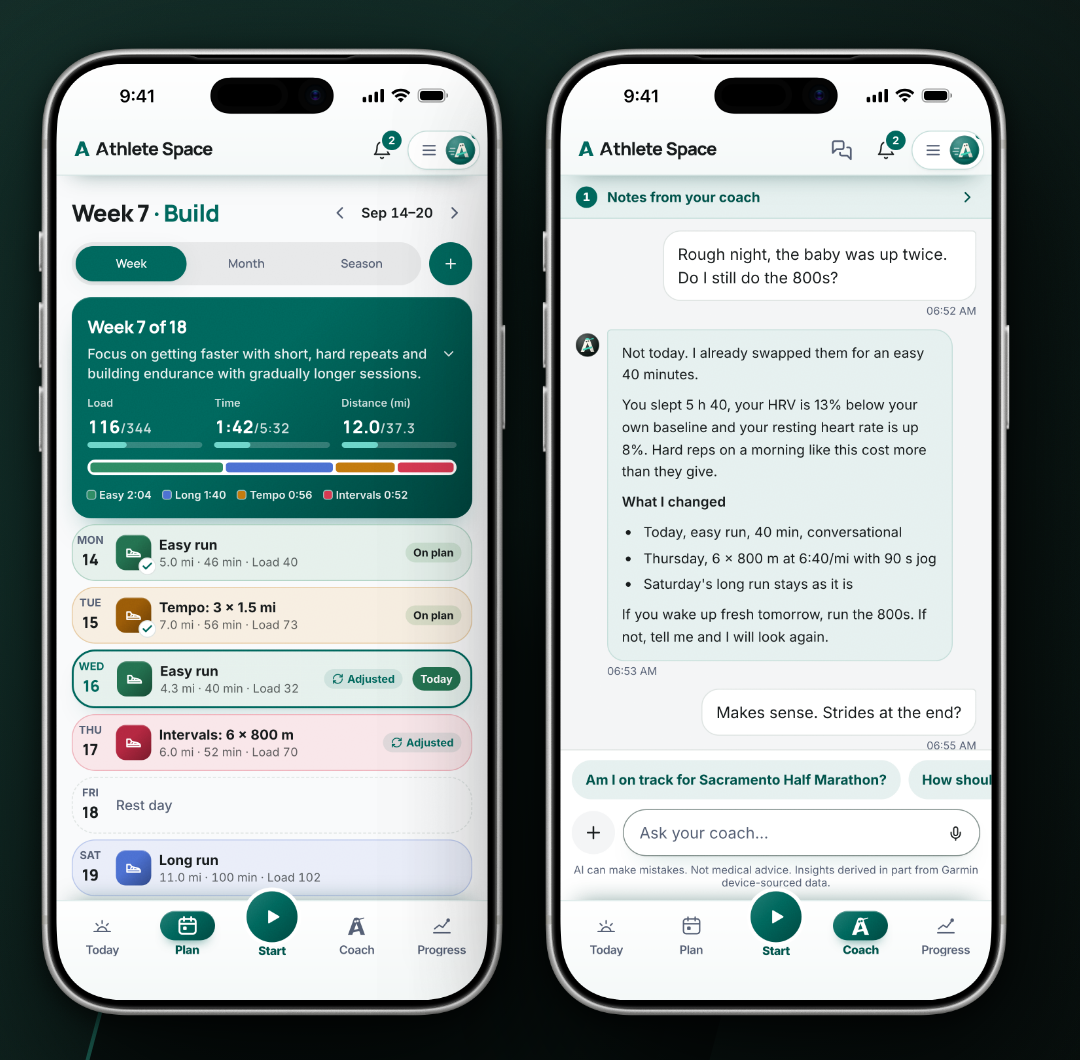
An easy run that turned into a hard effort counts as a hard effort, a disrupted night can soften the next morning’s session, and a family holiday can be planned around before it arrives. The coach starts learning individual recovery patterns after about a week of overnight data, compared against a rolling 28-day baseline.
How the coach makes decisions
Athlete Space draws on four sources of information:
- Training progress: completed workouts, distance, pace, power and intensity, and how they compare with the programme.
- Recovery: sleep, heart rate variability and resting heart rate, against the athlete’s own baseline.
- Everyday life: work, travel, family, illness and other changes the athlete reports.
- Conditions: weather forecasts, heat and humidity, hills and race-course terrain.
If an athlete has trained harder than planned, the next session accounts for it. If recovery is poor, the day’s workout gets easier, and if a trip is coming up, the week is reorganised before it starts. Hills feed into pacing and effort targets, and heat and humidity are weighed against the athlete’s acclimatisation.
A missed session is not automatically squeezed into the next day. Sometimes the coach moves it, sometimes it swaps in something easier, and sometimes it lets the session go. Every change comes with an explanation, and the athlete can push back: asking to keep Saturday’s long run where it is, for example, makes the coach rebuild the sessions around it.
During a workout or race, Athlete Space can talk to the athlete through their headphones, from simple reminders to detailed pacing and effort instructions. It also offers Norwegian-style running and cycling plans built on double-threshold training, aimed at athletes with about six hours a week and at least two years of consistent training behind them.
One marathon, plenty of real life
Bruno Artacho, who built Athlete Space, uses it as his own coach. His build for the St. Jude Memphis Marathon in December 2025 shows how it handles a block that doesn’t go to plan. He had a full-time job, a toddler at home and a hot, hilly Nashville summer to train through, and his weekly mileage started at 40 and peaked at 81.
- Mid-October, 75 miles became 51. A bug from nursery went through the family and a 10-mile race went badly. The coach eased the following days rather than trying to make up the lost miles.
- Late October, 81 miles. The peak week finished with a 20-mile run at 6:30 per mile (4:02 per km).
- Early November, 37 miles. Five weeks out, a family trip to South Carolina coincided with a flare-up of a long-standing IT band problem. Artacho gave the coach the travel dates and details of the injury, and it let four days of training go rather than cramming them into the next week.
- Mid-November, 80 miles. Training returned to its previous level, finishing with a 15-mile run at 6:29 per mile.
- After Thanksgiving, 55 miles. His daughter was ill again and he spent a night on the floor beside her. He told the coach, which checked his HRV against his baseline and softened the next day’s session before he ran.
- 6 December 2025. Artacho finished the Memphis Marathon in 2:29, third overall and one minute behind the winner.
One result doesn’t prove that AI coaching beats a human coach. It does show a coach that kept adjusting through a messy block while the athlete got on with training and family life.
Quick answers
Is Athlete Space really free?
Yes. The training plan is free for life, and the AI coaching is free to use. It is built and run by one engineer on lean infrastructure, which keeps costs low.
How does the Garmin integration work after Garmin's API changes?
Athlete Space uses Garmin’s official developer programme, and athletes sign in directly with Garmin, so Athlete Space never sees their Garmin password. Activities arrive when the watch syncs with Garmin Connect, and planned workouts go back as structured workouts that appear on compatible watches after the next sync.
Can I disagree with the coach?
Yes. Athletes can ask questions, explain changes in their availability and ask for a different arrangement. The coach explains its decisions and rebuilds the schedule around the athlete’s instructions.
Sports and connected devices
Athlete Space covers these sports, alone or combined:
- Running, from 5K to marathon and ultras, including trail and treadmill.
- Cycling, road and indoor, including gran fondos, centuries, time trials and road races.
- Swimming, pool and open water.
- Triathlon, with all three sports planned together.
- HYROX, combining running and station work.
- CrossFit and strength training, alone or alongside endurance training.
Hikes and walks can also count towards the training week. These are the services it connects to:
| Service | What comes into Athlete Space | What goes out |
|---|---|---|
| Garmin | Activities and supported daily health data | Structured workouts to Garmin Connect and compatible watches |
| Apple Watch | Recorded workouts | Today’s session, targets and coaching cues |
| Apple Health | Workouts, sleep, HRV, resting heart rate and steps | Nothing |
| Health Connect | Workouts and wellness data from compatible Android apps | Nothing |
| Strava | Uploaded activities, including from COROS and Suunto | Nothing |
| Intervals.icu | Activities and wellness data | The next 14 days of planned sessions, including structured runs, rides and swims |
| Oura | Sleep, readiness, HRV and stress | Nothing |
| WHOOP | Recovery, sleep, strain and workouts | Nothing |
| Polar | Workouts, sleep and nightly recovery | Nothing |
| Wahoo | Cycling activities | Nothing yet |
| Google, Apple and Outlook calendars | Nothing | Planned sessions as calendar events |
On Garmin, Athlete Space works through the official developer programme, so activities come straight from Garmin Connect and planned sessions go back through Garmin’s Training API. Activities from COROS and Suunto watches reach it via Strava.
Built by an athlete who knows the problem
Artacho runs Athlete Space on his own from Nashville, Tennessee. He holds a PhD in artificial intelligence and spent several years building production AI systems at Amazon and Google. He is also an endurance athlete, with several Ironman finishes, a best of 9:01, and an age-group win and fourth overall at Ironman Maryland that earned a place at the World Championship in Kona.
Athletes now collect huge amounts of training data, but having the data and knowing what to do with it are different things. Athlete Space is meant for athletes without a coach, for whom it provides day-to-day guidance, and for coached athletes, for whom it takes over the admin of reviewing sessions and rebuilding weeks. As a one-person product, feedback goes straight to the person writing the software.
More information: athletespace.ai.
Author: Bruno Artacho, founder of Athlete Space, edited by the5krunner.
If you enjoyed reading this, here is another in the Indie Spotlight series: Indie App Spotlight: VMAX running plans come from a coach, not AI.
Last Updated on 11 November 2026 by tfk the5krunner
Small things I always use
- Garmin 90-degree charging adapter: Charges your Garmin from any USB-C cable. Essential when travelling. I use one.
- Body Glide: The blue anti-chafe stick swimmers and runners carry. I use it.
- Speedo earplugs: Fewer ear infections and no cold-water dizziness. I use them.
- Dryrobe Advance: My winter changing robe for open-water swims. I use one. A cheaper option is the AONYIYI changing robe.
- Maurten: Race fuel that stays easy on the stomach. I use them.
- Beet It Sport nitrate shots: Beetroot shots I take in the days before a race. I use them.
- Garmin charging puck: The quickest way to top up before a session. I use one.
- Injinji: Toe socks that stop rubbing, so you run more. I use them.
- Ultimate toe protectors: Stop black toenails on long runs. They work. I use them.
- Compressport R2 v2 calf sleeves: My calf sleeves of choice. I use them.
- Cellucor C4: My pre-workout before hard sessions.
- TPU tubes: Schwalbe Aerothan, Tubolito and Pirelli SmarTube. Light, tiny spares. I use all three.
- G8 insoles: Adjustable insoles that are good. I use them.
- Cycplus Cube: A 97g electric pump that gets a road tyre rideable in two minutes. I carry one. 5% off with code THE5KRUNNER.
Watches and sensors
- Polar H10: My daily driver for waking HRV.
- Polar Verity Sense: My backup arm-worn HR sensor.
- Nomad bedside charger: Charges my iPhone and Apple Watch overnight. I use it, and many of their bands.
- Train.Red: The best muscle oxygen sensor I’ve used.
- Tymewear: Accurate heart rate and reliable ventilatory zones. I use it to pace endurance rides over an hour.
- Garmin Forerunner 970: A pro-grade triathlon watch. I use this.
- Apple Watch Ultra 4: My daily smartwatch. No phone needed on rides.
- Garmin Fenix 9 Pro: I’ve just bought one.
On the bike
- Continental GP5000 for everyday riding, and Aero 111 on the front for special occasions.
- Helmets: Specialized S-Works Evade 3 for road riding, and Rudy Project Wing for TT-style races. I use both.
- Ravemen FR300: A front light that mounts under your Garmin or Wahoo. I use one.
- Ravemen FR1000: The light and the computer mount in one unit, so nothing else goes on the bars. Better than mine.
- Ravemen FR1500SE: 1,500 lumens hanging under your Garmin, for proper night rides.
- Ravemen FR1100SE: 1,100 lumens under your Garmin, and up to 46 hours on slow flash.
- Ravemen FR500: A brighter FR300 with the same mount.
- Wahoo TRACKR Radar: I use it on one bike and Varia on the other. They perform the same.
- Garmin Varia RTL515: Radar that warns you of cars from behind. I use this model.
- Wahoo ELEMNT Roam 3: The bike computer that’s easy to use. I use mine on most rides.
- Favero Assioma Pro RS2: Accurate power pedals that swap easily between bikes. I use this model.
Home and indoor training
- NPE Runn: Makes my basic treadmill smart, sending more accurate speed and distance to my watch and Zwift. I use it.
- Google Wifi: Keeps Zwift connected in my pain cave. I use it.
- Apple TV 4K: Zwift on the big screen. I use two.
- Google Nest Doorbell (wired, 2nd gen): My video doorbell, running in both Google Home and Apple Home. I use it.
Health, recovery and sleep
- FreeStyle Libre 3 Plus: Shows how my blood sugar responds to diet.
- hDrop: Measures my sweat loss in summer and indoors.
- Fourth Frontier Zone: Checks my heart under load in hard sessions.
- Kineon MOVE+: Red and infrared light for sore knees, Achilles and other joints after hard training. I use it.
- Oura Ring 5: My partner’s recovery tracker of choice.
- Eight Sleep: A cooling mattress cover my partner and I use nightly.
Reader-Powered Content

This content is not sponsored. It’s mostly me behind the labour of love, which is this site, and I appreciate everyone who supports it.
Support the site: Follow (free, fewer ads) · Subscribe (paid, ad-free) · Buy Me A Coffee
Written by real people, with AI assistance. Fact-checked and verified for originality. See the Editorial Policy. FTC: Affiliate Disclosure — some links pay commission. As an Amazon Associate, I earn from qualifying purchases.
tfk is the founder and author of the5krunner, an independent endurance sports technology publication. With 20 years of hands-on testing of GPS watches and wearables, and competing in triathlons at an international age-group level, tfk provides in-depth expert analysis of fitness technology for serious athletes and endurance sport competitors. See the gear tfk uses. ID
