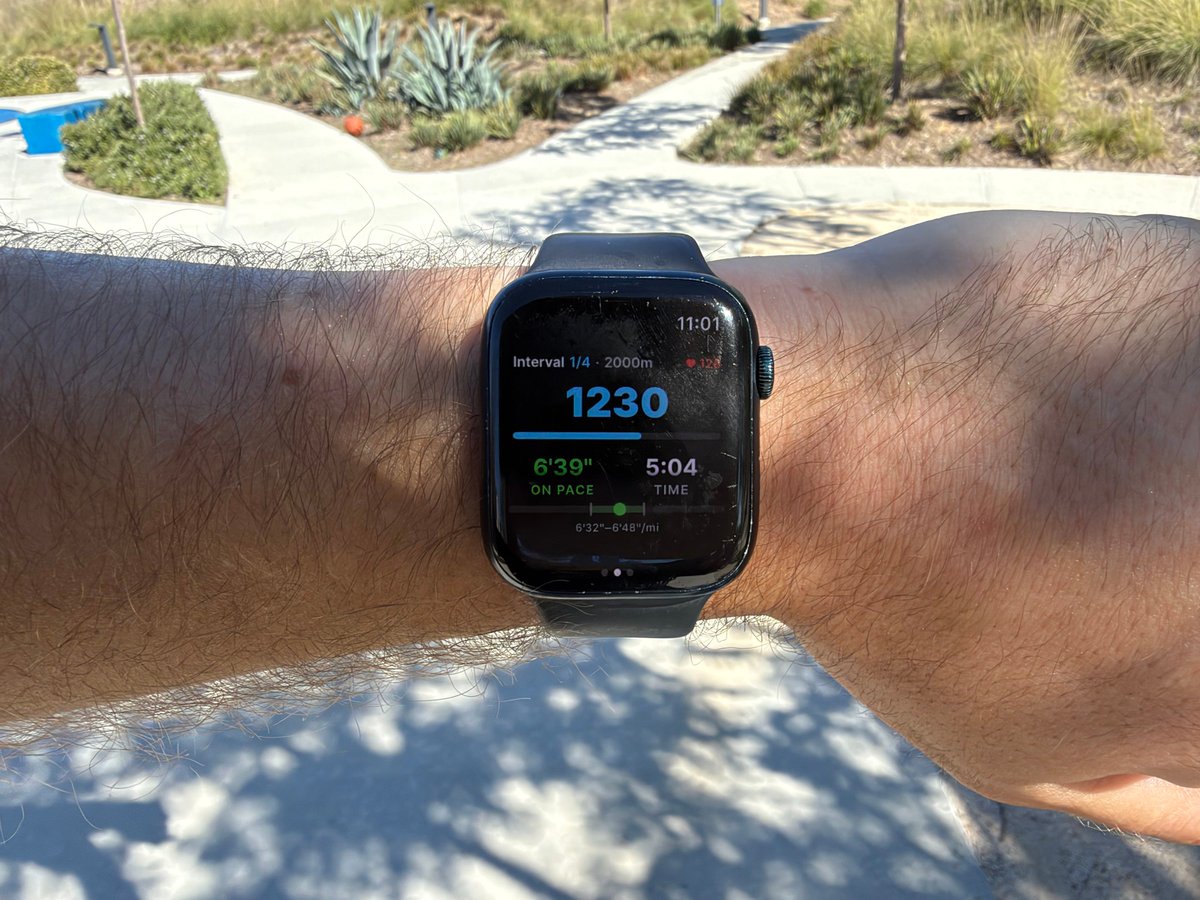
A self-coached runner can find a training plan easily. What is harder to find is a coach’s judgement: when to push, when to back off, and what to do when a week falls apart. That is what a coach is paid for, but not every runner wants to pay a coach’s monthly fee.
VMAX is a run coaching app for iPhone, Apple Watch and Android, built to come as close as possible to working one-to-one with a coach, at a fraction of the cost. It is the work of Brad Merrill, a UESCA-certified running coach who has worked in tech and digital media since 2007, run since 2014 and coached since 2020. His aim was to bring those two worlds together in the training app he wanted for himself.
Every plan written by a coach, not AI
A runner who starts with a coach usually fills out an intake form covering their background, experience and goals. The coach writes a plan from those answers, and a good coach then adjusts it from performance data and how the runner actually feels. That is how Merrill wanted VMAX to feel, and the question was how to recreate it inside an app.
Merrill did the work upfront, prewriting every training variation that his intake form could produce. That came to more than 900 variations across 14 programmes, from a beginner 5K plan to an advanced marathon plan. The three years it took went mostly on the training rather than the app, and none of the plans in VMAX were written by AI.
How VMAX works
TL;DR: The runner answers a few questions and enters a recent race time. VMAX matches them to one of its prewritten plan variations, calculates more than 20 personal pace ranges, and guides each run with live on-screen targets and audio cues in Merrill’s recorded voice. As training goes on, it picks easier or harder versions of upcoming sessions from real performance data.
At setup, the runner can enter a recent race result, a time trial or an honest estimate of current fitness. VMAX uses research-based formulas to turn that into more than 20 training paces, each aimed at a specific training zone and adaptation. They are always given as ranges rather than a single number, they adjust over time from actual performance, and a new race result recalibrates all of them.
The prewritten plan is only the starting point. Merrill built a set of levers that adjust training on the fly, as a coach would:
- VMAX swaps in an easier or harder version of a session depending on how the runner is responding to training.
- A long run that doesn’t fit can move a day or two, and VMAX rearranges the week around it.
- After illness or injury, it eases the runner back in rather than asking them to cram in what they missed.
- Heat-adjusted paces are available on hot days as an opt-in.
- Easing paces or dropping to a lower level is always the runner’s call.
Because every one of these situations was planned in advance, the result is the same kind of plan a one-to-one client would get, grounded in Merrill’s own training philosophy.
On the run, VMAX shows the live pace target on the phone or Apple Watch. The spoken cues are Merrill’s own recorded voice rather than text-to-speech, and every workout comes with instructions and a short explanation of what it is meant to improve. Runs save to the device as they happen, so if the app closes or the battery dies mid-run, VMAX picks up where it left off.
A worked example: one week, several versions
Here is one week from a VMAX plan, as written:
- Monday: rest
- Tuesday: easy run, 85 minutes
- Wednesday: cross-training or an easy 50-minute run
- Thursday: The Oxygen Debt Collector, 7 x 1,200m with a 600m jog between reps, plus a 10-minute warm-up and a 5-minute cool-down
- Friday: rest or cross-training
- Saturday: easy run, 55 minutes
- Sunday: the Afterburner Long Run, 15 miles (24km), with the last three miles run progressively faster
Each of those runs exists in several versions, and VMAX chooses which one the runner gets from their real performance data. A runner who has been struggling might get six reps on Thursday instead of seven, and a two-mile fast finish on Sunday instead of three. A runner handling everything comfortably gets slightly harder versions of both. The easy runs shrink or stretch by a few minutes to match, and the runner simply sees that day’s session.
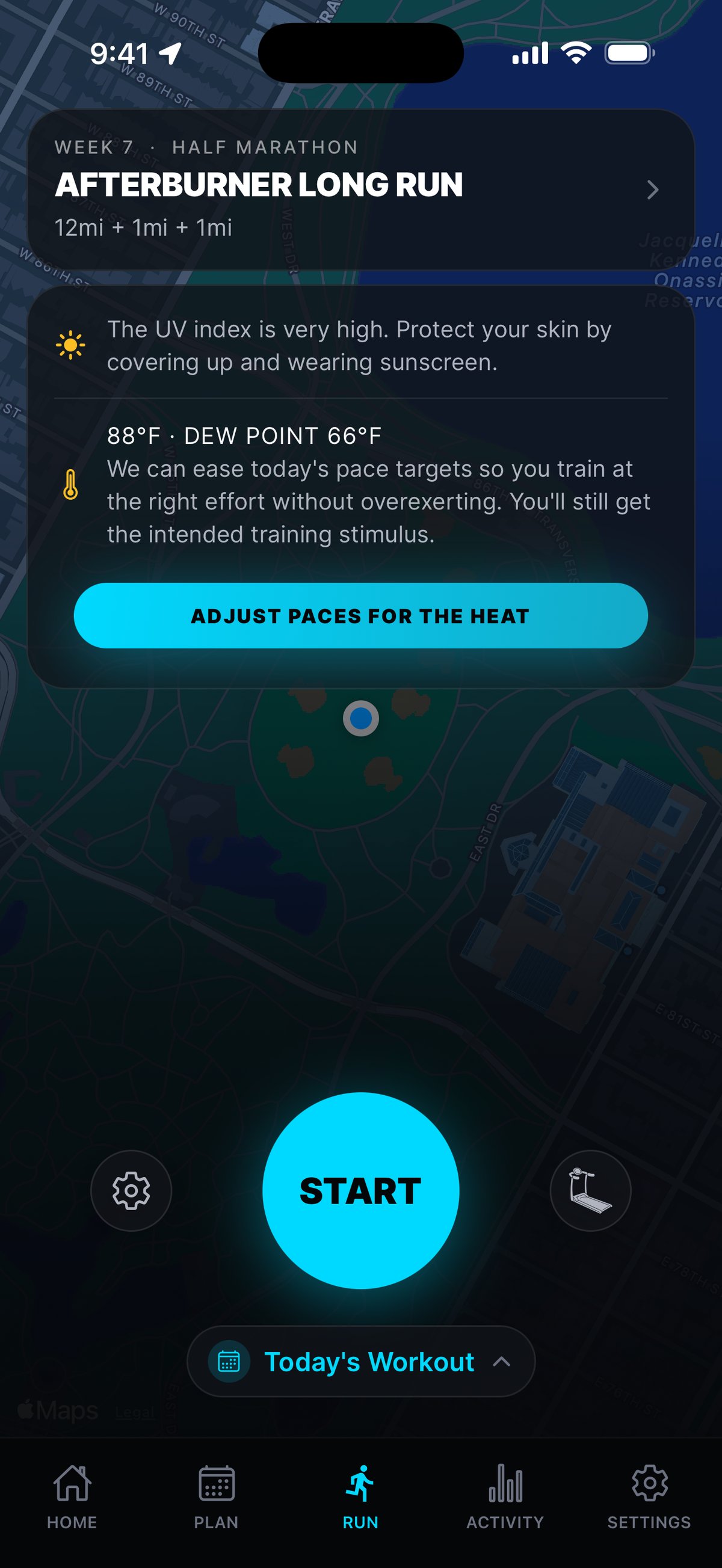
The screenshot shows an easier version of that Sunday long run on a morning of 88F (31C) with a 66F (19C) dew point. VMAX flags the UV index and offers to adjust the day’s pace targets for the heat.
Quick answers
Does VMAX work with a Garmin or COROS watch?
Not directly yet, though Garmin and COROS sync is in development. A watch whose own app syncs runs to Apple Health or Health Connect can already complete a VMAX workout by importing the run. Guided workouts with live pace targets run in VMAX’s own phone and Apple Watch apps.
When is VMAX coming to the UK?
There is no UK date yet. VMAX launched in the United States, Canada, Australia and New Zealand, and more countries will be added over time.
Do I need a recent race result to start?
No. An official race result, a time trial or an honest estimate of current fitness all work, at any distance from the mile to the marathon. The step can also be skipped and a time added later, though pace targets stay unset until then.
Integrations and availability
Apple Health and Health Connect are how data moves in and out of VMAX today, with export to Strava as well. Direct sync with Garmin and COROS is in development and expected in the coming months.
- Apple Health (iPhone): VMAX saves runs to Apple Health and can import runs recorded by other apps or watches in the past seven days to complete a VMAX workout.
- Health Connect (Android): the same, in both directions.
- Apple Watch: a standalone app that starts and records runs with its own GPS and shows live pace targets during guided workouts. In companion mode it supplies heart rate and shows a run started on the phone.
- Strava: runs upload automatically, which can be switched off. It is export only, so nothing is read back from Strava.
- Garmin and COROS: no direct sync yet.
- Availability: App Store and Google Play, in the United States, Canada, Australia and New Zealand.
What it costs and what is free
GPS run tracking is free. Plans, guided workouts and personal paces are part of VMAX Pro, at $99.99 a year or $19.99 a month, with a seven-day free trial.
| Feature | Free | VMAX Pro |
|---|---|---|
| GPS and treadmill run tracking, with open, distance, time and interval goals | Yes | Yes |
| Standalone Apple Watch app | Yes | Yes |
| Run history, personal records and awards | Yes | Yes |
| Apple Health, Health Connect and Strava | Yes | Yes |
| A full training plan with personal pace ranges | No | Yes |
| Guided workouts with live pace targets and voice cues | No | Yes |
| Adaptive sessions, illness ease-back and heat-adjusted paces | No | Yes |
More information: vmax.run, the App Store and Google Play.
Author: Brad Merrill, founder and head coach of VMAX, edited by the5krunner.
If you enjoyed reading this, here is another in the Indie Spotlight series: Indie App Spotlight: Observatory puts the real sky on a Garmin dial.
Last Updated on 11 November 2026 by tfk the5krunner
Small things I always use
- Garmin 90-degree charging adapter: Charges your Garmin from any USB-C cable. Essential when travelling. I use one.
- Body Glide: The blue anti-chafe stick swimmers and runners carry. I use it.
- Speedo earplugs: Fewer ear infections and no cold-water dizziness. I use them.
- Dryrobe Advance: My winter changing robe for open-water swims. I use one. A cheaper option is the AONYIYI changing robe.
- Maurten: Race fuel that stays easy on the stomach. I use them.
- Beet It Sport nitrate shots: Beetroot shots I take in the days before a race. I use them.
- Garmin charging puck: The quickest way to top up before a session. I use one.
- Injinji: Toe socks that stop rubbing, so you run more. I use them.
- Ultimate toe protectors: Stop black toenails on long runs. They work. I use them.
- Compressport R2 v2 calf sleeves: My calf sleeves of choice. I use them.
- Cellucor C4: My pre-workout before hard sessions.
- TPU tubes: Schwalbe Aerothan, Tubolito and Pirelli SmarTube. Light, tiny spares. I use all three.
- G8 insoles: Adjustable insoles that are good. I use them.
- Cycplus Cube: A 97g electric pump that gets a road tyre rideable in two minutes. I carry one. 5% off with code THE5KRUNNER.
Watches and sensors
- Polar H10: My daily driver for waking HRV.
- Polar Verity Sense: My backup arm-worn HR sensor.
- Nomad bedside charger: Charges my iPhone and Apple Watch overnight. I use it, and many of their bands.
- Train.Red: The best muscle oxygen sensor I’ve used.
- Tymewear: Accurate heart rate and reliable ventilatory zones. I use it to pace endurance rides over an hour.
- Garmin Forerunner 970: A pro-grade triathlon watch. I use this.
- Apple Watch Ultra 4: My daily smartwatch. No phone needed on rides.
- Garmin Fenix 9 Pro: I’ve just bought one.
On the bike
- Continental GP5000 for everyday riding, and Aero 111 on the front for special occasions.
- Helmets: Specialized S-Works Evade 3 for road riding, and Rudy Project Wing for TT-style races. I use both.
- Ravemen FR300: A front light that mounts under your Garmin or Wahoo. I use one.
- Ravemen FR1000: The light and the computer mount in one unit, so nothing else goes on the bars. Better than mine.
- Ravemen FR1500SE: 1,500 lumens hanging under your Garmin, for proper night rides.
- Ravemen FR1100SE: 1,100 lumens under your Garmin, and up to 46 hours on slow flash.
- Ravemen FR500: A brighter FR300 with the same mount.
- Wahoo TRACKR Radar: I use it on one bike and Varia on the other. They perform the same.
- Garmin Varia RTL515: Radar that warns you of cars from behind. I use this model.
- Wahoo ELEMNT Roam 3: The bike computer that’s easy to use. I use mine on most rides.
- Favero Assioma Pro RS2: Accurate power pedals that swap easily between bikes. I use this model.
Home and indoor training
- NPE Runn: Makes my basic treadmill smart, sending more accurate speed and distance to my watch and Zwift. I use it.
- Google Wifi: Keeps Zwift connected in my pain cave. I use it.
- Apple TV 4K: Zwift on the big screen. I use two.
- Google Nest Doorbell (wired, 2nd gen): My video doorbell, running in both Google Home and Apple Home. I use it.
Health, recovery and sleep
- FreeStyle Libre 3 Plus: Shows how my blood sugar responds to diet.
- hDrop: Measures my sweat loss in summer and indoors.
- Fourth Frontier Zone: Checks my heart under load in hard sessions.
- Kineon MOVE+: Red and infrared light for sore knees, Achilles and other joints after hard training. I use it.
- Oura Ring 5: My partner’s recovery tracker of choice.
- Eight Sleep: A cooling mattress cover my partner and I use nightly.
Reader-Powered Content

This content is not sponsored. It’s mostly me behind the labour of love, which is this site, and I appreciate everyone who supports it.
Support the site: Follow (free, fewer ads) · Subscribe (paid, ad-free) · Buy Me A Coffee
Written by real people, with AI assistance. Fact-checked and verified for originality. See the Editorial Policy. FTC: Affiliate Disclosure — some links pay commission. As an Amazon Associate, I earn from qualifying purchases.
tfk is the founder and author of the5krunner, an independent endurance sports technology publication. With 20 years of hands-on testing of GPS watches and wearables, and competing in triathlons at an international age-group level, tfk provides in-depth expert analysis of fitness technology for serious athletes and endurance sport competitors. See the gear tfk uses. ID
