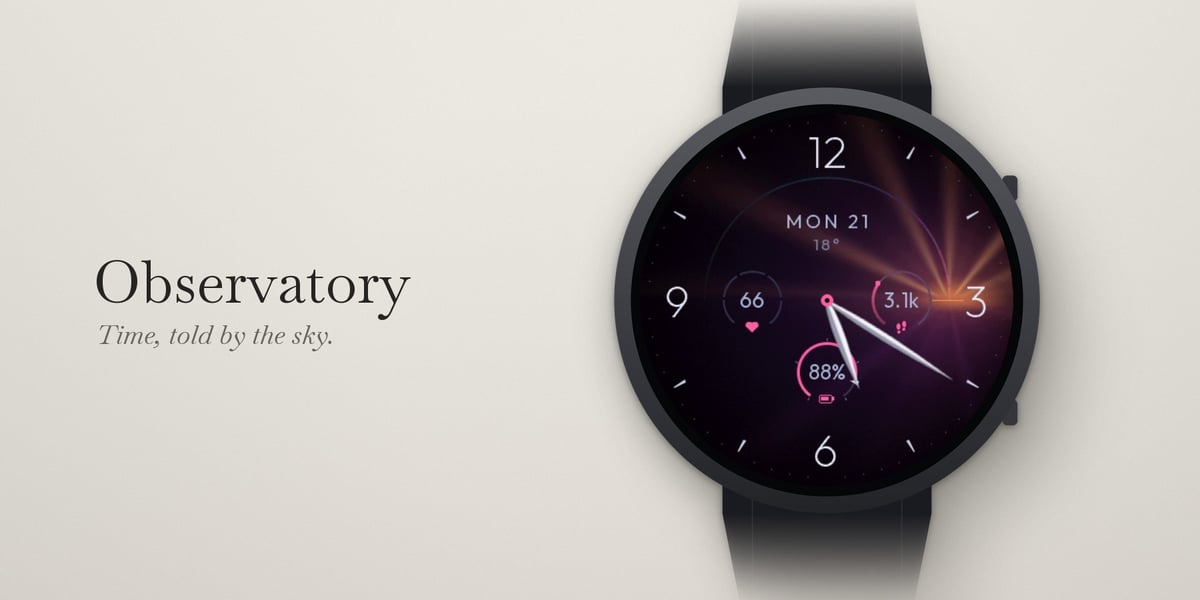
On 21 December the sun sets in London at 3:53 p.m., and civil twilight is over by 4:34 p.m. For anyone fitting in a late-afternoon run, those 41 minutes decide whether the run finishes in fading light or in the dark. Observatory, a new Garmin watch face, puts that light on the dial. The sun reaches the 3 at the wearer’s own sunset, the sky turns from gold to violet through their twilight, and after dark the dial becomes a map of the stars overhead.
Mihir Kadiya built Observatory for himself. After learning Garmin’s Connect IQ SDK, he wanted an analogue face he would enjoy looking at every time he raised his wrist, one that feels like a window rather than a dashboard. Partway through, he decided to share it, and it is now on the Connect IQ Store for 12 AMOLED watches.
A day on Observatory
TL;DR: The sun crosses the top half of the dial from the wearer’s real sunrise at the 9 to their real sunset at the 3. The dial’s colour and the length of the hands’ shadows follow the sun’s height, and after dusk the dial shows the stars and constellations overhead, with the moon keeping the hours below.
The dial is a clock and a sky at once. The sun rises at the 9 at the wearer’s sunrise, stands highest at the 12 and sets at the 3. At night the moon keeps the hours in the lower half, from the 3 at sunset round to the 9 at sunrise, drawn in that night’s phase. Three readings sit inside the dial.
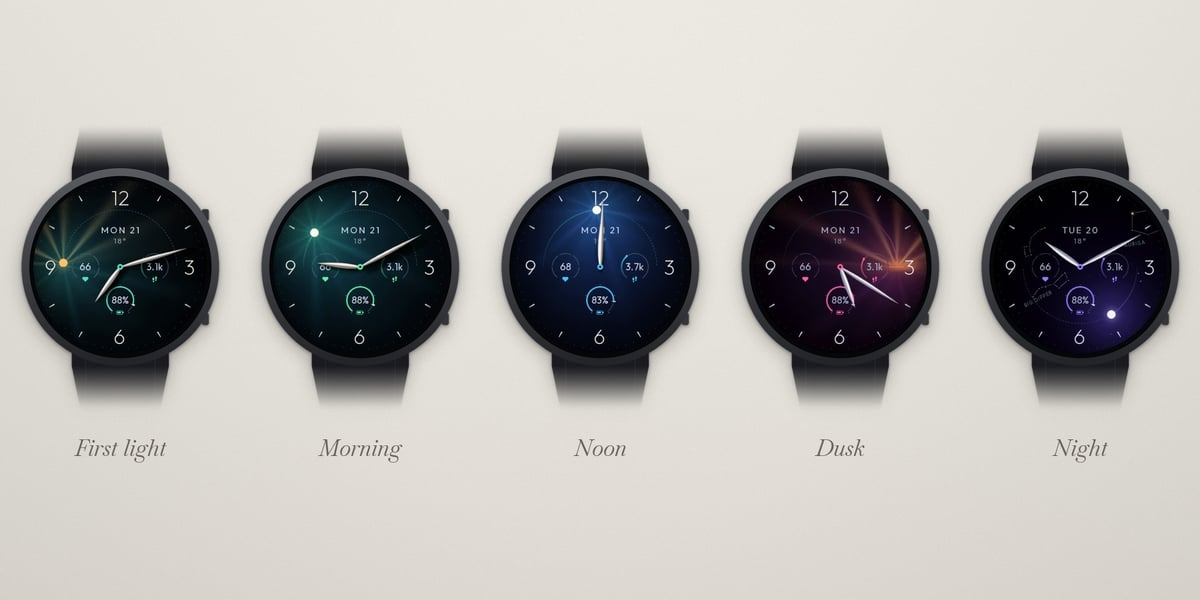
In the morning the sun is low, so the hands cast long shadows away from it, two and a half times their length. As the sun climbs, the dial brightens and the shadows shorten to half the hands’ length at midday. Through the afternoon it runs in reverse until the sun reaches the 3 and the shadows go with it. After dark the dial shows the stars straight overhead, with up to three constellations drawn in fine lines and named, while the moon crosses below.
With the wrist down, the face falls back to a few grey lines. On a raise the sky returns at once, with the stars fading in at their places.
A December evening in London
On 21 December the sun in London never climbs higher than 15 degrees, so the hands’ shadows stay long all day. With one reading set to the next sunrise or sunset, the evening runs like this:
- 2:52 p.m. The sun drops below 6 degrees and golden hour starts. The rays nearest the sun turn gold, and the shadows lengthen towards two and a half times the hands.
- 3:43 p.m. Ten minutes before sunset, a short horizon line grows in at the 3, with a soft band of light along it.
- 3:53 p.m. The sun sinks behind the line, the shadows go with it, and the reading turns to the next sunrise, 8:04 a.m.
- Until 4:18 p.m. A fan of light shines up from under the horizon, gold, then orange, then rose, and the brightest stars come out.
- 4:18 to 4:34 p.m. In the blue hour the moon comes in at the 3, more stars appear, and the constellations are drawn and named.
- 4:34 p.m. Civil twilight ends, and the dial is the night sky until morning.
In New York the same evening starts at 3:48 p.m., the sun sets at 4:31 p.m. and night has fallen by 5:02 p.m.
How the sky is drawn
Everything is worked out on the watch for the wearer’s date and place, and the face makes no network calls of its own.
- The sun. Sunrise, sunset and the end of civil twilight, when the sun is 6 degrees below the horizon, come from the equations behind NOAA’s solar calculator. The location comes from Garmin’s weather or the last GPS activity.
- The stars. The face carries 290 stars from the Yale Bright Star Catalogue, each in its real colour, and the lines and names of 28 constellations, the Southern Cross among them. Once an hour the watch places about 56 stars for the wearer’s latitude and picks at most three constellations that stay clear of the hands and numerals. As in the real sky, the view at a given hour moves on month by month.
- The moon. Its phase is counted from a known new moon, in cycles of 29.53 days.
The hardest part was the colour. The watch screen has 16-bit colour, so a dusk gradient that looks smooth on a laptop breaks into visible rings on the wrist. Kadiya compared eight ways of drawing the same dusk side by side at three times zoom. The face now scatters the colour steps with a blue-noise pattern, evenly enough that the eye averages them away. The watch can’t blend two full-screen images, so each stage of twilight is prepared in advance and swapped in as the light changes.
Readings and settings
Each of the three slots, left, right and bottom, shows one of 16 readings: heart rate, stress, Body Battery, Pulse Ox, respiration, recovery time, steps, calories, intensity minutes, distance, move bar, battery, battery in days, next calendar event, next sunrise or sunset, and weather. Touching and holding a slot opens Garmin’s own screen for that reading. Everything is set in the face’s own menu on the watch.
| Setting | Options | Default |
|---|---|---|
| Slots | Any of the 16 readings in each | Three readings |
| Small reading under the date | Temperature, high and low, next sun event, moon, or none | Temperature |
| Numerals | 12, 3, 6 and 9; all 12; or none | 12, 3, 6 and 9 |
| Constellation names | On or off | On |
| Seconds hand | On or off | On |
| Bed mark | On or off | On |
The bed mark reads the sleep schedule set in Garmin Connect. In the three hours before bedtime, a small bed appears on the dial’s edge where the hour hand will be at bedtime, with a fine line from the hour hand to it. When the hand reaches the bed, it’s time to sleep.
The always-on page draws the dial in fine grey lines that light about 3% of the screen. It is redrawn once a minute and shifted slightly each time to protect the AMOLED display.
Quick answers
Does Observatory work without GPS or a phone nearby?
Yes. It uses the last location the watch knows, and everything is calculated on the watch. With no location at all, it assumes sunrise at 6:30 and sunset at 18:30.
Can I set it up from my phone?
Not yet. Every setting is in the face’s menu on the watch, and phone settings are planned.
My watch isn't listed. Is it next?
Owners of other models can ask for theirs, and those requests decide which watches come next.
Watches, battery and price
All 12 compatible watches are round AMOLED models with 390-pixel screens, and more are planned.
- Vivoactive: Vivoactive 5 and Vivoactive 6
- Venu: Venu 3S and Venu 4 41mm
- Forerunner: Forerunner 170, Forerunner 170 Music and Forerunner 570 42mm
- Epix: Epix Pro (Gen 2) 42mm
- Approach: Approach S70 42mm
- Descent: Descent Mk3 43mm
- MARQ: MARQ (Gen 2), including the Commander Carbon Edition, and MARQ (Gen 2) Aviator
On a Vivoactive 5 with always-on enabled, Observatory uses about the same battery as Garmin’s own analogue face, around 1% an hour.
Observatory is a one-off purchase of $4.99 through Garmin’s Connect IQ Store. There is no trial, but Garmin refunds a purchase within 48 hours. The most popular faces in the store are tracked every month in the Connect IQ charts.
The dial images are renders from Garmin’s Connect IQ simulator.
More information: Observatory on the Connect IQ Store and a video of a full day on the dial.
Author: Mihir Kadiya (Arka on the Connect IQ Store), developer of Observatory, edited by the5krunner.
If you enjoyed reading this, here is another in the Indie Spotlight series: Indie App Spotlight: OpenMaps puts a map under the route on a Garmin Instinct.
Last Updated on 10 November 2026 by tfk the5krunner
Small things I always use
- Garmin 90-degree charging adapter: Charges your Garmin from any USB-C cable. Essential when travelling. I use one.
- Body Glide: The blue anti-chafe stick swimmers and runners carry. I use it.
- Speedo earplugs: Fewer ear infections and no cold-water dizziness. I use them.
- Dryrobe Advance: My winter changing robe for open-water swims. I use one. A cheaper option is the AONYIYI changing robe.
- Maurten: Race fuel that stays easy on the stomach. I use them.
- Beet It Sport nitrate shots: Beetroot shots I take in the days before a race. I use them.
- Garmin charging puck: The quickest way to top up before a session. I use one.
- Injinji: Toe socks that stop rubbing, so you run more. I use them.
- Ultimate toe protectors: Stop black toenails on long runs. They work. I use them.
- Compressport R2 v2 calf sleeves: My calf sleeves of choice. I use them.
- Cellucor C4: My pre-workout before hard sessions.
- TPU tubes: Schwalbe Aerothan, Tubolito and Pirelli SmarTube. Light, tiny spares. I use all three.
- G8 insoles: Adjustable insoles that are good. I use them.
- Cycplus Cube: A 97g electric pump that gets a road tyre rideable in two minutes. I carry one. 5% off with code THE5KRUNNER.
Watches and sensors
- Polar H10: My daily driver for waking HRV.
- Polar Verity Sense: My backup arm-worn HR sensor.
- Nomad bedside charger: Charges my iPhone and Apple Watch overnight. I use it, and many of their bands.
- Train.Red: The best muscle oxygen sensor I’ve used.
- Tymewear: Accurate heart rate and reliable ventilatory zones. I use it to pace endurance rides over an hour.
- Garmin Forerunner 970: A pro-grade triathlon watch. I use this.
- Apple Watch Ultra 4: My daily smartwatch. No phone needed on rides.
- Garmin Fenix 9 Pro: I’ve just bought one.
On the bike
- Continental GP5000 for everyday riding, and Aero 111 on the front for special occasions.
- Helmets: Specialized S-Works Evade 3 for road riding, and Rudy Project Wing for TT-style races. I use both.
- Ravemen FR300: A front light that mounts under your Garmin or Wahoo. I use one.
- Ravemen FR1000: The light and the computer mount in one unit, so nothing else goes on the bars. Better than mine.
- Ravemen FR1500SE: 1,500 lumens hanging under your Garmin, for proper night rides.
- Ravemen FR1100SE: 1,100 lumens under your Garmin, and up to 46 hours on slow flash.
- Ravemen FR500: A brighter FR300 with the same mount.
- Wahoo TRACKR Radar: I use it on one bike and Varia on the other. They perform the same.
- Garmin Varia RTL515: Radar that warns you of cars from behind. I use this model.
- Wahoo ELEMNT Roam 3: The bike computer that’s easy to use. I use mine on most rides.
- Favero Assioma Pro RS2: Accurate power pedals that swap easily between bikes. I use this model.
Home and indoor training
- NPE Runn: Makes my basic treadmill smart, sending more accurate speed and distance to my watch and Zwift. I use it.
- Google Wifi: Keeps Zwift connected in my pain cave. I use it.
- Apple TV 4K: Zwift on the big screen. I use two.
- Google Nest Doorbell (wired, 2nd gen): My video doorbell, running in both Google Home and Apple Home. I use it.
Health, recovery and sleep
- FreeStyle Libre 3 Plus: Shows how my blood sugar responds to diet.
- hDrop: Measures my sweat loss in summer and indoors.
- Fourth Frontier Zone: Checks my heart under load in hard sessions.
- Kineon MOVE+: Red and infrared light for sore knees, Achilles and other joints after hard training. I use it.
- Oura Ring 5: My partner’s recovery tracker of choice.
- Eight Sleep: A cooling mattress cover my partner and I use nightly.
Reader-Powered Content

This content is not sponsored. It’s mostly me behind the labour of love, which is this site, and I appreciate everyone who supports it.
Support the site: Follow (free, fewer ads) · Subscribe (paid, ad-free) · Buy Me A Coffee
Written by real people, with AI assistance. Fact-checked and verified for originality. See the Editorial Policy. FTC: Affiliate Disclosure — some links pay commission. As an Amazon Associate, I earn from qualifying purchases.
tfk is the founder and author of the5krunner, an independent endurance sports technology publication. With 20 years of hands-on testing of GPS watches and wearables, and competing in triathlons at an international age-group level, tfk provides in-depth expert analysis of fitness technology for serious athletes and endurance sport competitors. See the gear tfk uses. ID
