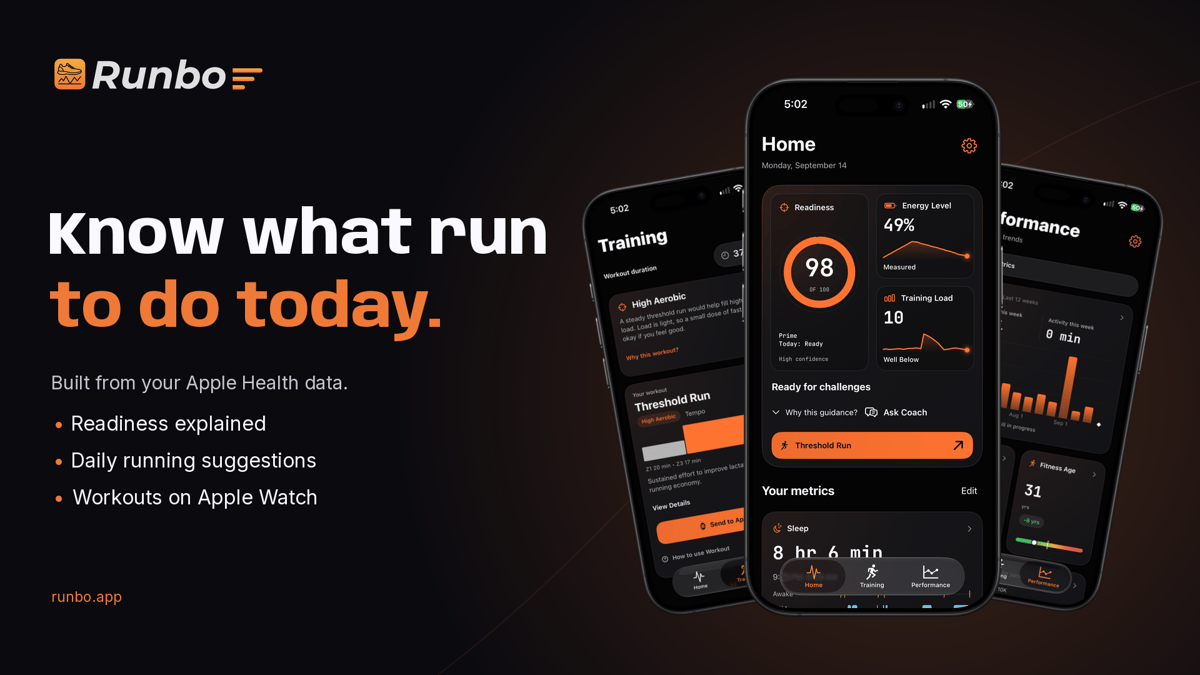
An Apple Watch records a runner’s workouts, sleep, heart rate variability, and resting heart rate, then leaves the runner to turn it all into a training session. Which run today, how long, at what pace or heart rate, and why that one?
Runbo is an iPhone and Apple Watch app that answers those questions. It reads the data already in Apple Health, looks at how training has been going and how recovered the runner is, then suggests a run for the day and explains the choice. One tap sends the session to the watch, where it runs in Apple’s own Workout app.
Runbo is built for self-coached runners who want each run to have a purpose without committing to a rigid plan. Anyone who has used a Garmin will recognise the ideas: a daily suggested workout, Training Load, Load Focus, Training Readiness and an all-day energy gauge, each calculated by Runbo for Apple Watch. There is no account to create, and the training calculations run on the device.
How Runbo works
TL;DR: Runbo reads workouts, sleep and health data from Apple Health, compares the last week of training with the last month, checks recovery, and suggests a run with a duration and pace or heart rate targets to follow on Apple Watch. The scores and the reasons behind them are free, and the personalised daily session is part of Pro, from $1.99 a month.
With the runner’s permission, Runbo reads these from Apple Health:
- Workouts, with their duration, distance and heart rate
- Sleep duration and sleep stages
- Heart rate variability and resting heart rate
- Other vitals where the watch records them: respiratory rate, blood oxygen and wrist temperature
- Daily activity and VO2 max
The runner gets back:
- Each day, with Pro: a personalised run, with the reasoning shown
- In Apple’s Workout app: the session as a structured workout, with its steps and targets
- On iPhone: Training Load and Load Focus, Training Readiness with its factors, Energy Level and Stress, sleep and vitals, and performance estimates
- In the Runbo watch app: Readiness, Load Focus, Energy Level and Stress, plus the day’s workout with Pro
- On the watch face: an Energy Level complication in circular, corner, rectangular and inline layouts
- On the iPhone Home Screen: widgets for the Today overview, Readiness, Energy, Sleep and Training Load
Apple Watch gives the fullest picture. Runbo also works with the data that Garmin, WHOOP and Oura sync to Apple Health, and the Quick answers below explain how far that goes.
Today’s run, and why
The Training tab shows one suggested session for the day: an easy run, a tempo run, threshold work or intervals, with its length and its targets. The reasoning sits above the session in plain words, naming the kind of training the runner is short of and how much intensity the recent load allows, and “Why this workout?” opens the detail.
The runner stays in charge. Runbo offers alternative sessions when the first suggestion doesn’t suit the day, and the duration can be changed on workouts that support it. Runners who keep a regular long-run day can tell Runbo which days those are, and it suggests a long run on them when mileage and recovery allow.
“Send to Apple Watch” places the session in Apple’s Workout app. The runner chooses pace or heart rate targets and an indoor or outdoor run, and the warm-up, work intervals, recoveries and cool-down arrive as separate steps. The session also appears in the Runbo watch app, with its duration and pace range, where one tap opens it in the Workout app.
A worked example: Monday 14 September
On Monday 14 September, the developer’s Home screen showed Training Load at 10, labelled “Well Below”, because the last week was less than half of his four-week norm. Training Readiness was 98 out of 100 with high confidence, after 8 hours 6 minutes of sleep. Energy Level, which tracks reserves through the day and is separate from Readiness, read 49%.
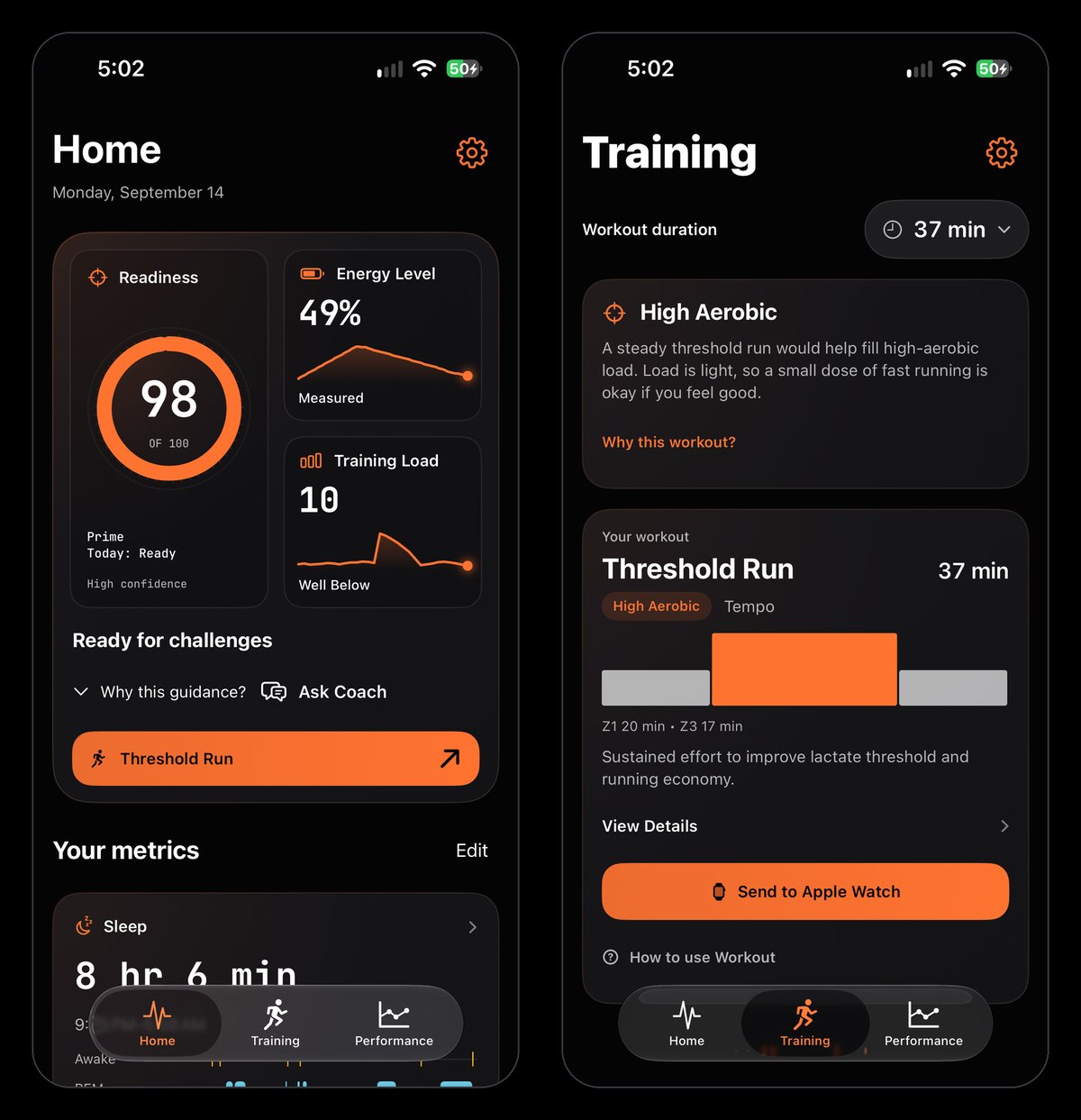
A rested runner coming off a light week could do almost anything, so the useful part is what Runbo chose and why. It picked out high-aerobic work, the sustained harder running between easy miles and sprints, as the gap. The Training tab said: “A steady threshold run would help fill high-aerobic load. Load is light, so a small dose of fast running is okay if you feel good.”
The session was a 37-minute Threshold Run: 17 minutes in Zone 3, the third of five heart rate zones, with 20 minutes of easy Zone 1 running around it.
Quick answers
How is Runbo different from Apple's own Readiness on Series 12 and Ultra 4?
Apple’s Readiness says how ready the body is, while Runbo suggests what to do next. It weighs training load and the balance of recent work alongside recovery, suggests a specific run and sends it to the Workout app as a structured workout. Runbo’s own Training Readiness also brings a score, and its factors to older Apple Watches, and the two scores are calculated separately, so they won’t always match.
Does Runbo work for a runner who only wears a Garmin?
Yes, with less detail. Runbo reads whatever a device’s app syncs to Apple Health, so workouts, sleep, and heart rate from Garmin Connect, WHOOP, or Oura all count. Garmin Connect sends all-day heart rate, but only high and low values for timed activities, and WHOOP and Oura don’t share HRV, so Runbo lowers its confidence where a reading is missing. Sending a session to the wrist and the watch app requires an Apple Watch.
Does Runbo need an account, and where does the data go?
No account is needed, and the training calculations run on the device. The optional AI features are the exception: Ask Coach can use Apple’s Private Cloud Compute, and an Online AI setting, off by default, sends the question and calculated results to Google Gemini through Runbo’s server. None of them receives raw Health samples or routes.
Training Load and Load Focus
Training Load compares the runner’s last seven days with their last four weeks and labels the result, as in the example above. It uses Apple’s own training load data where the watch has it and estimates load from the workout where it doesn’t.
Load Focus splits those four weeks into low aerobic, high aerobic and anaerobic work: easy running, sustained harder efforts and short fast bursts. A shortage in one of the three is often the reason behind the day’s suggestion, which is why two runners with the same recovery can be given different sessions. Load Focus needs at least seven training days and about four weeks of workouts before Runbo treats its picture as established and counts workouts already in Apple Health.
Runbo also keeps hard sessions at least 42 hours apart and allows no more than two in about a week, so a runner who feels fresh the morning after two hard days is still steered towards an easy run.
Readiness, Energy and the longer view
Training Readiness is a score out of 100 for how prepared the body is for hard training. It draws on six factors: recovery time still owed from recent workouts, recent training load, last night’s sleep, sleep over recent nights, heart rate variability and stress history. “Why this guidance?” shows each factor with the points it took off the score. Readiness is free, and it brings a readiness score to many Apple Watch models that don’t have one.
Energy Level shows how sleep, daily activity, workouts, and stress fill and drain the runner’s reserves throughout the day, with a Stress view beside it. Both update on the watch without the iPhone nearby. The Performance tab adds VO2 max, race forecasts and Fitness Age, all of which are estimates.
Ask Coach and connected assistants
Ask Coach lets Pro users ask a coach in the app questions about their training, such as why today’s session is easy or what the week’s load means. The runner can give Coach a goal race, with its distance, date and target time, and their usual training days, and the answers take both into account.
Connected Assistants, also part of Pro, brings Runbo summaries into ChatGPT, Claude, Grok and other AI assistants that support MCP, the standard for connecting assistants to apps. The runner chooses which summaries to share and can disconnect at any time, and access is read-only, so the assistant can’t change anything in Apple Health.
What is free and what is Pro
| Feature | Free | Runbo Pro |
|---|---|---|
| Training Load, Training Readiness with its factors, Energy Level, sleep and performance views | Yes | Yes |
| Short AI summaries of Readiness, on Apple Intelligence iPhones | Yes | Yes |
| An example workout, sent to Apple’s Workout app | Yes | Yes |
| Personalised daily workouts and alternatives | No | Yes |
| Duration changes on supported workouts | No | Yes |
| The day’s workout in the Runbo watch app | No | Yes |
| Advanced Load Focus guidance | No | Yes |
| Ask Coach | No | Yes |
| Connected Assistants | No | Yes |
Pro costs $1.99 a month, $19.99 a year or $39.99 once for lifetime access in the US App Store, and all three unlock the same features. Prices in other countries differ. Runbo needs an iPhone on iOS 18 or later, and the watch features need an Apple Watch.
Race training is the next addition. The coming version lets the runner set a race goal, from 5K to marathon, ultra or triathlon, and builds towards it in phases from base to taper, with Pro’s daily workouts following the plan.
More information: runbo.app and the App Store.
Author: Andrei Pervychine, developer of Runbo, edited by the5krunner.
If you enjoyed reading this, here is another in the Indie Spotlight series: Indie App Spotlight: Athlete Space is a free AI coach that replans your week.
Last Updated on 12 November 2026 by tfk the5krunner
Small things I always use
- Garmin 90-degree charging adapter: Charges your Garmin with any USB-C cable. Essential when travelling. I use one.
- Body Glide: The blue anti-chafing stick swimmers and runners carry. I use it.
- Speedo earplugs: Fewer ear infections and no cold-water dizziness. I use them.
- Dryrobe Advance: My winter changing robe for open-water swims. I use one. A cheaper option is the AONYIYI changing robe.
- Maurten: Race fuel that stays easy on the stomach. I use them.
- Beet It Sport nitrate shots: Beetroot shots I take in the days before a race. I use them.
- Garmin charging puck: The quickest way to top up before a session. I use one.
- Injinji: Toe socks that stop rubbing, so you run more. I use them.
- Ultimate toe protectors: Stop black toenails on long runs. They work. I use them.
- Compressport R2 v2 calf sleeves: My calf sleeves of choice. I use them.
- Cellucor C4: My pre-workout before hard sessions.
- TPU tubes: Schwalbe Aerothan, Tubolito and Pirelli SmarTube. Light, tiny spares. I use all three.
- G8 insoles: Adjustable arches, perfect position. I use them.
- Cycplus Cube: A 97g electric pump that gets a road tyre rideable in two minutes. I carry one. 5% off with code THE5KRUNNER.
Health, recovery and sleep
- Kineon MOVE+: Red and infrared light for sore knees, Achilles and other joints after hard training. I use it.
- FreeStyle Libre 3 Plus: Shows how my blood sugar responds to diet. Occasional use.
- hDrop: Measures my sweat loss in summer and indoors. I use it.
- Fourth Frontier Zone: Checks my heart under load in hard sessions.
- Oura Ring 5: My partner’s recovery tracker of choice.
- Eight Sleep: A cooling mattress cover my partner and I use nightly.
Watches and sensors
- Polar H10: My daily driver for waking HRV.
- Polar Verity Sense: My backup arm-worn HR sensor.
- Nomad bedside charger: Charges my iPhone and Apple Watch overnight. I use it, and many of their bands.
- Train.Red: The best muscle oxygen sensor I’ve used. Occasional use.
- Tymewear: Accurate heart rate and reliable ventilatory zones. I use it to pace endurance rides over an hour.
- Garmin Forerunner 970: A pro-grade triathlon watch. I use this.
- Apple Watch Ultra 4: My daily smartwatch. No phone needed on rides.
On the bike
- Continental GP5000 for everyday riding, and Aero 111 on the front for special occasions. I use both.
- Helmets: Specialized S-Works Evade 3 for road riding, and Rudy Project Wing for TT-style races. I use both.
- Ravemen FR300: A front light that mounts under your Garmin or Wahoo. I use one.
- Ravemen FR1000: The light and the computer mount in one unit, so nothing else goes on the bars. Better than mine.
- Ravemen FR1500SE: 1,500 lumens hanging under your Garmin, for proper night rides.
- Ravemen FR1100SE: 1,100 lumens under your Garmin, and up to 46 hours on slow flash.
- Ravemen FR500: A brighter FR300 with the same mount.
- Wahoo TRACKR Radar: I use it on one bike and Varia on the other. They perform the same.
- Garmin Varia RTL515: Radar that warns you of cars from behind. I use this model.
- Wahoo ELEMNT Roam 3: The bike computer that’s easy to use. I use mine on most rides.
- Favero Assioma Pro RS2: Accurate power pedals that swap easily between bikes. I use this model.
Home and indoor training
- NPE Runn: Makes my basic treadmill smart, sending more accurate speed and distance to my watch and Zwift. I use it.
- Google Wifi: Keeps Zwift connected in my pain cave. I use it.
- Apple TV 4K: Zwift on the big screen. I use two.
- Google Nest Doorbell (wired, 2nd gen): My video doorbell, running in both Google Home and Apple Home via Starling. I use it.
Reader-Powered Content
This content is not sponsored. It’s mostly me behind the labour of love, which is this site, and I appreciate everyone who supports it.
Support the site: Follow (free, fewer ads) · Subscribe (paid, ad-free) · Buy Me A Coffee
Written by real people, with AI assistance. Fact-checked and verified for originality. See the Editorial Policy. FTC: Affiliate Disclosure — some links pay commission. As an Amazon Associate, I earn from qualifying purchases.
tfk is the founder and author of the5krunner, an independent endurance sports technology publication. With 20 years of hands-on testing of GPS watches and wearables, and competing in triathlons at an international age-group level, tfk provides in-depth expert analysis of fitness technology for serious athletes and endurance sport competitors. See the gear tfk uses. ID
