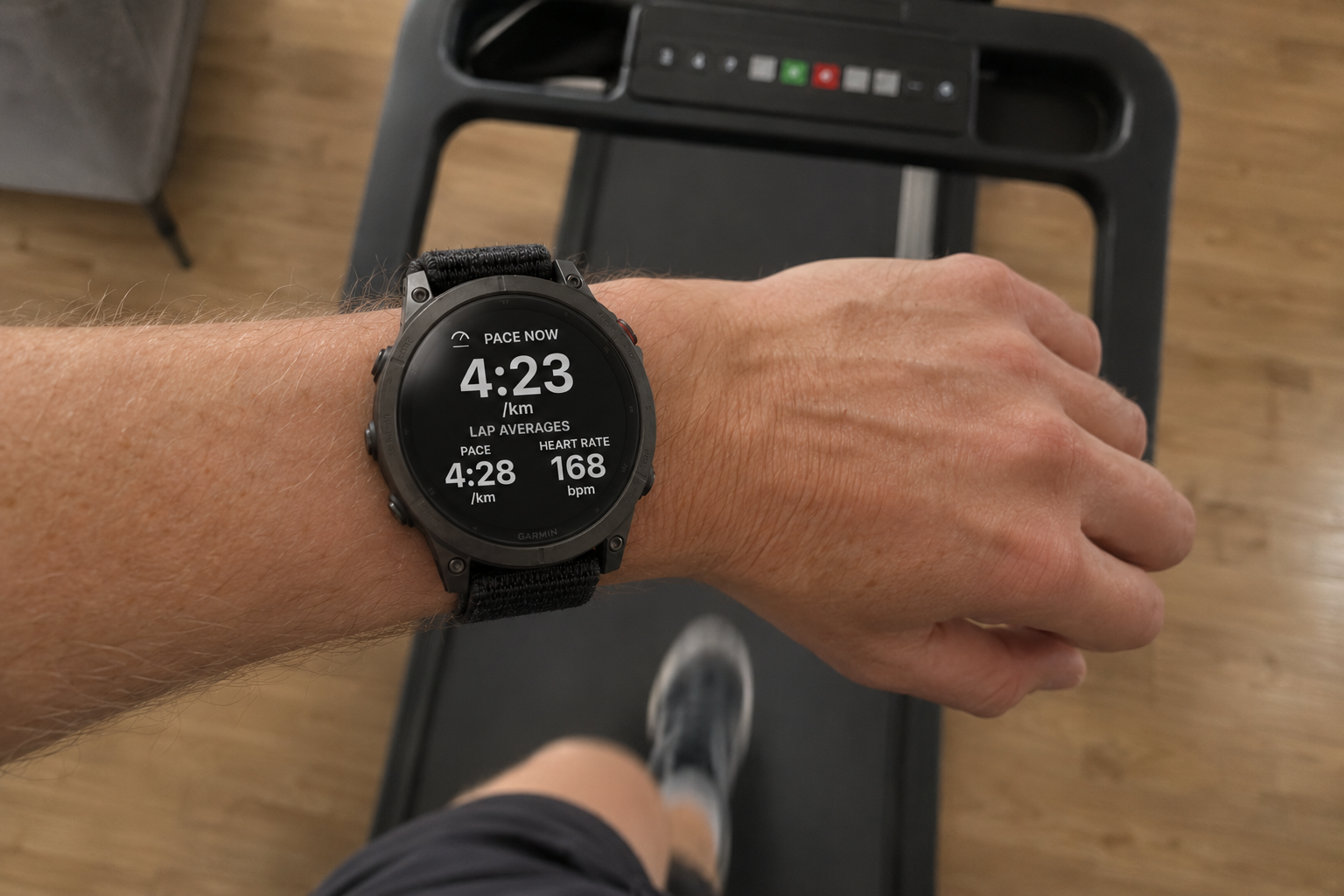
A Garmin can show the same data on every run, and the trouble starts when the biggest number answers the wrong question. Pace can pull an easy run faster than planned. On a long out-and-back, the next decision might be whether it is time to turn around. Mid-interval, a fast pace reading can make a runner back off even when the kilometre is still on target.
Each session benefits from a different number in the largest spot. Garmin’s built-in fields can cover all three sessions, but independent designer and runner Michał Aleksander built three standalone ORBIT data fields around those decisions.
What each ORBIT data field shows
TL;DR: COMMAND puts effort first, RHYTHM puts distance first, and ATTACK puts current pace beside the current lap average. The runner picks the field that fits the session and adds it to its own activity screen. RHYTHM is free, and COMMAND and ATTACK cost $1.99 each.
| Field | Best suited to | Default readings |
|---|---|---|
| COMMAND | Easy runs | Current heart rate and its zone at the top, with distance and current pace below |
| RHYTHM | Long runs | Distance at the top, heart rate in the middle, and current pace and run timer below |
| ATTACK | Intervals and 5K pacing | Current pace at the top, with average pace and average heart rate for the current lap below |
On a 10 km out-and-back, RHYTHM makes the 5 km turnaround easy to spot. For a long run with a 60-minute limit, the run timer can take the same top position, with distance in a smaller field.
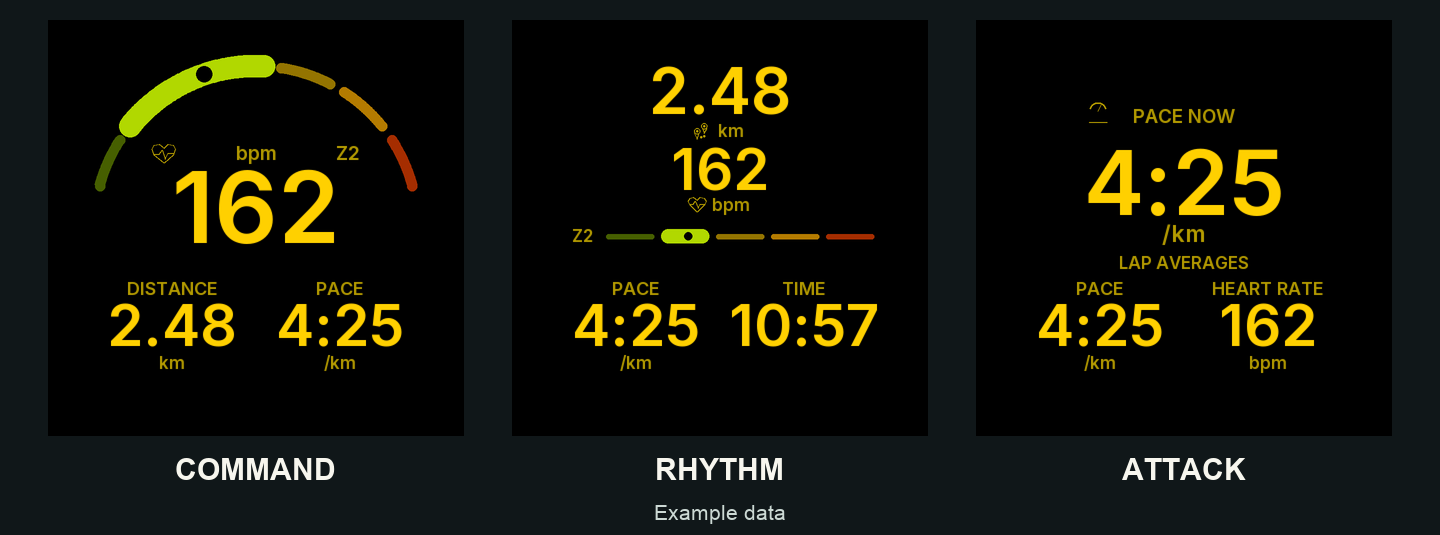
The three fields have 10 configurable positions in total, and each position offers the same 17 choices, including Off.
- Effort: current heart rate, lap-average heart rate, activity-average heart rate and current power.
- Pace and speed: current pace, pace averaged over three samples, lap-average pace, activity-average pace and current speed.
- Distance and time: distance, run timer and lap timer.
- Other readings: altitude, total ascent, calories and watch battery, while Off hides the position.
The display can follow the watch’s settings or use English or Polish and metric or imperial units. A reading appears only when the watch provides the data it needs.
Worked example: a 5:00/km interval
A runner is aiming for 5:00/km in a one-kilometre rep. Halfway through the lap, ATTACK shows a current pace of 4:45/km and a lap average of 5:02/km. The first number says the runner is moving 15 seconds per kilometre faster than target at that moment. The second says the lap so far is only two seconds per kilometre slower than target.
There is no reason to brake on one glance. The runner can hold a steady effort and check again a few seconds later. If current pace stays fast and the lap average starts moving clearly ahead of target, easing off makes more sense. The lap average starts again when the next lap begins, so its first few readings are based on very little distance.
Garmin calls its own built-in average for the lap in progress Lap Pace, and Last Lap Pace refers to the previous lap, as set out in Garmin’s pace-field definitions.
How to set it up on a Garmin
- Install: download COMMAND, RHYTHM or ATTACK from the Connect IQ Store and sync the field to a compatible watch.
- Add a data screen: open the Run activity settings, go to Data Screens and add a page with a one-field layout. Select the field, open Connect IQ and choose the ORBIT field. Menu names vary by watch.
- Choose the readings: in the Connect IQ phone app, open the field’s settings, assign the readings and save before starting the activity.
For kilometre splits, set Auto Lap to 1 km. For reps with their own boundaries, press the lap button as each rep starts, if the activity allows it. The field appears only inside the activity, and the normal watch face returns when the session ends. Garmin explains data-screen setup in its manual, and ORBIT has its own running guide.
Price and compatible watches
RHYTHM is free, and COMMAND and ATTACK each cost $1.99 as a one-time purchase, with the local price shown in the store. All three fields list the same compatible Garmin models:
- Forerunner and Venu: Forerunner 265S and Venu 3S.
- epix: epix (Gen 2) and epix Pro (Gen 2) in 42mm, 47mm and 51mm.
- Others: quatix 7 Sapphire, quatix 7 Pro, D2 Mach 1 Pro and tactix 7 AMOLED Edition.
The Connect IQ listing for each field confirms the exact watches.
How ORBIT decides what to build
A Garmin owner once asked Aleksander for a deer in Dzika Grań, ORBIT’s mountain-wildlife watch face, and the deer became another scene in that face. The same owner’s suggestions of a phoenix and a dragon became MYTHIC, a separate collection of fantasy illustrations. The running fields grew from a similar question about what a runner needs at a glance, which is why each screen starts with the reading that matters most for that session. The most popular Connect IQ apps are tracked every month in the Connect IQ charts.
More information: ORBIT RUN CONTROL.
Author: Michał Aleksander, designer and developer of ORBIT, edited by the5krunner.
Quick answers
Why does the ORBIT field show just one large number?
Garmin gives a Connect IQ data field less space on a page with several fields, so the ORBIT field shows a simplified main reading. Adding it as the only field on a data page shows the full layout.
Why does ATTACK show dashes for lap averages?
If ATTACK starts collecting data partway through a lap, it waits for the next lap before showing its own averages. Dashes can also mean a reading is missing or out of date, and an asterisk next to lap-average heart rate marks gaps in the heart rate samples.
Where do COMMAND's heart rate zones come from?
COMMAND uses the zones saved for running on the Garmin, which can be checked or changed in the watch’s heart rate settings. For the zone arc to show, the main reading must be set to current heart rate and the zone gauge switched on.
If you enjoyed reading this, here is another in the Indie Spotlight series: Indie App Spotlight: Buena Vida sets your calories from tomorrow’s run.
Last Updated on 28 November 2026 by tfk the5krunner
2026 Seasonal Gifts
- Garmin CIRQA: Garmin’s screenless band, which uses your phone as the display. I tested it and sometimes use it as a backup on the site.
- HoloSwim 3 Pro: Swim goggles with GPS and your pace in the lens, so you can swim without a watch. Code THE5KRUNNER takes 10% off. I tested them.
- Kineon MOVE+: Red and infrared light for sore knees, Achilles and other joints after hard training. I use it.
- Fitbit Air: A screenless band for steps, sleep and heart rate, with no subscription needed. It was closest to a manual 9,000-step test. I use it as a backup sometimes.
Small things I always use
- Garmin 90-degree charging adapter: Charges your Garmin with any USB-C cable. Essential when travelling. I use one.
- Body Glide: The blue anti-chafing stick swimmers and runners carry. I use it.
- Speedo earplugs: Fewer ear infections and no cold-water dizziness. I use them.
- Dryrobe Advance: My winter changing robe for open-water swims. I use one. A cheaper option is the AONYIYI changing robe.
- Maurten: Race fuel that stays easy on the stomach. I use them.
- Beet It Sport nitrate shots: Beetroot shots I take in the days before a race. I use them.
- Garmin charging puck: The quickest way to top up before a session. I use one.
- Injinji: Toe socks that stop rubbing, so you run more. I use them.
- Ultimate toe protectors: Stop black toenails on long runs. They work. I use them.
- Compressport R2 v2 calf sleeves: My calf sleeves of choice. I use them.
- Cellucor C4: My pre-workout before hard sessions.
- TPU tubes: Schwalbe Aerothan, Tubolito and Pirelli SmarTube. Light, tiny spares. I use all three.
- G8 insoles: Adjustable arches, perfect position. I use them.
- Cycplus Cube: A 97g electric pump that gets a road tyre rideable in two minutes. I carry one. 5% off with code THE5KRUNNER.
Health, recovery and sleep
- FreeStyle Libre 3 Plus: Shows how my blood sugar responds to diet. Occasional use.
- hDrop: Measures my sweat loss in summer and indoors. I use it.
- Fourth Frontier Zone: Checks my heart under load in hard sessions.
- Oura Ring 5: My partner’s recovery tracker of choice.
- Eight Sleep: A cooling mattress cover my partner and I use nightly (see next).
- Chilipad 2.0: Cools or heats your side of the bed on a schedule, with no subscription. US only. I am testing it; it seems pretty good.
Watches and sensors
- Polar H10: My daily driver for waking HRV.
- Polar Verity Sense: My backup arm-worn HR sensor.
- Nomad bedside charger: Charges my iPhone and Apple Watch overnight. I use it, and many of their bands.
- Train.Red: The best muscle oxygen sensor I’ve used. Occasional use.
- Tymewear: Accurate heart rate and reliable ventilatory zones. I use it to pace endurance rides over an hour.
- Garmin Forerunner 970: A pro-grade triathlon watch. I use this.
- Apple Watch Ultra 4: My daily smartwatch. No phone needed on rides.
On the bike
- Continental GP5000 for everyday riding, and Aero 111 on the front for special occasions. I use both.
- Helmets: Specialized S-Works Evade 3 for road riding, and Rudy Project Wing for TT-style races. I use both.
- Ravemen FR300: A front light that mounts under your Garmin or Wahoo. I use one.
- Ravemen FR1000: The light and the computer mount in one unit, so nothing else goes on the bars. Better than mine.
- Ravemen FR1500SE: 1,500 lumens hanging under your Garmin, for proper night rides.
- Ravemen FR1100SE: 1,100 lumens under your Garmin, and up to 46 hours on slow flash.
- Ravemen FR500: A brighter FR300 with the same mount.
- Wahoo TRACKR Radar: I use it on one bike and Varia on the other. They perform the same.
- Garmin Varia RTL515: Radar that warns you of cars from behind. I use this model.
- Wahoo ELEMNT Roam 3: The bike computer that’s easy to use. I use mine on most rides.
- Favero Assioma Pro RS2: Accurate power pedals that swap easily between bikes. I use this model.
Home and indoor training
- NPE Runn: Makes my basic treadmill smart, sending more accurate speed and distance to my watch and Zwift. I use it.
- Google Wifi: Keeps Zwift connected in my pain cave. I use it.
- Apple TV 4K (4th generation): Zwift on the big screen. I use two.
- Google Nest Doorbell (wired, 2nd gen): My video doorbell, running in both Google Home and Apple Home via Starling. I use it.
Reader-Powered Content

This content is not sponsored. It’s mostly me behind the labour of love, which is this site, and I appreciate everyone who supports it.
Support the site: Follow (free, fewer ads) · Subscribe (paid, ad-free) · Buy Me A Coffee
Written by real people, with AI assistance. Fact-checked and verified for originality. See the Editorial Policy. FTC: Affiliate Disclosure — some links pay commission. As an Amazon Associate, I earn from qualifying purchases.
tfk is the founder and author of the5krunner, an independent endurance sports technology publication. With 20 years of hands-on testing of GPS watches and wearables, and competing in triathlons at an international age-group level, tfk provides in-depth expert analysis of fitness technology for serious athletes and endurance sport competitors. See the gear tfk uses. ID
