Turn alerts come from the course file, so a poor file gives poor directions
Races, unfamiliar trails and long rides planned in advance
Most watches hold 50 course points, turns included, so long routes get trimmed
Quick answers
Does a Garmin watch give turn-by-turn directions on a course?
Yes. Garmin Connect generates a point for every turn on the route, and each one triggers an alert as the athlete approaches. Watches with maps show the turn on the map, while watches without maps show the route as a line.
How many course points can a Garmin hold?
Edge bike computers typically hold 200 course points and most watches hold 50. The limit counts every turn generated for the route, as well as points added by hand, so a long, winding course can exceed it, and the device will drop the least important points.
Can I follow a Garmin course in reverse?
Yes. Current watches offer Do Course in Reverse alongside Do Course when a saved course is selected, so an out-and-back route needs only one file.
Why does my Garmin course have no turn alerts?
Turn alerts depend on the course file, and routes imported from some planning apps arrive on the watch without them. Rebuilding the route in Garmin Connect generates the turn points afresh.
Course following – a deep dive
When course following is actually useful
Bike navigation is subtly different from car navigation, despite the obvious similarity of getting from A to B. Routes can be much twistier, more convoluted, and less marked than car routes. It’s far easier to make a wrong turn or miss a turn, but because speeds are lower, it’s usually easier to quickly rectify mistakes. The reality is that certain cycling routes would be impossible without it. In years gone by, I have tried to follow fairly complex routes with breadcrumb navigation, which is following a line without the context of a map – that was very difficult, but the current generation of navigation tech from many brands helps the explorer do their job with relative ease.
Introduction
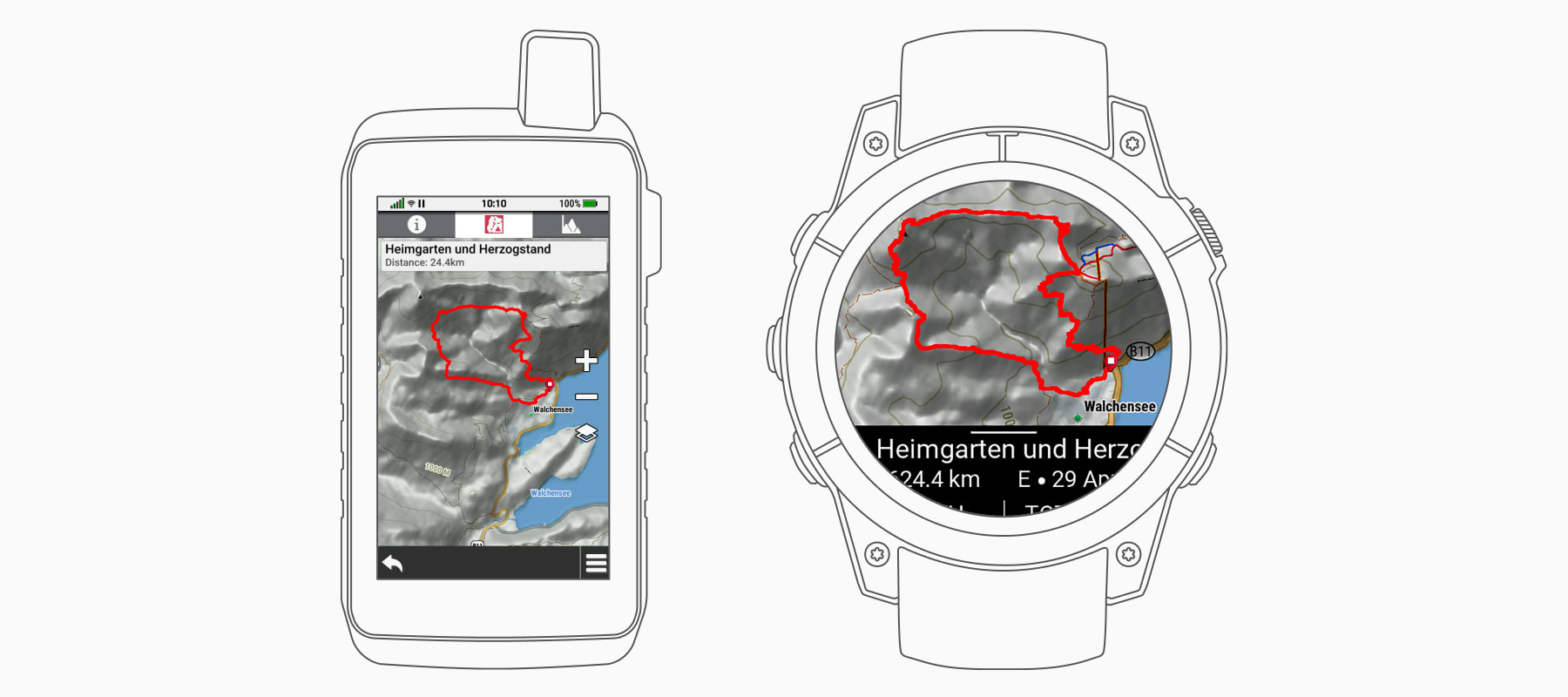
Garmin course following, which most athletes search for as turn-by-turn navigation, is how a Garmin watch or Edge guides an athlete along a route planned in advance. Garmin calls the planned route a course and starts it with the Do Course command. Garmin’s support page describes what happens on the way: when the athlete follows the course, its points “appear on the map and trigger a notification as you approach, much like a turn-by-turn direction.”
Several other Garmin features need a course before they work: PacePro builds a pace plan around its hills, ClimbPro splits its climbs, and Course Planner adds rest breaks and cutoff times at course points on recent watches. The limitation is size, because every device has a cap on the number of points a course can carry.
What course following shows
A course appears on the watch as a line on the map, or as a line on a plain screen for watches without maps, along with an elevation plot and a list of course points. Course points come in two kinds. Garmin Connect generates one for every turn, and the athlete can add their own in the categories General, Aid Station, Cycling, Personal, Landmarks and Hazard. Each one triggers an alert on approach, so a hazard on a bike path or an aid station in a race gets the same warning as a turn. If the athlete leaves the line, the device shows an off-course warning.
How Garmin course following works
Garmin states the steps rather than the method. A course is built in Garmin Connect or on the watch itself, reaches the device on the next sync and is started from Navigate, then Courses. The most plausible way the device tracks progress is by comparing its GPS position with the course line and the next course point, and triggering the alert when the distance falls below a set value. Garmin does not publish that distance, or the distance that counts as straying off the course.
What affects course following
The course file decides most of the experience. Garmin’s limit on course points includes every generated turn, so a long route through a town can carry hundreds of turns and exceed the cap; Garmin then cuts the point count and shows a “Course Point Max Exceeded” message. Routes built in other planning apps can arrive without turn cues, a fault reported in the5krunner’s Fix Files. Garmin advises splitting very long routes into two or more courses and being sparing with custom points.
The GPS fix sets the rest, because the watch’s GPS accuracy decides how closely the position on screen follows the course line.
How accurate is Garmin course following
Garmin publishes no accuracy figure for course following, and no single figure would fit: directions depend on the course file, and position depends on the watch’s GPS, as described above.
Competitor equivalents
- Polar has Route Guidance, which follows routes recorded in earlier sessions or imported into Polar Flow from Komoot, Strava or a GPX or TCX file.
- COROS offers turn-by-turn guidance on routes built in its app, with a Deviate Alert after 20 m off route for ten seconds and waypoint alerts along the way.
- Suunto navigates routes during an exercise and adds Snap to route, which uses GPS only to place the athlete on a predefined route.
- Apple added custom routes and turn-by-turn directions on trails with watchOS 11.
Which Garmin devices support course following
Course following dates back at least to the Forerunner 205 and 305, launched in January 2006, whose owner’s manual already used the Do Course command and warned the athlete when they left the course. Today the rule is that Garmin GPS watches and Edge bike computers can follow a course, with maps, turn alerts and course points varying by model. Course Planner, which adds rest breaks and cutoff times, is limited to recent watches: D2 Mach 2, Enduro 3 and 4, Fenix 8, Fenix 9 and Fenix E, Forerunner 570 and 970, MARQ (Gen 3), Quatix 8, Tactix 8, Venu 4 and Venu X1.
Where to find course following on Garmin
- On the watch: select a GPS activity, then Navigate > Courses, choose the course and select Do Course or Do Course in Reverse.
- Course options: the same menu offers Map, Elevation Plot, View Course Points and PacePro before the start.
- Garmin Connect: create the course, add course points and set Course Planner breaks or cutoffs, then sync it to the device.
- On the watch itself: Create a Course or Round-Trip Course, which offers up to three loops of a chosen distance and direction.
Common problems and misreadings
A “Course Point Max Exceeded” message means the route has more turns and custom points than the device holds. See Quick answers above for the limits and how the device trims them.
Missing turn alerts come from the course file rather than the watch, so the fix is to rebuild the route in Garmin Connect, which generates a point for every turn.
How to improve course following
Course following is not a trainable metric. Better guidance on long routes comes from fewer custom points and from splitting the event into more than one course.
How course following connects to other Garmin features
A course is the starting point for PacePro pacing and ClimbPro climb data, and its line can appear on the LiveTrack page so followers can see the route ahead. Without a course, Back to Start leads the athlete home along the track already recorded. On a race course, crowd-weaving adds distance that the course does not include, and AutoLap by Timing Gate on the Forerunner 970 deals with that by splitting laps at the course’s own mile or kilometre markers. Riders who plan routes in Ride with GPS can read the Ride with GPS hub, and cyclists choosing a navigation device can start at the bike computers hub. The other navigation features are listed on the Garmin navigation page, and Garmin’s own guide to course points is on its course points support page.
Small things I always use
- Garmin 90-degree charging adapter: Charges your Garmin with any USB-C cable. Essential when travelling. I use one.
- Body Glide: The blue anti-chafing stick swimmers and runners carry. I use it.
- Speedo earplugs: Fewer ear infections and no cold-water dizziness. I use them.
- Dryrobe Advance: My winter changing robe for open-water swims. I use one. A cheaper option is the AONYIYI changing robe.
- Maurten: Race fuel that stays easy on the stomach. I use them.
- Beet It Sport nitrate shots: Beetroot shots I take in the days before a race. I use them.
- Garmin charging puck: The quickest way to top up before a session. I use one.
- Injinji: Toe socks that stop rubbing, so you run more. I use them.
- Ultimate toe protectors: Stop black toenails on long runs. They work. I use them.
- Compressport R2 v2 calf sleeves: My calf sleeves of choice. I use them.
- Cellucor C4: My pre-workout before hard sessions.
- TPU tubes: Schwalbe Aerothan, Tubolito and Pirelli SmarTube. Light, tiny spares. I use all three.
- G8 insoles: Adjustable arches, perfect position. I use them.
- Cycplus Cube: A 97g electric pump that gets a road tyre rideable in two minutes. I carry one. 5% off with code THE5KRUNNER.
Health, recovery and sleep
- Kineon MOVE+: Red and infrared light for sore knees, Achilles and other joints after hard training. I use it.
- FreeStyle Libre 3 Plus: Shows how my blood sugar responds to diet. Occasional use.
- hDrop: Measures my sweat loss in summer and indoors. I use it.
- Fourth Frontier Zone: Checks my heart under load in hard sessions.
- Oura Ring 5: My partner’s recovery tracker of choice.
- Eight Sleep: A cooling mattress cover my partner and I use nightly.
Watches and sensors
- Polar H10: My daily driver for waking HRV.
- Polar Verity Sense: My backup arm-worn HR sensor.
- Nomad bedside charger: Charges my iPhone and Apple Watch overnight. I use it, and many of their bands.
- Train.Red: The best muscle oxygen sensor I’ve used. Occasional use.
- Tymewear: Accurate heart rate and reliable ventilatory zones. I use it to pace endurance rides over an hour.
- Garmin Forerunner 970: A pro-grade triathlon watch. I use this.
- Apple Watch Ultra 4: My daily smartwatch. No phone needed on rides.
On the bike
- Continental GP5000 for everyday riding, and Aero 111 on the front for special occasions. I use both.
- Helmets: Specialized S-Works Evade 3 for road riding, and Rudy Project Wing for TT-style races. I use both.
- Ravemen FR300: A front light that mounts under your Garmin or Wahoo. I use one.
- Ravemen FR1000: The light and the computer mount in one unit, so nothing else goes on the bars. Better than mine.
- Ravemen FR1500SE: 1,500 lumens hanging under your Garmin, for proper night rides.
- Ravemen FR1100SE: 1,100 lumens under your Garmin, and up to 46 hours on slow flash.
- Ravemen FR500: A brighter FR300 with the same mount.
- Wahoo TRACKR Radar: I use it on one bike and Varia on the other. They perform the same.
- Garmin Varia RTL515: Radar that warns you of cars from behind. I use this model.
- Wahoo ELEMNT Roam 3: The bike computer that’s easy to use. I use mine on most rides.
- Favero Assioma Pro RS2: Accurate power pedals that swap easily between bikes. I use this model.
Home and indoor training
- NPE Runn: Makes my basic treadmill smart, sending more accurate speed and distance to my watch and Zwift. I use it.
- Google Wifi: Keeps Zwift connected in my pain cave. I use it.
- Apple TV 4K: Zwift on the big screen. I use two.
- Google Nest Doorbell (wired, 2nd gen): My video doorbell, running in both Google Home and Apple Home via Starling. I use it.
Reader-Powered Content

This content is not sponsored. It’s mostly me behind the labour of love, which is this site, and I appreciate everyone who supports it.
Support the site: Follow (free, fewer ads) · Subscribe (paid, ad-free) · Buy Me A Coffee
Written by real people, with AI assistance. Fact-checked and verified for originality. See the Editorial Policy. FTC: Affiliate Disclosure — some links pay commission. As an Amazon Associate, I earn from qualifying purchases.
