Untested, and built on sleep tracking that is itself only moderately accurate
Getting to bed earlier after hard training or a run of short nights
Garmin does not publish how much each factor moves the target
Plain English: Sleep coach tells an athlete how much sleep to aim for tonight, shown as hours and minutes. It starts from a typical figure for the athlete’s age or body clock, then adds time after hard training or short nights and takes time off after naps or good sleep. A higher target means the body has more to recover from.
In practice: It is great to have a sleep target, but controlling how much sleep you get can be extremely difficult, making this a hard recommendation for some to follow. However, if it encourages you to go to bed slightly earlier than normal, or to set your alarm a little later, and you achieve the total sleep time, then it is useful for you.
Quick answers
How does Garmin sleep coach work?
Garmin starts from a baseline set by age, or by sleep alignment on newer watches, then adjusts it for training load, HRV status, recent sleep and naps. The result is a sleep need for the coming night, shown in 10-minute steps.
What is the maximum sleep need on Garmin?
Garmin’s technology page says sleep coach will never suggest less than 6.5 hours or more than 9.5 hours in a single night. Earlier Garmin material gave a range of 7 to 9 hours.
Why is my Garmin sleep need so high?
A hard workout, a high training load, recent short nights or a low HRV status all raise the target. One good night will not fully cancel several bad ones, because Garmin also counts the three nights before last night.
Does a nap reduce my Garmin sleep need?
Yes. Garmin says napping can reduce nightly sleep need and will never increase it; a longer nap reduces it more.
Sleep Coach – a deep dive
When sleep coach is actually useful
A lot of nonsense is written about sleep; many brands misrepresent the science simply to invent yet another metric, or pretend to quantify things that can’t be accurately measured, like sleep stages. As it happens, your total sleep time, including naps, is probably one of the simplest things to measure and control that has a real impact. Good sleep hygiene, such as sleeping in a cool, dark room on a regular schedule, helps too.
Introduction
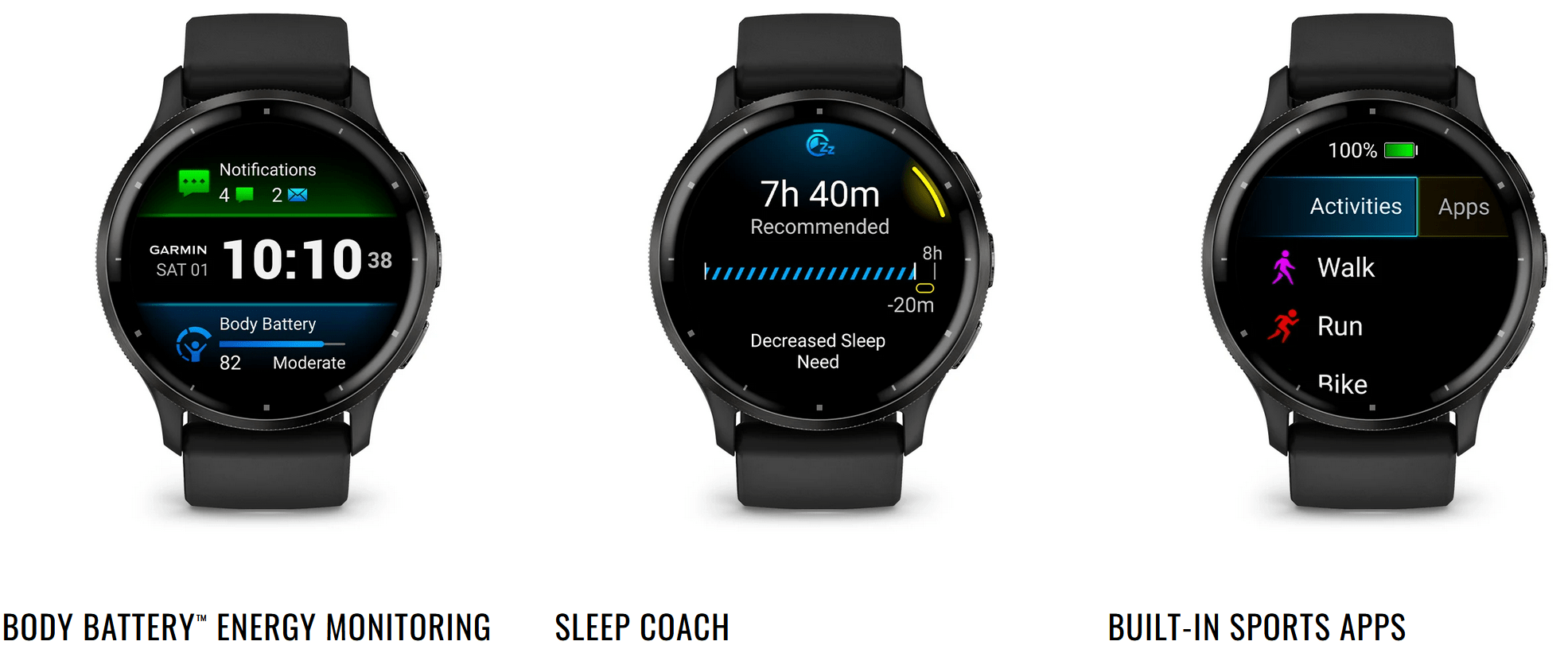
Garmin Sleep Coach “recommends the amount of sleep your body needs for the upcoming night based on your current state of activity, stress, recovery, and previous sleep patterns,” in Garmin’s words. Its output is sleep need, a target for the coming night, which is why the terms sleep coach, sleep coaching and sleep need all describe the same feature.
Sleep coach sits inside Garmin’s sleep tracking, alongside sleep score and sleep stages. Garmin launched it on the Venu 3 in August 2023 as “personalised sleep coaching”, and added it to the Forerunner 965 and 955 in the 18.12 beta software in January 2024. Garmin explains the factors but not how much each one moves the target, and no study has tested the recommendation.
What sleep coach actually means
A higher sleep need means the body has more to recover from, through training, short recent nights or a low HRV status. A lower one means recent sleep and activity have left less to make up. Garmin’s technology page says sleep coach “will never suggest less than 6.5 hours or more than 9.5 hours of sleep in a single night.” Garmin’s 2025 blog and DC Rainmaker’s 2023 Venu 3 review both gave a narrower 7-to-9-hour range, so the range has widened since launch.
On older watches, the starting point depends on age. “The baseline sleep recommendation for adults under the age of 35 is 8 hours,” falling gradually so that adults over 65 start from 7.5 hours. DC Rainmaker reported that Garmin told him the starting figure for 35- to 49-year-olds is 7 hours 50 minutes.
How Garmin calculates sleep need
Garmin states the factors. The support page says the need “is first determined by your age-based baseline” and then adjusted for training load, HRV status, sleep history and naps, and is shown in 10-minute steps. The technology page names six factors: “your age, your body’s internal rhythm, daily and longer-term activity levels, recent sleep history, naps taken and heart rate variability (HRV).”
Newer watches replace the age baseline with sleep alignment, “an estimate of your body’s internal rhythm based on sleep history and body temperature data,” which needs 3 weeks of recorded sleep before it appears. The first estimate is made when the athlete wakes and is then adjusted through the day for activity and naps. How much each factor adds or removes is unknown.
What affects the sleep need reading
Training has the largest daily effect. Garmin says “A hard workout can significantly increase your sleep need for the night,” while a light day may slightly reduce it, and longer-term patterns over the past few weeks also count. Activities recorded on the watch are counted fully; daytime activity minutes are counted too.
Sleep history works in both directions. Short nights create a sleep debt that raises the target, and an especially good night banks sleep that lowers it. Last night counts most, but Garmin also uses the three previous nights, so “one good night will not fully erase the effects of several bad nights in a row.” Naps only ever lower the target, by more for a longer nap.
How accurate is Garmin sleep coach
No study has tested Garmin’s sleep need recommendation. The inputs carry their own error: Schyvens and colleagues (JMIR mHealth and uHealth, 2024, PMID 38557808) reviewed a Garmin vívosmart 4, a Fitbit, and WHOOP against laboratory sleep studies and rated their total sleep time and sleep-stage accuracy as moderate. Sleep coach builds on that sleep data, so a night the watch misreads feeds straight into the next target.
The age baselines follow published guidance rather than a Garmin finding. The American Academy of Sleep Medicine and Sleep Research Society recommend 7 or more hours a night for adults (Watson and colleagues, Sleep, 2015, PMID 26039963), and Garmin’s 6.5- to 9.5-hour limits bracket that figure. the5krunner’s own sleep coach explainer was sceptical: “It’s not magic sauce. It’s smoke and mirrors.”
Competitor equivalents
- WHOOP’s Sleep Need is the closest match, built from a baseline adjusted for strain, sleep debt and naps.
- Oura calculates a sleep need from the past 90 days within its Sleep Debt feature, and its Bedtime Guidance suggests when to sleep rather than how long.
- Polar SleepWise rates alertness and a sleep gate around a sleep time the athlete sets, without a personal sleep need.
- Apple Watch has no equivalent; the sleep goal is set by the wearer.
- COROS has no equivalent and refers to a general 7 to 9 hours.
- Suunto has no equivalent; the sleep target is set by the wearer.
Which Garmin devices support sleep coach
Garmin’s support page lists the watches with Sleep Coach. In November 2026, they include the Forerunner 70, 165, 170, 255, 265, 570, 955, 965 and 970, Fenix 7, 8, 9 and E, Enduro 2, 3 and 4, Epix (Gen 2), Venu 3, Venu 4 and Venu X1, Instinct 3, MARQ (Gen 2), and the Index Sleep Monitor. It is not on the Venu 2, Fenix 6, Forerunner 945 or 745, or Instinct 2. Sleep alignment, which replaces the age baseline, is limited to watches from 2024 onwards, such as the Fenix 8, Forerunner 570 and 970, Enduro 3 and 4, Venu 4 and Venu X1. The feature launched on the Venu 3 in August 2023.
Where to find sleep coach on Garmin
- Watch: the sleep coach glance, with tonight’s sleep need.
- Garmin Connect app: the Sleep Coach section, which also holds sleep alignment on newer watches.
Common problems and misreadings
A high target after a hard day is the feature working, not a fault. See Quick answers above.
Editing sleep in Garmin Connect may not change the target. Garmin says “Editing sleep times older than 24 hours will update your sleep score but will not update sleep coach recommendations.”
The 9.5-hour cap is a ceiling on the recommendation, not a judgment that more sleep is harmful. Garmin says Sleep Coach “will not encourage you to sleep more than 9.5 hours, even when your workout habits are extreme,” and suggests naps for athletes who need more.
How to improve sleep coach
Sleep need is a recommendation, not a score to raise, so improving it means meeting it. The figure falls when sleep history is good and debt is cleared, and Garmin’s factors point to steady bedtimes, a nap after a short night, and extra sleep in the days after hard training.
Scientific basis
Watson NF and colleagues. Sleep, 2015. PMID 26039963. The joint American Academy of Sleep Medicine and Sleep Research Society consensus that adults need 7 or more hours of sleep a night, the range Garmin’s baselines follow.
Mah CD, Mah KE, Kezirian EJ, Dement WC. Sleep, 2011. PMID 21731144. Extending sleep improved athletic performance in collegiate basketball players, the clearest athletic case for sleep need.
How sleep coach connects to other Garmin features
Sleep coach reads HRV status and training load, and the sleep it recommends feeds Body Battery recharge and training readiness. Its sleep history comes from the same tracking as sleep score and sleep stages.
Small things I always use
- Garmin 90-degree charging adapter: Charges your Garmin with any USB-C cable. Essential when travelling. I use one.
- Body Glide: The blue anti-chafing stick swimmers and runners carry. I use it.
- Speedo earplugs: Fewer ear infections and no cold-water dizziness. I use them.
- Dryrobe Advance: My winter changing robe for open-water swims. I use one. A cheaper option is the AONYIYI changing robe.
- Maurten: Race fuel that stays easy on the stomach. I use them.
- Beet It Sport nitrate shots: Beetroot shots I take in the days before a race. I use them.
- Garmin charging puck: The quickest way to top up before a session. I use one.
- Injinji: Toe socks that stop rubbing, so you run more. I use them.
- Ultimate toe protectors: Stop black toenails on long runs. They work. I use them.
- Compressport R2 v2 calf sleeves: My calf sleeves of choice. I use them.
- Cellucor C4: My pre-workout before hard sessions.
- TPU tubes: Schwalbe Aerothan, Tubolito and Pirelli SmarTube. Light, tiny spares. I use all three.
- G8 insoles: Adjustable arches, perfect position. I use them.
- Cycplus Cube: A 97g electric pump that gets a road tyre rideable in two minutes. I carry one. 5% off with code THE5KRUNNER.
Health, recovery and sleep
- Kineon MOVE+: Red and infrared light for sore knees, Achilles and other joints after hard training. I use it.
- FreeStyle Libre 3 Plus: Shows how my blood sugar responds to diet. Occasional use.
- hDrop: Measures my sweat loss in summer and indoors. I use it.
- Fourth Frontier Zone: Checks my heart under load in hard sessions.
- Oura Ring 5: My partner’s recovery tracker of choice.
- Eight Sleep: A cooling mattress cover my partner and I use nightly.
Watches and sensors
- Polar H10: My daily driver for waking HRV.
- Polar Verity Sense: My backup arm-worn HR sensor.
- Nomad bedside charger: Charges my iPhone and Apple Watch overnight. I use it, and many of their bands.
- Train.Red: The best muscle oxygen sensor I’ve used. Occasional use.
- Tymewear: Accurate heart rate and reliable ventilatory zones. I use it to pace endurance rides over an hour.
- Garmin Forerunner 970: A pro-grade triathlon watch. I use this.
- Apple Watch Ultra 4: My daily smartwatch. No phone needed on rides.
On the bike
- Continental GP5000 for everyday riding, and Aero 111 on the front for special occasions. I use both.
- Helmets: Specialized S-Works Evade 3 for road riding, and Rudy Project Wing for TT-style races. I use both.
- Ravemen FR300: A front light that mounts under your Garmin or Wahoo. I use one.
- Ravemen FR1000: The light and the computer mount in one unit, so nothing else goes on the bars. Better than mine.
- Ravemen FR1500SE: 1,500 lumens hanging under your Garmin, for proper night rides.
- Ravemen FR1100SE: 1,100 lumens under your Garmin, and up to 46 hours on slow flash.
- Ravemen FR500: A brighter FR300 with the same mount.
- Wahoo TRACKR Radar: I use it on one bike and Varia on the other. They perform the same.
- Garmin Varia RTL515: Radar that warns you of cars from behind. I use this model.
- Wahoo ELEMNT Roam 3: The bike computer that’s easy to use. I use mine on most rides.
- Favero Assioma Pro RS2: Accurate power pedals that swap easily between bikes. I use this model.
Home and indoor training
- NPE Runn: Makes my basic treadmill smart, sending more accurate speed and distance to my watch and Zwift. I use it.
- Google Wifi: Keeps Zwift connected in my pain cave. I use it.
- Apple TV 4K: Zwift on the big screen. I use two.
- Google Nest Doorbell (wired, 2nd gen): My video doorbell, running in both Google Home and Apple Home via Starling. I use it.
Reader-Powered Content

This content is not sponsored. It’s mostly me behind the labour of love, which is this site, and I appreciate everyone who supports it.
Support the site: Follow (free, fewer ads) · Subscribe (paid, ad-free) · Buy Me A Coffee
Written by real people, with AI assistance. Fact-checked and verified for originality. See the Editorial Policy. FTC: Affiliate Disclosure — some links pay commission. As an Amazon Associate, I earn from qualifying purchases.
