| Manufacturer | Google (Fitbit) |
|---|---|
| Type | Smartwatch |
| Series | Sense |
| Released | September 2022 |
| Price at launch | £219.99 / $299.95 |
| Predecessor | Fitbit Sense |
| Successor | None confirmed |
| Band size | Small (130mm to 180mm) and large (165mm to 220mm), both included in the box |
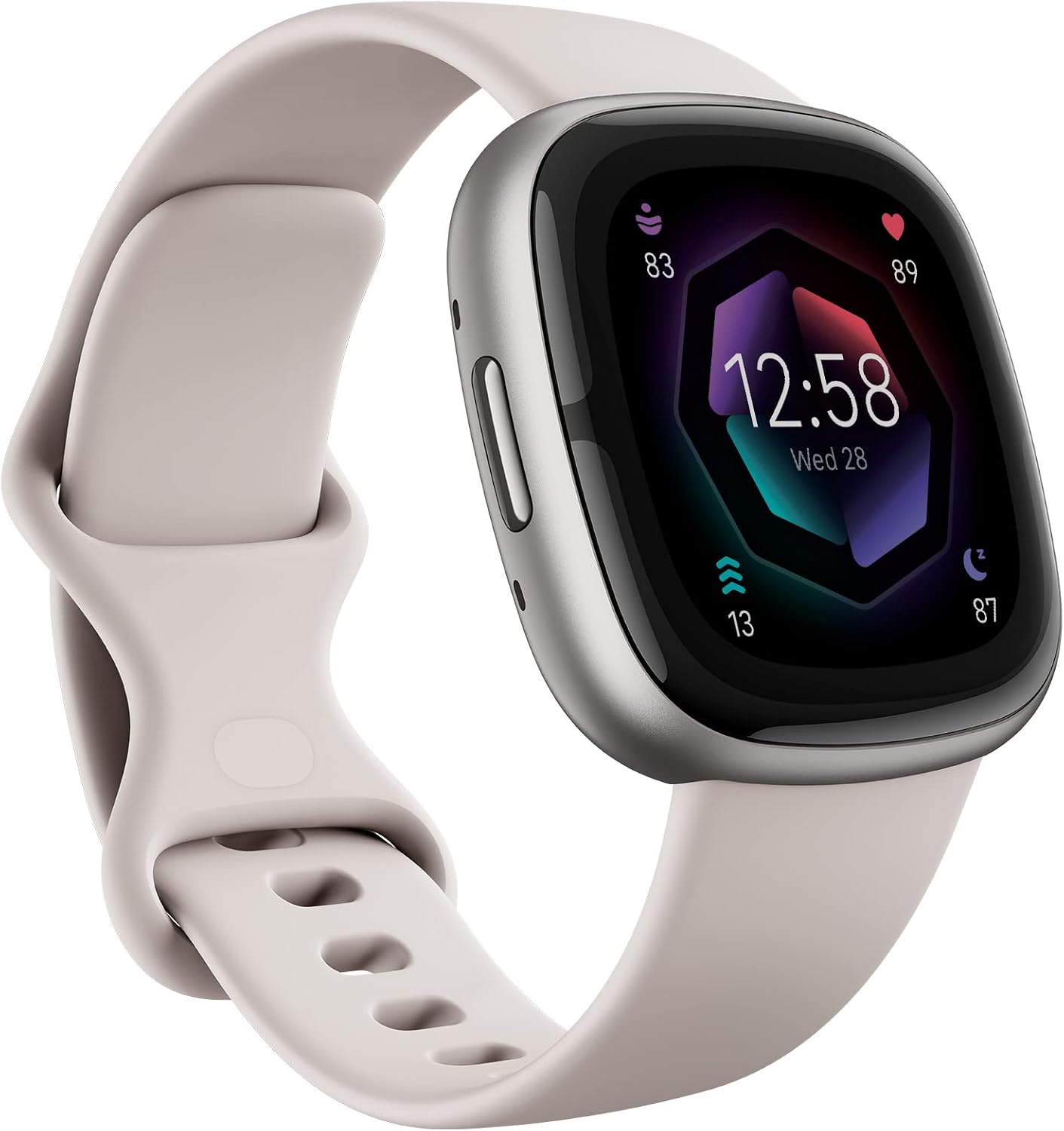
| Colours | Shadow Grey/Graphite Aluminium, Lunar White/Platinum Aluminium, Blue Mist/Soft Gold Aluminium |
Specifications and features as at launch.
Expert opinion | What’s new versus Fitbit Sense | Specifications | Battery life | Features | Sensors and health features | Further reading
Expert opinion
The Fitbit Sense 2 positions itself as Fitbit’s ultimate health and wellness tracker. It excels at holistic body monitoring with its continuous electrodermal activity (cEDA) sensor for real-time stress tracking, an integrated ECG app, skin temperature tracking, and detailed sleep analysis, alongside a lightweight design with an updated tactile physical button and up to six days of battery life.
Google significantly downgraded its utility as a true smartwatch by stripping out third-party app support, Wi-Fi connectivity, and all music controls or offline storage, while basic Google utilities like Maps and Wallet were added strictly as bare-bones utilities. Its workout performance is held back by slow built-in GPS lock times, unreliable optical heart rate accuracy during dynamic exercise, a lack of external sensor support, and a paywall that locks long-term health trends behind a Fitbit Premium subscription. The Sense 2 is a highly capable lifestyle and stress-management wearable for casual users, but tech-focused buyers wanting a full smartwatch experience or serious athletes needing robust training analysis are much better served by alternatives from Apple, Samsung or Garmin.

What’s new versus Fitbit Sense
Hardware
- A physical side button replaces the original Sense’s capacitive touch strip, which was prone to missed and phantom presses.
- The case is slimmer and roughly 15% lighter than the original Sense, with narrower bezels around the same 1.58in display.
Software
- A continuous EDA (cEDA) sensor replaces the original Sense’s manual EDA Scan app, which required placing a palm over the screen for around two minutes to take a single stress reading. The Sense 2 measures body response passively throughout the day.
- Google Assistant is removed. The Sense 2 supports Amazon Alexa only, where the original Sense let the wearer choose between Alexa and Google Assistant.
- Music controls are removed entirely. The original Sense supported Spotify and Deezer playback controls; the Sense 2 has none.
- Google Wallet and Google Maps are built in, both absent from the original Sense.
- Workout modes expand to 40+ under the newer Fitbit OS, though this update did not extend back to the original Sense.
Specifications
| Display | |
|---|---|
| Type | AMOLED |
| Cover glass | Corning Gorilla Glass 3 |
| Physical | |
| Dimensions | 40.5mm (L) x 40.5mm (W) x 11.2mm (H) |
| Weight | 37.64g |
| Materials | Flexible band, aluminium case and buckle |
| Water resistance | 50 metres (5 ATM, ISO 22810:2010) |
| Sensors and positioning | |
| Positioning | Built-in GPS and GLONASS |
| Heart rate | Multi-path optical heart rate sensor |
| Motion | 3-axis accelerometer |
| Elevation | Altimeter |
| Blood oxygen | Red and infrared SpO2 sensors |
| Skin temperature | Device temperature sensor, variation shown in the Google Health app |
| Electrical | cEDA sensor for continuous stress tracking, plus ECG app and EDA app compatible electrodes |
| Other | Ambient light sensor, vibration motor |
| Connectivity, voice and storage | |
| Radio | Bluetooth 5.0, NFC |
| Wi-Fi | Present in hardware but deactivated; cannot be turned on |
| Voice and audio | Speaker (75dB SPL at 10cm), microphone, Amazon Alexa built in |
| Sync range | Up to 30ft (9m) |
| On-device storage | 7 days of minute-by-minute motion data |
| Operating temperature | -10°C to 45°C |
Battery life
| Mode | Battery life |
|---|---|
| Typical use | 6+ days |
| Continuous GPS | Up to 5 hours |
| Quick charge | 12 minutes for 1 day of use |
Battery life and charge cycles vary with use, settings and other factors. The always-on display, SpO2 tracking and the cEDA sensor all require more frequent charging.
Features
The Sense 2 pairs with the Google Health app, which replaced the Fitbit app, and requires a Google account.
- Stress Management Score draws on the cEDA sensor for all-day body response tracking, alongside heart rate and skin temperature.
- ECG app checks heart rhythm for signs of atrial fibrillation, available in select countries.
- Sleep Score rates the previous night’s sleep.
- 40+ exercise modes cover running, cycling, weights, yoga and more, with live stats on the wrist.
- Menstrual health tracking logs periods and symptoms in the Google Health app.
- Google Wallet enables contactless payments from the wrist.
- Amazon Alexa handles voice queries, alarms and weather checks through the built-in speaker and microphone.
- Choose from hundreds of clock face designs, with up to 5 favourites stored on the wrist.
- Three months of Google Health Premium are included at launch, unlocking AI-based coaching built with Gemini. It renews at £7.99 a month after the trial.
Sensors and health features
The cEDA, SpO2 and skin temperature sensors are not available in all countries and are not intended for medical diagnosis; Google positions them as wellbeing tools rather than clinical measurements. The ECG app and irregular heart rhythm notifications are restricted to select countries and are not intended for users under 22 or those with known arrhythmias, with heart rhythm data recorded only when the wearer is still or sleeping.
Advanced trend analytics for stress, sleep and SpO2 require a Google Health Premium subscription. The Sense 2 has no external sensor support, so heart rate accuracy during dynamic exercise depends entirely on the wrist-worn optical sensor.
