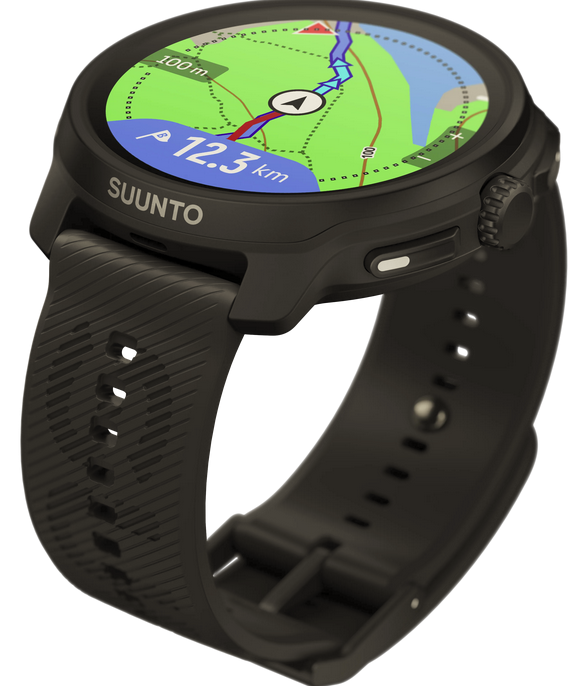
Full specifications, features and battery life for the Suunto Race 2, the brand’s flagship GPS multisport watch.
| Manufacturer | Suunto |
| Type | GPS multisport watch |
| Series | Race |
| Released | August 2025 |
| Price at launch | Steel: $499.99. Titanium: $599.99. |
| Predecessor | Suunto Race (2023) |
| Successor | — |
| Thickness | 12.5mm |
| Weight | 76g, steel case |
Specifications and features as at launch.

Expert opinion | What’s new | Specifications | Battery life | Features | Further reading
Expert opinion
Race 2 scored 81% on tfk’s standard 10-mile GPS accuracy test, against 92% for the Forerunner 970 and 87% for the original Race, a regression rather than an improvement. Performance was flat and uniform across easy and difficult sections alike, a pattern that points to firmware-level distance filtering rather than a chipset limitation, and matches reports on Suunto’s own community forum of a consistent 1 to 1.5% distance shortfall in the recorded FIT file versus raw GPS data. Heart rate accuracy against a Polar Verity Sense reference showed a consistent bias, including an 18.8bpm underreport on a steady-state run and a period of roughly 80bpm recorded during a ramp test where reference devices agreed on values 30 to 50bpm higher; the redesigned 6-LED sensor performs reasonably during sustained steady effort but underreports through transitions into harder effort. Automatic triathlon transitions record the whole activity as a single blended file with no segment breaks; manual transitions correctly produce five separate swim, T1, bike, T2 and run segments.
What’s new versus the original Race
Hardware
- Display grows from 1.43in to 1.5in, with peak brightness up from 1,000 to 2,000 nits
- New LTPO AMOLED panel, adding dynamic refresh rate, better power efficiency and an always-on display option
- Thinner, 12.5mm versus 13.3mm, and lighter, 76g versus 83g in steel
- Redesigned case: bezel ridges removed, flatter lugs, polymer lug construction combined with metal
- Redesigned optical heart rate sensor, 6 LEDs and 4 photodetectors
- New Ambiq Apollo510 processor, roughly twice the processing speed of the predecessor with more RAM
- Storage increased to 32GB on all models, intended for onboard maps
- Battery life claim rises from 50 to 55 hours on dual-frequency GPS
- USB-C charging, replacing the previous connector
Software
- Multiple sensors of the same type can now be saved, not just one
- Climb Guidance improved with waypoints and added route detail
- New watch face and a dynamic recovery widget
- Map downloads over WiFi, without needing to be on charge
- Passcode lock added
- Custom multisport profiles expanded: built in the app by combining multiple sports, transitions selectively enabled or disabled, and changes to a base sport profile propagate to linked multisport profiles
Specifications
| Display | |
|---|---|
| Type | LTPO AMOLED, dynamic refresh rate, always-on option |
| Size | 1.5in |
| Peak brightness | 2,000 nits |
| Physical | |
| Thickness | 12.5mm |
| Weight | 76g, steel case |
| Case | Durable plastic and metal, polymer lugs |
| Interface | Digital crown, plus physical buttons |
| Charging | USB-C |
| Sensors and positioning | |
| GNSS | Dual-frequency, Sony chipset |
| Optical heart rate | 6 LEDs, 4 photodetectors, redesigned from the original Race |
| ABC sensors | Altimeter, barometer, compass |
| Processor | Ambiq Apollo510 |
| Connectivity and battery | |
| Wireless | Bluetooth, with multiple sensors of the same type pairable simultaneously, and heart rate broadcast to external devices |
| Storage | 32GB |
| Maps | Onboard, downloadable over WiFi without a charger connection, with improved Climb Guidance |
| App ecosystem | SuuntoPlus |
| Battery, full GNSS recording | Up to 55 hours |
Battery life
Suunto claims up to 55 hours of continuous dual-frequency GPS recording, up from 50 hours on the original Race, despite the move to a larger, brighter LTPO AMOLED display. The LTPO panel’s dynamic refresh rate is the stated reason efficiency improved rather than declined with the larger screen.
Features
Full feature detail is covered on the Suunto specifications index.
Triathlon and multisport
- Automatic transitions in the predefined Triathlon and Swimrun sport modes. In current firmware these record the entire activity as one continuous file with no segment breaks between disciplines.
- Manual transitions record swim, T1, bike, T2 and run as five separate, correctly structured segments
- Custom multisport profiles built in the app, combining multiple sports with selectively enabled or disabled transitions
- Heart rate broadcast from the watch to external devices such as a bike computer, confirmed working with a Wahoo ELEMNT
- Pool swimming drill sets, logged without drill-type tagging
- Multiple sensors of the same type can be paired simultaneously
Navigation
- Onboard maps, downloadable over WiFi without a charger connection
- Climb Guidance with waypoints and added route detail
Other
- Passcode lock
- Dynamic recovery widget
Further reading
- the5krunner Suunto Race 2 review
- the5krunner Suunto Race 2 triathlon feature testing
- Suunto specifications index
Related
Vertical 2 shares the same processor, GNSS chipset and heart rate sensor, in a thicker case with a button-only interface, an LED flashlight, and a longer 65-hour GNSS battery claim.
