
Garmin Solar Technology Explained
Garmin’s solar charging technology in outdoor wearables aims to maximise battery life without increasing the watch’s size by using larger batteries.
The technology first appeared in the Fenix 6 series in 2019, following Garmin’s acquisition of SunPartner Technologies. Batteries remain the primary power source, with the solar lens boosting battery life to ‘Unlimited’ in low-power modes (Instinct 3 Solar).
Solar Mechanism Evolution
The early solar watches, including the Instinct Solar and Instinct 2 Solar, featured a design where the solar charging component was a single transparent layer bonded between the display and the glass.
- This panel was split into two parts: highly efficient solar panels (100% photovoltaic efficiency – light-gathering ability) on the display edge and significantly less efficient panels (10% photovoltaic efficiency) under the main screen area.
Power Glass vs. Power Sapphire
Garmin watches use the same general approach with either a Power Glass or Power Sapphire solar charging lens, sapphire being the most resistant lens material.
The lens is used in combination with its standard Memory-in-Pixel (MIP) display panels, as found on Instinct Solar.
Instinct 3 Solar vs. Instinct 2: Hardware Improvements and Efficiency Gains
The Instinct 3 Solar (Jan 2025) introduced the first significant upgrade to this technology since 2019. The latest design uses a new MIP display. Further, it eliminates the transparent layer over the main screen, keeping the solar component purely on the non-screen portions of the watch, thereby removing the slight reddish tint seen in earlier models.
New Garmin Solar: Up to 5 times the solar charging power of the Instinct 2 Solar.
But the actual claimed performance improvements are more modest but still impresive
| Mode | Instinct 2 (Non-Solar) | Instinct 2 Solar (45mm) | Instinct 3 Solar (45mm) |
|---|---|---|---|
| Smartwatch Mode | Up to 28 days | Up to 28 days / Unlimited w/ solar | Up to 28 days / Unlimited w/ solar |
| Battery Saver Watch Mode | Up to 65 days | Up to 65 days / Unlimited w/ solar | Up to 65 days / Unlimited w/ solar |
| GPS Mode (GPS Only) | Up to 30 hours | Up to 30 hours / 48 hours w/ solar | Up to 40 hours / 130 hours w/ solar |
| Max Battery GPS | Up to 70 hours | Up to 70 hours / 370 hours w/ solar | Up to 100 hours / Unlimited w/ solar |
| Expedition GPS | Up to 32 days | Up to 32 days / Unlimited w/ solar | Up to 36 days / Unlimited w/ solar |
| All Satellite Systems + Multi-Band | – | – | Up to 24 hours / 40 hours w/ solar |
and they are equally as impressive for Fenix.
| Mode | Fenix 8 (Non-Solar MIP, 47mm) | Fenix 8 Solar (MIP, 47mm) |
|---|---|---|
| Smartwatch Mode | Up to 21 days | Up to 21 days / 28 days w/ solar |
| Battery Saver Watch Mode | Up to 34 days | Up to 34 days / 58 days w/ solar |
| GPS Only Mode | Up to 67 hours | Up to 67 hours / 92 hours w/ solar |
| All Satellite Systems | Up to 48 hours | Up to 48 hours / 59 hours w/ solar |
| All Satellite Systems + Multi-Band | Up to 37 hours | Up to 37 hours / 43 hours w/ solar |
| Max Battery GPS Mode (UltraTrac) | Up to 132 hours | Up to 132 hours / 283 hours w/ solar |
| Expedition GPS Mode | Up to 34 days | Up to 34 days / 58 days w/ solar |
How Reliable Are Garmin’s Unlimited Battery Life Claims?
Garmin’s battery life claims are solidly based on specific conditions: all-day wear with three hours per day in 50,000 lux (sunlight).
Full, direct sun can be between 2 and 3 times as intense as this benchmark, with 150,000 lux possible near the equator at high altitude.
For the Instinct 3 50mm Solar model, the claimed unlimited battery life applies to modes like Smartwatch Mode, Battery Saver Watch Mode, Max Battery GPS, and Expedition GPS. These claims have been validated by reviewers such as dcrainmaker and the author in independent, real-world tests in high-drain GPS modes. Battery burn rates were often under 1% per hour.
The solar recharging capability is also substantial. Even the early Garmin solar tech could regenerate battery levels by 20% per day if the watch were left unused in good sunlight. The rate of charging from sunlight decreases as the watch’s battery becomes fuller.
Alternative Solar Tech
Solar energy capture is usually the best way to augment the power of advanced wearable devices, as Photovoltaic (PV) cells—which turn light into direct current (DC) electricity—can produce between 1 and 10 milliwatts per square centimetre (). This is significantly higher than what is produced by other methods:
- Thermoelectric Generators (TEGs): Less than .
- Piezoelectric Generators (PEGs): Less than .
- Triboelectric Generators (TENGs): Between and .
How Solar Power is Monitored
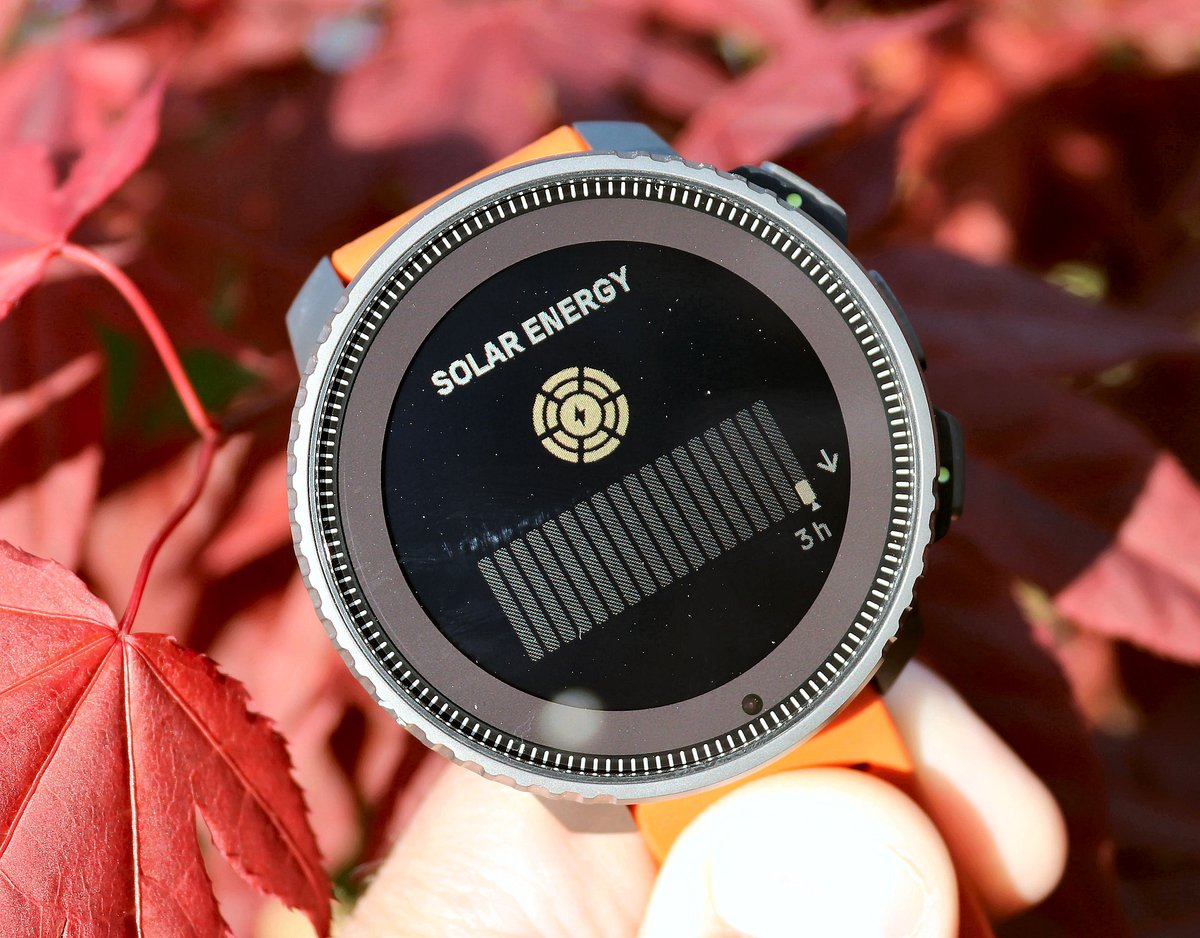
Solar intensity can be displayed on a Garmin watch face or a dedicated widget, typically showing the power gains over the past six hours. For maximum charging efficiency, the watch lens must directly face the sun and remain uncovered.

Design tidbits
The panel’s orientation relative to the sun is key to efficient charging. The orientation comes from how you hold your wrist, as well as the curvature and number of panels.
A curved panel might reduce output by 20% but the power will be reduced by a factor of 6 when at a 90-degree angle.
With that in mind, wearable solar panel designers will consider multiple panels with different orientations to compensate for the sun’s angle relative to your wrist throughout the day. The entire array is further optimised with a Power Management Unit, which typically uses Maximum Power Point Tracking algorithms to continuously optimise energy harvesting.
Solar Across the Garmin Ecosystem
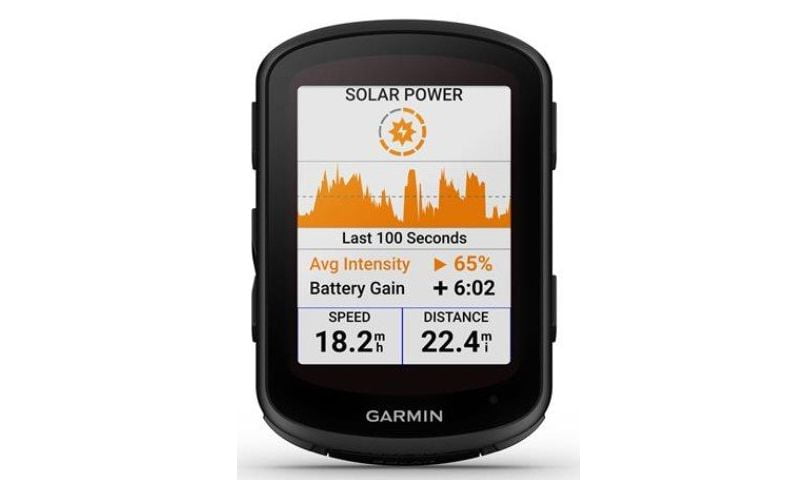
Garmin solar charging is integrated across watch (Fenix, Forerunner, Instinct, Edge, Tactix, Descent, Approach, and Quatix), bike (Edge 840 Solar and Edge 1040 Solar) and handheld (Etrex) product lines. In each case, the solar product commands a higher MRSP.
Cycling Solar Tech
For its cycling products, Garmin quantifies solar energy subtly differently as “ride gain,” roughly 20 extra minutes of battery life per hour of riding in the sun.
It is not entirely clear, in the long term, how Garmin will implement solar charging for its bike computers, which have large, power-hungry screens, so that solar gains will make little difference to their power consumption.
Solar Technology Competition
Garmin’s competitors either took years longer to launch their first solar-powered product than Garmin did or, even now, have not yet made that move. Perhaps the only company to have delivered solar performance better than Garmin is Coros with its DURA bike computer; however, that product was a mess in other aspects, so it presents little real competition – at least for now.
Solar Technological Developments
Garmin’s newer Edge bike computers use Transmissive LCD, without a solar option.
Garmin has filed Solar AMOLED patents, but this may never translate into actual products.
We have seen the second and third generations of MIP and AMOLED display technologies, and each generation has become more power-efficient. The same can be said of the new GNSS chipsets and optical heart rate arrays that Garmin uses. This broadly affects the ongoing attractiveness of solar in 2 conflicting ways.
- The non-solar models are becoming so energy efficient that they offer superior battery life without solar. Solar doesn’t enable a new use case.
- The impact of solar charging on ever-lower-powered watches means the battery gain from it will last much longer. Enabling new use cases!
Solar technology is a point of difference between brands that attracts a notable price premium. For this reason alone, solar tech on wearables is probably here to stay.
Take Out: Is the Garmin Solar Upgrade Worth the Premium for Outdoor Users?
Garmin’s solar charging technology is a proven way to extend the real-world battery life of its outdoor wearables. By adding solar panels to Power Glass and Power Sapphire lenses with efficient MIP displays, Garmin has delivered market-leading battery life for over 5 years without increasing device size.
Real World Gains – Depend on your usage in the sun
The Solar Gen 2 improvements, first seen in Instinct 3 Solar, demonstrate that Garmin intends to further develop and improve its tech. The first Instinct model with ‘forever battery’ gives a taste of what might eventually spread to other models in Garmin’s stable, at least in low battery draw modes.
Competitors and Garmin alike offer new generations of non-solar models with highly efficient processors and sensors which provide excellent battery life on their own; the added benefit of Garmin’s solar tech remains a key point of difference. Solar charging helps enable use cases where access to a power outlet is difficult or impossible – handy for true off-grid adventurers.
Ultimately, for anyone who demands maximum independence from a charger, the solar option remains a must-have feature. Solar watches are here to stay, at least for the medium term.
Sources and further reading
- Why You Should Use Garmin Smartwatches with Solar Charging (Garmin Official Blog)
- Garmin Instinct Solar Review (TechRadar)
- Garmin Watch Battery Life Comparison: Solar and GPS 2025 (The5kRunner)
- Initial Thoughts on Solar Utility Usefulness (Garmin Forums)
- Solar Energy Harvesting for Wearable Electronics (PubMed Central Study)
- Flexible Solar Cells for Smartwatches (Nature Scientific Reports)
- Review of Wearable Solar Energy Harvesters (PubMed Central Study)
- Wearable Solar Power for Smartwatches (ACS Applied Materials & Interfaces)
- Garmin Instinct 3 In-Depth Review: AMOLED and Solar (DC Rainmaker)
- Instinct Flashlight Equipped Model Review (DC Rainmaker)
- Reddit Discussion: Is the Solar Worth It (Instinct/Instinct 2)
Last Updated on 27 January 2026 by the5krunner
Reader-Powered Content

This content is not sponsored. It’s mostly me behind the labour of love, which is this site, and I appreciate everyone who supports it.
Support the site: Follow (free, fewer ads) · Subscribe (paid, ad-free) · Buy Me A Coffee ❤️
All articles are written by real people, fact-checked, and verified for originality. See the Editorial Policy. FTC: Affiliate Disclosure — some links pay commission. As an Amazon Associate, I earn from qualifying purchases.

tfk is the founder and author of the5krunner, an independent endurance sports technology publication. With 20 years of hands-on testing of GPS watches and wearables, and competing in triathlons at an international age-group level, tfk provides in-depth expert analysis of fitness technology for serious athletes and endurance sport competitors.

Do yourself a favor and avoid using the term efficiency in the context of that 100% / 10% split. The “100%” will still just be ca 20% efficient, just like any other solar panel. That 10/100 difference is that the 100 part uses the full spectrum as input to “ca 20%” whereas the 10 part allows 90% of the solar input to pass through to illuminate the tranflective display (so it’s ca 2% efficient)
As long as MIP exists in parallel to more thirsty screens, the main function of “solar” is to have a name for the MIP variant that is more positive than “the one with the dull screen”. That’s nice even if the actual contribution to runtime is completely dwarfed by the screen tech.
That is unless they start doing solar *behind* pixel emitter screens like AMOLED, because those tend to be transparent and require a properly dark backdrop for contrast, should be easy to stack them on top of a somewhat blackish solar cell. That would then be “100%” (20ish) across the whole screen, with a little bonus for harvesting photos emitted in the wrong direction by the pixels, of those happen to do that. But even with that, due to the massive consumption of those screens solar would be even less impactful, in runtime minutes, than what they have on and around MIP.