Garmin CIRQA Smart Band Bicep Wear Confirmed: What It Means for Athletes
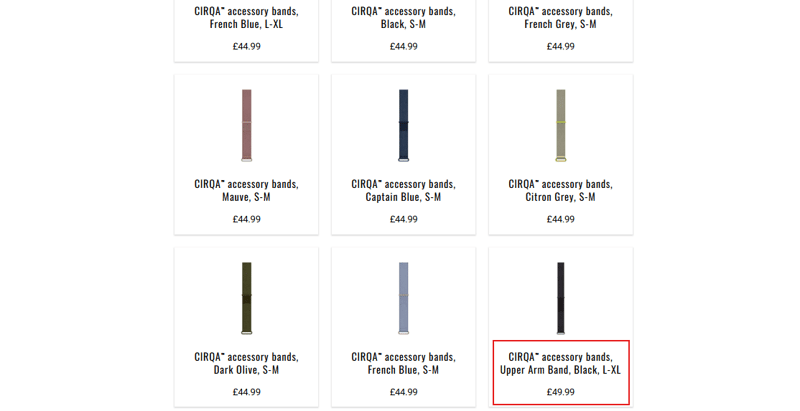
The CIRQA Smart Band ships with a wrist band and official support for upper arm wear, set per activity in Garmin Connect. Separate upper arm bands are available at $59.99 in black, in both S/M and L/XL. Full specifications are at the Garmin CIRQA specs page.
Accuracy during high-intensity exercise
Optical heart rate accuracy on the wrist degrades during high-intensity exercise because wrist movement creates motion artefact that the sensor cannot cleanly separate from the blood flow signal. The upper arm sits over the bicep, which is a flatter, more stable surface with better skin contact and less movement relative to the muscle beneath. For interval sessions, threshold runs, and anything involving significant arm movements, upper arm placement produces cleaner heart rate data.
Contact sports
A hard device on a fast-moving wrist is dangerous and often banned in rugby, martial arts, basketball, and any sport where impacts are likely.
Automatic activity detection
Garmin’s owner’s manual sets band position per activity, either arm or wrist, and treats rep counting as a separate per-activity setting with a Workouts Only option. Garmin does not state that arm position disables either feature.
What Garmin does say, in its own product video, is that for strength training the band should be worn with the button pointing towards the hand for more accurate rep counting. That is an orientation instruction rather than a restriction on where the band sits.
Detection algorithms are trained on wrist accelerometer data, and the upper arm produces a different acceleration signature during the same movement. Step counting and activity type detection are therefore likely to be less reliable from the upper arm. Garmin has published nothing on the size of that difference, so it needs testing rather than assuming.
Heart rate broadcasting
The CIRQA broadcasts heart rate over BLE/ANT+ to any paired device or app, including Garmin watches and bike computers. Upper arm placement makes that broadcast more reliable during vigorous efforts, which is exactly when a secondary source is most useful for athletes who train with both a CIRQA and a Garmin watch.
When to use the wrist position
For general daily wear and overnight sleep tracking, the wrist position is adequate and the more practical choice. Skin temperature is measured during sleep, and the wrist is the natural default for most wearers. Upper arm wear is an option for sports use cases rather than a general recommendation.
The full review tested this directly: wrist-worn CIRQA under-read heart rate by 20 to 30bpm in open water swimming and 9 to 10bpm in running intervals, both fixed by moving to the biceps, while gym, yoga and cycling stayed excellent on the wrist throughout.
In first impressions testing, the CIRQA pod was found to fit inside a Whoop 4.0 bicep sleeve without modification, which provides a no-cost alternative to Garmin’s $59.99 accessory band for sports use. See the CIRQA first impressions for full details.
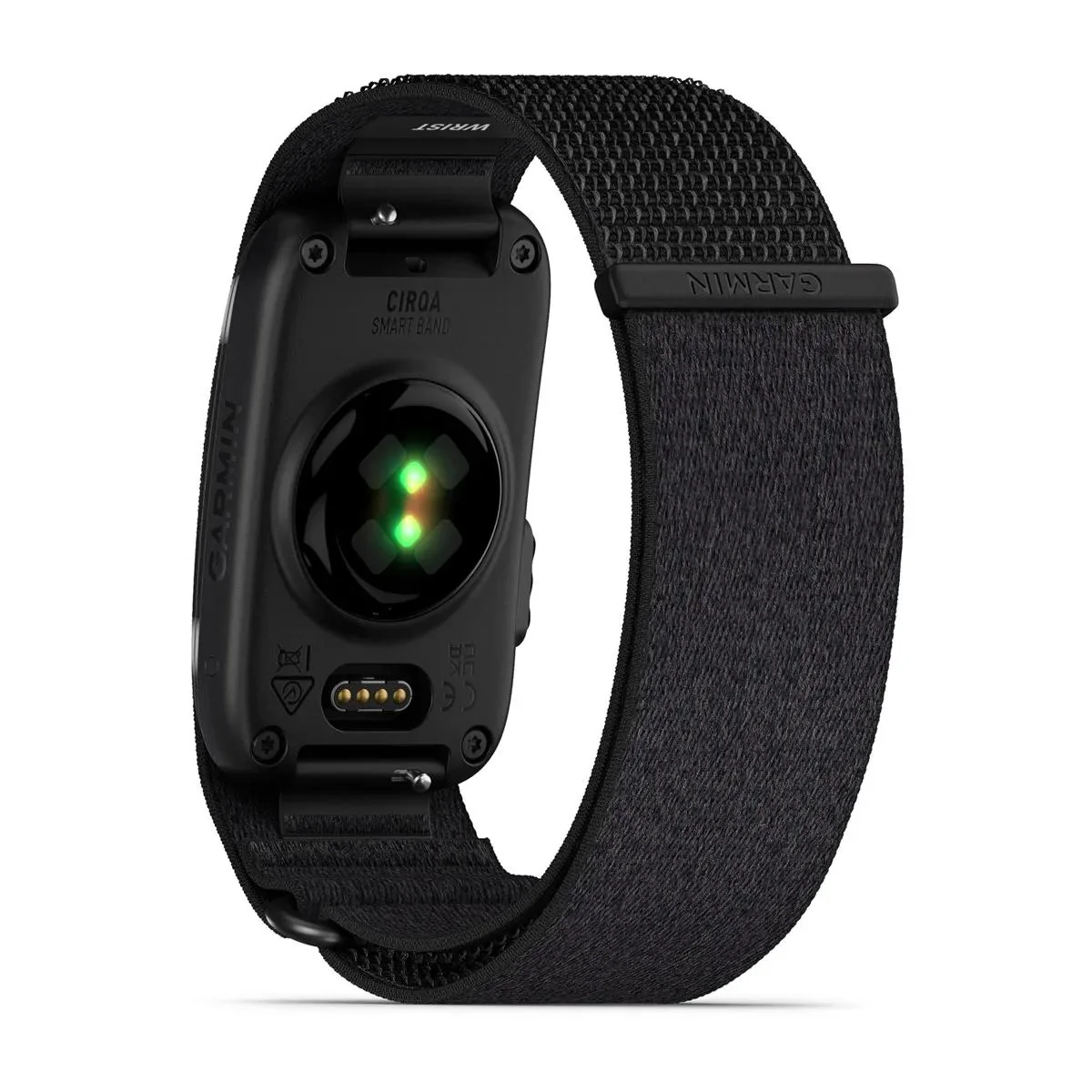
Garmin CIRQA Smart Band
Screenless health and fitness band (no subscription required)
 +other retailers
Quick answers
Can the Garmin CIRQA be worn on the upper arm?
Yes. The CIRQA officially supports wrist and upper arm wear, with the position set per activity in Garmin Connect. A dedicated upper arm band is available at $59.99 in black, in both S/M and L/XL.
Does upper arm wear improve heart rate accuracy on the CIRQA?
For high-intensity exercise, yes. Wrist movement during vigorous effort creates motion artefact that degrades optical heart rate readings. The upper arm sits over the bicep on a flatter, more stable surface with less movement, which produces cleaner data during intervals, threshold runs, and contact sports.
Does the CIRQA track sleep when worn on the upper arm?
Garmin does not specify upper arm wear as the recommended position for sleep tracking. Skin temperature is measured during sleep and the wrist is the natural default for most wearers overnight. Upper arm wear is better suited to specific exercise use cases.
Last Updated on 8 October 2026 by tfk the5krunner
Small things I always use
- Garmin 90-degree charging adapter: Charges your Garmin from any USB-C cable. Essential when travelling. I use one.
- Body Glide: The blue anti-chafe stick swimmers and runners carry. I use it.
- Speedo earplugs: Fewer ear infections and no cold-water dizziness. I use them.
- Dryrobe Advance: My winter changing robe for open-water swims. I use one. A cheaper option is the AONYIYI changing robe.
- Maurten: Race fuel that stays easy on the stomach. I use them.
- Beet It Sport nitrate shots: Beetroot shots I take in the days before a race. I use them.
- Garmin charging puck: The quickest way to top up before a session. I use one.
- Injinji: Toe socks that stop rubbing, so you run more. I use them.
- Ultimate toe protectors: Stop black toenails on long runs. They work. I use them.
- Compressport R2 v2 calf sleeves: My calf sleeves of choice. I use them.
- Cellucor C4: My pre-workout before hard sessions.
- TPU tubes: Schwalbe Aerothan, Tubolito and Pirelli SmarTube. Light, tiny spares. I use all three.
- G8 insoles: Adjustable insoles that are good. I use them.
- Cycplus Cube: A 97g electric pump that gets a road tyre rideable in two minutes. I carry one. 5% off with code THE5KRUNNER.
Watches and sensors
- Polar H10: My daily driver for waking HRV.
- Polar Verity Sense: My backup arm-worn HR sensor.
- Nomad bedside charger: Charges my iPhone and Apple Watch overnight. I use it, and many of their bands.
- Train.Red: The best muscle oxygen sensor I’ve used.
- Tymewear: Accurate heart rate and reliable ventilatory zones. I use it to pace endurance rides over an hour.
- Garmin Forerunner 970: A pro-grade triathlon watch. I use this.
- Apple Watch Ultra 4: My daily smartwatch. No phone needed on rides.
- Garmin Fenix 9 Pro: I’ve just bought one.
On the bike
- Continental GP5000 for everyday riding, and Aero 111 on the front for special occasions.
- Helmets: Specialized S-Works Evade 3 for road riding, and Rudy Project Wing for TT-style races. I use both.
- Ravemen FR300: A front light that mounts under your Garmin or Wahoo. I use one.
- Wahoo TRACKR Radar: I use it on one bike and Varia on the other. They perform the same.
- Garmin Varia RTL515: Radar that warns you of cars from behind. I use this model.
- Wahoo ELEMNT Roam 3: The bike computer that’s easy to use. I use mine on most rides.
- Favero Assioma Pro RS2: Accurate power pedals that swap easily between bikes. I use this model.
Home and indoor training
- NPE Runn: Makes my basic treadmill smart, sending more accurate speed and distance to my watch and Zwift. I use it.
- Google Wifi: Keeps Zwift connected in my pain cave. I use it.
- Apple TV 4K: Zwift on the big screen. I use two.
- Google Nest Doorbell (wired, 2nd gen): My video doorbell, running in both Google Home and Apple Home. I use it.
Health, recovery and sleep
- FreeStyle Libre 3 Plus: Shows how my blood sugar responds to diet.
- hDrop: Measures my sweat loss in summer and indoors.
- Fourth Frontier Zone: Checks my heart under load in hard sessions.
- Oura Ring 5: My partner’s recovery tracker of choice.
- Eight Sleep: A cooling mattress cover my partner and I use nightly.
Reader-Powered Content

This content is not sponsored. It’s mostly me behind the labour of love, which is this site, and I appreciate everyone who supports it.
Support the site: Follow (free, fewer ads) · Subscribe (paid, ad-free) · Buy Me A Coffee
Written by real people, with AI assistance. Fact-checked and verified for originality. See the Editorial Policy. FTC: Affiliate Disclosure — some links pay commission. As an Amazon Associate, I earn from qualifying purchases.
tfk is the founder and author of the5krunner, an independent endurance sports technology publication. With 20 years of hands-on testing of GPS watches and wearables, and competing in triathlons at an international age-group level, tfk provides in-depth expert analysis of fitness technology for serious athletes and endurance sport competitors. See the gear tfk uses. ID
