If you want solar that meaningfully extends battery life, the Garmin Fenix 9 Pro Solar is the one of the two that delivers, and it charges a premium for the whole package. If you want the ‘better’ display, a lighter watch and a much lower price, and you treat solar as an occasional bonus rather than the point, the Amazfit T-Rex Dual Solar is the easy pick. That is the core comparison in two sentences.
You’re likely considering a solar model purely for maximal battery life. Solar isn’t the only thing you need to consider. Let’s find out what else matters.
The display choice is the first to consider
Both watches carry a solar charging ring around the area that displays your metrics and maps.
The key difference is the brightness and resolution of AMOLED versus the arguably more readable, less power-hungry MIP. Garmin uses a MIP transflective display, which is dim and low resolution but sips power, so even a modest solar ring offsets a real share of the draw, and the battery gains are proportionately larger. Amazfit keeps a bright, sharp AMOLED display, which looks far better but is power hungry, so the same kind of charging struggles to keep up with its power demands.
That is why Amazfit had to add a second, larger panel on the caseback, which can only help when the watch is off your wrist and turned to the sun. Solar charging is always slower than the rate an AMOLED display drains the battery, which is the whole problem Amazfit is working around.
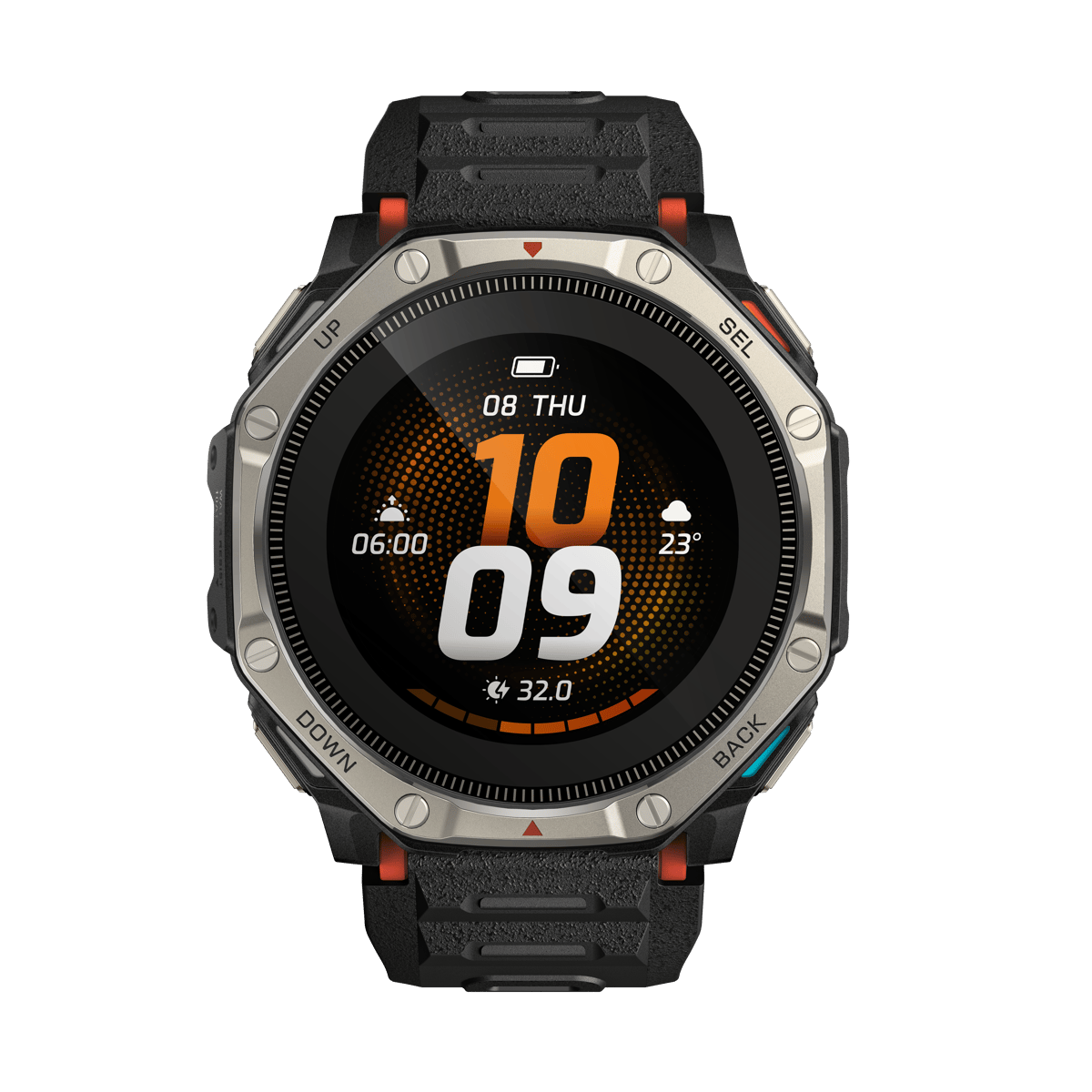
Specifications compared
The 51mm Fenix 9 Pro Solar is the closest match to the 51.4mm Amazfit by size. The 47mm Garmin is a little cheaper and lighter if you want it.
| Specification | Amazfit T-Rex Dual Solar | Garmin Fenix 9 Pro Solar (51mm) |
|---|---|---|
| Display type | AMOLED, 3,000 nits, touchscreen | MIP transflective, buttons only |
| Display size and resolution | 1.32 inch, 466 x 466 | 1.4 inch, 280 x 280 |
| Solar | Front ring plus rear caseback panel (rear works off-wrist only) | Front solar ring, works while worn |
| Case | 51.4 x 16.9mm | 51 x 16.6mm |
| Weight | 69g | 102g |
| Lens and case | Sapphire lens, Grade 5 titanium bezel, glass-ceramic caseback | Power Sapphire lens, titanium case and bezel |
| Smartwatch battery | Up to 25 days (up to 51 with rear solar, off-wrist) | Up to 30 days (up to 57 with solar, worn) |
| GPS battery | GPS accuracy up to 41 hours | Max Battery up to 186 hours (up to 1,000 with solar) |
| Positioning | Dual-band, six satellite systems | Multi-band GPS, GLONASS, Galileo, QZSS, BeiDou, SatIQ |
| Heart rate | BioTracker 6.0 PPG | Elevate Gen 5, plus ECG |
| Storage | 64GB | 64GB |
| Water resistance | 10 ATM | 10 ATM |
| Platform | Zepp OS | Garmin, with inReach option |
| Launch price | GBP 649.90 / USD 649.99 | GBP 1,029.99 / USD 1,199.99 (47mm from GBP 949.99) |
The battery numbers are not measuring the same thing
Read the solar rows with care.
Garmin’s figures assume the watch is worn all day, because its front ring charges on the wrist. On both watches, that also assumes a sleeve isn’t covering the face, since the front solar panel charges only when exposed to the sun. Up to 30 days in smartwatch mode becomes up to 57 with solar, and its longest GPS setting runs up to 186 hours, rising to a claimed 1,000 with sun. Those gains happen while you use it.
Amazfit’s best solar figures depend on the rear panel, which means the watch is off your wrist and face down to the sky. Worn and running GPS, its solar contribution is small, and the smaller 660mAh battery, shrunk to fit the solar hardware, leaves it well short of the Garmin on endurance. Amazfit’s 180-day headline applies only to its Outdoor Extreme power-saving mode with continuous rear-panel sun, not everyday use.
Battery management
The display is a big battery draw, so disabling the always-on display makes a real difference to battery life.
Battery management is a real Garmin advantage and an easy one to miss. Garmin’s Power Manager lets you build and save named power modes, toggle individual drains such as the GPS system, sensors, the always-on display, and phone connection, watch the estimated battery time in days or hours change as you go, and assign a mode per sport. It is a proper expedition planning tool.
Amazfit gives you a system-wide Battery Saver toggle, preset GPS modes for workouts, individual settings for things like heart-rate sampling and the always-on display, and a Battery Assistant that estimates remaining life. You can trade features for battery, but you cannot engineer and save a precise custom mode the way you can on the Garmin.
Looks and screen
Both watches have a visible solar ring that harks back to watches of 5-10 years ago criticised for having a thick, ugly bezel.
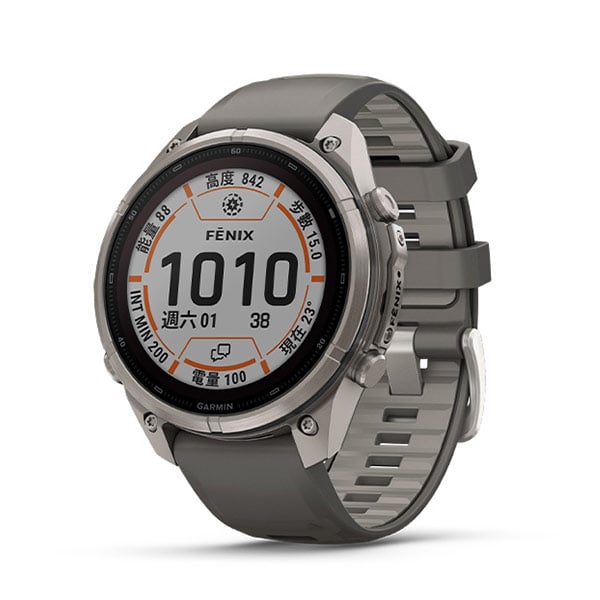
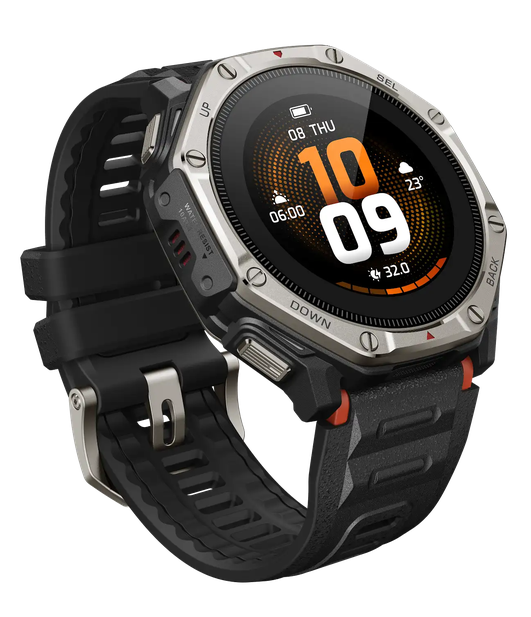
To our eye, the Garmin looks more naturally proportioned; Amazfit’s ‘bezel’ is chunkier. By contrast, the display area inside the Amazfit’s ring is far nicer to look at: a sharp, bright, full-colour AMOLED touchscreen, while the Garmin’s is a dim, low-resolution MIP panel driven by buttons. So the Amazfit is the better watch to read and use day to day, even if the Garmin is the prettier.
Platform depth cuts both ways.
Garmin has the deeper platform, with Training Readiness, Training Status, Body Battery, the full physiology suite, mature mapping, the Connect IQ app store, ANT+ sensor support and inReach satellite messaging as an option. But depth is not automatically an advantage. Garmin’s software is often called unintuitive and awkward to navigate, and much of that depth is in features most people never touch. Amazfit has closed much of the gap with Zepp OS, Zepp Coach and its readiness and recovery tools, and for most buyers it already covers what they actually need, arguably with a simpler way to find a feature and use it. So this is less a Garmin walkover than a question of whether you want maximum capability or merely sufficient.
The verdict
These are two honest answers to the same question.
- Garmin’s real edges are solar that works while worn, savable custom power modes, a tidier look, and a deeper platform if you want it.
- Amazfit gives you the better screen, a lighter watch, a feature set that already suits most people, and it does all of it for around GBP 380/$550 less.
If solar has to earn its keep, buy the Garmin. If you want the nicer watch to live with and see solar as a bonus, buy the Amazfit.
Quick answers
Is the Amazfit T-Rex Dual Solar better than the Garmin Fenix 9 Pro Solar?
It depends on what you want. The Fenix 9 Pro Solar gets far more from solar and has the deeper platform, but costs around GBP 380 more. The T-Rex Dual Solar has the better screen, weighs less, and covers what most people need for considerably less.
Which has the better screen?
The Amazfit. It uses a sharp 1.32-inch AMOLED touchscreen at up to 3,000 nits. The Fenix 9 Pro Solar uses a dim, low-resolution MIP display controlled by buttons, chosen because it uses very little power.
Which lasts longer on battery?
The Garmin, by a wide margin once solar is involved. The 51mm Fenix 9 Pro Solar reaches up to 57 days in smartwatch mode and up to 1,000 GPS hours with solar. The T-Rex Dual Solar reaches up to 51 days, and its best figures require the watch to be off your wrist.
Why does the Garmin get more from solar?
Its MIP screen uses very little power, so a modest solar ring offsets a real share of the draw. The Amazfit’s bright AMOLED uses far more, so even a front ring plus a rear caseback panel barely keeps up.
How much cheaper is the Amazfit?
The T-Rex Dual Solar launches at GBP 649.90. The 51mm Fenix 9 Pro Solar is GBP 1,029.99 and the 47mm is GBP 949.99, so the Amazfit is roughly GBP 300 to 380 less.
Can you charge the Amazfit T-Rex Dual Solar while wearing it?
The front ring charges on the wrist but adds little. The larger rear panel only works with the watch off your wrist and turned to the sun, so the biggest solar figures assume you are not wearing it.
Full details are on the Amazfit T-Rex Dual Solar specifications and Garmin Fenix 9 Pro specifications pages, and in our T-Rex Dual Solar launch coverage.

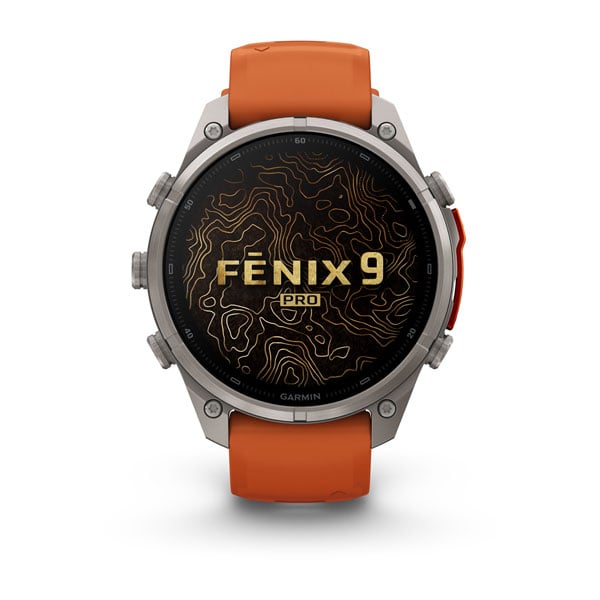
Garmin Fenix 9 range
Every Fenix 9 and Fenix 9 Pro model, including AMOLED, Solar, and inReach variants across all sizes. One link to the full range.

More: Amazfit coverage, Garmin coverage, and the Release Radar.
Last Updated on 22 September 2026 by the5krunner
My favourite kit and nutrition
- Garmin Fenix 9 Pro — I’ve just bought one.
- Injinji – Runners protect your toes. Avoid discomfort and minor injury. Run more. Run faster. I use them.
- Garmin 90-degree charging adapter — A small keyring adapter you can use anywhere. Essential when away. I use one.
- Garmin charging puck — the fastest and most reliable way to top up your Garmin before a session. I use one.
- Ravemen FR300 — Front light that mounts directly under your Garmin or Wahoo head unit. Keeps your bars clean and your beam pointed where it matters. I use one.
- Body Glide – The blue anti-chafe stick that all swimmers and many runners use. I use it.
- Maurten — The race nutrition trusted by elite athletes. Gels and drink mixes engineered to be easy on the stomach. I use them.
- Garmin Varia RTL515 — A radar rear light that alerts you to vehicles approaching from behind. Pairs with your Edge or Wahoo. I use this model.
- Favero Assioma Pro RS2 — The power-meter pedals most serious cyclists choose. Accurate, easy to move between bikes. I use this model.
- Garmin Forerunner 970 — A serious choice for a pro-grade triathlon watch. I use this.
- Polar H10 — My daily driver for accurate, waking HRV readings.
- Wahoo ELEMNT Roam 3 — The bike computer that has the feature Garmin lacks: usability. I use mine on most rides.
Reader-Powered Content

This content is not sponsored. It’s mostly me behind the labour of love, which is this site, and I appreciate everyone who supports it.
Support the site: Follow (free, fewer ads) · Subscribe (paid, ad-free) · Buy Me A Coffee ❤️
All articles are written by real people, fact-checked, and verified for originality. See the Editorial Policy. FTC: Affiliate Disclosure — some links pay commission. As an Amazon Associate, I earn from qualifying purchases.

tfk is the founder and author of the5krunner, an independent endurance sports technology publication. With 20 years of hands-on testing of GPS watches and wearables, and competing in triathlons at an international age-group level, tfk provides in-depth expert analysis of fitness technology for serious athletes and endurance sport competitors. ID
