Most runners know they should be lifting. Ask why they aren’t, and the answer usually isn’t time. It’s the choosing. Which program, which split, how many sets, how many reps, and when is it actually time to add weight? Strength apps tend to answer that with more: more programs, more templates, more buttons. For someone who would rather be out running, all of that choice turns into a reason to skip the session.
Scott Shumaker lived a version of this for years. He trained consistently, but he carried the whole thing in his head: dozens of numbers week to week, which weight on which machine, in what order. Progress came in waves, and nothing held him to it. The apps he tried were doing too much. “I don’t need to complicate my workout,” he says. “I just need to complete it.” So over the past year he built Compound, a strength app for iPhone and Apple Watch that takes the decisions out and leaves the lifting.
How Compound works
TL;DR: Compound has one four-day routine. It tells the athlete which day is next, what goes on the bar, how many reps to aim for, and when to add weight. The lifting is theirs to do.
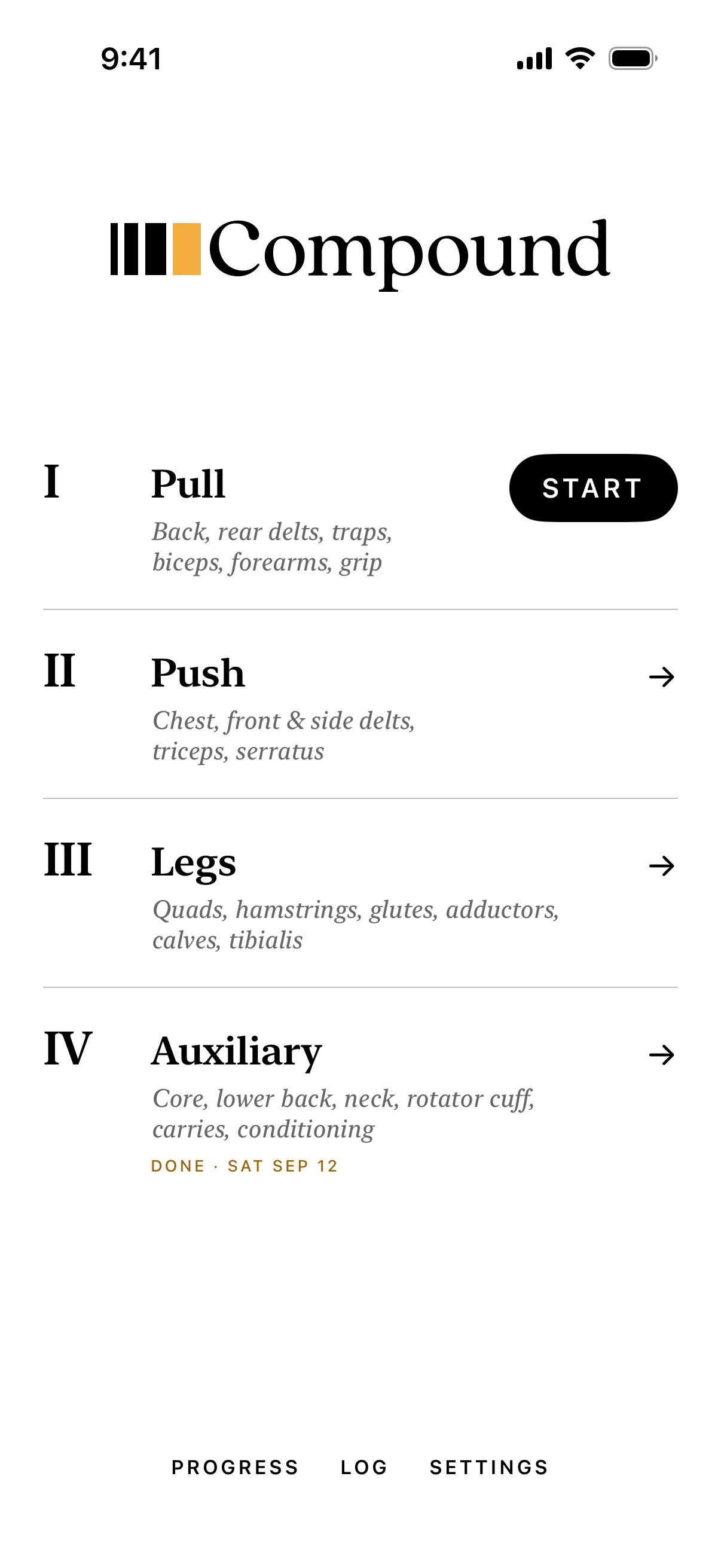
Open the app and the next day is waiting. Compound doesn’t care what day of the week it is: a session on Monday followed by three rest days and a return on Friday still picks up with the next day in the cycle. Every session runs the same way:
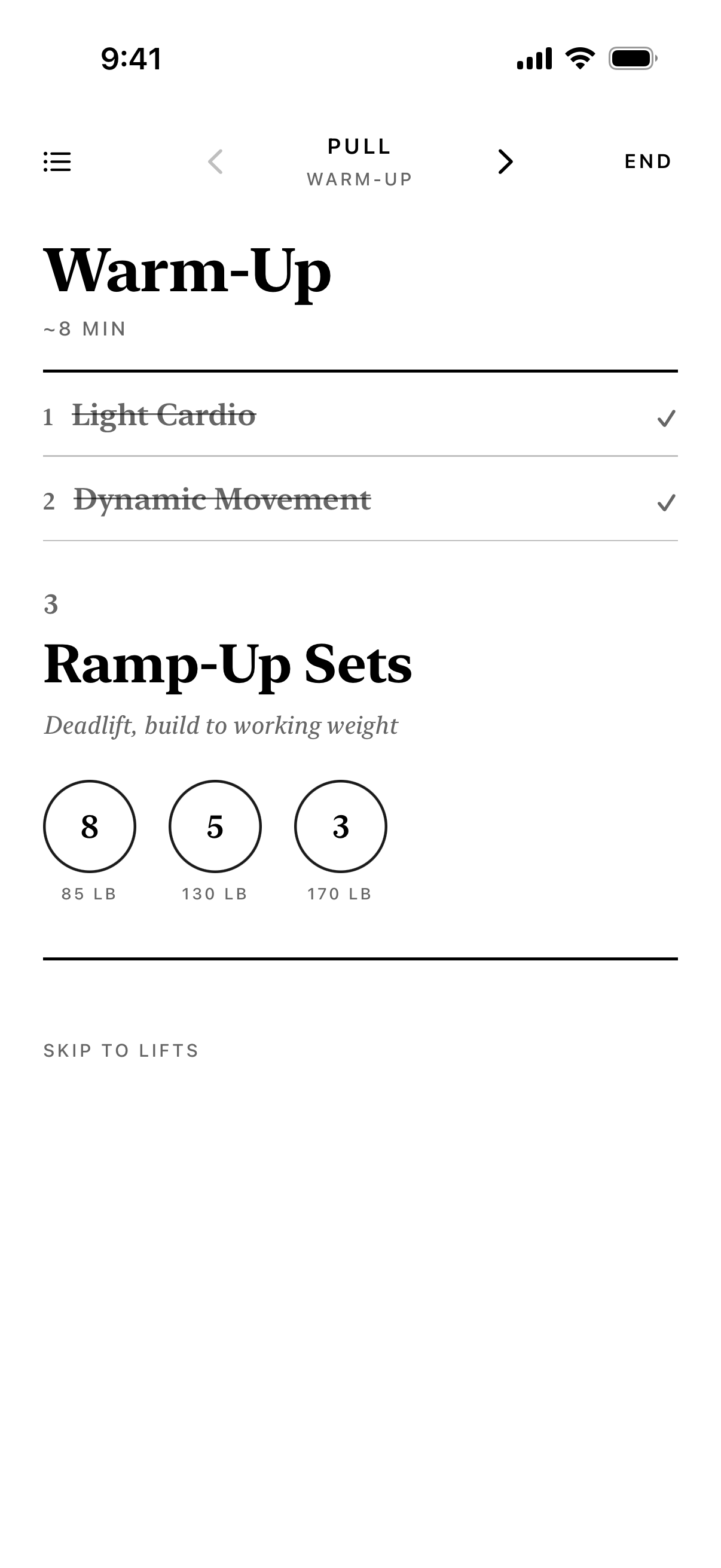
- Warm-up. A few minutes of cardio on a timer, the day’s dynamic movements, then ramp-up sets at about 40, 60 and 80 percent of the first lift’s working weight (8, 5 and 3 reps), rounded to plates that can actually be loaded.
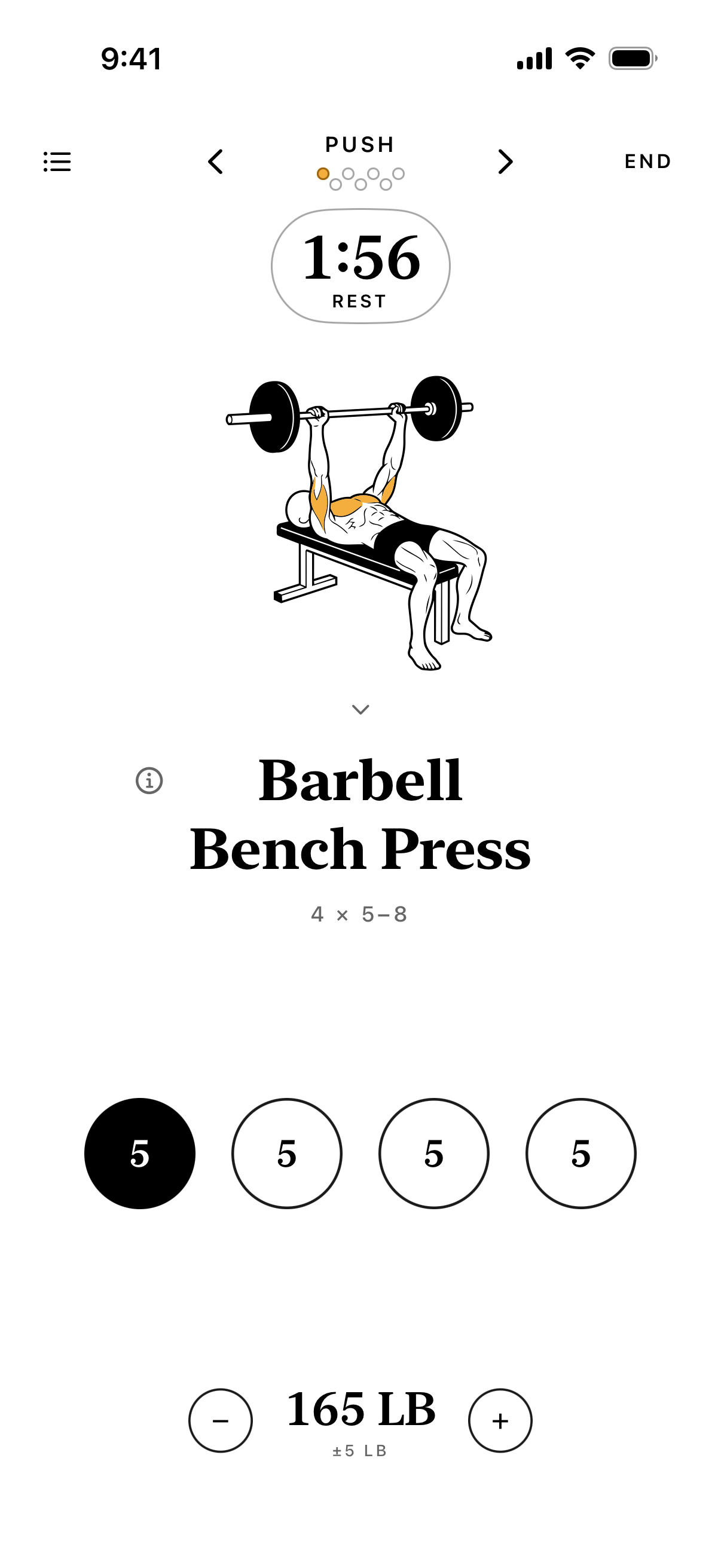
- Lifts. Each exercise shows its sets as circles. Tapping one logs the set at the target; holding it logs a different number instead.
- Rest. The timer starts itself the moment a set is logged: three minutes after heavy compounds, two after medium lifts, 90 seconds after isolation work. It can be lengthened, shortened or switched off.
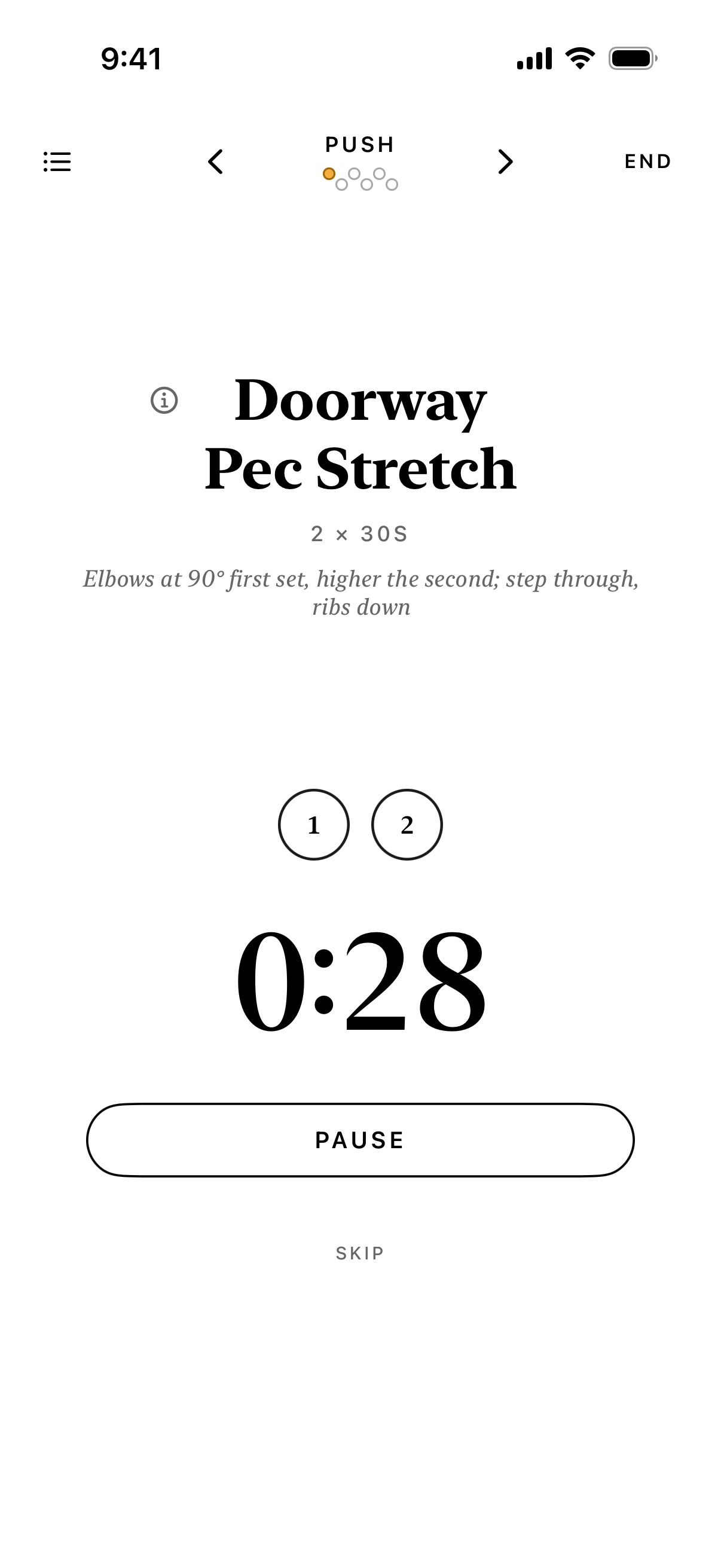
- Mobility. About ten minutes of stretches closes every session, each on its own countdown.
One routine, on purpose
This is the part that makes Compound different, and the part that will put some people off. There is no program library. There is one routine, a four-day split ordered so that heavy deadlifts and heavy squats never land back to back:
- Pull: back, rear delts, traps, biceps, forearms, grip.
- Push: chest, front and side delts, triceps, serratus.
- Legs: quads, hamstrings, glutes, adductors, calves, tibialis.
- Auxiliary: core, lower back, neck, rotator cuff, loaded carries.
The Auxiliary day covers the areas most programs leave behind. The exercises don’t rotate; the numbers do. If a machine is taken or a movement doesn’t suit a particular lifter, most exercises have alternatives to swap to, and each one keeps its own progress.
Shumaker is upfront about the trade: “It won’t be for everyone, and I don’t need it to be.” The bet is that for someone who wants to get stronger and is tired of deciding how, one solid routine followed for years beats a better one abandoned in week three.
A worked example: three Push days on the bench
Compound uses double progression: reps go up first, then weight, the same logic behind the progressive overload other lifting apps automate. The bench press is written as four sets of 5 to 8 reps, with 5 lb jumps.
- Push day one: 165 lb, target 7. All four sets land at 7. Next time the target is 8.
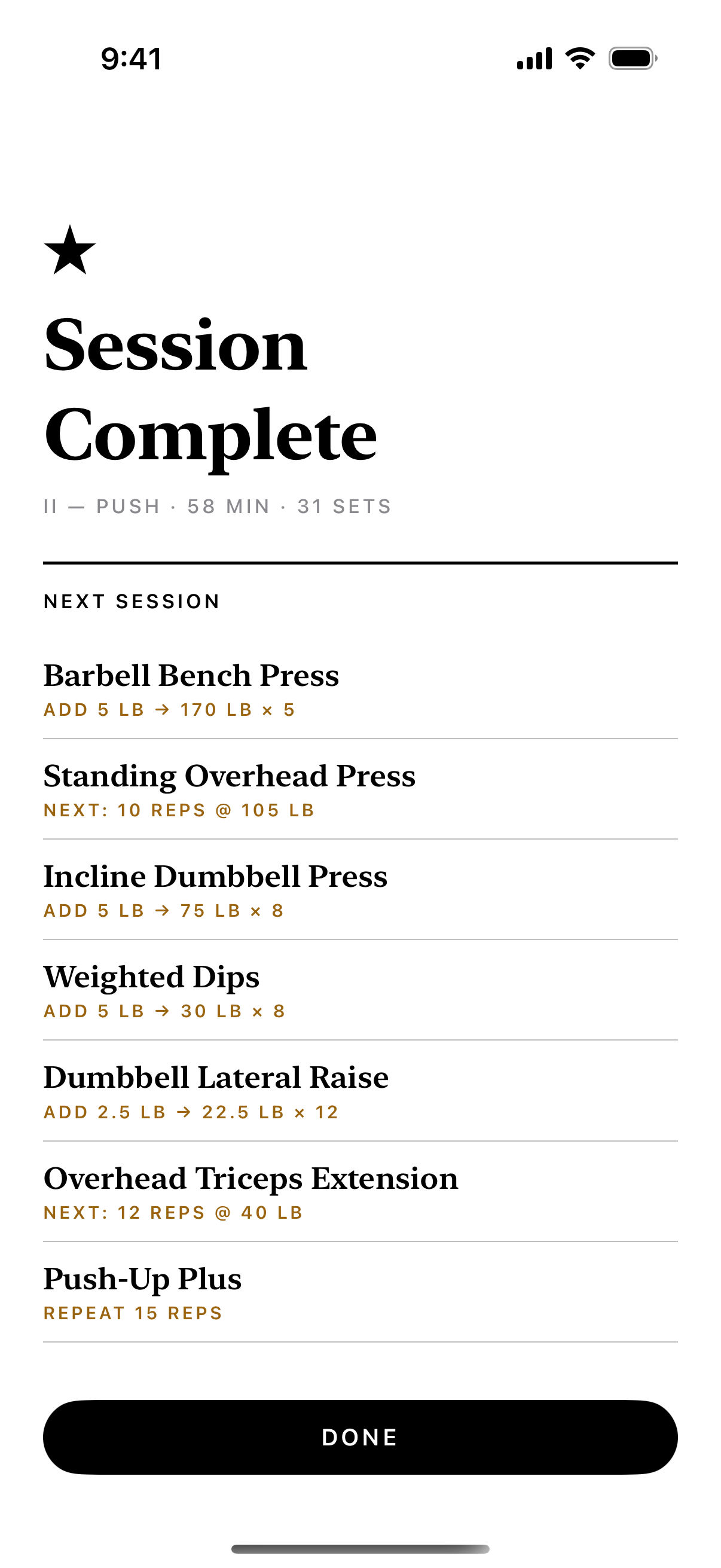
- Push day two: 165 lb, target 8. All four sets hit 8, the top of the range. The session summary reads “ADD 5 LB, 170 LB x 5”.
- Push day three: 170 lb, target 5. The last set stalls at 4, logged by holding the circle. Not every set hit the target, so nothing moves: the next Push day is 170 lb for 5 again.
The trigger is simple: every set at the target, at the same weight. One big final set doesn’t count, because the progression reads the weakest set, not the best. By default the step happens after every successful session, and a setting slows it to every second through fifth session for anyone who wants longer at each step. Kilograms work the same way, in 2.5 kg jumps.
On the wrist, in Apple Health, and nowhere else
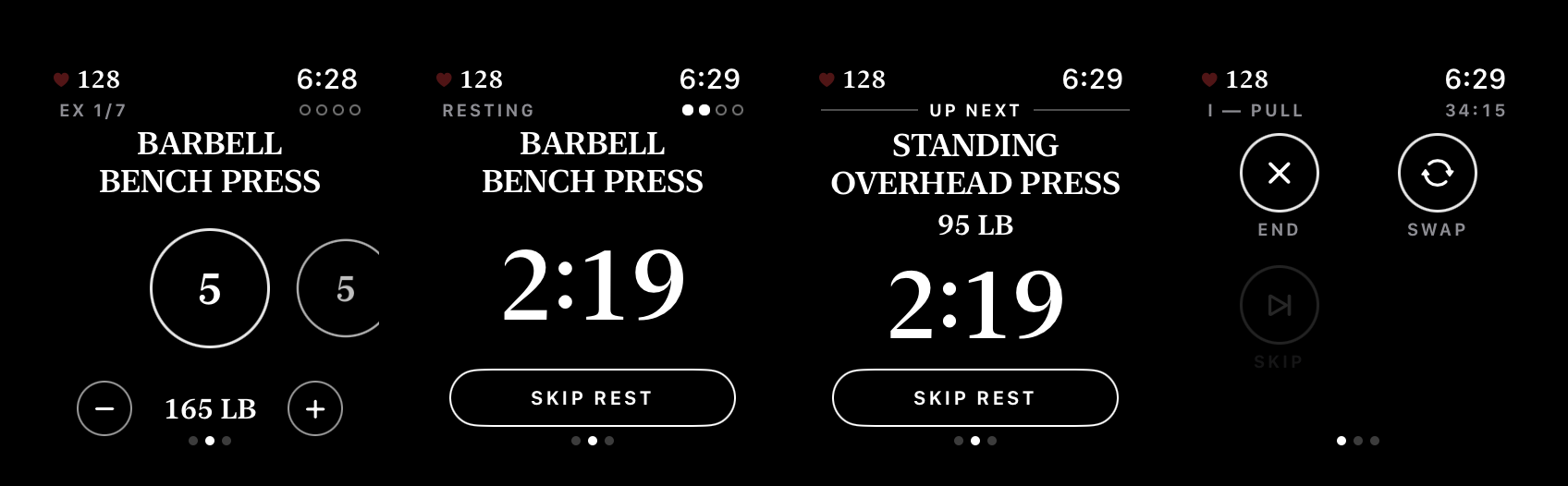
Once a session is under way, the Apple Watch app runs it from the wrist:
- The Digital Crown moves through the day’s lifts, one exercise per page.
- Tapping a set circle logs it; holding it picks a different rep count. Plus and minus buttons adjust the weight.
- The rest countdown starts on its own. While it runs, an Up Next screen shows the next lift and its weight, so the plates can go on before the clock ends.
- Timed holds, stretches and carries get their own clocks, with an eight-second change-over between sides.
- A controls page ends the session, swaps an exercise for one of its alternatives, or skips it.
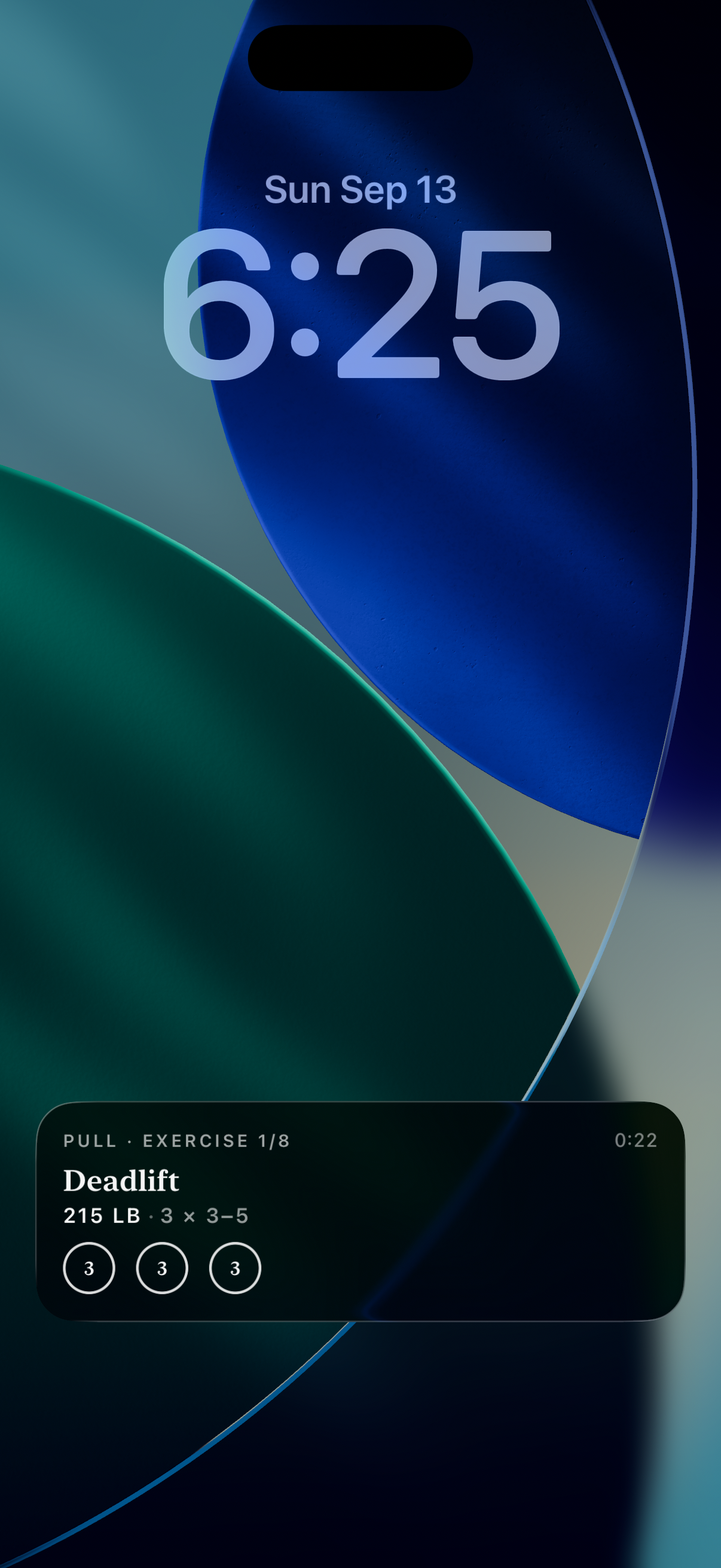
The iPhone still does the thinking, so it needs to stay nearby, in a pocket or a gym bag. Its Lock Screen follows the session too, so sets can be logged there without unlocking. Each session saves to Apple Health as a workout, with heart rate and calories.
There is no account, no sign-up, no server and no analytics, and the App Store privacy label reads “Data Not Collected”. Training history is a file on the phone that can be exported, and the app works in a gym with no signal.
What Compound doesn’t do
- One routine, for now. There’s no way to build a custom program in this version. A custom routine builder is planned for a later update.
- A gym program. It assumes barbells, dumbbells and a few machines.
- No standalone Watch mode yet. The Watch runs the session but needs the iPhone close by. A version that works without the phone is in progress.
- English only.
- One developer. Compound is built and supported by one person. The upside is that feedback goes straight to the person writing the code, which Shumaker counts as a feature: “a real person that will listen to your feedback.”
Quick answers
Which devices does Compound run on?
iPhone, on iOS 17 or later. An Apple Watch on watchOS 10 or later is optional, and with one the whole session runs from the wrist, but the iPhone needs to stay nearby. There is no Android, Garmin or web version.
What does it cost?
$4.99 a month or $29.99 a year, after a 14-day free trial. There’s no account to create; the subscription goes through the App Store.
Can I fit it around a running plan?
Yes. The cycle ignores the calendar, so there are no fixed training days. The next session can happen whenever there’s time, whether that’s four days a week or two, and Compound picks up where it left off. A full session, warm-up and mobility included, takes about an hour.
Related reading: BulkForged, RunSync.
Author: Scott Shumaker, developer of Compound, edited by the5krunner.
Last Updated on 28 September 2026 by the5krunner
Small things I always use
- Garmin 90-degree charging adapter: Charges your Garmin from any USB-C cable. Essential when travelling. I use one.
- Body Glide: The blue anti-chafe stick swimmers and runners carry. I use it.
- Speedo earplugs: Fewer ear infections and no cold-water dizziness. I use them.
- Maurten: Race fuel that stays easy on the stomach. I use them.
- Garmin charging puck: The quickest way to top up before a session. I use one.
- Injinji: Toe socks that stop rubbing, so you run more. I use them.
- Cellucor C4: My pre-workout before hard sessions.
- TPU tubes: Schwalbe Aerothan, Tubolito and Pirelli SmarTube. Light, tiny spares. I use all three.
Watches and sensors
- Polar H10: My daily driver for waking HRV.
- Polar Verity Sense: My backup arm-worn HR sensor.
- Nomad bedside charger: Charges my iPhone and Apple Watch overnight. I use it, and many of their bands.
- Train.Red: The best muscle oxygen sensor I’ve used.
- Garmin Forerunner 970: A pro-grade triathlon watch. I use this.
- Apple Watch Ultra 4: My daily smartwatch. No phone needed on rides.
- Garmin Fenix 9 Pro: I’ve just bought one.
On the bike
- Continental GP5000 for everyday riding, and Aero 111 on the front for special occasions.
- Ravemen FR300: A front light that mounts under your Garmin or Wahoo. I use one.
- Wahoo TRACKR Radar: I use it on one bike and Varia on the other. They perform the same.
- Garmin Varia RTL515: Radar that warns you of cars from behind. I use this model.
- Wahoo ELEMNT Roam 3: The bike computer that’s easy to use. I use mine on most rides.
- Favero Assioma Pro RS2: Accurate power pedals that swap easily between bikes. I use this model.
Home and indoor training
- Google Wifi: Keeps Zwift connected in my pain cave. I use it.
- Apple TV 4K: Zwift on the big screen. I use two.
- Google Nest Doorbell (wired, 2nd gen): My video doorbell, running in both Google Home and Apple Home. I use it.
Health, recovery and sleep
- FreeStyle Libre 3 Plus: Shows how my blood sugar responds to diet.
- hDrop: Measures my sweat loss in summer and indoors.
- Fourth Frontier Zone: Checks my heart under load in hard sessions.
- Oura Ring 5: My partner’s recovery tracker of choice.
- Kineon MOVE+: Red light therapy for niggles. It works.
- Eight Sleep: A cooling mattress cover my partner and I use nightly.
Reader-Powered Content

This content is not sponsored. It’s mostly me behind the labour of love, which is this site, and I appreciate everyone who supports it.
Support the site: Follow (free, fewer ads) · Subscribe (paid, ad-free) · Buy Me A Coffee ❤️
Written by real people, with AI assistance. Fact-checked and verified for originality. See the Editorial Policy. FTC: Affiliate Disclosure — some links pay commission. As an Amazon Associate, I earn from qualifying purchases.
tfk is the founder and author of the5krunner, an independent endurance sports technology publication. With 20 years of hands-on testing of GPS watches and wearables, and competing in triathlons at an international age-group level, tfk provides in-depth expert analysis of fitness technology for serious athletes and endurance sport competitors. ID
