BPC-157 and TB-500 are sold to endurance athletes as injectable shortcuts to faster tendon, ligament and muscle repair. Neither has a controlled human trial showing that it speeds recovery from any of those injuries, and both are prohibited at all times under the 2026 WADA Prohibited List.
A 2026 scoping review in the American Journal of Sports Medicine examined six peptides sold for muscle, tendon and bone recovery, including these two. Its authors found promising animal results and concluded that the claimed benefits “remain unsubstantiated by current human trials”.
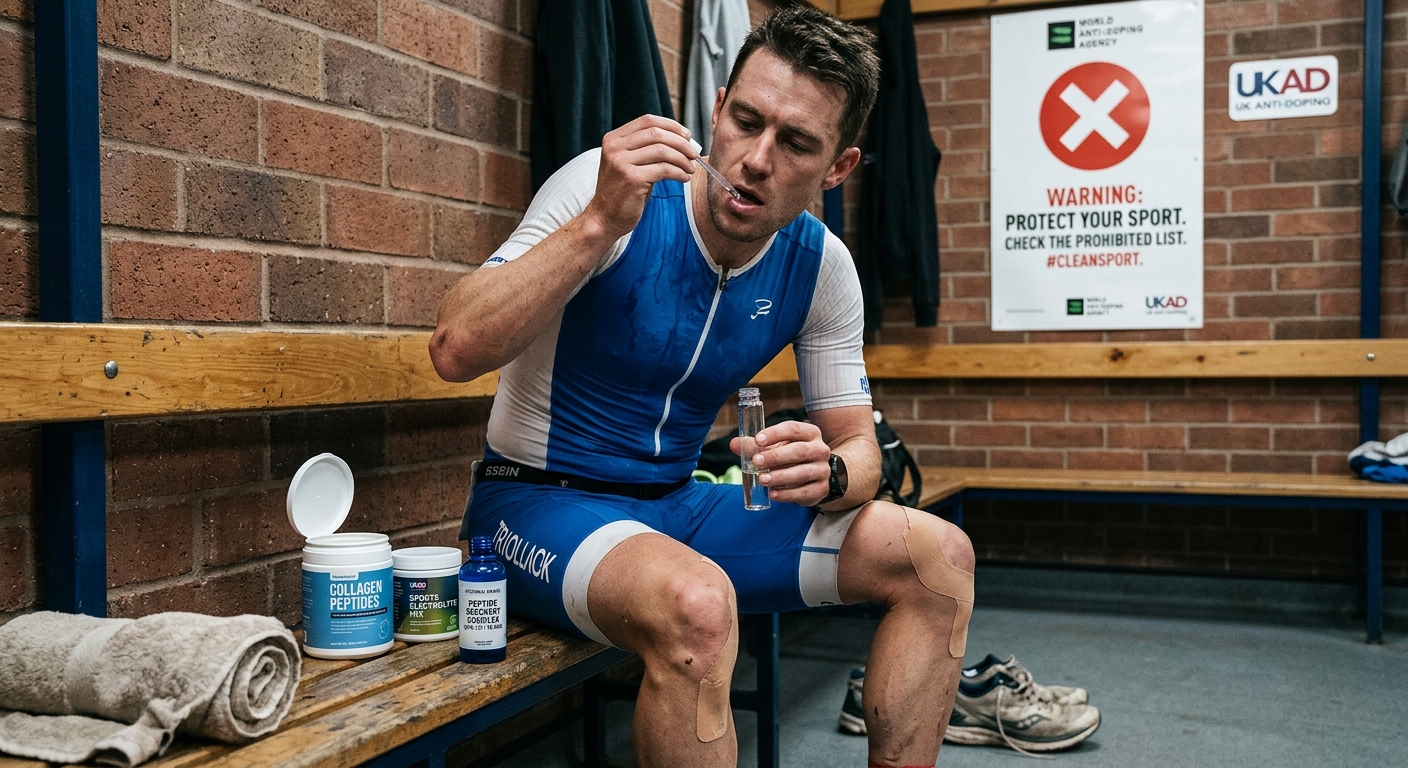
What peptides are: collagen, licensed medicines and unapproved compounds
Peptides are short chains of amino acids that the body uses as signalling molecules. The word covers three very different groups of products.
- Food-derived peptides such as collagen peptides are sold legally as supplements and taken by mouth.
- Licensed peptide medicines such as insulin and semaglutide have passed clinical trials and are prescribed by doctors.
- Unapproved research compounds such as BPC-157 and TB-500 have no licensed medical use and are usually sold online for injection.
Growth hormone-releasing peptides such as CJC-1295 and ipamorelin belong to the third group. They work differently from the two repair peptides and are outside the scope of this article.
Why endurance athletes are turning to peptides
Tendons and ligaments have a poor blood supply and heal slowly. Achilles, hamstring and plantar injuries can interrupt training for months, and the standard treatment is patient load management and progressive strengthening. Sellers offer an injection that promises to shorten that wait, and they have moved faster than sports science can test the claims.
The authors of the 2026 review describe a fast-growing market in which athletes often see these peptides as low risk, even though many have no human data showing that they work or are safe.
Use has reached amateur endurance sport. In September 2025, USADA announced a four-year ban for a 46-year-old age-group triathlete who possessed and used BPC-157 and TB-500 and promoted prohibited peptides to his social media followers.
BPC-157: what the evidence shows
BPC-157 is a synthetic chain of 15 amino acids based on a protein found in human gastric juice. Animal and cell studies suggest it may encourage new blood vessel growth, increase collagen production, and dampen inflammation, which is why it is promoted for tendon and ligament injuries. Researchers have not identified its molecular targets, and the FDA describes its mechanisms as poorly understood.
A 2025 systematic review in HSS Journal found 36 relevant studies published up to June 2024. Thirty-five were animal or cell studies. The single clinical study was a retrospective report of 12 patients given BPC-157 injections for knee pain, with no control group, so it cannot separate the injection’s effect from natural recovery or placebo.
The FDA’s 2026 evaluation searched again and found five small clinical studies in total, covering ulcerative colitis, interstitial cystitis, knee pain and two healthy-volunteer studies. All were short, with limited safety reporting, and none tested recovery from a sports injury. The HSS review stated that human safety remains unknown, and USADA says no human clinical trial has established that BPC-157 works for any condition.
TB-500: what the evidence shows
- Thymosin beta-4 is a 43-amino-acid protein found in most human cells, where it helps cells move and repair tissue.
- TB-500 is a synthetic seven-amino-acid fragment copied from one region of that protein.
Sellers use the two names interchangeably, and the human research applies to only one. Human studies have tested full-length thymosin beta-4 as eye drops and as a skin treatment for wounds. Those results do not transfer to the injectable substance, and no controlled human trial has tested TB-500 for tendon, ligament or muscle injuries.
BPC-157 vs TB-500: how they differ, and the “Wolverine stack”
| BPC-157 | TB-500 | |
|---|---|---|
| What it is | Synthetic 15-amino-acid peptide based on a gastric juice protein | Synthetic seven-amino-acid fragment of thymosin beta-4 |
| Proposed action | New blood vessel growth, collagen production, lower inflammation | Cell movement into damaged tissue |
| Human evidence for injury recovery | One uncontrolled report on 12 knee patients | None for the fragment |
| WADA status | Prohibited at all times (S0) | Prohibited at all times (S2) |
Sellers combine the two as the “Wolverine stack”, on the theory that their proposed mechanisms complement each other. No human trial has tested the combination, and the evidence cannot rank one compound above the other.
Are BPC-157 and TB-500 banned in sport?
Both are banned in and out of competition. The 2026 Prohibited List names BPC-157 under S0, the class for non-approved substances, and has listed it by name since 2022. TB-500 is named under S2 as a derivative of thymosin beta-4. S0 it reaches further than the named examples. It covers any pharmacological substance not approved by a government health authority for human therapeutic use, so a newer research peptide is banned even if the list does not name it.
USADA says a Therapeutic Use Exemption for BPC-157 is unlikely to be approved. Under the World Anti-Doping Code, using or possessing TB-500 carries a default four-year ban, and the sanction in any case depends on the facts.
The rules apply equally to age-group athletes. In the UK, national governing bodies adopt anti-doping rules that follow the WADA Code, with UK Anti-Doping overseeing the system, so any athlete competing under a governing body is bound by them, whatever their level. The USADA case against the age-group triathlete began with a whistleblower and rested on possession and use, with no positive test needed.
Safety and the grey market
Neither compound has enough human safety data to show that it is safe to inject for a sports injury. The practical risks come from how the products are made and sold.
- Products sold online as research chemicals are not necessarily made or tested to the standards required for medicines, so their identity, strength, purity and sterility may not be reliably established.
- Most products are injected, which adds a risk of infection from a contaminated vial or poor technique.
- The FDA has flagged a risk of immune reactions to injected BPC-157 and to products containing the TB-500 fragment, associated with peptide clumping and impurities.
- Long-term effects are unknown because nobody has followed users over time.
The FDA’s 2026 evaluation also found three adverse event reports involving injected BPC-157: swelling at the injection site, shortness of breath, and skin and gum darkening in a user of a combined BPC-157 and TB-500 product. The FDA says reports like that cannot prove causation.
Thomas Kremen, a UCLA sports medicine specialist and co-author of the 2026 review, told UCLA Health that the FDA has not vetted these products and that there is little to no evidence they work.
Some sellers claim that the FDA has cleared BPC-157. It has not. The FDA restricted pharmacy compounding of BPC-157 in 2023 and reviewed it again in 2026 after the original nominations were withdrawn. FDA staff concluded that the evidence weighed against allowing compounding and that no approved product containing BPC-157 exists in any country. On 23 July 2026, the FDA’s Pharmacy Compounding Advisory Committee nevertheless voted 8 to 6 to recommend adding BPC-157 to the compounding list, and it later recommended TB-500 too. Those votes are advisory. The FDA has yet to decide, and even a substance added to that list remains an unapproved drug that only a pharmacy can prepare on prescription.
Collagen peptides: what the human evidence shows
Collagen peptides are a food supplement taken by mouth and are not on the Prohibited List. Unlike BPC-157 and TB-500, they have been tested in placebo-controlled trials in runners.
A 2023 double-blind trial in Sports Medicine – Open gave moderately trained men 15g of collagen peptides or a placebo every day for 12 weeks alongside a combined running and strength programme. Among the 32 men who completed it, the collagen group increased its one-hour time-trial distance by 1,727m, compared with 1,018m for the placebo group. An earlier trial by the same research group reported improved running performance in physically active women.
Both trials came from one research group, the collagen was supplied by its manufacturer Gelita, and the runners were recreational or moderately trained. The trials measured performance during a training block and did not test healing of an injured tendon, so independent replication would strengthen the finding.
I wrote about a month of TRR collagen supplementation in 2021. Tested athletes should still choose a batch-tested product, because any supplement can be contaminated during manufacture.
Can a sports watch show whether a peptide is working?
A watch cannot show that a peptide is healing an injury. Resting heart rate, heart rate variability, sleep and scores such as Garmin Training Readiness describe whole-body recovery, and none of them measures tendon structure. An injured athlete also trains less, so those numbers tend to improve whether or not anything was injected. Tendon recovery is judged by symptoms, load tolerance, strength tests and, where needed, imaging.
Verdict
| Compound | Sold for | Human evidence | Evidence confidence | WADA status |
|---|---|---|---|---|
| BPC-157 | Tendon, ligament and muscle repair | Five small studies, none in sports injury; one uncontrolled report on 12 knee patients | Very low | Prohibited (S0) |
| TB-500 | Tissue repair and recovery | None for the fragment | Very low | Prohibited (S2) |
| BPC-157 with TB-500 | Faster healing than either alone | None | Very low | Prohibited |
| Collagen peptides | Connective tissue support and endurance performance | Placebo-controlled trials in recreational and moderately trained runners | Low to moderate | Not prohibited |
An athlete in a tested sport who injects either compound risks a ban of up to four years for a treatment that has never passed a human trial for sports injury. An untested athlete takes on an unregulated injection of uncertain purity for the same unproven benefit.
Quick answers
Is BPC-157 banned in sport?
Yes. The WADA Prohibited List names BPC-157 under S0, non-approved substances, so it is banned in and out of competition for professional and age-group athletes.
Is TB-500 banned by WADA?
Yes. TB-500 is a synthetic fragment of thymosin beta-4, and WADA prohibits thymosin beta-4 and its derivatives at all times under S2.
Does BPC-157 work for tendon injuries?
Animal studies show faster tendon healing, but no controlled human trial has shown that BPC-157 helps injured athletes recover sooner.
Last Updated on 6 October 2026 by tfk the5krunner
Small things I always use
- Garmin 90-degree charging adapter: Charges your Garmin from any USB-C cable. Essential when travelling. I use one.
- Body Glide: The blue anti-chafe stick swimmers and runners carry. I use it.
- Speedo earplugs: Fewer ear infections and no cold-water dizziness. I use them.
- Dryrobe Advance: My winter changing robe for open-water swims. I use one. A cheaper option is the AONYIYI changing robe.
- Maurten: Race fuel that stays easy on the stomach. I use them.
- Garmin charging puck: The quickest way to top up before a session. I use one.
- Injinji: Toe socks that stop rubbing, so you run more. I use them.
- Ultimate toe protectors: Stop black toenails on long runs. They work. I use them.
- Compressport R2 v2 calf sleeves: My calf sleeves of choice. I use them.
- Cellucor C4: My pre-workout before hard sessions.
- TPU tubes: Schwalbe Aerothan, Tubolito and Pirelli SmarTube. Light, tiny spares. I use all three.
- G8 insoles: Adjustable insoles that are good. I use them.
- Cycplus Cube: A 97g electric pump that gets a road tyre rideable in two minutes. I carry one. 5% off with code THE5KRUNNER.
Watches and sensors
- Polar H10: My daily driver for waking HRV.
- Polar Verity Sense: My backup arm-worn HR sensor.
- Nomad bedside charger: Charges my iPhone and Apple Watch overnight. I use it, and many of their bands.
- Train.Red: The best muscle oxygen sensor I’ve used.
- Tymewear: Accurate heart rate and reliable ventilatory zones. I use it to pace endurance rides over an hour.
- Garmin Forerunner 970: A pro-grade triathlon watch. I use this.
- Apple Watch Ultra 4: My daily smartwatch. No phone needed on rides.
- Garmin Fenix 9 Pro: I’ve just bought one.
On the bike
- Continental GP5000 for everyday riding, and Aero 111 on the front for special occasions.
- Helmets: Specialized S-Works Evade 3 for road riding, and Rudy Project Wing for TT-style races. I use both.
- Ravemen FR300: A front light that mounts under your Garmin or Wahoo. I use one.
- Wahoo TRACKR Radar: I use it on one bike and Varia on the other. They perform the same.
- Garmin Varia RTL515: Radar that warns you of cars from behind. I use this model.
- Wahoo ELEMNT Roam 3: The bike computer that’s easy to use. I use mine on most rides.
- Favero Assioma Pro RS2: Accurate power pedals that swap easily between bikes. I use this model.
Home and indoor training
- NPE Runn: Makes my basic treadmill smart, sending more accurate speed and distance to my watch and Zwift. I use it.
- Google Wifi: Keeps Zwift connected in my pain cave. I use it.
- Apple TV 4K: Zwift on the big screen. I use two.
- Google Nest Doorbell (wired, 2nd gen): My video doorbell, running in both Google Home and Apple Home. I use it.
Health, recovery and sleep
- FreeStyle Libre 3 Plus: Shows how my blood sugar responds to diet.
- hDrop: Measures my sweat loss in summer and indoors.
- Fourth Frontier Zone: Checks my heart under load in hard sessions.
- Oura Ring 5: My partner’s recovery tracker of choice.
- Kineon MOVE+: Red light therapy for niggles. It works.
- Eight Sleep: A cooling mattress cover my partner and I use nightly.
Reader-Powered Content

This content is not sponsored. It’s mostly me behind the labour of love, which is this site, and I appreciate everyone who supports it.
Support the site: Follow (free, fewer ads) · Subscribe (paid, ad-free) · Buy Me A Coffee ❤️
Written by real people, with AI assistance. Fact-checked and verified for originality. See the Editorial Policy. FTC: Affiliate Disclosure — some links pay commission. As an Amazon Associate, I earn from qualifying purchases.
tfk is the founder and author of the5krunner, an independent endurance sports technology publication. With 20 years of hands-on testing of GPS watches and wearables, and competing in triathlons at an international age-group level, tfk provides in-depth expert analysis of fitness technology for serious athletes and endurance sport competitors. ID
