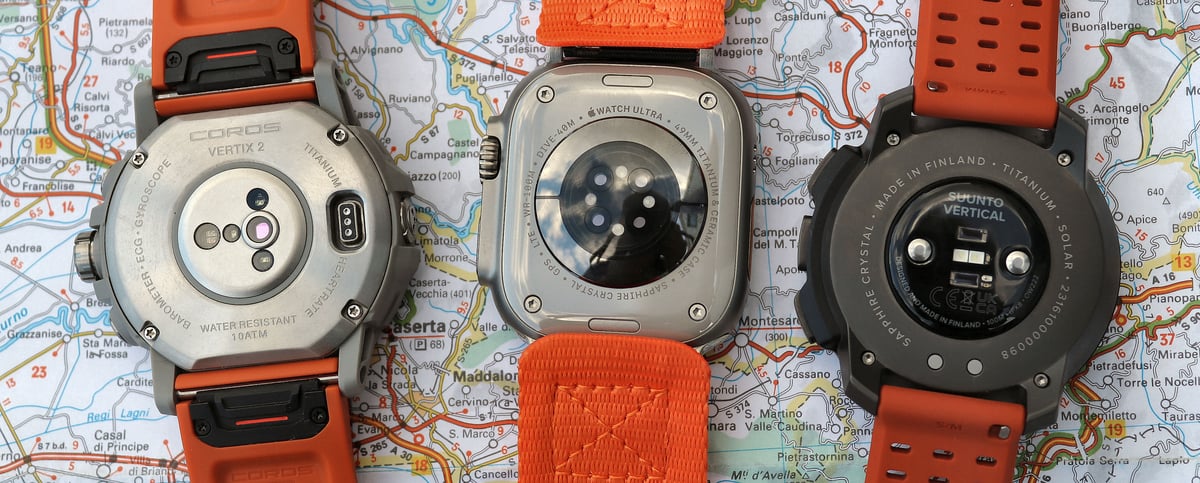
Metal cases block radio waves: Bluetooth, Wi-Fi, and satellite, which is why every titanium and stainless steel smartwatch has plastic somewhere in its shell. The choice between titanium, stainless steel, aluminium, ceramic, and polymer affects more than weight and scratch resistance, because it also determines where the antennas go, how thick the case has to be, and which radios fit within the available size.
Why a smartwatch case is harder to build
A traditional watch case has to keep water out and look good. A smartwatch case does both while meeting four further demands:
- It must let GNSS, Bluetooth, Wi-Fi, LTE, and sometimes satellite signals pass through in both directions.
- It must hold an optical sensor flat against the skin.
- Its buttons must survive diving pressure.
- On solar models, it must keep a light-harvesting layer facing the sky.
The antenna is the awkward part. Polar’s GNSS guide says an antenna works best when it is large and well away from the wrist. Most people want the opposite: a thin, small watch.
Titanium vs stainless steel watch cases, and the alternatives
| Material | Density (g/cm³) | Hardness (HV) | Under impact | Radio signals | Heat spreading |
|---|---|---|---|---|---|
| Grade 2 titanium (commercially pure) | about 4.5 | 120 to 200 | Scratches, dents | Blocks | Moderate |
| Grade 5 titanium (alloy) | 4.43 | about 350 | Resists scratches and dents rather than cracks | Blocks | Poor |
| 316L stainless steel | about 8.0 | 150 to 220 | Scratches, dents, polishes out | Blocks | Moderate |
| Aluminium, anodised | 2.7 | Soft metal, hard oxide skin | Dents, scratches through to bare metal | Blocks | Good |
| Fibre-reinforced polymer | 1.3 to 1.6 | Soft | Flexes, scuffs | Passes (glass fibre) | Insulates |
| Carbon fibre and forged carbon | 1.5 to 1.7 | Depends on resin | Can chip or delaminate | Blocks or weakens | Low |
| Zirconia ceramic | about 6.0 | 1,200 to 1,400 | Resists scratches, can chip or crack | Passes | Low |
- Titanium is a little over half the weight of stainless steel and contains no nickel. Grade 5, the alloy, is about twice as hard as pure Grade 2 and can be polished. Grade 2 is softer, so it is usually brushed or bead-blasted to hide scratches.
- Stainless steel scratches more easily than Grade 5 titanium, but the scratches polish out. It contains nickel, which irritates some people’s skin. Its weight is the main reason sports watch brands stopped using it.
- Aluminium is the lightest and cheapest metal to work with, so mid-priced metal smartwatches use it. Anodising gives it colour and a hard surface. The metal underneath is still soft, so it dents. A deep scratch shows bare metal through the colour.
- Fibre-reinforced polymer flexes rather than breaks, and sweat and seawater do not affect it. The glass-fibre type lets radio signals straight through. It scuffs, and it does not feel expensive.
- Carbon fibre and forged carbon look like plastic but block radio signals almost as much as metal. That is because carbon fibres conduct electricity. Glass-fibre and aramid composites let signals through.
- Ceramic is the hardest case material to scratch, and radio signals pass through it. It cannot bend, so a hard knock can chip or crack it. That is why brands mostly use it for bezels and casebacks.
Titanium is also poor at spreading heat. Grade 5 conducts heat at about 6.7 W/m·K, less than half the rate of 316L steel. A titanium case therefore does little to draw heat away from the processor during charging or long LTE use. The watch’s internal design has to do that job instead.
Lenses and coatings
- Sapphire is the hardest common lens material, at about 2,000 HV, so grit and keys rarely mark it. It is more likely than strengthened glass to crack if its edge takes a hard knock.
- Chemically strengthened glass is softer, but its surface is treated to resist cracks. Some brands now use glass designed to sit between the two. The strengthened glass vs sapphire comparison explains the differences.
- Mineral glass is cheaper and scratches sooner.
- Plastic scratches easily but almost never shatters.
Anti-reflective coatings make the screen easier to read in sunshine. They also let more light reach a solar panel underneath. On the outside of the lens, the coating can wear off before the lens does, which can look like a scratch on sapphire. DLC and PVD coatings give titanium and steel a colour and a harder surface. A deep scratch still shows the bare metal underneath. Unlike bare steel, a coated case cannot be polished back to new; it has to be stripped and recoated.
The radio problem: why metal and antennas fight
Metal reflects radio waves and soaks up their energy, so a sealed metal case stops signals from reaching the antennas inside it. Metal close to an antenna also detunes it. The antenna then no longer works best at the frequency it was designed for. Different radios suffer in different ways:
- GNSS suffers most, because satellite signals are already very weak by the time they reach your wrist.
- LTE and satellite messaging send and receive signals. A badly placed antenna drains the battery and can drop the connection.
- Bluetooth is the most forgiving, because the phone is usually close by.
Your body makes things worse. In tests by the European GNSS Agency, a watch’s position errors were two to four times larger on the wrist than with the same watch strapped face-up to a backpack. The arm and body absorb the signal and point the antenna away from the sky. No independent test has compared metal and plastic cases while keeping everything else the same. There is no scientific evidence that metal watches are less accurate.
Antenna design and placement likely matter more than case material.
Six ways to get signals through a metal case
Most premium watches combine two or three of these approaches.
| Approach | How it works | Examples |
|---|---|---|
| Polymer mid-case | A polymer body sits between a metal bezel and a metal back, so signals pass out through the sides. | Fenix 8, most outdoor watches |
| Bonded polymer windows | Thin polymer strips set into a metal case let signals out while keeping the metal look. | Fenix 9 Pro, MARQ Gen 3, Apple Watch Ultra |
| Bezel antenna | An electrically isolated metal bezel works as the antenna itself. | Fenix since 2015, Huawei Watch GT Runner 2 |
| Slots and breaks | Insulating gaps turn sections of a metal frame into tuned antennas. | Bezel and frame antennas |
| Non-metal caseback | A ceramic, sapphire, or polymer back passes signals out through the underside. | Cellular Apple Watch since Series 3 |
| Display antenna | The display stack, which faces the sky, carries the antenna. | Apple Watch Series 3 LTE |
Bonded windows: Garmin and Apple
Older designs such as Fenix 8 sandwich a polymer middle between metal parts. Every joint needs a rubber seal, and each seal adds height. Nano-moulding gets rid of those seals. The metal surface is etched with tiny pits, tens of nanometres across. The polymer is then injected, flows into the pits, and locks in place. Garmin COO Brad Trenkle told TechRadar this is why the all-titanium Fenix 9 Pro uses it: “You add multiple gaskets, you get thickness, and then suddenly you’re wearing a tuna can on your wrist.” The 47mm Fenix 9 Pro is 13.8mm thick, against 16mm for the Fenix 8 Pro it replaced.
Apple gets the same result a different way. The 3D-printed titanium case of Apple Watch Ultra 3 has a texture printed on the inside, so the plastic antenna strips grip the metal better. Apple says this makes the cellular models more waterproof.
Bezel antennas: Garmin and Huawei
Garmin has used the metal bezel as a GPS antenna on Fenix watches since Fenix 3 in 2015. Huawei Watch GT Runner 2 separates its titanium bezel from the rest of the case with a thin 1mm ring, so the bezel works as a second GNSS antenna. It produced some of the best wrist GPS tracks I have tested.
Garmin patent applications published in March 2026 go further. They describe the bezel and the metal back plate working as two separate antennas. The watch would switch them between GPS, the right mobile bands for the country it is in, and satellite messaging. Two more applications, published in October 2026, split the metal case into sections, each working as its own antenna.
Display and caseback: Apple
When Apple added LTE to Apple Watch Series 3 in 2017, it said the watch used “the display itself as both a transmitting and receiving element for LTE and UMTS”. The cellular model also got a ceramic and sapphire back, whereas the GPS-only model had a composite one. The display faces the sky, which suits an antenna. It also has to hold the touch layer, the screen panel, and, on some watches, a solar layer, which leaves little room.
Satellite messaging and the size squeeze
Every extra radio needs its own antenna space. Dual-band GNSS adds the L5 band, which needs a bigger antenna than L1. LTE adds several more bands. Satellite messaging needs a transmitter strong enough to reach orbit from your wrist. All of them have to work without interfering with each other. A smaller case has less room for them.
Case size has already decided one product line:
- Garmin launched Fenix 8 Pro in 2025 without a 43mm version, saying this was “due to hardware limitations with integrating the LTE antenna”.
- A year later, Fenix 9 Pro offers LTE and satellite messaging in all three sizes. The 43mm model is 13.3mm thick, thinner than the 43mm Fenix 8, which has neither.
Garmin says the nano-moulded full titanium case made the watch thinner. Apple says it redesigned the satellite antenna in Ultra 3 to double its signal strength. It also says the watch can use two antennas at once when mobile signal is weak.
Water, buttons, and seals
Every opening in a case is a possible leak. Rubber seals also age, because heat, sunscreen, and soap harden them and squash them out of shape. A water resistance rating applies to the watch when it is new, which is why dive watches are pressure-tested at every service.
Sealed buttons get rid of the holes. They detect a press through the solid case wall instead of pushing a part through it. Trenkle described the MARQ Gen 3 design as “a wall of polymer that makes a complete seal between the watch case. There’s no gasket, and it’s just one piece.” Sealed buttons can feel soft, so MARQ adds a mechanical clicker just for the feel. Nano-moulded joints also cut the number of seals. Nobody has published data yet on how well those metal-to-polymer bonds last after years of sweat, sun, and temperature changes.
Weight, heat, and sensors
- A lighter case leaves room for a bigger battery without adding weight. That is one reason large multisport watches use titanium or polymer rather than steel.
- Metal feels cold when you first put the watch on. It can also carry the outside temperature to the skin temperature sensor, so the sensor has to be insulated from the case.
- ECG and body composition readings use parts of the metal case as electrodes, so those parts have to be electrically separated from the rest of the case.
- Where two different metals touch, sweat can cause galvanic corrosion, so joints between, for example, titanium and aluminium need insulation.
- Magnets in chargers and straps have to sit far enough from the compass not to throw it off.
Straps, fit, ports, and ratings
How the strap attaches
Most straps attach in one of three ways:
- Standard spring bars take any strap of the right width, and replacements are cheap.
- Quick-release spring bars have a small lever, so you can swap straps without tools. Most mid-range watches use them.
- Proprietary systems, such as a latch that clicks into the case or a band that slides into a groove, are quick and secure. They limit you to the brand’s own straps or licensed ones.
Fenix 9 Pro uses Garmin’s own latching bands, in 20mm, 22mm, or 26mm widths depending on case size. Owners who have lost watches in open water mostly describe a silicone band snapping or a loose strap end catching and pulling free, rather than the latch opening. A nylon loop-through strap or a second keeper is the usual precaution for open-water swimming and sailing.
Metal bracelets
No watch brand or independent test has shown that a metal bracelet hurts GPS reception. Owners say steel bracelets can upset the compass. Titanium does not, because it is not magnetic. A bracelet adjusts a whole link at a time, so it often sits looser than a strap. The heart rate sensor can then move about during a run.
Case length and fit
The size printed on the box is the case diameter. The distance from one lug tip to the other decides whether a watch fits a small wrist. If the lugs hang over the edge of your wrist, the case rocks and the back lifts off your skin. That upsets the sensors. Garmin’s manuals say to wear the watch above the wrist bone, snug but comfortable, so it doesn’t move during exercise.
Speaker, microphone, and barometer ports
Speakers, microphones, and barometric altimeters all need openings to the outside air. Water can get through those openings too, so each one is covered by a waterproof membrane. The membrane lets sound and air pressure through but not water. Rinsing the watch in fresh water after swimming in the sea or a pool stops salt and chlorine from building up on it.
Water ratings and dive standards
A rating such as 10 ATM describes a pressure test, not a diving certification. ISO 6425 is the standard for diving watches, and EN13319 covers diving equipment. Fenix 9 Pro has a 40m dive rating under EN13319.
How the case is made
Metal cases can be machined from a solid block, forged, made by metal injection moulding, or 3D printed. The method decides which shapes are possible. Apple says its 3D-printed titanium cases use half as much metal as its earlier machined ones. It also says printing lets the antenna strips lock into the titanium in a way machining could not.
What traditional watches learned first
GPS analogue watches ran into these problems before smartwatches did. Seiko’s history of its Astron GPS Solar shows three stages:
- The first Astron GPS Solar, in 2012, had a ring-shaped antenna around the movement. A ceramic bezel stopped the metal case from blocking satellite signals. The case was 47mm wide and 16.5mm thick.
- In 2018, a new GPS chip and a differently shaped antenna allowed a metal bezel on the 5X series.
- In 2019, a flat antenna allowed smaller cases. Seiko says a smaller case puts the antenna closer to the bezel, which makes good reception harder to achieve.
Smartwatches have followed the same path. Brands started with non-metal parts and switched to full metal once antennas and receivers were good enough.
How to choose
- Choose titanium if light weight and comfort on long sessions are worth paying for. Pick Grade 5 or a coated finish if you want it to keep looking new.
- Choose stainless steel for the cheapest metal case, or for a polished finish you can restore. Expect the extra weight.
- Choose aluminium for a light metal watch at a lower price, but expect it to dent.
- Choose fibre-reinforced polymer if you crash, climb, or swim in the sea and care more about weight and toughness than looks.
- Choose ceramic for a bezel or back that will not scratch, and treat it more carefully than metal.
If GPS accuracy is your priority, look at test results rather than case materials. A well-designed metal watch can track as well as a plastic one. The latest results are on the GPS accuracy hub.
Quick answers
Is titanium or stainless steel better for a watch?
Titanium is better for a sports watch. It weighs a little over half as much as stainless steel, contains no nickel, and does not corrode in sweat or sea water. Stainless steel is cheaper and heavier, and it is easier to polish back to new.
Is the titanium or aluminium Apple Watch better?
Titanium is harder to dent, usually comes with a sapphire lens, and costs more. Aluminium is lighter and cheaper, but it dents more easily and scratches through its coloured finish to bare metal.
What is the difference between Grade 2 and Grade 5 titanium?
Grade 2 is commercially pure titanium, while Grade 5 is an alloy with aluminium and vanadium. Grade 5 is about twice as hard, so it scratches less and takes a polish, while Grade 2 is softer and usually comes brushed or blasted.
Does a titanium case hurt GPS accuracy?
A metal case blocks radio signals, so titanium watches use polymer windows, an isolated bezel antenna, or a non-metal back to let them through. Independent tests have not shown metal watches to be less accurate than plastic ones. Antenna design affects accuracy more than the case material.
Is sapphire better than mineral glass on a watch?
Sapphire scratches far less than mineral glass but can crack from a hard knock on its edge. Mineral glass is cheaper and scratches sooner.
Can a quick-release watch strap come off while swimming?
Owner reports of watches lost in open water mostly describe a silicone band snapping or a loose strap end catching, rather than the release mechanism opening. Checking the band for cracks and using a second keeper or a loop-through nylon strap reduces the risk.
Is a ceramic watch case durable?
Ceramic is almost impossible to scratch in daily wear, but it cannot bend, so a hard drop onto a sharp edge can chip or crack it.
Source and original research by: the5krunner and TechRadar
Last Updated on 3 November 2026 by tfk the5krunner
Small things I always use
- Garmin 90-degree charging adapter: Charges your Garmin from any USB-C cable. Essential when travelling. I use one.
- Body Glide: The blue anti-chafe stick swimmers and runners carry. I use it.
- Speedo earplugs: Fewer ear infections and no cold-water dizziness. I use them.
- Dryrobe Advance: My winter changing robe for open-water swims. I use one. A cheaper option is the AONYIYI changing robe.
- Maurten: Race fuel that stays easy on the stomach. I use them.
- Beet It Sport nitrate shots: Beetroot shots I take in the days before a race. I use them.
- Garmin charging puck: The quickest way to top up before a session. I use one.
- Injinji: Toe socks that stop rubbing, so you run more. I use them.
- Ultimate toe protectors: Stop black toenails on long runs. They work. I use them.
- Compressport R2 v2 calf sleeves: My calf sleeves of choice. I use them.
- Cellucor C4: My pre-workout before hard sessions.
- TPU tubes: Schwalbe Aerothan, Tubolito and Pirelli SmarTube. Light, tiny spares. I use all three.
- G8 insoles: Adjustable insoles that are good. I use them.
- Cycplus Cube: A 97g electric pump that gets a road tyre rideable in two minutes. I carry one. 5% off with code THE5KRUNNER.
Watches and sensors
- Polar H10: My daily driver for waking HRV.
- Polar Verity Sense: My backup arm-worn HR sensor.
- Nomad bedside charger: Charges my iPhone and Apple Watch overnight. I use it, and many of their bands.
- Train.Red: The best muscle oxygen sensor I’ve used.
- Tymewear: Accurate heart rate and reliable ventilatory zones. I use it to pace endurance rides over an hour.
- Garmin Forerunner 970: A pro-grade triathlon watch. I use this.
- Apple Watch Ultra 4: My daily smartwatch. No phone needed on rides.
- Garmin Fenix 9 Pro: I’ve just bought one.
On the bike
- Continental GP5000 for everyday riding, and Aero 111 on the front for special occasions.
- Helmets: Specialized S-Works Evade 3 for road riding, and Rudy Project Wing for TT-style races. I use both.
- Ravemen FR300: A front light that mounts under your Garmin or Wahoo. I use one.
- Ravemen FR1000: The light and the computer mount in one unit, so nothing else goes on the bars. Better than mine.
- Ravemen FR1500SE: 1,500 lumens hanging under your Garmin, for proper night rides.
- Ravemen FR1100SE: 1,100 lumens under your Garmin, and up to 46 hours on slow flash.
- Ravemen FR500: A brighter FR300 with the same mount.
- Wahoo TRACKR Radar: I use it on one bike and Varia on the other. They perform the same.
- Garmin Varia RTL515: Radar that warns you of cars from behind. I use this model.
- Wahoo ELEMNT Roam 3: The bike computer that’s easy to use. I use mine on most rides.
- Favero Assioma Pro RS2: Accurate power pedals that swap easily between bikes. I use this model.
Home and indoor training
- NPE Runn: Makes my basic treadmill smart, sending more accurate speed and distance to my watch and Zwift. I use it.
- Google Wifi: Keeps Zwift connected in my pain cave. I use it.
- Apple TV 4K: Zwift on the big screen. I use two.
- Google Nest Doorbell (wired, 2nd gen): My video doorbell, running in both Google Home and Apple Home. I use it.
Health, recovery and sleep
- FreeStyle Libre 3 Plus: Shows how my blood sugar responds to diet.
- hDrop: Measures my sweat loss in summer and indoors.
- Fourth Frontier Zone: Checks my heart under load in hard sessions.
- Kineon MOVE+: Red and infrared light for sore knees, Achilles and other joints after hard training. I use it.
- Oura Ring 5: My partner’s recovery tracker of choice.
- Eight Sleep: A cooling mattress cover my partner and I use nightly.
Reader-Powered Content

This content is not sponsored. It’s mostly me behind the labour of love, which is this site, and I appreciate everyone who supports it.
Support the site: Follow (free, fewer ads) · Subscribe (paid, ad-free) · Buy Me A Coffee
Written by real people, with AI assistance. Fact-checked and verified for originality. See the Editorial Policy. FTC: Affiliate Disclosure — some links pay commission. As an Amazon Associate, I earn from qualifying purchases.
tfk is the founder and author of the5krunner, an independent endurance sports technology publication. With 20 years of hands-on testing of GPS watches and wearables, and competing in triathlons at an international age-group level, tfk provides in-depth expert analysis of fitness technology for serious athletes and endurance sport competitors. See the gear tfk uses. ID
