Here, we look at what has really changed in the Fenix 9 and 9 Pro. Garmin’s specs only go so far in telling us what has changed since the Fenix 8.
The official specifications merely confirm three hardware changes across the Fenix 9 generation: 64GB of storage on every model, brighter AMOLED displays at every size, and a full-titanium case on the Fenix 9 Pro. Garmin, via DC Rainmaker, confirms the Pro also runs a newer chip than the standard Fenix 9. Everything else Garmin lists is unchanged from the Fenix 8 generation, including the heart rate sensor and the advertised GPS capabilities.
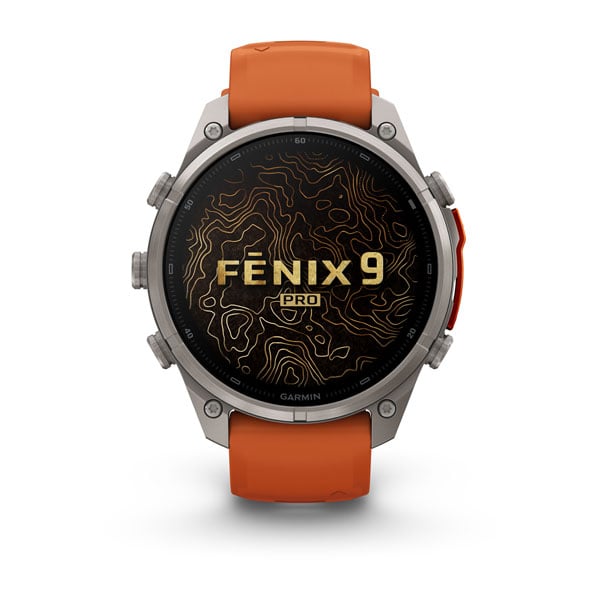
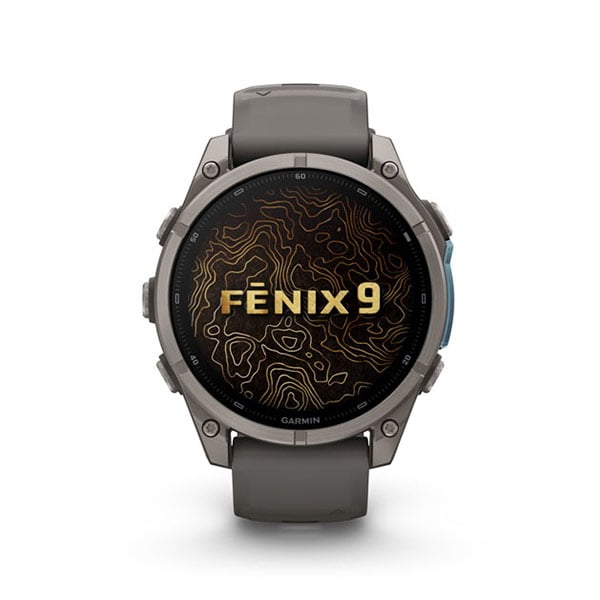
Some parts don’t appear on any spec sheet. The exact chip, the small helper chip that tracks background sensors, the WiFi/Bluetooth chip, the motion sensor, and the battery capacity are all things Garmin never publishes. What’s known for the Fenix 8 generation comes entirely from teardown work. No teardown exists for the Fenix 9 yet, so the table below separates what’s confirmed from what’s still a reasonable guess. If new info emerges, please add it in the comments and I will keep this updated.
| Component | Fenix 8 / 8 Pro | Fenix 9 | Fenix 9 Pro |
|---|---|---|---|
| Main chip | NXP RT595, 200MHz | Assumed RT700 | Newer chip (confirmed) |
| Working memory | 5MB | Assumed 7.5MB | Assumed 7.5MB |
| Graphics chip | Older, basic type | Assumed newer type | Assumed newer type |
| AI hardware | None | Assumed present, unused | Assumed present, unused |
| Storage | 32GB | 64GB | 64GB |
| Heart rate sensor | Elevate Gen 5 | Unchanged | Unchanged |
| GPS chip | Synaptics SYN4778 | TBC | TBC |
| GPS capability | Dual-frequency, 5 systems | Unchanged | Unchanged |
| Background sensor chip | Ambiq Apollo 3 | TBC | TBC |
| WiFi/Bluetooth chip | Silicon Labs RS9116 | TBC | TBC |
| Motion sensor | ST S4-420 | TBC | TBC |
| Display, 43mm | 1.3″/416×416 | Unchanged | Unchanged |
| Display, 47mm | 1.4″/454×454 | Unchanged | Unchanged |
| Display, 51mm | 1.4″/454×454 | Unchanged | 1.5″/466×466 (new) |
| Display, 51mm MicroLED | Up to 4,500 nits, 454×454 | N/A | N/A |
| Display brightness (AMOLED) | Baseline | ~2,000 nits | Up to 3,000 nits |
| Solar/MIP variant | Fenix 8: Solar 47/51mm; Fenix 8 Pro: not offered | Not offered | Solar 47/51mm, with inReach (confirmed) |
| Display generation | Established | New | New |
| Case material | Polymer, titanium rear | Polymer, titanium rear | Full titanium |
| Antenna design | Standard | Unchanged | TBC |
| Flashlight colours | White LED | TBC | White, plus green LED added (confirmed) |
| Battery capacity | 618mAh (51mm Solar, per teardown) | Unconfirmed capacity; longer battery life confirmed | Unconfirmed; same open question |
Is the chip actually new
Garmin has never named the chip in any Fenix watch. The Fenix 8’s chip, an NXP part called the RT595, is the same chip used since the Fenix 7X in 2022. It has 5MB of built-in memory and no way to add more, which is a reason Fenix 8 owners have complained for years about maps stuttering when they scroll around.
Garmin’s own launch figures say the Fenix 9 generation has 50% more memory than the Fenix 8, without splitting the standard model from the Pro. That maths lines up exactly with NXP’s next chip in the same family, the RT700, the RT595’s successor. That suggests both watches share the same new chip.
Garmin, via DC Rainmaker, confirms the Pro’s chip is newer than the standard model’s. At the same time, Garmin’s own map-speed figures barely move between the two: about 30% faster panning than the Fenix 8 on the standard watch, and roughly the same 30–40% range on the Pro. A genuinely different, faster chip would likely show a bigger gap. The inference is that both watches use the same new chip family, with the Pro running faster or configured differently.
A public benchmark of Garmin’s Connect IQ platform offers an early empirical check on that inference: the Fenix 9 Pro currently tops WristBench’s speed leaderboard, though the result rests on only two submitted devices.
What stayed the same
Every Fenix 9 model uses Elevate Gen 5, the same sensor as the Fenix 8 and Fenix 8 Pro.
The GPS is described the same way too: dual-frequency tracking across five satellite systems, worded identically to the Fenix 8. Before launch, this site and others expected Garmin to add a third GPS frequency this year or next. That didn’t happen. Whether the chip changed is unconfirmed, but a Garmin forum thread shows the Fenix 9 Pro’s GPS firmware on a different version track to the Fenix 8’s, worth watching, not proof. WiFi and Bluetooth firmware in the same thread matches exactly, a stronger sign those two are unchanged.
The screens, size by size
Every AMOLED screen got brighter: roughly 2,000 nits on the standard watch, up to 3,000 nits on the Pro. The 51mm Pro increased to 1.5″ with a 466×466 display, up from the Fenix 8 Pro’s 1.4-inch, 454×454 panel. Every other size and tier kept its existing dimensions and resolution.
A sharper, bigger screen at one size only proves Garmin used a new panel there. Garmin confirms the standard Fenix 9 also runs a new panel generation, not a carried-over Fenix 8 Pro display, which fits with every size getting brighter at once.
The titanium case, and the one real open question
The Fenix 9 Pro is the first Fenix built by fusing titanium and plastic together at a microscopic level. The Fenix 8 Pro only used titanium for the outer ring and the back. Garmin confirms the thinner build is measurable too: the 47mm Fenix 9 Pro is 16% slimmer than the 47mm Fenix 8 Pro.
Metal blocks radio signals. Watches with fully metal bodies have always needed a deliberate gap of non-metal material for GPS, satellite, WiFi and Bluetooth signals to pass through, which is exactly why the Fenix 8 Pro kept its titanium limited to the ring and back. Whether the fully-titanium Fenix 9 Pro handles this properly, especially with satellite messaging now offered on the 43mm size for the first time, remains to be seen. This is the one open hardware question in the whole lineup that could genuinely affect real-world performance.
Quick answers
Did Garmin upgrade the heart rate sensor on the Fenix 9 or Fenix 9 Pro?
No. Both use the same Elevate Gen 5 sensor as the Fenix 8 and Fenix 8 Pro, confirmed on Garmin’s own spec sheet.
Is the GPS chip different on the Fenix 9?
No confirmed difference. Garmin lists the same dual-frequency GPS across five satellite systems as the Fenix 8. Whether the physical chip changed is unconfirmed pending a teardown.
Does the Fenix 9 Pro have a faster chip than the standard Fenix 9?
Yes, confirmed by Garmin via DC Rainmaker. Both likely share the same new chip family at different speeds, but a teardown hasn’t confirmed that detail.
Which Fenix 9 model got a new screen?
Only the 51mm Fenix 9 Pro changed size and sharpness. Every other size kept its existing dimensions, just brighter.
Does the titanium case affect GPS or satellite signal?
Unknown. Fully metal cases have historically needed a special gap for signals to pass through. Garmin hasn’t addressed this for the Fenix 9 Pro, and no reviewer has tested it yet.
Source and original research by: the5krunner and NotebookCheck.
Last Updated on 3 October 2026 by tfk the5krunner
Small things I always use
- Garmin 90-degree charging adapter: Charges your Garmin from any USB-C cable. Essential when travelling. I use one.
- Body Glide: The blue anti-chafe stick swimmers and runners carry. I use it.
- Speedo earplugs: Fewer ear infections and no cold-water dizziness. I use them.
- Dryrobe Advance: My winter changing robe for open-water swims. I use one. A cheaper option is the AONYIYI changing robe.
- Maurten: Race fuel that stays easy on the stomach. I use them.
- Garmin charging puck: The quickest way to top up before a session. I use one.
- Injinji: Toe socks that stop rubbing, so you run more. I use them.
- Ultimate toe protectors: Stop black toenails on long runs. They work. I use them.
- Compressport R2 v2 calf sleeves: My calf sleeves of choice. I use them.
- Cellucor C4: My pre-workout before hard sessions.
- TPU tubes: Schwalbe Aerothan, Tubolito and Pirelli SmarTube. Light, tiny spares. I use all three.
- G8 insoles: Adjustable insoles that are good. I use them.
- Cycplus Cube: A 97g electric pump that gets a road tyre rideable in two minutes. I carry one. 5% off with code THE5KRUNNER.
Watches and sensors
- Polar H10: My daily driver for waking HRV.
- Polar Verity Sense: My backup arm-worn HR sensor.
- Nomad bedside charger: Charges my iPhone and Apple Watch overnight. I use it, and many of their bands.
- Train.Red: The best muscle oxygen sensor I’ve used.
- Tymewear: Accurate heart rate and reliable ventilatory zones. I use it to pace endurance rides over an hour.
- Garmin Forerunner 970: A pro-grade triathlon watch. I use this.
- Apple Watch Ultra 4: My daily smartwatch. No phone needed on rides.
- Garmin Fenix 9 Pro: I’ve just bought one.
On the bike
- Continental GP5000 for everyday riding, and Aero 111 on the front for special occasions.
- Helmets: Specialized S-Works Evade 3 for road riding, and Rudy Project Wing for TT-style races. I use both.
- Ravemen FR300: A front light that mounts under your Garmin or Wahoo. I use one.
- Wahoo TRACKR Radar: I use it on one bike and Varia on the other. They perform the same.
- Garmin Varia RTL515: Radar that warns you of cars from behind. I use this model.
- Wahoo ELEMNT Roam 3: The bike computer that’s easy to use. I use mine on most rides.
- Favero Assioma Pro RS2: Accurate power pedals that swap easily between bikes. I use this model.
Home and indoor training
- NPE Runn: Makes my basic treadmill smart, sending more accurate speed and distance to my watch and Zwift. I use it.
- Google Wifi: Keeps Zwift connected in my pain cave. I use it.
- Apple TV 4K: Zwift on the big screen. I use two.
- Google Nest Doorbell (wired, 2nd gen): My video doorbell, running in both Google Home and Apple Home. I use it.
Health, recovery and sleep
- FreeStyle Libre 3 Plus: Shows how my blood sugar responds to diet.
- hDrop: Measures my sweat loss in summer and indoors.
- Fourth Frontier Zone: Checks my heart under load in hard sessions.
- Oura Ring 5: My partner’s recovery tracker of choice.
- Kineon MOVE+: Red light therapy for niggles. It works.
- Eight Sleep: A cooling mattress cover my partner and I use nightly.
Reader-Powered Content

This content is not sponsored. It’s mostly me behind the labour of love, which is this site, and I appreciate everyone who supports it.
Support the site: Follow (free, fewer ads) · Subscribe (paid, ad-free) · Buy Me A Coffee ❤️
Written by real people, with AI assistance. Fact-checked and verified for originality. See the Editorial Policy. FTC: Affiliate Disclosure — some links pay commission. As an Amazon Associate, I earn from qualifying purchases.

tfk is the founder and author of the5krunner, an independent endurance sports technology publication. With 20 years of hands-on testing of GPS watches and wearables, and competing in triathlons at an international age-group level, tfk provides in-depth expert analysis of fitness technology for serious athletes and endurance sport competitors. ID

The Fenix 9 Pro has a new faster processor but the f9 seemingly doesn’t?
I have the impression that a Fenix 9 (non-pro) is virtually identical to a an original Fenix 8. The only difference seems to be enough memory to enable offscreen map tile rendering for faster pan and zoom and more solid state storage.
no, i believe it does!
the extra memory (as per garmin claims) can’t be added to the old processor. so it must be a new processor.
i have heard what various others have been told by garmin. perhaps the new processor is otherwise tuned down in some way?
The RT595 has 5 MB of RAM integrated into the SoC, and that amount is fixed. In theory, however, additional RAM could be added through its FlexSPI interface, which supports external memory. That seems unlikely in this case, but it is technically possible.
A 50% increase would bring the total to exactly 7.5 MB, matching the integrated SRAM available in NXP’s i.MX RT700 family. That would make much more sense. We’ll see…
exactly the conlusion i came to. i think i wrote that?
plus it just makes sense to have the same internals in this both variants of this generation of product
as @jay says, mayeb the ram is better or there is some other optimistion on the pro model. Garmin seems to not be being fully transparent here when there is no reason not to be
My conspiracy theory is that the Fenix 9 has the RT595 but theyre using much faster storage which allows the mapping assets to stream faster into memory off the new 64GB SSD.
Ok the RT700 makes sense. It has vector graphics hardware instructions and 50% more RAM which makes sense as the basis of the “new map engine”.
Maybe they have binned slow versions in the base vs full 325mhz in the pro. Maybe the pro case is actually thermally more efficient? Or they use faster storage in the pro?
https://benchmark.wristtale.com/?lang=eng&sort=logic&dir=desc
006-B4953-00
006-B4956-00
Both benchmarks are showing similar values to previous gen to be RT700, but maybe garmin does not expose full capacity to CIQ?
FCC filings indicate 9 Pro uses Nordic’s nRF9151 for LTE and satellite
ty. will check and add
According to Garmin, both the Fenix 9 and Fenix 9 Pro has the same processor, RAM and improvement over the 8 Pro.
Regarding the display, the F9 display is twice as bright as the F8 (meaning 2000 nits), whereas the Fenix 9 Pro offers up to 3000 nits.
Read carefully below the Hardware and Display Brightness sections:
https://www.garmin.com/en-US/blog/outdoor/the-difference-between-fenix-8-and-9/
For me personally, the Fenix 9 non-pro is the clever buy here. As long as there is Sapphire, I prefer the lighter model.
i dont trust that article: This is the same blog post already flagged for imprecision, it says “twice the amount of RAM,” while Garmin’s own press release says “50% more RAM than fēnix 8.”
Fair enough. But the press release is clearly wrong then, as it is 100% more RAM across the models (and the article remains correct on that point). Anyway, I went ahead and purchased the F9 non-pro, and from my initial non-scientific testing the panning across maps does feel faster compared to the 970 that I also have. Also, I see that the maps i now cached utilizing the memory a lot more.
it is better
i viedod actual performance next to a stopwatch. its not great quite a lot of the time. https://the5krunner.com/2026/09/03/garmin-fenix-9-pro-map-lag/
doubled/halved: i think i have the component specs above.