Best cycling computer 2026: Garmin Edge vs Wahoo vs Hammerhead
A cycling computer does one thing a GPS watch cannot: it puts a readable screen on your bars where your eyes already go. The best one for you depends on how you ride, how deeply you engage with training software, and whether you want a device that is simple by design or one that rewards complexity with capability.
This page covers the criteria that actually differentiate cycling computers in 2026 and applies them to the leading options. For the full Garmin Edge model breakdown, see the Garmin Edge hub. For the full Wahoo range, see the Wahoo hub.
What actually matters in a cycling computer
Battery life: most road and sportive rides fall within six to eight hours, which any current cycling computer handles comfortably. Battery life becomes the decisive factor for ultra-distance and bikepacking, where a device needs to survive 20 to 48 hours between charges. The Garmin Edge 1040 Solar at 45 hours base battery — extending further with solar in good conditions — is the only mainstream device that addresses this seriously. The Edge 1050 and 850, by contrast, deliver 20 and 12 hours respectively: shorter than the previous generation and a step backwards for endurance riders. If your rides regularly exceed 10 hours, the 1040 Solar is still the right choice in the Garmin range despite being the older device.
Sensor connectivity: ANT+ and Bluetooth dual-channel support is now standard on all serious cycling computers. The practical requirement is compatibility with power meters, heart rate straps, cadence sensors, speed sensors, radar, and Di2/AXS electronic groupsets. Every device on this page supports all of these. Where they differ is depth of integration: Garmin’s Rally power meter pedals and Varia radar pair natively with deep data screens and safety alerts that third-party devices cannot replicate on a Wahoo. For athletes heavily invested in third-party sensors, Hammerhead’s Karoo Extensions SDK has resolved compatibility issues — including with Shimano Di2 — that Garmin and Wahoo have not always handled smoothly.
Maps and navigation: all three leading platforms carry offline maps. Garmin’s TopoActive maps are preloaded worldwide. Wahoo uses a clean turn-by-turn implementation paired with Komoot. Hammerhead’s Karoo 3 has among the best map rendering of any cycling computer, with fast redraws and clear visual hierarchy. Map rendering speed matters more than map data quality at this level: the previous-generation Garmin x40 suffered from sluggish redraws on complex routes; the current 1050, 850, and 550 are significantly faster.
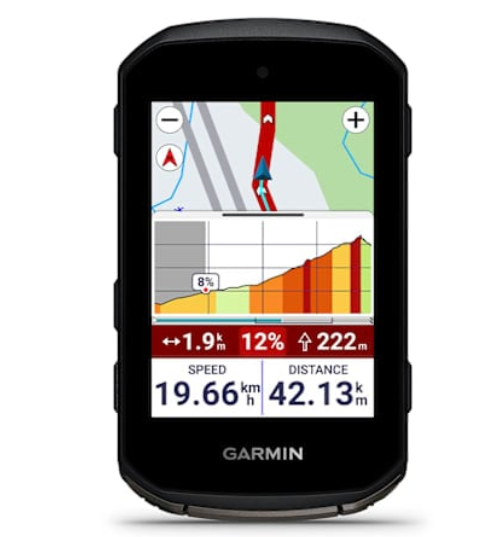
Climb-specific features: ClimbPro on Garmin is the standard that others are measured against. It displays the current climb as a profile with distance remaining, average gradient, and a colour-segmented segment showing where the hardest sections are. It feeds from a loaded course and updates in real time. It is available on the Edge 550, 850, 1050, and 1040 Solar. The ability to execute ClimbPro on a loaded course — not just a live grade readout — is now the mark of a mature, competent cycling computer. Wahoo has implemented a climb feature on recent ELEMNT firmware; Hammerhead has equivalent functionality on the Karoo 3. Budget computers from Bryton, Magene, and Coospo either lack it or implement it poorly. If you ride routes with significant climbing, this feature alone should narrow your shortlist to the leading three brands.
Strava Live Segments: Strava segment compatibility on device is not simply a link to Strava. It requires the computer to download starred segments, detect when you enter one in real time, display your current pace against the KOM and your PR simultaneously, and save the effort for Strava to verify. Garmin, Wahoo, and Hammerhead all implement this correctly. Budget devices often show a segment alert but cannot deliver the live comparison data that makes it useful.
Structured workout execution: a serious training platform integration is more than syncing a calendar. The computer must receive a structured workout from TrainingPeaks, Garmin Connect, or a coaching platform, execute it step by step on the device with target power, cadence, or heart rate for each interval, alert when you drift outside the target window, and advance automatically to the next step. Garmin’s implementation via Garmin Connect and TrainingPeaks is the most mature. Wahoo’s structured workout execution has improved significantly and now covers ERG mode control on KICKR trainers as well as outdoor intervals. Hammerhead’s TrainingPeaks integration is strong. This is not a feature budget devices support meaningfully.
Touchscreen vs buttons: Wahoo’s ELEMNT range is the clearest demonstration of what a button-first cycling computer interface looks like when designed from scratch for buttons. The LED strip on the ELEMNT Bolt 3 provides at-a-glance status without looking at the screen; the physical controls work reliably with gloves and in wet conditions. Garmin’s menu system was designed for touchscreens, and button-only models — the Edge 550 — inherit an interface that is harder to navigate than it should be. For pure ease of use out of the box, Wahoo leads. For depth of features and Garmin ecosystem integration, the Edge wins.
Garmin Edge: the deepest feature set
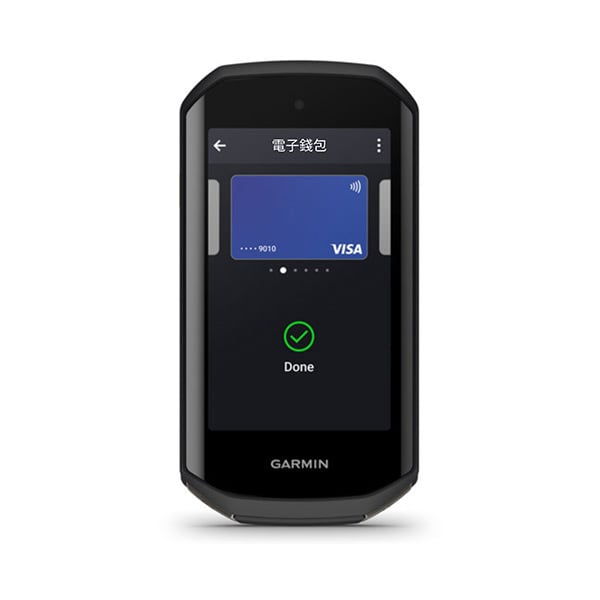
The Edge range is the most feature-complete cycling computer platform available. ClimbPro, Power Guide, Course Demands, Smart Fueling, GroupRide, Cycling Coach plans, Strava Live Segments, structured workout execution from TrainingPeaks and Garmin Coach, Varia radar integration, Garmin Pay, and direct ecosystem connection to Garmin watches via Physio TrueUp and extended display.
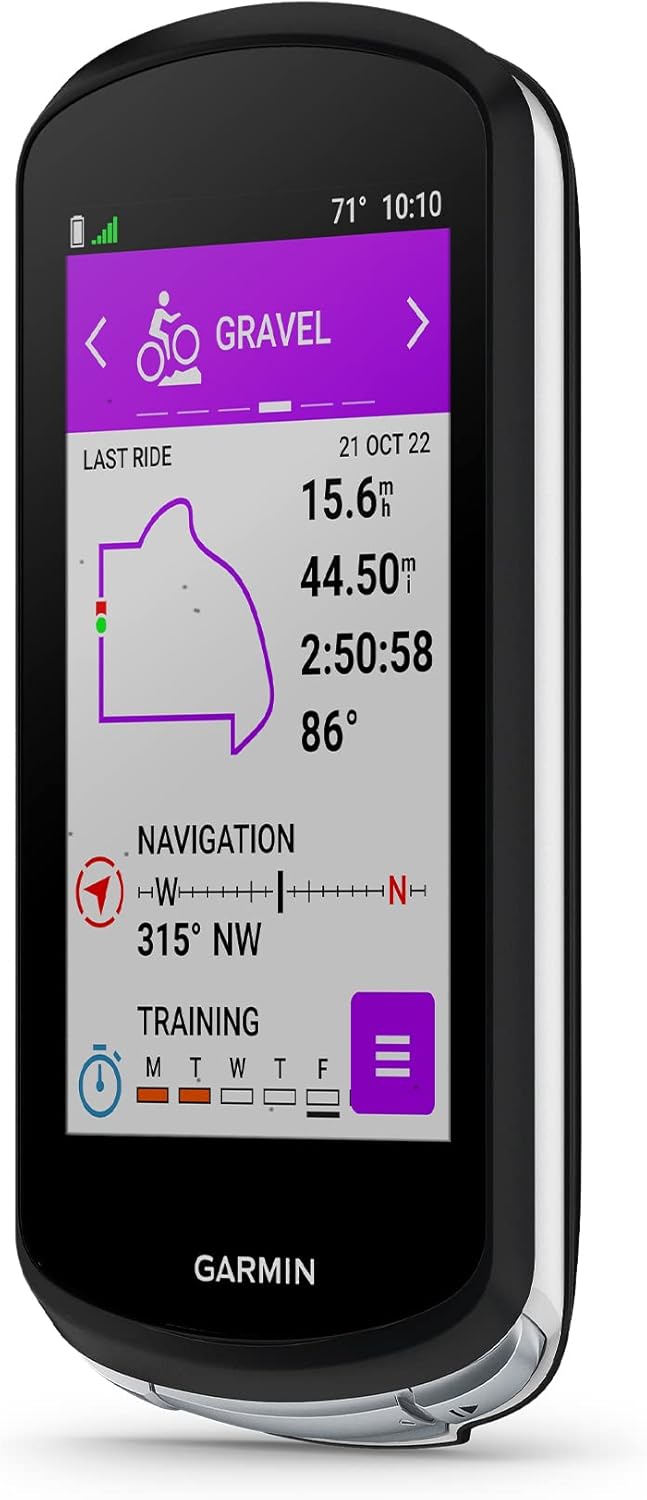
- Edge 1050 ($699): best for most serious road and sportive riders. 3.5-inch bright display, touchscreen, speaker, Garmin Pay, 20 hours battery. Buy Edge 1050.
- Edge 1040 Solar ($749 discounted): best for endurance, ultra-distance, and bikepacking. 45 hours base battery with solar extension. MIP display. Buy Edge 1040 Solar.
- Edge 850 ($599): best mid-size option. 2.7-inch touchscreen, full training stack, speaker, Garmin Pay, 12 hours battery. Buy Edge 850.
- Edge 550 ($499): button-only. Same training depth as the 850, harder to navigate. Buy Edge 550.

Wahoo ELEMNT: the easiest to use
Wahoo’s ELEMNT range is the right answer for riders who want a capable cycling computer without the configuration overhead of Garmin. The LED strip status indicator, clean page layouts, and button-first interface all work better out of the box than any Edge. Strava Live Segments, structured workout execution, ClimbPro-equivalent climb features, TrainingPeaks integration, and turn-by-turn navigation are all present. What Wahoo lacks relative to Garmin is ecosystem depth: no Varia deep integration, no native power meter pedals, no physio metrics from a paired watch.
- ELEMNT Bolt 3: compact, button-first, excellent battery, strong for everyday training and racing. Buy Bolt 3.
- ELEMNT Roam 3: larger screen, more navigation-focused, better for unfamiliar routes and longer rides. Buy Roam 3.
- ELEMNT Ace: Wahoo’s flagship, AMOLED touchscreen, most complete feature set in the Wahoo range. Buy ACE.
Hammerhead Karoo 3: the best display
The Karoo 3 has the best map rendering of any cycling computer currently available and a large, bright AMOLED touchscreen. The Karoo Extensions SDK allows third-party developers to add features directly to the device, which has resolved compatibility issues with Shimano Di2 and other hardware that Garmin and Wahoo have been slower to address. ClimbPro-equivalent climb features, Strava Live Segments, and structured workout execution from TrainingPeaks are all present. For riders who prioritise display quality and open platform flexibility, the Karoo 3 is a compelling alternative to the Edge 1050.
Budget options: Magene, Bryton, Coospo
Budget cycling computers from Magene, Bryton, and Coospo deliver GPS tracking, sensor connectivity, and basic navigation at prices from $80 to $200. What budget devices consistently lack is the climb-specific features, Strava Live Segment live comparison, and structured workout execution from a training plan that define a mature cycling computer. For a rider who wants GPS data on rides and nothing more, a budget device is adequate. For anyone who trains to a structured plan, targets segments, or rides significant climbing, the feature gaps are real.
Which cycling computer to buy
- Best for most serious riders: Garmin Edge 1050. Full feature set, bright touchscreen, ClimbPro, Strava Live Segments, structured workouts, Varia radar, 20 hours battery.
- Best for ultra-distance and bikepacking: Garmin Edge 1040 Solar. 45 hours base battery.
- Best for ease of use: Wahoo ELEMNT Bolt 3 or Roam 3. Button-first interface, all the features most riders need, simpler setup than any Edge.
- Best display and open platform: Hammerhead Karoo 3. Best map rendering, AMOLED screen, strong Di2 compatibility. Buy Karoo 3.
- Best mid-size Garmin: Edge 850. Touchscreen, full training stack, 12 hours battery.
- Not recommended unless budget is the primary constraint: Bryton, Coospo. Missing climb features, Strava live comparison, and structured workout execution.
For the full Garmin Edge model comparison, specs, and firmware history, see the Garmin Edge hub. For the full Wahoo range including KICKR trainer integration, see the Wahoo hub. For cycling watch recommendations, see the best cycling watch guide.
Best-of guides
Explore the full resource library
This site covers endurance sport technology across a range of dedicated reference sections. Each one collects the most relevant articles, tests, and analysis on its topic in one place.
Buyer guides
- Best sports watch: tested recommendations by sport and athlete type (triathlon, running, marathon, cycling, hiking, and women)
- Best Garmin watch: Forerunner versus Fenix by series, sport, and budget
- Best wearables: recovery trackers, heart rate monitors, running power meters, and female athlete tech
- Best cycling products: computers, smart trainers, power meters, and cycling heart rate monitors
Brand and product guides
- Amazfit: the full Amazfit range from Balance to Cheetah to T-Rex, accuracy tests, HYROX partnership, and Zepp Health analysis
- Apple Watch: athlete-first coverage of Apple Watch across running, cycling, and triathlon
- COROS: watches, features, and firmware across the full COROS range
- Garmin: the company, the platform and the full range, and the starting point for choosing across every Garmin product line
- Garmin Edge: bike computers from entry-level navigation to flagship endurance and mountain biking
- Garmin Fenix: every model, feature, and firmware development for Garmin's flagship outdoor watch
- Garmin Fenix 8 Series: which variant to buy, upgrade advice, accuracy data, and the full Fenix 8 review and firmware coverage
- Garmin Forerunner: the full Forerunner line covered from entry level to triathlon flagship
- Garmin Instinct: rugged GPS watches for endurance and adventure athletes
- Garmin Features Explained: how Garmin's metrics work, from Training Load and Body Battery to Race Predictor and HRV Status
- Google Fitbit: Fitbit Air, Google Health, Pixel Watch and the Wear OS platform
- Polar: watches, sensors, Polar Flow and training science across the full Polar range
- Runna: coach-written running plans that adapt as you train
- Suunto: Race, Vertical, Run and the SuuntoPlus ecosystem
- Strava: features, privacy, segments, and how Strava fits into a serious training setup
- Ride with GPS: route planning, navigation and how it works alongside Strava
- Wahoo: KICKR trainers, ELEMNT bike computers, and the Wahoo ecosystem
- WHOOP: strain, recovery, sleep and the full WHOOP ecosystem
Specifications database
- Full Specifications Database: detailed spec sheets, battery life, sensor lists and generation-on-generation comparisons for current Garmin, COROS, Amazfit, Samsung, Google Fitbit, Huawei, Polar, Suunto, Wahoo and Apple Watch models
Glossary
- Sports Technology Glossary: non-branded terminology across running, cycling, swimming, triathlon, hiking, strength training, HYROX, sensors, ecosystems, and brands
Sport and topic guides
- Running Watches: how to choose by discipline (road racing, trail, track, beginner, and multisport)
- Triathlon and Multisport Technology: watches, sensors, and race-day tools for swimmers, cyclists, and runners
- HYROX: training science, race analysis, and technology for the functional fitness race format
- parkrun: technology, training, and performance for the weekly 5K
- Hiking Technology: navigation, safety, and trail tech for walkers and hikers
- Heart Rate Monitoring: optical sensors, chest straps, accuracy comparisons, and how to set training zones
- Optical Sensors (PPG): the 40 things a wrist optical sensor could measure, from heart rate to glucose, ranked by evidence
- GPS Accuracy: how satellite systems perform across brands, terrains, and conditions
- Sports Watch Battery Life: battery claims, real-world tests, and how to manage battery life across Garmin, Apple, Amazfit and COROS
- Recovery Trackers: WHOOP, Oura, and the science of readiness scoring
- Muscle Oxygen Sensors: SmO2 and NIRS explained, Train Red and Moxy compared, and the category from BSX and Humon to Garmin and WHOOP
- Female Athlete Tech: wearables, physiology, and performance for female endurance athletes, covering cycle-synced training, RED-S, HR accuracy, and VO2max
- Sports Science: peer-reviewed research on HRV, VO2max, lactate threshold, running power, wearable accuracy, and supplementation
- Testing Methodology: how this site tests GPS accuracy, heart rate, battery life, and other performance claims
Content series
- Release Radar: confirmed launches, leaks, and rumours across Garmin, Apple, COROS, Polar, Suunto, and Wahoo
- Deep Dive Feature Files: weekly firmware feature updates across all brands (bug fixes excluded)
- Fix Files: weekly firmware bug fix tracking across all brands
