Bryton makes GPS bike computers for riders who want maps, structured training and radar alerts for less than the biggest brands charge. This page sorts the current Rider range, says which model suits which rider, and links every Bryton review and spec page on the site. The bike computers hub compares Bryton with every other brand.
Bryton in brief
- Best thing: a colour touchscreen, preloaded maps and climb data at prices well below the Garmin Edge range.
- Biggest drawback: everything runs through the phone app. Bryton units have no Wi-Fi, and speed, cadence and power sensors must be ANT+.
Which Bryton to buy
- Rider S810 suits serious road cyclists, endurance riders and touring cyclists who want a large navigation display, climb data on any ride and up to 50 hours of battery.
- Rider S510 suits performance-focused cyclists who want full navigation, structured training and broad sensor support in a smaller unit than the S810.
- Rider 650 suits recreational and club cyclists who want a light colour unit with maps, training tools and 33 hours of battery at a lower price.
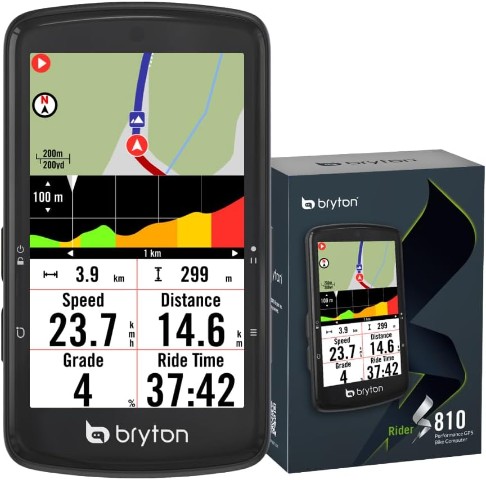
Bryton Rider S810
A big 3.5" colour touchscreen and up to 50 hours of battery, with preloaded maps and climb data on any ride.
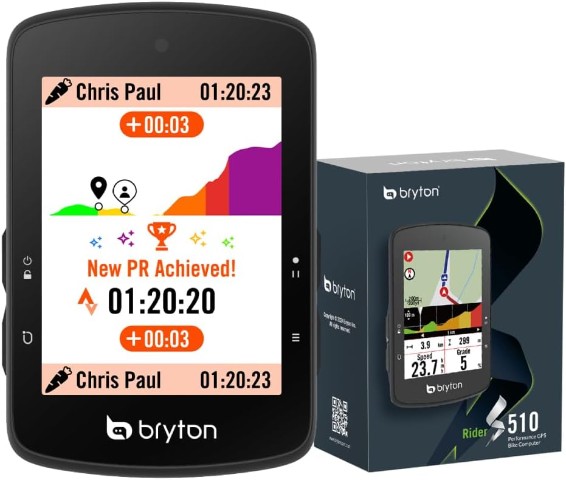
Bryton Rider S510
A compact colour touchscreen with offline maps, on-device rerouting and up to 30 hours of battery.
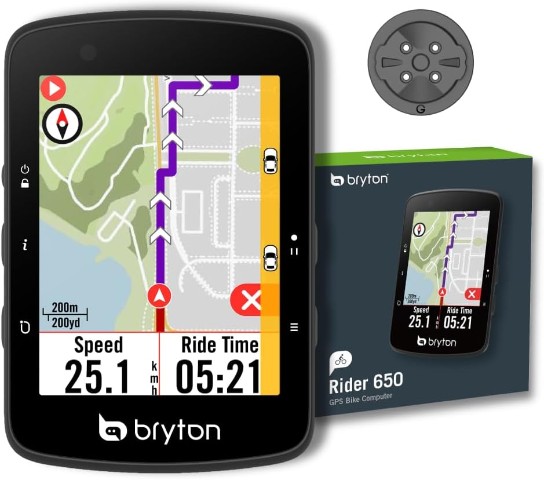
Bryton Rider 650
Bryton's lowest-priced colour touchscreen with preloaded maps, turn-by-turn directions and up to 33 hours of battery.
Riders who do not need maps can drop to the black and white Rider 460 or Rider 420, which give turn-by-turn directions on a followed route. The Rider 17 records the basics, and the GO and E10 show speed and distance without recording the ride at all.
How the range splits
Two features separate the models more than screen size does: whether the unit reroutes you without a phone when you miss a turn, and whether it shows climb data on a ride with no route loaded. Only the S510 does both. The S810 shows climbs on any ride but reroutes through the phone, as do the S800, S500 and 750 SE, and the Rider 650 and below show climbs only on a loaded route.
The price ladder is uneven. The S500 costs the same as the S810, and the S800 costs more than either, so the two newest S-series models are the better buys at Bryton’s own prices unless you want the S800’s MIP display, which Bryton designed for reading in bright sun. In the Rider series, the step that adds most is from the 550 to the 650, which brings a touchscreen and preloaded maps.
| Model | Screen | Maps | Reroutes | Climb data | Battery (claimed) | Bryton RRP (EUR) |
|---|---|---|---|---|---|---|
| Rider S810 | 3.5in colour touch | Yes | With phone | Any ride | 50 hours | 299.95 |
| Rider S510 | 2.8in colour touch | Yes | Without phone | Any ride | 30 hours | 249.95 |
| Rider S800 | 3.4in colour MIP touch | Yes | With phone | Routes only | 36 hours | 399.95 |
| Rider S500 | 2.4in colour touch | Yes | With phone | Routes only | 24 hours | 299.95 |
| Rider 750 SE | 2.8in colour touch | Yes | With phone | Routes only | 40 hours | 249.95 |
| Rider 650 | 2.8in colour touch | Yes | With phone | Routes only | 33 hours | 169.95 |
| Rider 550 | 2.8in colour, buttons | No | With phone | Routes only | 37 hours | 129.95 |
| © the5krunner. Link required. | ||||||
| Rider 460 | 2.6in black and white | No | With phone | Routes only | 32 hours | 129.95 |
| Rider 420 | 2.3in black and white | No | No | No | 35 hours | 149.95 |
| Rider 320 | 2.3in black and white | No | No | No | 35 hours | 99.95 |
| Rider 17 | 3.0in black and white | No | No | No | 25 hours | 69.95 |
| GO and Rider E10 | 2.5in black and white | No | No | No | 30 hours | 39.95 |
Every quoted figure comes from the official specs and is expanded on the Bryton specifications pages.
What Bryton does well
Training support runs deep for the price. Every touchscreen model controls an ANT+ FE-C smart trainer for structured workouts and virtual rides, shows Shimano Di2, SRAM eTap and Campagnolo EPS gear data, displays pedal power dynamics, and reads Shimano STEPS e-bike data. The Bryton Active app uploads rides automatically to Strava, TrainingPeaks, Komoot, Relive and Ride with GPS, and routes planned on those platforms sync to the device.
Bryton’s own Gardia R300L radar works across the range, down to the Rider 17 over Bluetooth. My Gardia R300L review found it better specified and cheaper than its main rival, with some caveats. Value has been the constant across my tests: the Rider 420 review rated it the best bike computer for commuting, and the Rider 750 review found more features than its price suggested.
Where Bryton falls short
- Bluetooth is the only wireless link, so routes, workouts and uploads all move through the phone, and address search and back-to-start need the app on most models.
- The colour models accept at most a Bluetooth heart rate strap. Speed, cadence and power sensors must be ANT+, which rules out Bluetooth-only sensors.
- Features thin out quickly below the 650. The 550 has one bike profile and no Bluetooth sensors, and my Rider 460 first look found capable hardware held back by restricted features.
Bryton against the alternatives
The closest rivals on price have their own reviews here: the Magene C506, the Coospo CS600 and the COROS Dura. The Wahoo hub covers the ELEMNT range, and the best cycling computer guide ranks the lot.
Quick answers
Which Bryton bike computers have maps?
The Rider S810, S510, S800, S500, 750 SE and Rider 650 come with preloaded OpenStreetMap maps. The Rider 550, 460 and 420 give turn-by-turn directions on a followed route without a map.
Which Bryton has the longest battery life?
Bryton rates the Rider S810 at up to 50 hours, the longest in its range. The Rider 750 SE follows at 40 hours.
Does Bryton work with Strava?
Yes. The Bryton Active app uploads rides automatically to Strava, TrainingPeaks, Komoot, Relive and Ride with GPS, and routes planned on Strava, Komoot and Ride with GPS sync to the device. The Rider S810 and S510 also run Strava Live Segments.
Can a Bryton control a smart trainer?
Yes. Every Bryton from the Rider 420 upwards controls ANT+ FE-C smart trainers, and the touchscreen models add virtual rides that simulate a route’s gradients. The Rider 320, Rider 17, GO and E10 do not control trainers.
Product details come from Bryton’s official product pages, for example the Rider S810.
Bryton coverage on the5krunner
Reviews
First looks and news
- Bryton Rider 460
- Bryton Rider S500 launch
- Bryton Rider 15 neo
- Bryton Rider 860 announced
- Bryton Rider 420 and 860 specifications
Related
- Bryton specifications
- Bike computers hub
- Wahoo Trackr Radar review
- Magene L508 radar review
- Garmin Varia RTL510 review
Explore the full resource library
This site covers endurance sport technology across a range of dedicated reference sections. Each one collects the most relevant articles, tests, and analysis on its topic in one place.
Buyer guides
- Best sports watch: tested recommendations by sport and athlete type (triathlon, running, marathon, cycling, hiking, and women)
- Best Garmin watch: Forerunner versus Fenix by series, sport, and budget
- Best wearables: fitness trackers, recovery trackers, heart rate monitors, running power meters, and female athlete tech
- Best cycling products: computers, smart trainers, power meters, and cycling heart rate monitors
- Buying guides: every upgrade guide and product comparison in one place, by brand, for owners deciding whether to move to the newest model
- Gear I use: the watches, bikes, sensors, fuel and sleep kit tfk actually trains and races with, and what his partner uses
Brand and product guides
- Amazfit: the full Amazfit range from Balance to Cheetah to T-Rex, accuracy tests, HYROX partnership, and Zepp Health analysis
- Apple Watch: athlete-first coverage of Apple Watch across running, cycling, and triathlon
- COROS: watches, features, and firmware across the full COROS range
- Garmin: the company, the platform and the full range, and the starting point for choosing across every Garmin product line
- Garmin Edge: bike computers from entry-level navigation to flagship endurance and mountain biking
- Bike computers: Garmin, Wahoo, Hammerhead, COROS and the value brands compared
- Bryton: the Rider range compared, from basic GPS units to the S810 with maps
- Garmin Fenix: every model, feature, and firmware development for Garmin's flagship outdoor watch
- Garmin Fenix 8 Series: which variant to buy, upgrade advice, accuracy data, and the full Fenix 8 review and firmware coverage
- Garmin Forerunner: the full Forerunner line covered from entry level to triathlon flagship
- Garmin Instinct: rugged GPS watches for endurance and adventure athletes
- Garmin Features Explained: how Garmin's metrics work, from Training Load and Body Battery to Race Predictor and HRV Status
- Google Fitbit: Fitbit Edge, Fitbit Air, Google Health, Pixel Watch and the Wear OS platform
- Magene: which Magene bike computer to buy, from the C506 to the C706, with tested verdicts
- Polar: watches, sensors, Polar Flow and training science across the full Polar range
- Runna: coach-written running plans that adapt as you train
- Suunto: Race, Vertical, Run and the SuuntoPlus ecosystem
- Strava: features, privacy, segments, and how Strava fits into a serious training setup
- Ride with GPS: route planning, navigation and how it works alongside Strava
- Wahoo: KICKR trainers, ELEMNT bike computers, and the Wahoo ecosystem
- WHOOP: strain, recovery, sleep and the full WHOOP ecosystem
Specifications database
- Full Specifications Database: detailed spec sheets, battery life, sensor lists and generation-on-generation comparisons for current Garmin, COROS, Amazfit, Samsung, Google Fitbit, Huawei, Polar, Suunto, Wahoo and Apple Watch models
Glossary
- Sports Technology Glossary: non-branded terminology across running, cycling, swimming, triathlon, hiking, strength training, HYROX, sensors, ecosystems, and brands
Sport and topic guides
- Running Watches: how to choose by discipline (road racing, trail, track, beginner, and multisport)
- Triathlon and Multisport Technology: watches, sensors, and race-day tools for swimmers, cyclists, and runners
- HYROX: training science, race analysis, and technology for the functional fitness race format
- parkrun: technology, training, and performance for the weekly 5K
- Hiking Technology: navigation, safety, and trail tech for walkers and hikers
- Heart Rate Monitoring: optical sensors, chest straps, accuracy comparisons, and how to set training zones
- Optical Sensors (PPG): the 40 things a wrist optical sensor could measure, from heart rate to glucose, ranked by evidence
- GPS Accuracy: how satellite systems perform across brands, terrains, and conditions
- Sports Watch Battery Life: battery claims, real-world tests, and how to manage battery life across Garmin, Apple, Amazfit and COROS
- Recovery Trackers: WHOOP, Oura, and the science of readiness scoring
- Muscle Oxygen Sensors: SmO2 and NIRS explained, Train Red and Moxy compared, and the category from BSX and Humon to Garmin and WHOOP
- Female Athlete Tech: wearables, physiology, and performance for female endurance athletes, covering cycle-synced training, RED-S, HR accuracy, and VO2max
- Sports Science: peer-reviewed research on HRV, VO2max, lactate threshold, running power, wearable accuracy, and supplementation
- Testing Methodology: how this site tests GPS accuracy, heart rate, battery life, and other performance claims
Content series
- Release Radar: confirmed launches, leaks, and rumours across Garmin, Apple, COROS, Polar, Suunto, and Wahoo
- Deep Dive Feature Files: weekly firmware feature updates across all brands (bug fixes excluded)
- Fix Files: weekly firmware bug fix tracking across all brands
Small things I always use
- Garmin 90-degree charging adapter: Charges your Garmin from any USB-C cable. Essential when travelling. I use one.
- Body Glide: The blue anti-chafe stick swimmers and runners carry. I use it.
- Speedo earplugs: Fewer ear infections and no cold-water dizziness. I use them.
- Dryrobe Advance: My winter changing robe for open-water swims. I use one. A cheaper option is the AONYIYI changing robe.
- Maurten: Race fuel that stays easy on the stomach. I use them.
- Beet It Sport nitrate shots: Beetroot shots I take in the days before a race. I use them.
- Garmin charging puck: The quickest way to top up before a session. I use one.
- Injinji: Toe socks that stop rubbing, so you run more. I use them.
- Ultimate toe protectors: Stop black toenails on long runs. They work. I use them.
- Compressport R2 v2 calf sleeves: My calf sleeves of choice. I use them.
- Cellucor C4: My pre-workout before hard sessions.
- TPU tubes: Schwalbe Aerothan, Tubolito and Pirelli SmarTube. Light, tiny spares. I use all three.
- G8 insoles: Adjustable insoles that are good. I use them.
- Cycplus Cube: A 97g electric pump that gets a road tyre rideable in two minutes. I carry one. 5% off with code THE5KRUNNER.
Watches and sensors
- Polar H10: My daily driver for waking HRV.
- Polar Verity Sense: My backup arm-worn HR sensor.
- Nomad bedside charger: Charges my iPhone and Apple Watch overnight. I use it, and many of their bands.
- Train.Red: The best muscle oxygen sensor I’ve used.
- Tymewear: Accurate heart rate and reliable ventilatory zones. I use it to pace endurance rides over an hour.
- Garmin Forerunner 970: A pro-grade triathlon watch. I use this.
- Apple Watch Ultra 4: My daily smartwatch. No phone needed on rides.
- Garmin Fenix 9 Pro: I’ve just bought one.
On the bike
- Continental GP5000 for everyday riding, and Aero 111 on the front for special occasions.
- Helmets: Specialized S-Works Evade 3 for road riding, and Rudy Project Wing for TT-style races. I use both.
- Ravemen FR300: A front light that mounts under your Garmin or Wahoo. I use one.
- Wahoo TRACKR Radar: I use it on one bike and Varia on the other. They perform the same.
- Garmin Varia RTL515: Radar that warns you of cars from behind. I use this model.
- Wahoo ELEMNT Roam 3: The bike computer that’s easy to use. I use mine on most rides.
- Favero Assioma Pro RS2: Accurate power pedals that swap easily between bikes. I use this model.
Home and indoor training
- NPE Runn: Makes my basic treadmill smart, sending more accurate speed and distance to my watch and Zwift. I use it.
- Google Wifi: Keeps Zwift connected in my pain cave. I use it.
- Apple TV 4K: Zwift on the big screen. I use two.
- Google Nest Doorbell (wired, 2nd gen): My video doorbell, running in both Google Home and Apple Home. I use it.
Health, recovery and sleep
- FreeStyle Libre 3 Plus: Shows how my blood sugar responds to diet.
- hDrop: Measures my sweat loss in summer and indoors.
- Fourth Frontier Zone: Checks my heart under load in hard sessions.
- Oura Ring 5: My partner’s recovery tracker of choice.
- Eight Sleep: A cooling mattress cover my partner and I use nightly.
Reader-Powered Content

This content is not sponsored. It’s mostly me behind the labour of love, which is this site, and I appreciate everyone who supports it.
Support the site: Follow (free, fewer ads) · Subscribe (paid, ad-free) · Buy Me A Coffee
Written by real people, with AI assistance. Fact-checked and verified for originality. See the Editorial Policy. FTC: Affiliate Disclosure — some links pay commission. As an Amazon Associate, I earn from qualifying purchases.
