Which Fenix 8 Variant to buy
The Fenix 8 Series has five variants across four hardware platforms. The decision is not primarily about features — Solar and AMOLED run identical software — it is about what kind of athlete you are and how you use a watch. The Fenix 9 launched on 25 August 2026; see Fenix 9 vs Fenix 8: which to buy and the Fenix 9 buying options.
Buy the Fenix 8 Solar if you run ultras, do multi-day expeditions, or work outdoors without reliable access to charging. Events over 30 hours rule out a single charge for AMOLED. The Solar’s GPS activity life of up to 52 hours (47mm) or 68 hours (51mm), per Garmin’s published specifications, extends further with daylight exposure. It is the only model in the range capable of indefinite smartwatch operation given sufficient sunlight. Titanium and sapphire crystal throughout, no steel option. From $1,099.99 / £869.99.
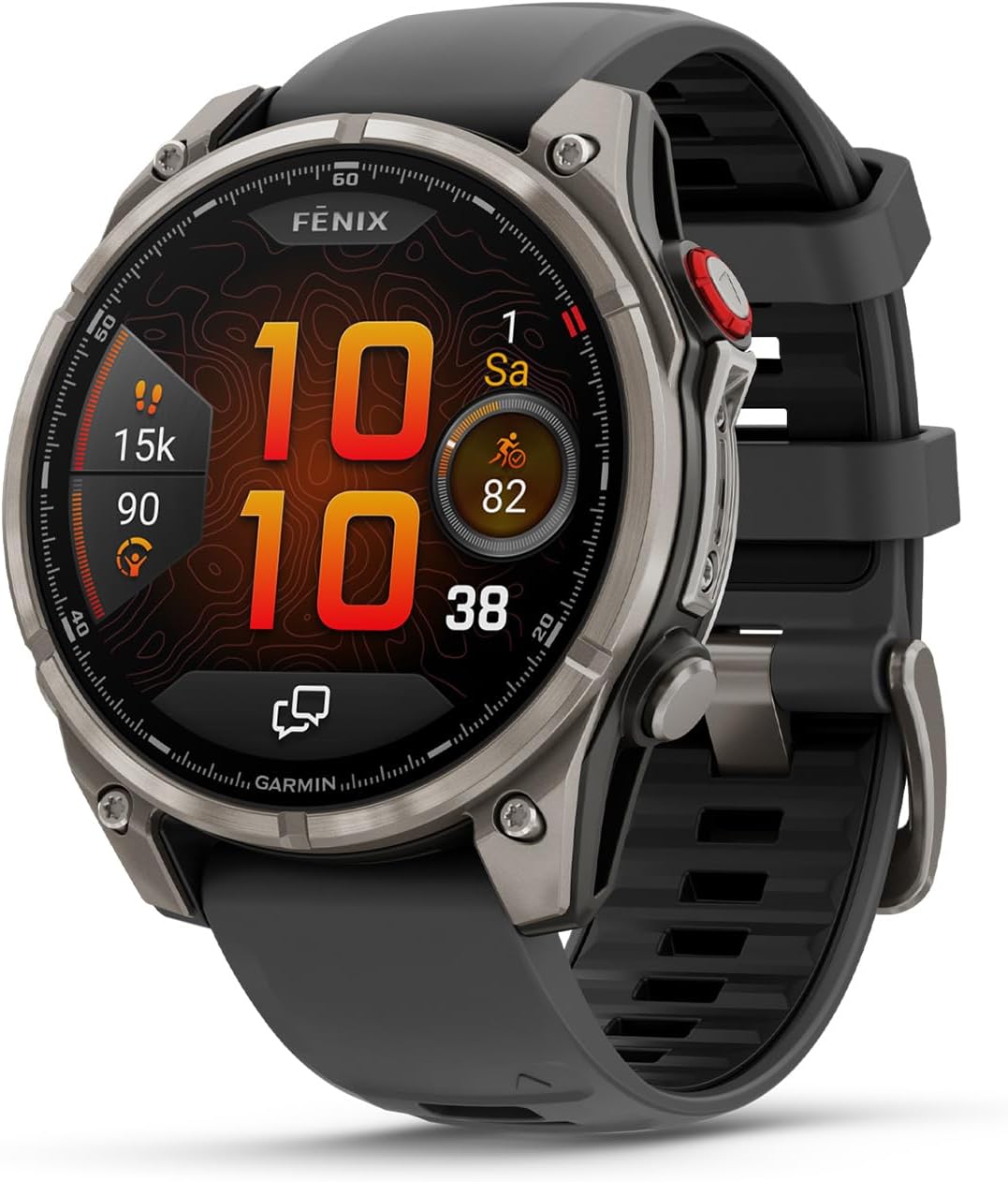

Buy the Fenix 8 AMOLED if you are an endurance athlete who trains daily and charges at home. The 47mm delivers 47 hours of GPS activity on a full charge — enough for any single event and most weekend trips. The higher-resolution display performs better as an all-day watch than the Solar does, and the 43mm option suits smaller wrists. Base models in steel with Gorilla Glass; premium variants in titanium with sapphire. From $999.99 / £879.99.
Buy the Fenix 8 Pro if you regularly go off-grid where phone coverage cannot be assumed: mountaineering, remote hiking, backcountry skiing, offshore sailing. The mandatory inReach subscription, starting at $7.99 per month, activates two-way satellite messaging and SOS directly from the wrist. Voice call capability is handled through the Garmin Messenger app. Satellite coverage via Skylo varies by region; check Garmin’s coverage information before purchase. DLC titanium and sapphire throughout. From $1,199.99 / £1,119.99.
The size question
Three case sizes serve different needs.
- The 43mm AMOLED is the only sub-47mm option in the Fenix 8 generation, at 56g in steel — the right choice for wrists with a circumference under approximately 165mm, or anyone who finds the 47mm physically large. Battery life is proportionally shorter: smartwatch mode reaches 10 days versus 16 days on the 47mm.
- The 47mm is the most versatile size, covering the widest range of wrist sizes and balancing battery life, display area, and weight.
- The 51mm maximises battery life and display area at the cost of 89g on the wrist in AMOLED titanium — best suited to larger wrists and buyers for whom maximum endurance matters more than everyday comfort.
Should you upgrade?
From Fenix 7 Pro or epix Gen 2 Pro: The hardware step is modest. The sensors are the same generation; GPS and heart rate performance is not meaningfully different. What you gain is the new UI platform, the speaker and microphone, inductive buttons, and dive capability. The site’s full review verdict is that existing 7 Pro owners are not compelled to upgrade unless those specific additions matter to them.
From Fenix 7 (non-Pro): More compelling. The Fenix 7 non-Pro lacked SatIQ multi-band GPS on non-sapphire models; all Fenix 8 models except the Fenix E carry it as standard. Add the new UI, AMOLED option, speaker and mic, and the step up is substantive.
From Fenix 6 or older: A significant upgrade. Touchscreen, multi-band GPS, AMOLED display option, updated sensors, and a UI generation ahead. Worth doing.
From the original epix Gen 2: The Fenix 8 AMOLED adds a speaker, a microphone, dive capability, inductive buttons, and the new UI on the same hardware platform. A meaningful step.
The Pro subscription: what it costs and what the alternatives are
The inReach subscription is not optional on the Fenix 8 Pro. Satellite and LTE features are inactive without it. The base plan starts at $7.99 per month. Higher tiers increase the included message allowance and tracking frequency. Garmin’s plan pricing is subject to change; check current rates at garmin.com before purchase. The site’s inReach guide covers a lower-cost plan option that is not prominently advertised.
The alternative worth considering: a base Fenix 8 AMOLED 47mm ($999.99 / £879.99) plus a standalone inReach Mini 3 (around $399) comes to approximately $1,400, against $1,199.99 for the Fenix 8 Pro 47mm. The integrated Pro costs less upfront and eliminates the need for a second device, but the Mini 3 has its own battery that operates independently of the watch — an advantage on multi-day trips, where the watch’s battery may be in GPS mode for extended periods.
What the accuracy data shows
GPS performance on the Fenix 8 AMOLED was tested across road, trail, and a 3.5-hour hike on the North Downs against calibrated reference sensors. Positional accuracy in open terrain is strong. Multi-band GPS with SatIQ produces better results in dense woodland and urban environments than single-frequency alternatives — the difference is most visible in long runs through tree cover or city streets, where single-frequency watches show course deviation. The full GPS accuracy charts are in the Fenix 8 review.
Optical heart rate from Elevate 5 is accurate for passive wear, resting metrics, and overnight HRV. For hard intervals and racing, a chest strap remains more reliable for instantaneous data, consistent with every previous Garmin generation and with the broader evidence across the range. The physiology metrics are useful training guides, not clinical measurements.
What’s changed since launch
Firmware 21.25 (February 2026) added a battery manager glance, mixed-sport activity mode, and resolved several bugs including the cold-water shutdown. The Q1 2026 update added Course Planner, Sleep Alignment, and expanded gear tracking. A December 2025 firmware change made trail paths nearly invisible on the Fenix 8 Pro and Enduro 3 during navigation; Garmin resolved the issue in a subsequent update. The Fenix 8 Pro MicroLED launched at $1,999.99 / £1,730; Garmin reduced both prices in early 2026.
Fenix 8 coverage on this site
Reviews and buyer guides
- Garmin Fenix 8 Review: 18 Pros, 8 Cons
- Where to buy the Garmin Fenix 8
- Garmin Fenix 8 Pro: Buyer’s Guide and MicroLED
- The Fenix 8 Pro is Not Your Adventure Watch: 4 Critical Failures
- Garmin Fenix E Review: A Pointless Addition?
- Fenix 8 Pro and Bounce 2: CEO Confirms You Pay Twice for LTE
Specifications
- Garmin Fenix 8 specifications (AMOLED and Solar)
- Garmin Fenix 8 Pro specifications (AMOLED and MicroLED)
- Garmin Fenix E specifications
Software updates and new features
- Garmin Fenix 8: Significant New Features Coming for Ultra Runners
- Garmin Q1 2026 Features: Every Update Detailed
- Fenix 8 Pro: 14 New Features
- Official Garmin Q1 2026 Feature Update: All Watches
- Every New Garmin November 2025 Feature
Pricing and market
- Garmin Admits Fenix 8 Pricing Error: Permanent Changes Made
- Garmin Confirms Touch MicroLED Displays Are Coming
- MicroLED Watch Displays: Growth or Boutique Niche?
Hiking, navigation and safety
- Garmin Fenix 8 Satellite SOS, Hiking Rescues and inReach 2025
- Fenix 8 Pro Owners Can’t See Trails
- Garmin inReach SOS: Complete Guide to Activation, Rescue and Costs
- Garmin inReach Mini 3: All You Need to Know
- Garmin inReach Multi-Device Support
- Garmin inReach: A Hidden Plan That Lowers Your Cost
What’s next
Part of the Garmin Fenix series guide.
