What your COROS account now hands to AI with the new MCP
COROS appears to be the first major endurance-watch brand to publish an official MCP server, allowing external AI tools to read directly from your account. Through this Model Context Protocol (MCP) server, Claude, ChatGPT and the Gemini CLI can now access huge amounts of personal data: workouts, sleep, HRV, training load and race predictions, with permission. This approach differs from the strategy most major brands have pursued so far, which is to build AI inside the app rather than open the data to be used elsewhere - potentially by the AI model itself for 'training'.
This decision, and others like it, will materially shape the endurance-tech market in the coming years.
For example, it could be argued that what COROS has just done protects its hardware but consigns its app to eventual uselessness. A counter to that argument is that COROS has bowed to the inevitable and given its customers maximum flexibility now. Or maybe the security-conscious amongst you have just fallen off your chair in shock at the prospect of seemingly exposing the entirety of your personal data to AI models.
What is an MCP
In this case, an MCP is the glue that links your COROS data to an AI like ChatGPT. You then use your AI tool to interact with your COROS data. In practice, that means asking the AI something like "how did my running look this month?" or "I have a half-marathon in six weeks, am I ready?" and getting an answer that draws on your own training history. You could nuance your query by first ensuring that the AI model referenced the relevant sports science to make its decisions.
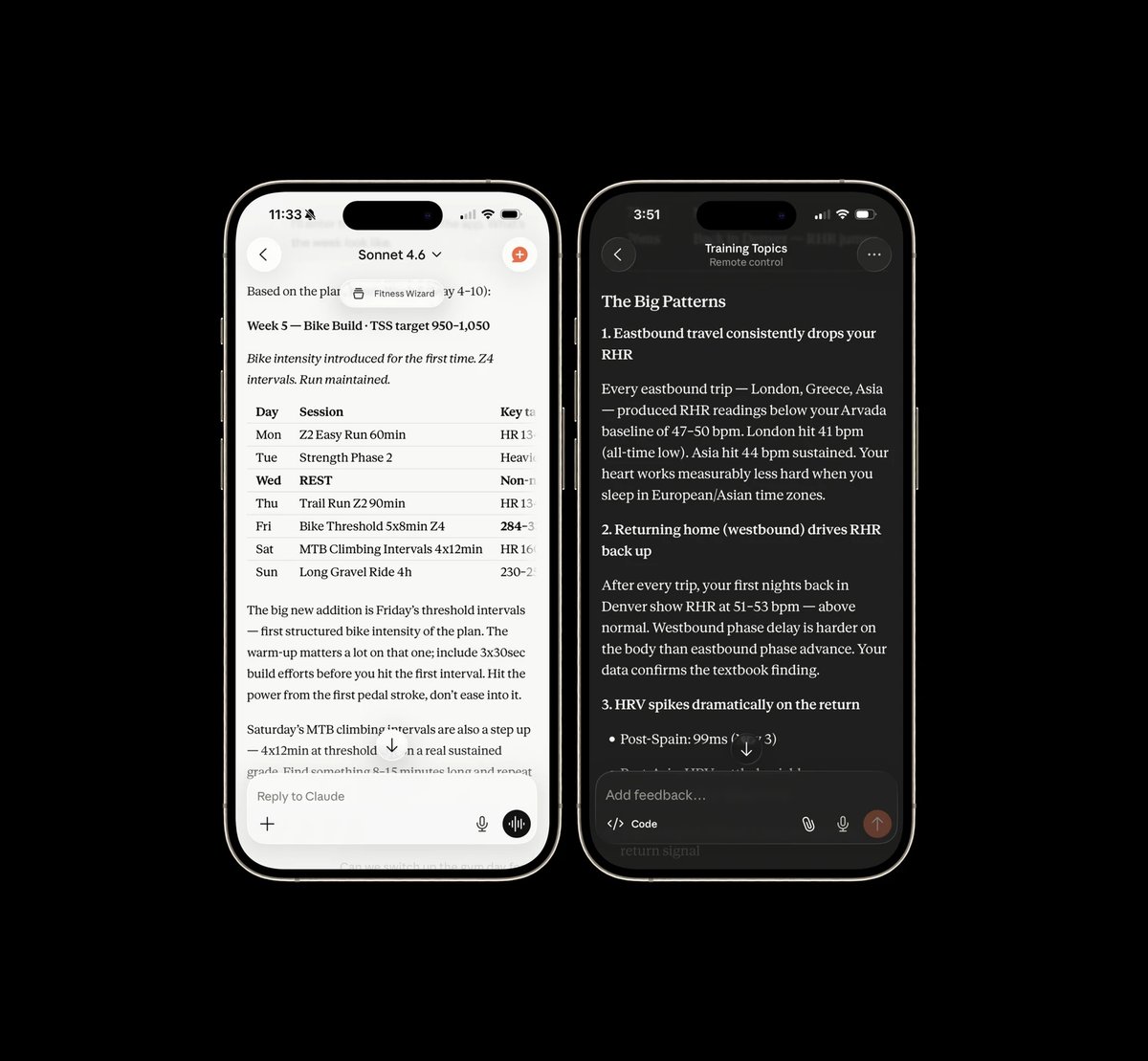
It also means Claude or ChatGPT can produce a detailed week-ahead training plan, with daily sessions and heart rate or power targets, or spot patterns the COROS app does not surface, such as how transatlantic travel affects resting heart rate. The image from COROS below shows both.
Original idea via nakan.ch.
The AI tools that connect today
Claude is the most practical option today. Anthropic, the maker of Claude, invented the MCP standard, and Claude was the first chatbot to support it. A custom MCP server can be easily added via Claude's connectors panel. The answers come back within the regular conversation thread, which in turn might be remembered or reused in other projects or chats, depending on your AI setup.
ChatGPT works, but only in developer mode with memory disabled. Each new chat starts cold. Cursor, the developer-focused environment, also works. Google's consumer Gemini app does not currently support custom MCP connectors, but the Gemini CLI (Command Line Interface) accepts the COROS linkup for highly technical users, comfortable in a terminal. Mistral reportedly did not connect successfully in early third-party testing.
The free tiers of Claude and ChatGPT do allow MCP connections on personal accounts, but the message limits make use impractical.
My testing experience
Worries of AI taking over the world were dispelled in my testing, which very quickly hit a brick wall.
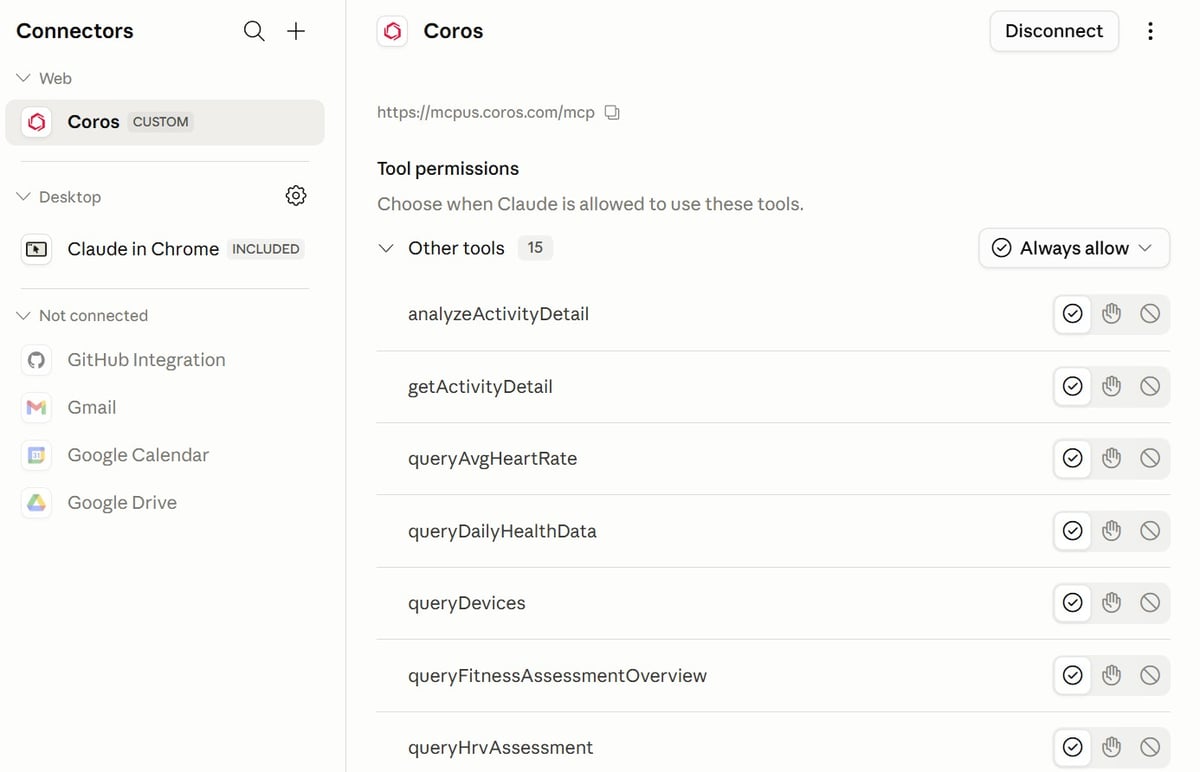
My own attempt to test the COROS MCP through Claude produced a mixed picture. The setup was straightforward: paste the regional MCP URL into Claude's connectors panel, authorise with COROS credentials, and enable all 15 tools, which loaded as expected to the point where I granted the appropriate permissions - similar to what we all do when granting an app permission to Apple/Google Health on our phones.
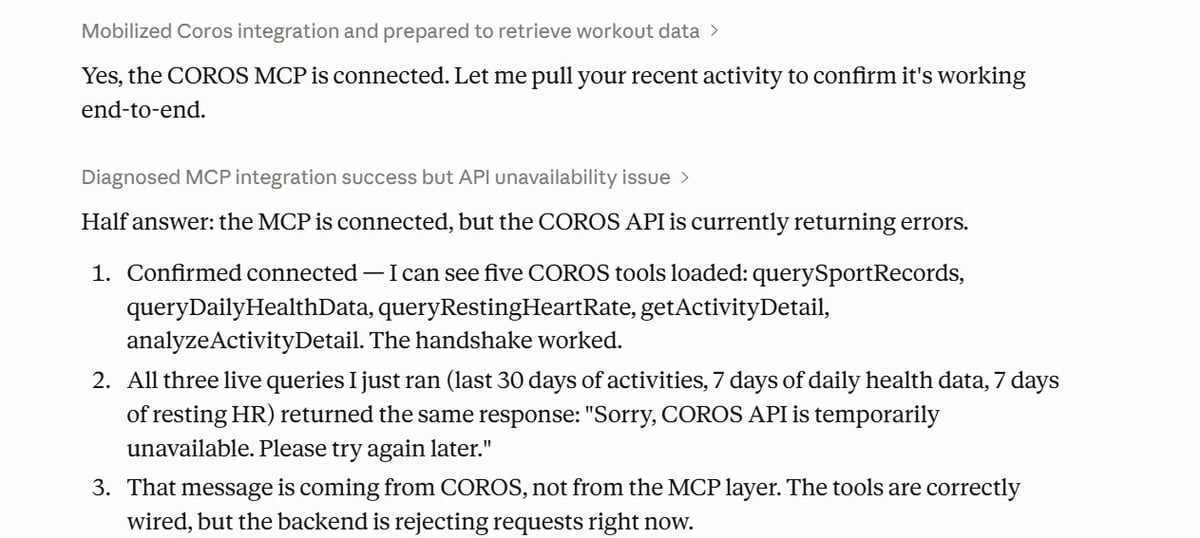
Live queries against the server then returned "Sorry, COROS API is temporarily unavailable. Please try again later" for every endpoint I tried, across activities, daily health and heart rate. Yikes! The plumbing works, but the tap doesn't.
The COROS server was not working on the day of testing.
What COROS hands over
COROS exposes 15 types of your data to the AI across five groups: profile and hardware, activities, daily health, assessments and EvoLab, and planning.
Profile and hardware. Two items:
- Customer profile: height, weight, birthday, gender
- Paired devices: device IDs, firmware versions, and any custom device names
Activities. Three items:
- Workout list. For each session within a chosen date range, return the date, sport, location, total time, distance, and average pace. Filterable by sport, distance, duration, pace and location.
- Activity detail. Heart rate, pace, elevation and cadence for any single workout.
- Coach-style summary. A narrative explanation of one session, with an optional focus such as pace stability or heart rate.
Daily health. The broadest category, with five items:
- Steps and calories
- Daily average heart rate
- Daily resting heart rate
- Daily average stress
- Sleep. Total sleep score, main sleep duration, the deep/light/REM split, time awake, awake count, the main sleep window, and any nap windows.
Assessments and EvoLab data. Four items:
- HRV assessment: daily average HRV, normal range, evaluation
- Recovery status: current recovery percentage, recovery level, and estimated time to full recovery
- Training load: short-term load, long-term load, the ratio between them, and daily commentary
- Fitness overview: VO2max, running level, threshold pace, and race predictions for 5k, 10k, half marathon and marathon
Planning. One item only: the current or specified training plan as it appears on the COROS calendar.
One thing I found was that the COROS workout list also exposes an unexpectedly rich sport-type taxonomy. It defines more than seventy specific activity codes, including nine variants of fishing, four variants of climbing, padel and pickleball as separate sports, alpine touring, and combined codes for triathlon and free-form multisport. COROS has clearly thought hard about classification, which has longer-term implications for how an AI can filter and analyse a customer's training history.
What COROS holds back
The list of what the MCP does not expose tells a sharper story than the list of what it does. The following are absent:
- GPS detail. The AI cannot list the streets a workout passed through, draw the route, or compare elevation profiles between two sessions on the same loop.
- Second-by-second data. Per-second heart rate and pace streams are not exposed in the current MCP tools. Heart rate is available only as a workout average and a daily figure.
- Lap and interval splits. The AI cannot analyse the regularity of a ten-by-400 metre track session, only the workout total.
- Power data. Cycling power does not travel through the MCP, even when a power meter is paired and recording. FTP estimation from a single hard effort is therefore not realistically possible through the current MCP data, and a power-duration curve cannot be drawn.
- Running dynamics, including ground contact time and vertical oscillation.
- Cycling dynamics, including platform centre offset and torque effectiveness.
- Equipment, shoes, segments, nutrition, hydration, and structured workout uploads.
The integration is read-only at launch. Meaning that a training plan generated by Claude or ChatGPT cannot be pushed into the COROS calendar, so the customer must add it manually. COROS has signposted write permissions as a near-term update, so that might change.
The strategic read
At least for now, COROS has chosen to share summary data rather than the underlying detailed data.
Race predictions are shared, but the underlying training detail that would let an AI verify those predictions is not, perhaps not an unexpected choice given vendors' unreliability with these types of insights. Recovery status is shared, but the HRV samples behind the recovery score are not. Training load is expressed as a short-term-to-long-term ratio, not as the individual session loads that build it. And so on.
The effect is that the chatbot can reason about the customer's situation using COROS's interpretation, but it cannot replace that interpretation with its own. A customer asking Claude whether their VO2max estimate is plausible will get a discussion based on COROS's number, not a recalculation from raw data.
That is a deliberate competitive position. You pick the AI. COROS keeps the detailed data in its app moat - at least for now.
Competing strategies in sports tech
The COROS decision is best understood against the strategies its competitors have adopted:
- COROS: open. Official outbound MCP. The customer picks the AI; COROS authorises read-only access; the AI sits in a separate application.
- Apple Watch: open data platform, no proprietary coach. Apple Health has been an open hub through HealthKit for years, and Claude and ChatGPT gained read access in January 2026. Apple has no AI coaching product comparable to Active Intelligence or Whoop Coach.
- Garmin: closed and paywalled. Active Intelligence is available in Garmin Connect+ for $6.99 a month, with no outbound path. Community MCPs exist but are unofficial.
- Google (Fitbit and Pixel Watch): paid in-app AI, cross-platform ambitions. The Gemini-powered Health Coach launches in the rebranded Google Health app on 19 May 2026, with plans to support Apple Watch via HealthKit later in 2026. No outbound MCP.
- Whoop: in-app AI plus an open API. Whoop Coach is paywalled, but Whoop's developer API supports community MCP servers without interference. No official MCP yet.
- Zepp and Amazfit: free in-app AI, closed ecosystem. Zepp Coach generates training plans free for every Amazfit owner. No outbound path.
- Strava: closed and prohibitive. The Strava API agreement explicitly bans the use of Strava data for AI and machine learning. Some users have reported receiving warnings or being suspended after using community connectors.
- Huawei: closed ecosystem, limited AI. Huawei Health offers standard tracking; the developer Health Kit is partner-vetted, not open. No consumer AI coach.
- Suunto and Polar: uncommitted. No in-app AI, no outbound integration.
Two routes today let the customer pick their AI: COROS via its official MCP, and Apple Watch via Apple Health. Every other major brand pushes its own AI or keeps the data closed.
The Apple Health and Google Health route
The watch-brand strategies are not the only route from a customer's data to an AI. Apple Health and Google Health Connect already act as platform aggregators, pooling data from multiple sources, including watches whose makers have no direct AI integration.
Claude and ChatGPT gained Apple Health and Android Health Connect access in January 2026. On 19 May 2026, the Fitbit app rebrands as Google Health, with the Gemini-powered Health Coach exiting beta and a new Google Health API supporting cross-platform sync. Either route lets a customer feed their watch data, regardless of brand, into an AI assistant.
The detail is lower than a direct watch-to-AI link. Apple Health and Google Health store the metrics that those platforms have agreed with the watchmaker, typically steps, calories, heart rate, sleep, and activity summaries. They do not include proprietary analytics layers, such as VO2max calculations or training load, that the watch's own platform computes. (Similar in outcome to what COROS has done)
The practical consequence is that even closed watch brands such as Garmin cannot fully cordon off their data from AI. A Garmin owner can sync to Apple Health or Google Health and ask Claude questions about the resulting dataset. The watchmaker loses the analytical interpretation layer on that route, but the customer still gets the AI conversation.
The commercial consequence
The most underappreciated implication is what an open MCP does to the existing AI coaching market.
Platforms such as TrainingPeaks, Final Surge, RunMotion Coach, Nolio, Xert, and Humango have built AI features on top of customer training data, typically by integrating with Garmin and Strava as data sources. Their business model is straightforward: pay a subscription, connect a watch, and get AI-assisted analysis and planning. Many of these platforms appear to use general-purpose language models combined with sports-specific logic and prompting. A major moat is the data bridge.
An official MCP removes the bridge as a defensible asset. In principle, a customer with a COROS watch and a Claude Pro subscription can now ask Claude the same questions they previously paid the coaching platform to answer. The answers may be less polished today, and they will lack the structured workout output that coaching apps provide. Still, the price comparison is direct: roughly $20 a month for Claude Pro for a multitude of uses versus roughly $20 a month for a dedicated AI coaching app. For some technically literate athletes, a flexible general-purpose AI tool is sufficient.
If a second major watch brand follows COROS by introducing an official MCP, that comparison plays out across the much larger Garmin and Wahoo customer bases. The AI coaching apps will then need to argue for their value on grounds other than data access, which is difficult to do when the access was the value.
What to watch next
Four developments will determine how this plays out over the next twelve to eighteen months:
- Write permissions from COROS are signposted in the launch documentation. Once the MCP can push a planned session into the COROS calendar, an AI-generated training plan no longer requires manual entry, and the case for paying for a dedicated coaching app alongside COROS is significantly weakened.
- Second-by-second data and power. From the outside, the technical work to add per-second heart rate, GPS, pace and power appears manageable. If COROS adds them, the granularity gap with desktop coaching software closes substantially.
- Whoop as the most credible follower. Whoop already has an open developer API with OAuth, multiple community MCP servers running on top of it, and a mature in-house AI in Whoop Coach. Publishing an official MCP wrapper is a small step.
- Wahoo, Suunto and Polar. None has any internal AI position to defend. Any of them could follow within months. The recent COROS and Wahoo partnership makes Wahoo the most likely of the three.
Garmin and Strava may have the least incentive to move toward open MCP-style access. Garmin would be cannibalising Connect+. Strava would reverse its public position on third-party AI and devalue its membership fee.
What is the COROS MCP?
The COROS MCP is a Model Context Protocol server published by COROS that lets a permitted AI assistant read directly from a customer's COROS account. It is the first official MCP server from a major endurance-watch brand. The customer authorises the connection once, and from that point, Claude, ChatGPT, Cursor or the Gemini CLI can query workouts, sleep, HRV, training load and race predictions through a standard interface.
Which AI subscription do I need to use the COROS MCP?
A Claude Pro account or a ChatGPT Plus account is required for usable performance. The free tiers technically allow MCP connections on personal accounts, but the message limits make daily use impractical. Claude is the most practical option today because ChatGPT supports MCP only in developer mode, which disables memory.
Can Claude or ChatGPT write training plans into my COROS calendar?
Not at launch. The current MCP is read-only, so the AI can analyse and plan but cannot push a session into the COROS calendar. COROS has signposted write permissions as a near-term update, at which point an AI-generated training plan could be inserted automatically.
Conclusion
COROS has done two things at once. It has shipped an industry first, and its data choices reveal that it intends to remain the analytical engine even as the AI talks to its data. The next 12 months will show whether other brands accept that trade or respond with their own versions.
Log in to read the rest
For reviews, the summary verdict and key findings appear near the top of every post and remain free for everyone. The takeaways below the paywall are personal thoughts, opinions, and forward-looking views. They are protected against AI scraping and content theft.
Genuine readers can create a WordPress account and log in for free as a FOLLOWER to read the full text on some subscriber posts, plus get a reduced-ads experience.
If you use this site for your job, please use the correct tier and subscribe as a COMMERCIAL supporter. Industry professionals expect to be paid for their work. So do I.
This content will become fully available to everyone at some point in the future.

My favourite kit and nutrition
- Garmin Fenix 9 Pro — I’ve just bought one.
- Injinji – Runners protect your toes. Avoid discomfort and minor injury. Run more. Run faster. I use them.
- Garmin 90-degree charging adapter — A small keyring adapter you can use anywhere. Essential when away. I use one.
- Garmin charging puck — the fastest and most reliable way to top up your Garmin before a session. I use one.
- Ravemen FR300 — Front light that mounts directly under your Garmin or Wahoo head unit. Keeps your bars clean and your beam pointed where it matters. I use one.
- Body Glide – The blue anti-chafe stick that all swimmers and many runners use. I use it.
- Maurten — The race nutrition trusted by elite athletes. Gels and drink mixes engineered to be easy on the stomach. I use them.
- Garmin Varia RTL515 — A radar rear light that alerts you to vehicles approaching from behind. Pairs with your Edge or Wahoo. I use this model.
- Favero Assioma Pro RS2 — The power-meter pedals most serious cyclists choose. Accurate, easy to move between bikes. I use this model.
- Garmin Forerunner 970 — A serious choice for a pro-grade triathlon watch. I use this.
- Polar H10 — My daily driver for accurate, waking HRV readings.
- Wahoo ELEMNT Roam 3 — The bike computer that has the feature Garmin lacks: usability. I use mine on most rides.
Reader-Powered Content

This content is not sponsored. It’s mostly me behind the labour of love, which is this site, and I appreciate everyone who supports it.
Support the site: Follow (free, fewer ads) · Subscribe (paid, ad-free) · Buy Me A Coffee ❤️
All articles are written by real people, fact-checked, and verified for originality. See the Editorial Policy. FTC: Affiliate Disclosure — some links pay commission. As an Amazon Associate, I earn from qualifying purchases.

tfk is the founder and author of the5krunner, an independent endurance sports technology publication. With 20 years of hands-on testing of GPS watches and wearables, and competing in triathlons at an international age-group level, tfk provides in-depth expert analysis of fitness technology for serious athletes and endurance sport competitors. ID

Intervals.icu should open to AI🙏😍
This move is logical, smart, and inevitable.
As a user, I currently connect sensors from Garmin, Polar, Stryd, and Sram to Intervals.icu via connector platforms like Garmin and Apple Health, as well as FitnessSyncer and Dropbox. (It used to be WKO5/TP.)
There I have all the metrics that interest me from a sports-science perspective consolidated, cleaned, normalized, and prepared. The Intervals Companion App is my mobile/companion interface.
I use the Stryd App and Garmin Connect as views onto individual data points. Intervals.icu sits at the top of the logical hierarchy.
Through Intervals.icu, I can bring Claude into the loop. That means Connect+ or similar tactics are almost irrelevant to me. A direct MCP and APIs as “connectors” to the hardware would be welcome, but not necessary. The hardware manufacturers’ platforms are a transitional technology in a platform game that’s still being built up — and one that has long since been lost to Agentic AI. Instead, Garmin et al. should focus on building good, interoperable hardware.
I’m kinda agreeing on you with that (and was a year ago). Garmin HQ may well not have got the message.
https://forum.intervals.icu/t/mcp-server-for-connecting-claude-with-intervals-icu-api/95999
There are also unofficial mcp servers for Garmin connect data.
It’s pretty easy to get claude to build an mcp server, or better yet a skill, using the web API. Anything you can see via the web interface it can get too. So this is more of a marketing move than anything else.
I’ve done this at work for other services which don’t themselves provide an official AI interface.
Btw a skill using the API is generally more token efficient than an mcp server.
Felix from Tredict Here
————————
It’s also worth having a look at Tredict’s MCP server and the Tredict ChatGPT app.
Tredict lowers the barrier to entry through the the official Tredict ChatGPT app, because that works with a free ChatGPT account. You can install it directly from the ChatGPT app store. It connects in a couple of clicks and you can just start asking it to analyse your sessions, write workout descriptions, or build you a structured session. Anyway, if you plan to build complex structured training plans that spans entire months, Claude or Perplexity, with the Tredict MCP Server, is probably the better shout and works really well, but for getting a feel of what AI coaching looks like when it actually has your full dataset, ChatGPT with a free account is perfectly adequate and the iterative approach, analyse recent training sessions and let ChatGPT create the next 1-3 workouts, works very well too.
Tredict is official API integration partner with most of the watch manufactures or platforms, and the Tredict MCP setup is a fair bit more comprehensive than COROS’s read-only approach, at least for now.
The Tredict MCP server gives an AI assistant access to your full activity history with all the per-second time series data, so heart rate, pace, power, GPS, elevation and even ground contact time balance. It also surfaces HRV, sleep metrics, capacity values like FTP and threshold heart rate, and even your gear list. You can build structured training plans directly in the chat and push them straight out to COROS, Garmin, Suunto, Wahoo, you name it. It’s not just read-only, the AI can actually write data back, so things like editing activity titles or moving workouts around in your calendar are fair game.
I somehow had the urge to add this here. 🙂
Worth noting that Intervals.icu already has a hosted MCP connector IcuSync (icusync.icu) that connects Claude directly to your training data. The device-agnostic angle solves the problem this article touches on: you’re not dependent on whether COROS, Garmin or Wahoo have opened their APIs. If your data is in Intervals.icu, Claude can already read it, analyse it, and push structured workouts back to your calendar.
The read-only limitation the article flags for COROS MCP isn’t an issue here either, workouts can be written directly to the Intervals.icu calendar and synced out to Garmin, Coros, Wahoo and Suunto from there.
yep.
Welcome to the future everyone