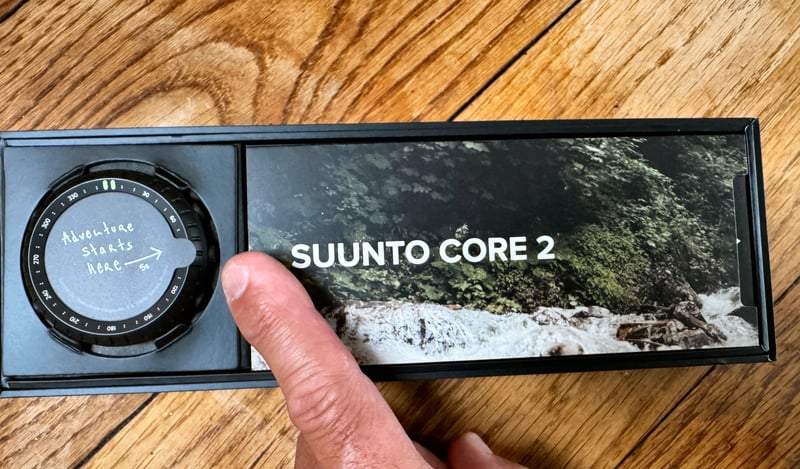
Suunto Core 2 First Impressions: An Old-School ABC Watch, Done Well
Suunto has launched the Core 2 at £155 / $199 / €199. It has an ABC sensor set (altimeter, barometer and compass), Bluetooth for firmware updates and time sync, and a claimed 15 months of battery life on a replaceable coin cell. There is no GPS, no wrist heart rate sensor and no maps. This is a specialist tool watch for adventure or military use, and I am reviewing it as one. These are my first impressions in review format after several days of wear.
Suunto Core 2 Quick Review
Suunto Core 2 review summary
The Suunto Core 2 is a classic ABC outdoor tool watch launched in July 2026 at £155 / $199 / €199. It carries altimeter, barometer, magnetic compass, storm alarm, moon phase, sunrise and sunset times, step counter and a freedive depth meter to 2 metres. It runs on a user-replaceable CR3032 lithium coin cell rated at up to 15 months, and adds a manual Bluetooth connection for firmware updates and time sync via the Suunto app. There is no GPS, no wrist heart rate sensor and no maps.
Build quality is good, the 49 mm case feels smaller and is well proportioned on the wrist. The flat caseback is comfortable. Water resistance is 10 ATM, glass is Corning Gorilla Glass, and the watch is MIL-STD-810 tested across seven environmental categories – all impressive. The 1.3-inch monochrome dot-matrix LCD with LED backlight is a claimed 40% brighter than the original Core, with a switchable red and green backlight – all less impressive.
Compass calibration is consistent with Suunto’s stated ±5° specification. Altimeter drift of around 10 metres in 24 hours of benign weather at a fixed location is unsurprising for a barometric-only watch.
The Core 2 is not a Fenix rival. It is a specialist tool watch for existing Core owners looking for a straight upgrade and outdoor generalists who want a digital ABC on the wrist at a sensible price.
Testing has raised two findings worth flagging: no user-accessible altitude or pressure log for a specific activity, and a suspected storm-alarm artefact after the profile seems to switch from altimeter back to barometer towards the end of hard exercise.
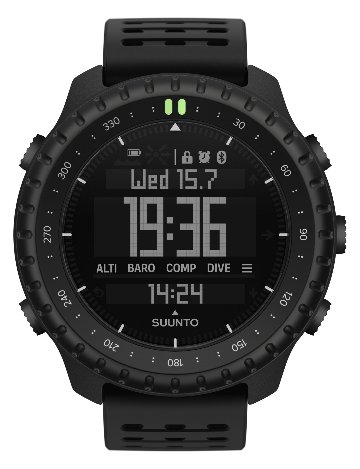
Suunto Core 2
Classic ABC outdoor watch with 15-month replaceable battery, 10 ATM water resistance and Bluetooth firmware sync
Pros
- 15-month battery on a user-replaceable CR3032 coin cell
- 10 ATM water resistance and Corning Gorilla Glass
- Well-judged 49 mm case size, weight and button feel
- Compass calibration consistent with Suunto’s stated ±5° specification
- Bluetooth firmware sync and time sync via the Suunto app
- Sensible £155 / $199 / €199 pricing for a specialist tool watch
Cons
- No user-accessible altitude or pressure log on watch or in app
- Replaceable battery requires a screwdriver
- Onboard Bluetooth may make it ineligible for military use
- Storm alarm shows a suspected artefact after activity ends
- Display hard to read in bright daylight
- Freedive depth meter regressed to 2 m from 10 m on the original Core
- View button and manual logbook removed compared with the original Core
- 0°C lower operating temperature limit is warmer than a tactical outdoor watch would normally offer
User Review
( votes)Build and feel
The Core 2 is a nice object to hold and wear. Case quality is good, the weight is well distributed, and the flat caseback sits comfortably against the skin. It is a medium 49 mm case which feels smaller than it is, closer to a proper tool watch than the oversized outdoor category has drifted towards. The rotating bezel has a satisfying, mechanical action, but it turns in both directions. For dive usage, the bezel should only ratchet one way so a knock during a dive can only shorten the reading rather than extend it. On the Core 2, the bezel is a bearing and timing aid rather than a dive tool, so a two-way action is defensible, but it sits uncomfortably next to the freedive depth meter Suunto has included.
The 5 buttons have a good, deliberate action. The strap is nice but better ones exist for sure. It is a standard 22 mm so that most buyers will treat that as a plus, with many cheap aftermarket options available.
Display
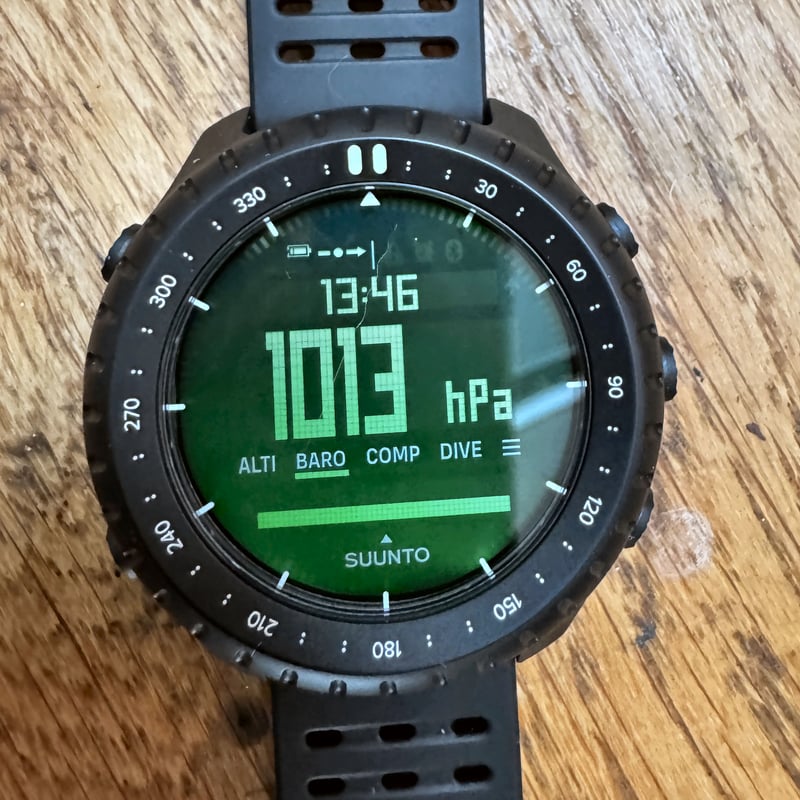
The display is a 1.3-inch monochrome dot-matrix LCD with LED backlight and Corning Gorilla Glass. Suunto claims a 40% improvement in brightness over the original Core. In practice, I found it hard to read in bright daylight, though it was fine indoors. The green backlight is more useful than the red for general readability. The red is intended for preserving night vision and for night-vision-goggle compatibility, and it works for that and is highly readable at night.
The panel resolution is broadly similar to a Garmin Instinct, but it is not as readable. On features, the Core 2 is light years behind. That is the point of this watch, not a criticism.
Test: compass
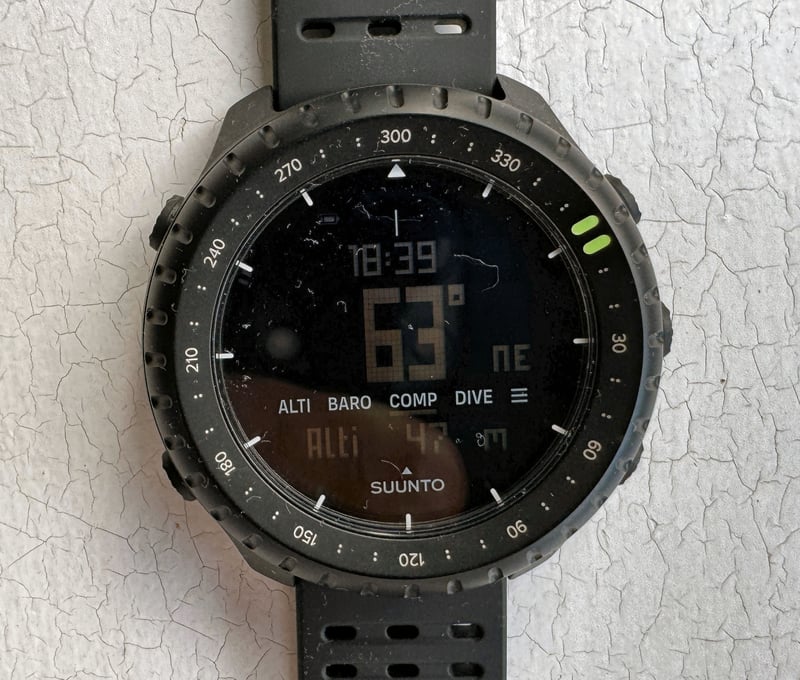
The compass calibrated cleanly at setup, spinning on a flat surface. Through 3 full days of normal wear, it has held calibration. Bearings agree with two smartphone compasses to within a couple of degrees, consistent with Suunto’s stated ±5° specification. The Core 2 is the first Suunto Core to carry a stated compass accuracy figure.
The bearing lock works as advertised. Set a bearing and walk. The display shows the difference between your current heading and the locked bearing.
Test: altimeter and barometer
The Core 2 measures air pressure directly and derives altitude from a reference point you must enter manually.
There is no GPS, so there is no automatic recalibration. If the weather changes, the altitude reading will drift, which is true of any baro-only ABC watch.
I set the altimeter manually at a known location on day one. Twenty-four hours later, at the same location with consistently benign conditions, the reading had drifted by about 10 metres. That is an unsurprising barometric drift figure. The practical implication is that any comparison of altitude readings between the Core 2 and a GPS watch will diverge on any day when weather changes. Suunto’s guidance is to reset the reference regularly, e.g. from a topographic map.
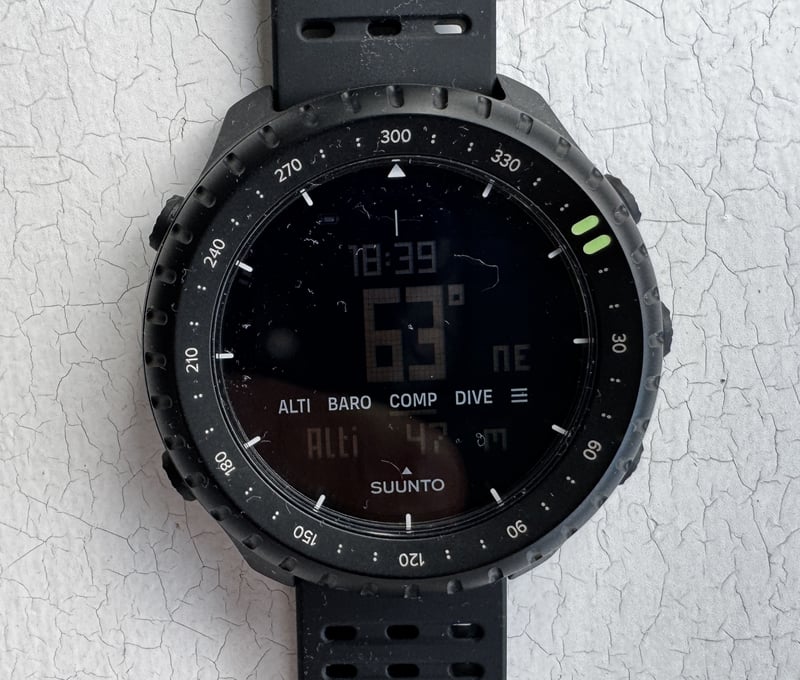
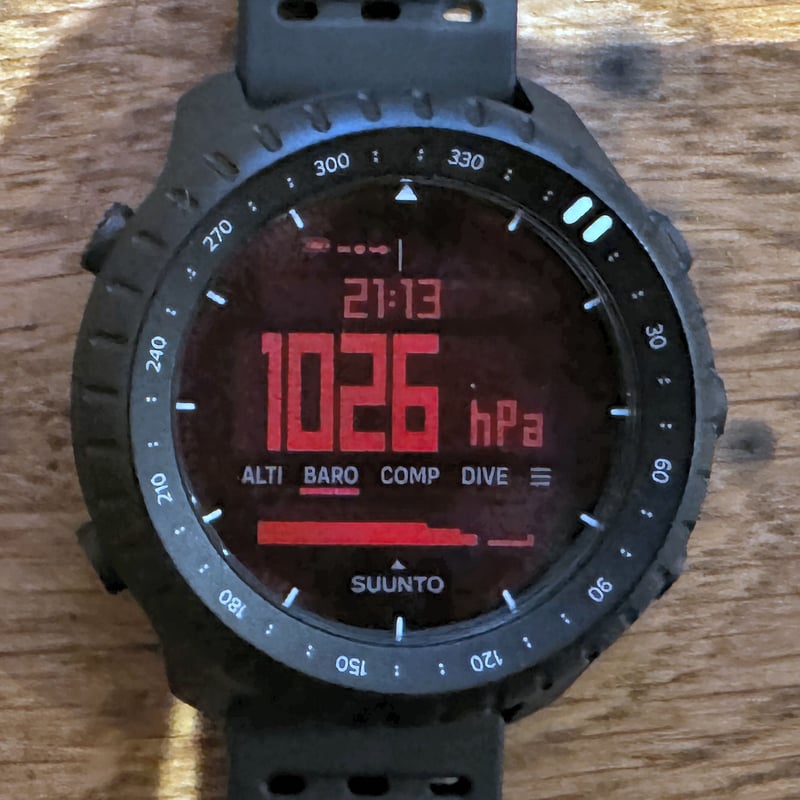
The barometer displays a pressure trend over recent hours, which is useful for hillwalkers. Absolute pressure is quoted to 1 hPa resolution. However, the display bar is tiny (10px high? – small). OK, it does the job but only just – see this image.
Test: storm alarm and an automatic profile artefact
The storm alarm fired for the first time towards the end of a bike ride on a hot and humid day. Skies were clear at the moment of the alert, and there was no storm in sight. The official forecast gave only a 20% chance of rain later that evening, and nothing significant developed, but the weather and cloud cover did change half an hour later.
The Meteo local pressure record for the day showed the atmosphere was flat at 1026 to 1027 mb across the entire day, with a maximum variation of 1 hPa. That is well below the 4 hPa over 3 hours that the Core storm alarm is designed to detect. Thus, the local weather record and actual conditions did not exhibit the pressure drop that would normally trigger the alarm, so I don’t know what happened here.
The finding is worth flagging for anyone planning to rely on the storm alerts. It is a possible limitation of the automatic profile rather than a broken sensor. I will watch out for more!
Test: can you actually log an activity?
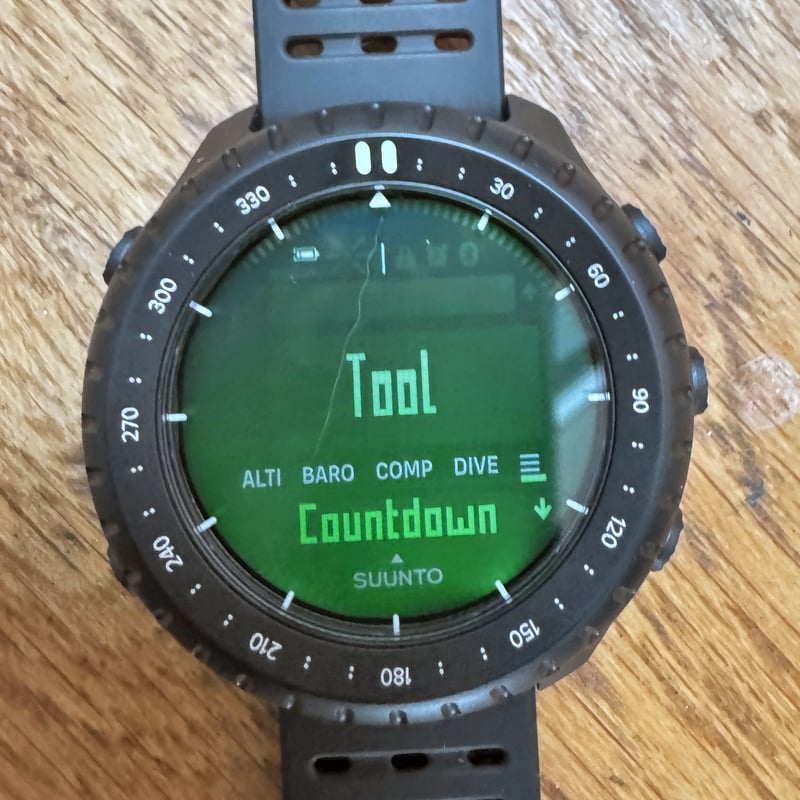
The Core 2 does not appear to offer any log of altitude or pressure against time. On the original Core, pressing Start/Stop in Alti and Baro modes began a logbook entry with a selectable recording interval between 1 and 60 seconds, and up to 10 logs could be stored on the watch and reviewed afterwards.
The Suunto app receives firmware updates, time sync and what looks like step data, but shows no altitude history, no pressure history and no session logs at all. The rolling 7-day weather log referenced in the specification appears to feed the storm alarm and the on-watch pressure trend, but is not exposed to the user in any form I can find.
On a watch marketed for ABC and outdoor use, at £155, if the user cannot press a button and log the altitude and pressure profile of a specific hike, that is a definite gap from what should be easily possible – but then I’m not entirely sure what the point of doing it would be in any case. I have asked Suunto to confirm.
What the marketing table leaves out
Suunto’s own upgrade table shows what has been added between the original Core and the Core 2.
Additions
It’s a more capable piece of hardware.
| Feature | Original Core | Core 2 |
|---|---|---|
| Backlight | Green only | Red and green switchable |
| Water resistance | 3 ATM | 10 ATM |
| Battery life | Up to 12 months | Up to 15 months |
| Battery cell | CR2032 | CR3032 |
| Display glass | Mineral crystal | Corning Gorilla Glass |
| Buttons | Standard | Larger, better tactile feedback |
| Strap | Elastomer | 22 mm silicone |
| Moon phase | No | Yes |
| Step counter | No | Yes |
| Bluetooth | No | Yes, time sync and firmware updates |
But Suunto’s table does not show what has changed for the worse or disappeared. Here is a fuller picture.
| Feature | Original Core | Core 2 |
|---|---|---|
| Freedive depth meter | 10 m at 0.1 m resolution | 2 m |
| Altimeter floor | -500 m | -100 m |
| View button | Cycled supplementary displays across all modes | Removed |
| Manual logbook | Up to 10 logs, selectable interval | Not found |
| Log recording rate | 1, 5, 10, 30, 60 seconds selectable | 1 Hz stated, selection not confirmed |
| Storage temperature (cold end) | -30°C | -20°C |
Water resistance has tripled from 3 ATM to 10 ATM, but the depth meter’s usable range has fallen from 10 metres to 2 metres. #odd
On the original Core, the storm alarm ran in barometer profile only. On a climb, the automatic profile switches to the altimeter, and the alarm likely drops out. Suunto has not documented any change for the Core 2.
The app
The Suunto app pairs with Core 2 once Bluetooth is manually enabled on the watch #PITA. It handles firmware updates and time synchronisation and appears to sync step data. There are no workouts to review, no training metrics, no maps and no altitude or pressure history. That is a description of what the watch collects (or seems to collect) rather than a criticism of the app.
Battery
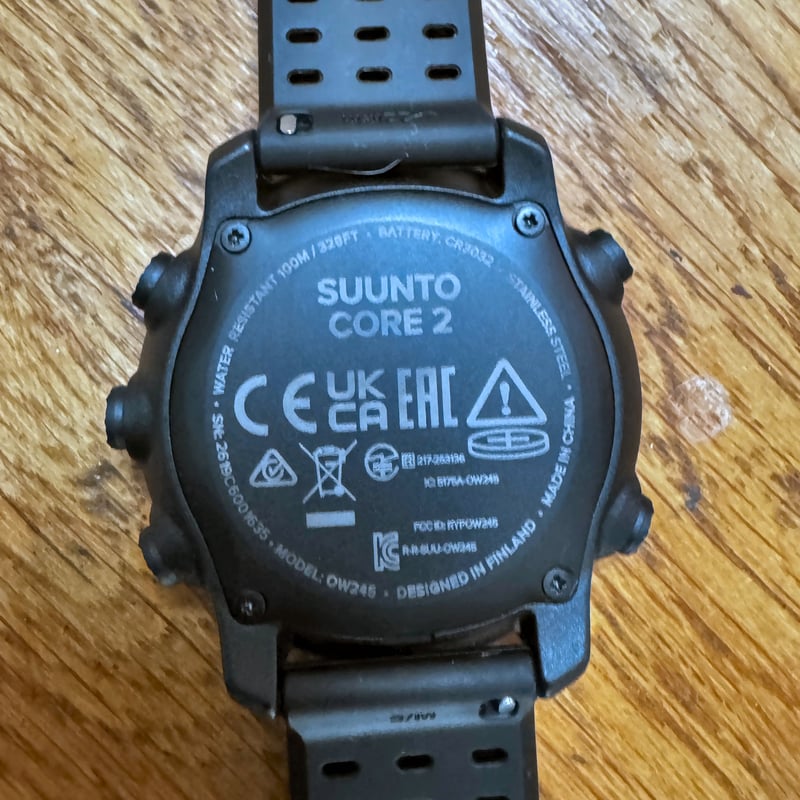
Suunto’s 15-month figure is plausible. The CR3032 coin cell holds roughly 500 mAh, against about 220 mAh for the CR2032 in the original Core. Suunto has more than doubled the battery capacity and added a manual Bluetooth connection and a step counter.
Who it is for
Your average Smartwatch buyer in general, or a Faenix buyer in particular, isn’t going to buy this as a daily driver.
The Core 2 is a tool watch for people who love the original Core/core Alpha. Upgraders get 10 ATM instead of 3, Gorilla Glass, a brighter display, larger buttons, moon phase, a step counter and Bluetooth firmware updates. Nothing revolutionary. Everything sensible. Most things better.
Next is anyone still in the analogue world of real physical compasses/altimeters and who wants a digital ABC on the wrist, either as a replacement or backup. At £155, the Core 2 replaces two pieces of dedicated kit for a not-too-crazy price.
Closing
An unfashionable watch made confidently. It’s a typically beautifully made Suunto – I love the case and design but, less so, the low-res display.
Suunto has resisted the temptation to add features that would have compromised the battery life or pushed the price up, and has delivered a tool watch that behaves like one.
Suunto Core 2 price: where to buy
Suunto launched Core 2 at £155, $199 and €199. Use the buy links below to check the current price in your market.
Suunto Core 2
Classic ABC outdoor watch with 15-month replaceable battery, 10 ATM water resistance and Bluetooth firmware sync
Full specifications: Suunto Core 2 specifications.
Quick answers
What is the Suunto Core 2?
The Suunto Core 2 is a classic ABC (altimeter, barometer, compass) outdoor tool watch launched in July 2026. It has no GPS, no wrist heart rate sensor and no maps. It uses a replaceable CR3032 coin cell rated at up to 15 months and adds Bluetooth for firmware updates and time sync via the Suunto app. UK price is £155, US $199, EU €199.
Is the Suunto Core 2 a smartwatch?
No, and deliberately so. The Core 2 is a specialist tool watch. It does not track workouts, does not map, does not measure heart rate and does not deliver phone notifications. Its purpose is altitude, barometric pressure, direction and time.
Does the Suunto Core 2 have GPS?
No. The Core 2 has no GPS or GNSS chip. Altitude is derived from barometric pressure against a manually entered reference. The compass is magnetic.
What battery does the Suunto Core 2 use and how long does it last?
The Core 2 uses a CR3032 lithium coin cell, user-replaceable, rated by Suunto at up to 15 months. CR3032 is a 30 mm diameter, 3.2 mm thick, 3 V lithium cell holding roughly 500 mAh. It is a larger sibling of the far more common CR2032 (20 mm diameter, 220 mAh) used in the original Core.
Where can I buy a CR3032 battery?
CR3032 batteries are available from major electronics retailers, watch parts specialists and online marketplaces. Brands include Panasonic, Renata and Maxell. They are less commonly stocked in supermarkets and convenience stores than the CR2032, so plan for a replacement.
Is the Suunto Core 2 waterproof?
The Core 2 is rated to 10 ATM, or 100 metres water resistance. That is a substantial upgrade on the original Core’s 3 ATM. A 10 ATM rating is suitable for swimming and surface watersports.
Can I dive with the Suunto Core 2?
The Core 2 includes a freedive depth meter with a maximum range of 2 metres. It is not a scuba dive computer, and Suunto does not position it as one. The rotating bezel also turns both ways, which is unusual for a dive-capable timing bezel.
How accurate is the altimeter?
Altitude is derived from air pressure against a manually set reference. Weather changes while the reference stays fixed will cause drift. On my first day of wear, the reading drifted by about 10 metres at a fixed location in 24 hours of benign weather. That is normal for a barometric-only ABC watch. Suunto’s guidance is to reset the reference regularly from a topographic map or a local sea-level pressure reading.
How accurate is the compass?
Suunto publishes a ±5° accuracy figure for the Core 2 compass. In practice, bearings match a smartphone compass to within a couple of degrees after a clean setup calibration. The Core 2 is the first Core watch to carry a stated compass accuracy figure.
How does the storm alarm work and is it reliable?
The storm alarm triggers on a rapid barometric pressure drop, historically 4 hPa or more over 3 hours on the original Core. It works only when the watch is in barometer profile. On automatic profile, the watch switches to altimeter mode when moving, and the storm alarm drops out with it. In first-week testing on the Core 2, the alarm fired at the end of a bike ride when the local Meteo pressure record showed the atmosphere had been flat all day, which is consistent with an artefact of the automatic profile switching from altimeter back to barometer rather than a real storm.
Can I log an activity on the Suunto Core 2?
I cannot find a way to start a user log of altitude and pressure against time on the Core 2, and the Suunto app shows no altitude or pressure history after sync. The original Core had a manual logbook holding up to 10 logs with selectable recording intervals. That functionality does not appear to have survived on the Core 2. Suunto has been asked to confirm.
What does the Suunto app do with the Core 2?
The app handles firmware updates, time sync and appears to sync step data. It does not show altitude history, pressure history or activity logs.
Does the Core 2 support phone notifications?
No. The Bluetooth radio is limited to time sync, firmware updates and step sync. It does not deliver call, message or app notifications.
Does the Core 2 show weather forecasts?
No. The watch shows a barometric pressure trend derived from its own sensor over the previous few hours, not a network-fed forecast. The pressure trend can indicate whether conditions are improving or deteriorating locally, but is not a substitute for a forecast.
What is new on the Core 2 versus the original Suunto Core?
Red and green switchable backlight in place of green only, 10 ATM in place of 3 ATM, 15-month battery in place of 12, CR3032 in place of CR2032, Gorilla Glass in place of mineral crystal, larger buttons, silicone strap, moon phase, step counter and Bluetooth for time sync and firmware updates.
What has been removed or reduced compared with the original Core?
The freedive depth meter has dropped from 10 metres at 0.1 metre resolution to 2 metres. The altimeter floor has risen from -500 metres to -100 metres, which places the Dead Sea out of range. The View button has been removed. Storage temperature at the cold end has narrowed from -30°C to -20°C. The manual logbook function I could find on the original Core does not appear to be present on the Core 2.
What is MIL-STD-810 and which tests did the Core 2 pass?
MIL-STD-810 is a United States Department of Defense specification for environmental testing of equipment. Suunto states the Core 2 has passed seven MIL-STD-810 tests: heat, humidity, salt fog, solar radiation, low pressure, icing / freezing rain, and dust. Shock and vibration are separate test methods within the same standard, and Suunto has not stated whether the Core 2 has been tested against them.
What size and weight is the Suunto Core 2?
The case is 49 x 49 x 14.8 mm, and the watch weighs 56.5 g. The 22 mm silicone strap adds 7.4 g. Case material is reinforced composite. The bezel is stainless steel.
What is the operating temperature range?
0°C to +40°C operating. Storage is -20°C to +60°C. The 0°C lower operating limit is warmer than some buyers looking at a tactical or mountaineering watch might expect.
Is the Suunto Core 2 made in Finland?
The design is Finnish. The country of origin is China. The FCC filing is held under Suunto Oy, Finland.
How does the Core 2 compare to a Garmin Fenix?
The Garmin Fenix is a modern full-feature outdoor watch with multi-band GNSS, mapping, optical heart rate, training metrics, music, payments and an AMOLED option, at several times the price and with a rechargeable battery lasting weeks rather than months. The Core 2 delivers only the ABC subset that many Fenix owners actually use day to day, on a coin cell rated in months, not weeks. Very different products for very different buyers.
How does the Core 2 compare to a Garmin Instinct?
The Garmin Instinct is a rugged GPS sports watch with heart rate, training metrics and workout logging. Display resolution is broadly similar to the Core 2’s, but the Instinct’s transflective panel is more readable in bright daylight. On features and data, the Instinct is many generations ahead. On battery life without a charging cable, the Core 2 is many generations ahead. Again, different products for different buyers.
How does the Core 2 compare to the Suunto Vertical or Race?
The Suunto Vertical, Race 2 and Run are Suunto’s modern GPS sports watches with training metrics, mapping and full workout logging. The Core 2 sits well below them in capability and price. It is a specialist tool watch, not a downmarket version of those products.
Who should buy the Suunto Core 2?
Two buyers. First, existing Suunto Core and Core Alpha owners who want a straight upgrade with better water resistance, a brighter display, moon phase, a step counter, and Bluetooth. Second, hillwalkers, hunters and outdoor generalists who want a durable ABC on the wrist at £155 and no interest in workout tracking, GPS or notifications.
Who should not buy the Suunto Core 2?
Anyone who wants GPS, mapping, heart rate, training metrics, notifications, music or payments. Anyone who wants to log the altitude and pressure profile of a specific hike and review it afterwards. Anyone shopping for a modern sports watch or a smartwatch.
Last Updated on 3 October 2026 by tfk the5krunner
Small things I always use
- Garmin 90-degree charging adapter: Charges your Garmin from any USB-C cable. Essential when travelling. I use one.
- Body Glide: The blue anti-chafe stick swimmers and runners carry. I use it.
- Speedo earplugs: Fewer ear infections and no cold-water dizziness. I use them.
- Dryrobe Advance: My winter changing robe for open-water swims. I use one. A cheaper option is the AONYIYI changing robe.
- Maurten: Race fuel that stays easy on the stomach. I use them.
- Beet It Sport nitrate shots: Beetroot shots I take in the days before a race. I use them.
- Garmin charging puck: The quickest way to top up before a session. I use one.
- Injinji: Toe socks that stop rubbing, so you run more. I use them.
- Ultimate toe protectors: Stop black toenails on long runs. They work. I use them.
- Compressport R2 v2 calf sleeves: My calf sleeves of choice. I use them.
- Cellucor C4: My pre-workout before hard sessions.
- TPU tubes: Schwalbe Aerothan, Tubolito and Pirelli SmarTube. Light, tiny spares. I use all three.
- G8 insoles: Adjustable insoles that are good. I use them.
- Cycplus Cube: A 97g electric pump that gets a road tyre rideable in two minutes. I carry one. 5% off with code THE5KRUNNER.
Watches and sensors
- Polar H10: My daily driver for waking HRV.
- Polar Verity Sense: My backup arm-worn HR sensor.
- Nomad bedside charger: Charges my iPhone and Apple Watch overnight. I use it, and many of their bands.
- Train.Red: The best muscle oxygen sensor I’ve used.
- Tymewear: Accurate heart rate and reliable ventilatory zones. I use it to pace endurance rides over an hour.
- Garmin Forerunner 970: A pro-grade triathlon watch. I use this.
- Apple Watch Ultra 4: My daily smartwatch. No phone needed on rides.
- Garmin Fenix 9 Pro: I’ve just bought one.
On the bike
- Continental GP5000 for everyday riding, and Aero 111 on the front for special occasions.
- Helmets: Specialized S-Works Evade 3 for road riding, and Rudy Project Wing for TT-style races. I use both.
- Ravemen FR300: A front light that mounts under your Garmin or Wahoo. I use one.
- Wahoo TRACKR Radar: I use it on one bike and Varia on the other. They perform the same.
- Garmin Varia RTL515: Radar that warns you of cars from behind. I use this model.
- Wahoo ELEMNT Roam 3: The bike computer that’s easy to use. I use mine on most rides.
- Favero Assioma Pro RS2: Accurate power pedals that swap easily between bikes. I use this model.
Home and indoor training
- NPE Runn: Makes my basic treadmill smart, sending more accurate speed and distance to my watch and Zwift. I use it.
- Google Wifi: Keeps Zwift connected in my pain cave. I use it.
- Apple TV 4K: Zwift on the big screen. I use two.
- Google Nest Doorbell (wired, 2nd gen): My video doorbell, running in both Google Home and Apple Home. I use it.
Health, recovery and sleep
- FreeStyle Libre 3 Plus: Shows how my blood sugar responds to diet.
- hDrop: Measures my sweat loss in summer and indoors.
- Fourth Frontier Zone: Checks my heart under load in hard sessions.
- Oura Ring 5: My partner’s recovery tracker of choice.
- Eight Sleep: A cooling mattress cover my partner and I use nightly.
Reader-Powered Content

This content is not sponsored. It’s mostly me behind the labour of love, which is this site, and I appreciate everyone who supports it.
Support the site: Follow (free, fewer ads) · Subscribe (paid, ad-free) · Buy Me A Coffee
Written by real people, with AI assistance. Fact-checked and verified for originality. See the Editorial Policy. FTC: Affiliate Disclosure — some links pay commission. As an Amazon Associate, I earn from qualifying purchases.
tfk is the founder and author of the5krunner, an independent endurance sports technology publication. With 20 years of hands-on testing of GPS watches and wearables, and competing in triathlons at an international age-group level, tfk provides in-depth expert analysis of fitness technology for serious athletes and endurance sport competitors. See the gear tfk uses. ID

Regarding the storm alert issue, the spec sheet says: “Available via software update in October, so it’s probably not ready yet.”
Here in Italy, the price is €179.
I paid 179€ in Germany too. BTW, the Core is still worn in the military because you can’t have any smartwatches and most fitness trackers in certain areas. And Suunto is still in a comparable price range with some G-Shocks. I just got one out of pure nostalgia. The Suunto Vector and Core were my first ABC watches and the Suunto X9 my first GPS watch. So, kudos to Suunto to bring an old classic back for a competetive price. The Core Alpha on their website is actually more expensive.
A great review. It seems like there’s some definite upgrades, and the price is less than the current models! Some odd changes though; why make the Dive function more prominent on the dial (it wasn’t there before), but have it max out at 2m? Who needs to track their depth in water you can stand up in? I’m guessing it’s to not cannibalise their dedicated diving watches.
I’d have liked to see pictures of the display without the backlight though. That’s the upgrade I’m most interested in gauging as no Core owner can honestly say the negative display is easy to read. Unless that’s fixed then I don’t see me upgrading.
yes you’re right i should post one
the display is harder to read without the backlight on and not great, as you can see, with the backlight on.
But they say Core 2 has “a higher-contrast display.” Isn’t that better than Core 1?
i dont have the og Core so cant comment.
i’ve added a picture without backlight
This watch is used by many Special Forces operatives.
I’ve had the Core for two weeks.
In my opinion…
Pros:
– More durable case
– Better button response
– Easier-to-turn bezel
– Slightly more visible (higher-contrast) display
– Two backlight colors
– Higher-capacity battery (hopefully longer battery life)
Cons:
– Narrower strap (22 mm vs. 24 mm on the Core Alpha) (Is Core 2 only for woman?!)
– Fragile, delicate Quick-release pins (a more durable screw-lock strap (like on Core Alpha) is better for a survival watch)
– The autofluorescence of the markers on the bezel fades much faster than on the Core Alpha
– An altimeter that’s still less accurate than, for example, my favorite Suunto Traverse Alpha
– Can’t display a barometric pressure graph on the main screen
– Removed manual logbook
– Declination can only be adjusted in 0.5-degree increments
– And the worst change of all!… They’ve removed the user-replaceable battery!!!
:-(((
Maybe I’ll discover something else. 🙁
I have a great Core Alpha, and I probably shouldn’t have upgraded to a Core 2. 🙁
The Bluetooth connect feature (even if it’s passive) makes the Core 2 prohibited in most US military units. Secondly, you’re going to need a tiny Philips head screwdriver to remove those tiny screws to replace the battery. In my view, this is utterly stupid. The Core 1 was made for the operator to remove the back panel with a coin or a 12-gauge shotgun shell and drop in a CR2032 battery. The same battery military personnel carry for their Romeo RMR optics. Easy to procure.
The review above is much more exhaustive than my two complaints about the Core 2.
Needless to overstate, I’m sticking with two Core 1 models. Both were issued by the Army.
Bottom line: I do NOT envision the Core 2 becoming popular in the Army due to the above issues.
Good point on the bluetooth. will add