Karvonen versus %Max HR: which HR zone method should you use?
Karvonen, Kentala and Mustala introduced the concept of heart rate reserve (HRR) in a 1957 paper. HRR is maximum heart rate (HRmax) minus resting heart rate (RHR).
Another method favoured by sports watches, %Max HR, needs only one estimated maximum, usually 220 minus age. Handy as you know your age but less handy when you consider the formula is likely wrong for you.
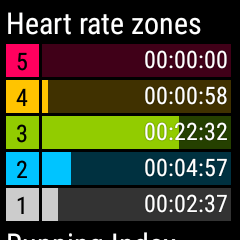
The Implications of Incorrect Assumptions
Resting heart rate matters because it defines one end of the workable range.
A maximum of 185 bpm and a Z2 range of sixty to seventy per cent places an easy effort in different zones depending on the method, as the table below shows.
| Method | Resting heart rate | 60% | 70% |
|---|---|---|---|
| %Max HR | not used | 111 bpm | 130 bpm |
| Karvonen | 60 bpm | 135 bpm | 148 bpm |
| Karvonen | 75 bpm | 141 bpm | 152 bpm |
Neither method uses the more precise alternatives that rely on lactate or ventilatory threshold estimates; those are covered in heart rate training zones. Both are estimates rather than measurements, and HRR tracks oxygen uptake reserve more closely than the %Max HR method does.
Why the %Max HR method is still the default
%Max HR needs one number: an age. Karvonen also needs an estimated resting heart rate. %Max HR is easier, and that is the reason it is widely used in sports tech.
The one number it does ask for, age, commonly leads to a wrong HRmax. Robergs and Landwehr found no research behind 220 minus age in a 2002 review, and the formula is commonly cited as carrying a standard error of seven to twelve beats per minute.
An error of that size can easily place an effort in the wrong zone.
When Karvonen earns its place
- Endurance athletes in their forties and fifties, runners whose resting rate has fallen across a training block, and anyone with an unusually high resting heart rate for other reasons are most impacted when using the %Max HR method.
- Resting heart rate falls as fitness improves, often within weeks. If RHR is monitored or automated, the Karvonen targets move with it; the %Max HR method only moves when the maximum is re-measured, and few watches do that separately for each sport.
Calculating your own zones
Resting heart rate comes from a morning reading averaged over several days, or a wearable’s overnight figure. Maximum heart rate should be measured, not estimated, e.g. the highest value from a race or hill session is usually close, whereas an age-based estimate can still be out by seven to twelve beats per minute. Maximum heart rate is also sport-specific: cycling and swimming typically produce a lower measured maximum than running or cross-country skiing, and few watches or apps record a separate maximum per sport.
The free Karvonen heart rate zone calculator turns both figures into bpm targets for the watch, and is worth updating as your fitness changes.
Quick answers
Is the Karvonen formula more accurate than %Max HR?
HRR correlates more closely with oxygen uptake reserve than the %Max HR method does, making it the better proxy for training intensity, though neither measures a lactate or ventilatory threshold directly.
Should I trust my watch's default heart rate zones?
Most watches default to the %Max HR method for convenience, not accuracy. If the maximum behind it was estimated from age rather than measured, it likely carries the seven-to-twelve-beat-per-minute error commonly cited for 220 minus age, following Robergs and Landwehr’s 2002 review.
Do heart rate zones change as fitness improves?
Under Karvonen, often, since a falling resting heart rate lowers the target and the calculation is worth revisiting periodically. Under the %Max HR method, zones move only when the maximum is re-measured, and few watches do that separately for each sport.
This article is for informational purposes only and is not a substitute for guidance from a doctor or certified trainer.
Last Updated on 31 July 2026 by the5krunner
My favourite kit and nutrition
- Garmin Fenix 9 Pro — I’ve just bought one.
- Injinji – Runners protect your toes. Avoid discomfort and minor injury. Run more. Run faster. I use them.
- Garmin 90-degree charging adapter — A small keyring adapter you can use anywhere. Essential when away. I use one.
- Garmin charging puck — the fastest and most reliable way to top up your Garmin before a session. I use one.
- Ravemen FR300 — Front light that mounts directly under your Garmin or Wahoo head unit. Keeps your bars clean and your beam pointed where it matters. I use one.
- Body Glide – The blue anti-chafe stick that all swimmers and many runners use. I use it.
- Maurten — The race nutrition trusted by elite athletes. Gels and drink mixes engineered to be easy on the stomach. I use them.
- Garmin Varia RTL515 — A radar rear light that alerts you to vehicles approaching from behind. Pairs with your Edge or Wahoo. I use this model.
- Favero Assioma Pro RS2 — The power-meter pedals most serious cyclists choose. Accurate, easy to move between bikes. I use this model.
- Garmin Forerunner 970 — A serious choice for a pro-grade triathlon watch. I use this.
- Polar H10 — My daily driver for accurate, waking HRV readings.
- Wahoo ELEMNT Roam 3 — The bike computer that has the feature Garmin lacks: usability. I use mine on most rides.
Reader-Powered Content

This content is not sponsored. It’s mostly me behind the labour of love, which is this site, and I appreciate everyone who supports it.
Support the site: Follow (free, fewer ads) · Subscribe (paid, ad-free) · Buy Me A Coffee ❤️
All articles are written by real people, fact-checked, and verified for originality. See the Editorial Policy. FTC: Affiliate Disclosure — some links pay commission. As an Amazon Associate, I earn from qualifying purchases.

tfk is the founder and author of the5krunner, an independent endurance sports technology publication. With 20 years of hands-on testing of GPS watches and wearables, and competing in triathlons at an international age-group level, tfk provides in-depth expert analysis of fitness technology for serious athletes and endurance sport competitors. ID

I found that the Joe Friel method of defining zones as a percentage of LT2 is more closely aligned to my RPE.
https://www.trainingpeaks.com/learn/articles/joe-friel-s-quick-guide-to-setting-zones/
yes. i used to use that method (its mentioned in the link from this post)