This is one test session from a six-session accuracy series. Read the full review for the complete picture, including where CIRQA excelled.
After my open water test with CIRQA two days ago, today was a more meaningful interval session. It was very hot, and in the end I decided that 5x 3 minutes would be enough. I was running a bit faster than I expected, which was nice but certainly not maximal; all that gym work seems to have been paying off after all.
I was on the Thames towpath, which is a combination of tarmac and hard-packed gravel, i.e., a good running surface.
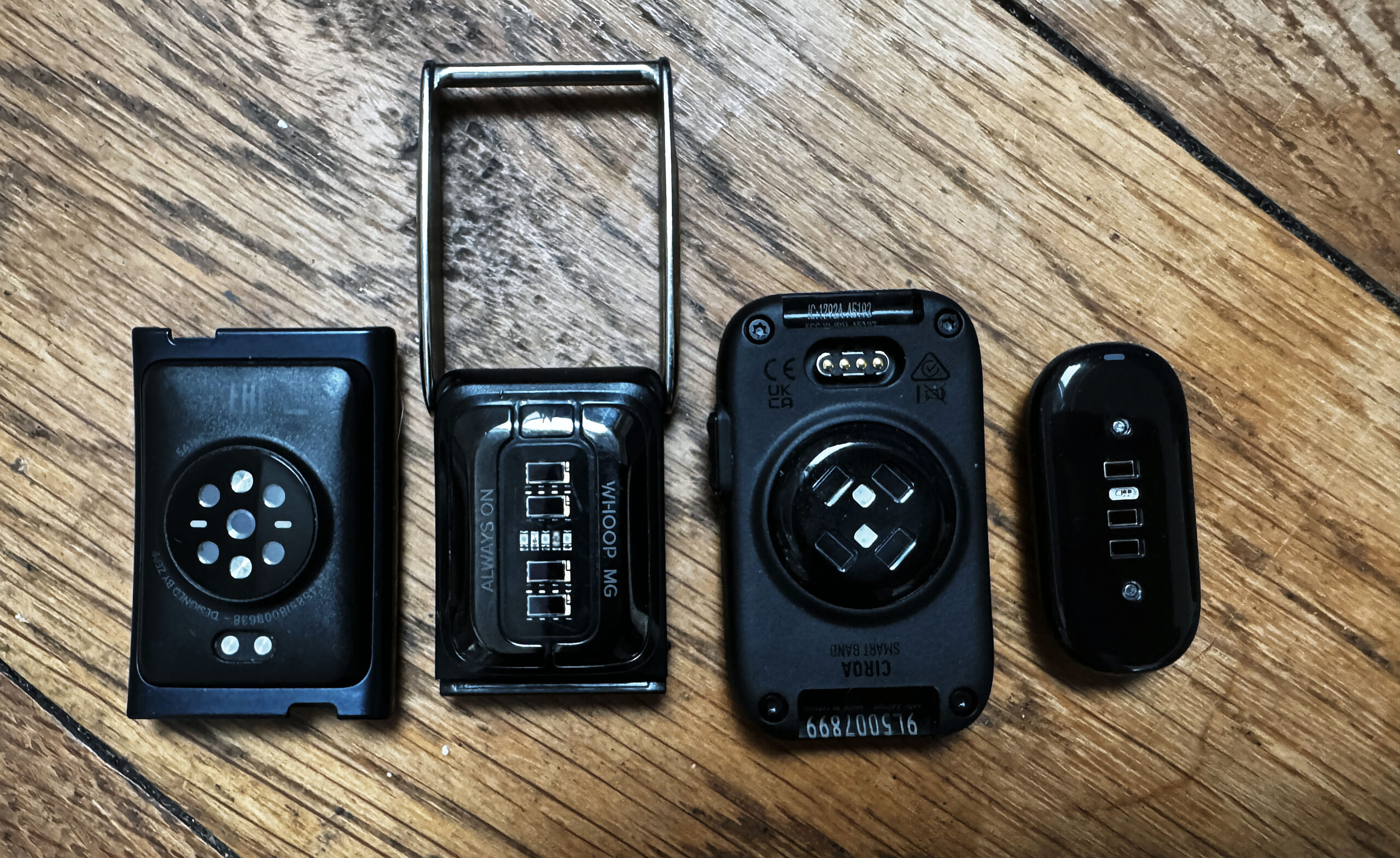
I had a lot of gadgets on test: Frontier X Plus chest strap, Apple Watch Ultra 3 (full specifications, left wrist), Garmin CIRQA (right wrist), Fitbit Air (left forearm underside), Amazfit Helio (right forearm underside), Polar SENSE (right biceps).
I forgot the Frontier only caches sports data infrequently and should have paired it to a watch, and I also forgot to change the Helio, so no data there. A further problem was that the CIRQA was initially located properly and tightly, but still sweat and motion caused it to slip slightly too close to the wrist bone. That sometimes happens with me with devices on the wrist, which is why I prefer a bicep-worn OHR.
The final problem was that the Polar SENSE gets stuck in a doom sync loop back to the Polar FLOW app. The data is on there; I just can’t see it.
In brief…
- WHOOP and Fitbit AIR emerge as the strongest visual and statistical pair.
- Frontier X is acknowledged as accurate but limited by sparse data.
- Apple Watch Ultra 3 is described as generally accurate except for the two obvious dropouts.
- Garmin CIRQA is identified as the poorest performer due to systematic under-reporting, which is evident both visually and in the Bland–Altman statistics.
Data Results
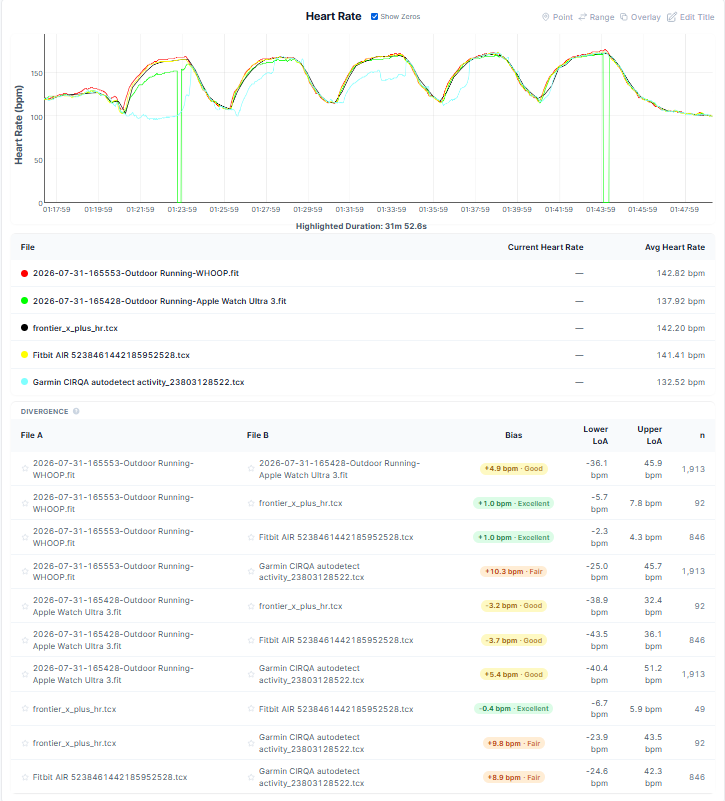
The chart and summary accuracy data show the heart rate traces during five repeated running intervals, that being the shorter section of a longer run. Visually, WHOOP and Fitbit AIR demonstrated the closest agreement throughout the test, with both devices closely matching the timing and magnitude of heart rate increases during the work intervals and the subsequent recovery phases. The Frontier X also tracked the overall heart rate profile well where data were available, but produced substantially fewer matched observations (n = 92), limiting visual and statistical interpretation. The Apple Watch Ultra 3 generally followed the interval pattern but exhibited two clear signal dropouts during the session, resulting in losses of heart rate data. In contrast, the Garmin CIRQA consistently underestimated heart rate at the start of each of four of the five reps, resulting in a visibly poorer fit to the other devices.
The visual observations were supported by the pairwise agreement analysis. WHOOP and Fitbit AIR demonstrated excellent agreement (bias +1.0 bpm, limits of agreement −2.3 to 4.3 bpm, n = 846), representing the strongest comparison with both a low systematic bias and narrow limits of agreement. Frontier X also showed excellent agreement with WHOOP (bias +1.0 bpm, limits of agreement −5.7 to 7.8 bpm), although this comparison included only 92 matched observations. Comparisons involving the Apple Watch Ultra 3 showed good agreement but wider limits of agreement, reflecting the impact of the two signal dropouts. Garmin CIRQA consistently exhibited the largest positive bias (approximately +9–10 bpm versus the other devices) and the widest limits of agreement, consistent with its visible underestimation of heart rate during the interval protocol.
Take Out
There are no huge surprises here, although Fitbit Air stands out as performing better than I expected.
Apple Watch’s good performance with dropout is typical (it appears to record nothing when it flags the data quality from the sensor as poor)
I’m not surprised by Garmin CIRQA’s performance on the wrist as I have often found Garmin’s OHR doesn’t suit my wrist. As a one-off, or if that were just me, it would be fine, but clearly other brands’ wrist algorithms and sensors work correctly for me. That said, I expect the Garmin to work very well in a week or so when I start testing on the biceps. Most devices perform well there.
Garmin CIRQA Smart Band
Screenless health and fitness band (no subscription required)
 +other retailers
Quick answers
Why did Garmin CIRQA underestimate heart rate during the interval test?
The CIRQA slipped slightly too close to the wrist bone during the session, and its wrist-based sensor has repeatedly struggled with this athlete’s wrist compared with other test devices.
Which device was most accurate for heart rate during the running intervals?
WHOOP and Fitbit Air showed the closest agreement, with a bias of +1.0bpm and limits of agreement of −2.3 to 4.3bpm across 846 matched observations.
Does the Frontier X chest strap's infrequent data caching limit its use in this test?
Yes. The Frontier X only produced 92 matched observations against WHOOP, against 846 for the WHOOP/Fitbit Air pair, which narrows how much the comparison can support.
Last Updated on 19 August 2026 by the5krunner
My favourite kit and nutrition
- Garmin Fenix 9 Pro — I’ve just bought one.
- Injinji – Runners protect your toes. Avoid discomfort and minor injury. Run more. Run faster. I use them.
- Garmin 90-degree charging adapter — A small keyring adapter you can use anywhere. Essential when away. I use one.
- Garmin charging puck — the fastest and most reliable way to top up your Garmin before a session. I use one.
- Ravemen FR300 — Front light that mounts directly under your Garmin or Wahoo head unit. Keeps your bars clean and your beam pointed where it matters. I use one.
- Body Glide – The blue anti-chafe stick that all swimmers and many runners use. I use it.
- Maurten — The race nutrition trusted by elite athletes. Gels and drink mixes engineered to be easy on the stomach. I use them.
- Garmin Varia RTL515 — A radar rear light that alerts you to vehicles approaching from behind. Pairs with your Edge or Wahoo. I use this model.
- Favero Assioma Pro RS2 — The power-meter pedals most serious cyclists choose. Accurate, easy to move between bikes. I use this model.
- Garmin Forerunner 970 — A serious choice for a pro-grade triathlon watch. I use this.
- Polar H10 — My daily driver for accurate, waking HRV readings.
- Wahoo ELEMNT Roam 3 — The bike computer that has the feature Garmin lacks: usability. I use mine on most rides.
Reader-Powered Content

This content is not sponsored. It’s mostly me behind the labour of love, which is this site, and I appreciate everyone who supports it.
Support the site: Follow (free, fewer ads) · Subscribe (paid, ad-free) · Buy Me A Coffee ❤️
All articles are written by real people, fact-checked, and verified for originality. See the Editorial Policy. FTC: Affiliate Disclosure — some links pay commission. As an Amazon Associate, I earn from qualifying purchases.
tfk is the founder and author of the5krunner, an independent endurance sports technology publication. With 20 years of hands-on testing of GPS watches and wearables, and competing in triathlons at an international age-group level, tfk provides in-depth expert analysis of fitness technology for serious athletes and endurance sport competitors. ID

I don’t know about you, but any OHR sensor fails on my wrists, whereas forearms and biceps basically match my HRM600 and don’t have the chest strap warm up issues. That’s what I’ve been seeing with the Band as well – better more consistent results than even a chest strap.
Doing a comparison with the devices in such different locations, and not rotating them, seems kind of pointless.
i’m doing wrist first as that will match the majority of use cases
then i will test on biceps
i will probably use myself on an ongoing basis on biceps if accuracy there turns out to be as good as i expect
would you be reviewing the Luna band as well ? Curious to know how it fairs against the other bands
no plans at this stage for either Luna or Hume