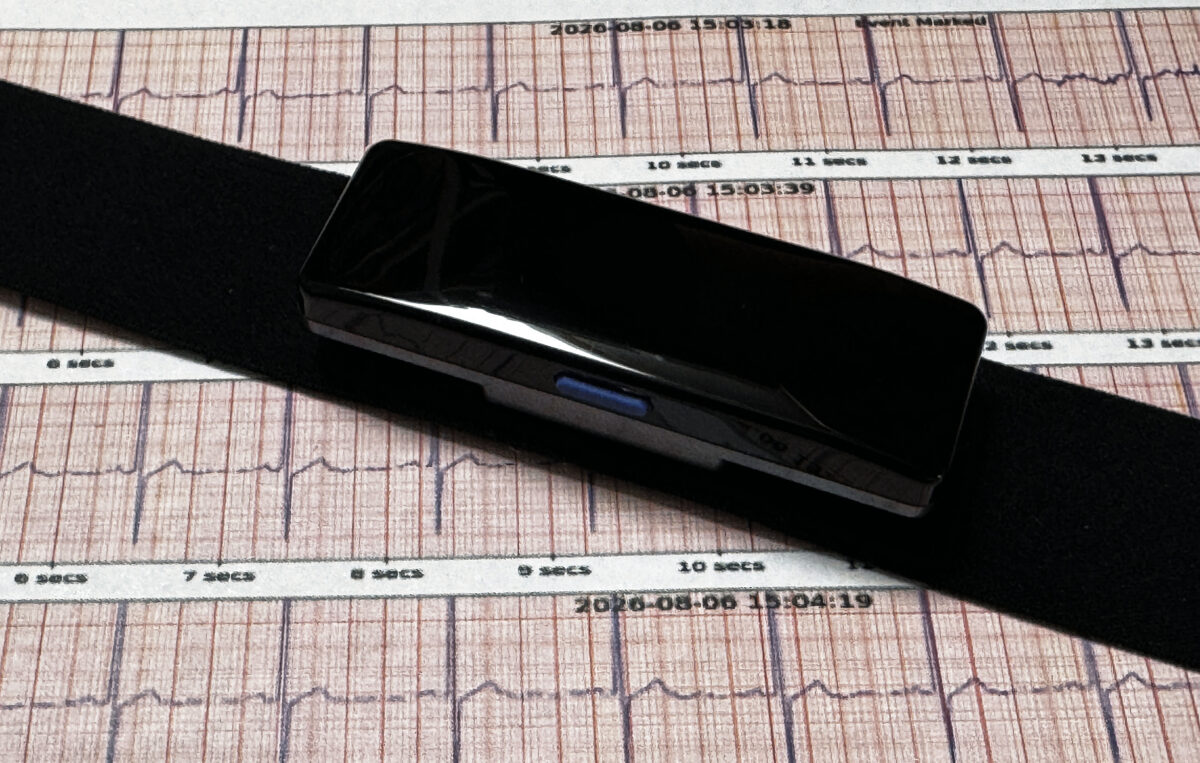
You are reading this review of the Fourth Frontier X Plus because you likely already have a diagnosis or suspicion of a heart condition and a prescription from your doctor. I’ve tested and used several Fourth Frontier devices, and this review is based on my own referral for an ECG, as well as my use of it in sports.
In the hospital, a clinical 12-lead ECG found a leftward electrical axis, a nonspecific ST abnormality, and a possible sign of left ventricular hypertrophy. I wore the Fourth Frontier X Plus two days later under similar conditions, and it showed none of these findings. That isn’t a failure of the strap: a single lead strap cannot provide the information needed to identify them. If you’re weighing the X Plus against a Holter monitor or a cardiologist’s ECG, that difference matters more than the price or the FDA clearance.
I recently started to take medication that raised blood pressure, which led to the need for a clinical ECG. It gave me a rare chance to compare a clinical trace with the strap. Both recordings were made lying down after several minutes of rest, at a similar time of day and around two hours after food. A simultaneous recording wasn’t possible because the 12-lead ECG needs bare skin across V1 to V6, exactly where the strap sits.
Fourth Frontier also sells the X2, a strap built for athletes that adds ST-segment strain monitoring and training metrics during exercise, and the newer Zone, which offers similar sport features but is currently only sold in the UK. The X Plus is a different branch of the company’s lineup: a device built for people who already have, or are being investigated for, a heart condition. It gives up those sports features in favour of FDA clearance and clinical reporting. It’s a US product only, and it doesn’t yet work in the UK (August 2026).
Heads Up: This is a media loaner. Fourth Frontier did not pay for or approve this review.
At $649 (currently around $485 with the 25% promo code 5KRUNNERX), the X Plus is available only via fourthfrontier.com, and only in the US.
Fourth Frontier X Plus Review Summary
Excellent clinical accuracy, but built for a narrow use case
The Fourth Frontier X Plus matched a clinical 12-lead ECG on rate, rhythm, P wave presence and QRS morphology in direct testing, and held that same excellent agreement through cycling and running, including some intense efforts.
It’s FDA 510(k) cleared, backed by a validation study across 832 patients, and it does what a clinical snapshot can’t: catch intermittent arrhythmias over hours or days rather than ten seconds.
It’s a US-only, prescription-gated device with no interval or axis data, and its deepest feature, the Weekly Cardiac Rhythm Report, requires a subscription.
Pros
- Rhythm and waveform accuracy held up directly against my clinical 12-lead ECG
- Excellent heart rate agreement through cycling and a hard-effort run
- Continuous recording catches intermittent symptoms a ten-minute clinic visit would miss
- Raw ECG export (CSV/EDF) is unusual for a consumer-facing chest strap
- Reusable design, cheaper over time than disposable patches
Cons
- No interval or axis data, so it can’t replicate the breadth of a full clinical ECG
- Multi-day monitoring means working around a charging routine, not one continuous trace
- The Weekly Report subscription is a meaningful cost on top of the device itself
- Not built for swimming or wet sport
- Buying one requires going through a US prescription pathway
What is the Fourth Frontier X Plus?
The X Plus is Fourth Frontier’s prescription-only ECG chest strap. It holds FDA 510(k) clearance (K240794), a substantial-equivalence determination for a Class II device rather than a full PMA approval. Neither the X2 nor the Zone has this clearance. It’s built for people who already have, or are being investigated for, a heart condition rather than for sport. A full charge gives up to 24 hours of continuous recording and takes around 3 hours to recharge, so multi-day monitoring requires a charging routine.
X Plus vs X2
The X Plus adds FDA 510(k) clearance and an accuracy study behind it (98.1% sensitivity and 97.9% specificity for AFib detection against a 12-lead ECG across 832 patients). The X2 was never FDA cleared. It also offers a Weekly Cardiac Rhythm Report subscription, covering AFib, bradycardia and tachycardia trends with beat-by-beat analysis. The X2 has its own optional subscription instead, Frontier Premium ($14 a month or $119 a year), which covers fitness metrics such as VO2max, training readiness and sleep stages rather than cardiac reporting.
It has a downside as it gives up the features that make the X2 useful in sport:
- No Heart Strain monitoring, the X2’s ST-segment shift alert during exercise.
- No breath rate alerts or breath-based training load.
- No Body Shock tracking for mechanical stress and injury risk.
- Clinical involvement is required to obtain one: either an existing prescription uploaded after checkout, or a referral through Fourth Frontier’s own physician network as part of the order.
What stays the same:
- Continuous recording.
- Live streaming.
- The same small colour display and haptic alerts as the X2.
- Pairing to third-party sports watches and apps, the same way the X2 does. It was paired directly to a sports watch to capture the higher-resolution sports test data used below, despite the single-device Bluetooth limit.
X Plus vs Holter monitors and ECG patches
Fourth Frontier positions the X Plus against two other options a prescription-holder might be offered: Holter monitors and adhesive ECG patches. This is the manufacturer’s comparison, not something I independently tested here. A broad summary is that traditional Holters use wired electrodes, while disposable adhesive patches are used for shorter periods.
| Feature | Frontier X Plus | Holter monitors | ECG patches |
|---|---|---|---|
| High-quality ECG during exercise | Yes | No | No |
| No skin prep needed | Yes | No | No |
| No adhesives and wires | Yes | No | No |
| Live ECG review | Yes | No | No |
| Easy self-application | Yes | No | No |
| Rechargeable and reusable | Yes | No | No |
| Comfortable for extended use | Yes | No | No |
| Wearable during daily activities | Yes | No | Yes |
| Long-term cost | $ | $$ | $$$ |
For anything longer than a few days, the X Plus’s reusability changes the cost picture in its favour.
Design and fit
The X Plus uses a pod and strap most similar to the X2’s, both carrying a small colour display, unlike the newer, screen-free Zone. The pod clips onto a standard chest strap. It’s small enough to sit under a jersey or base layer without attracting much attention, although it’s a tad bigger than a traditional sports chest strap. The button must face down.
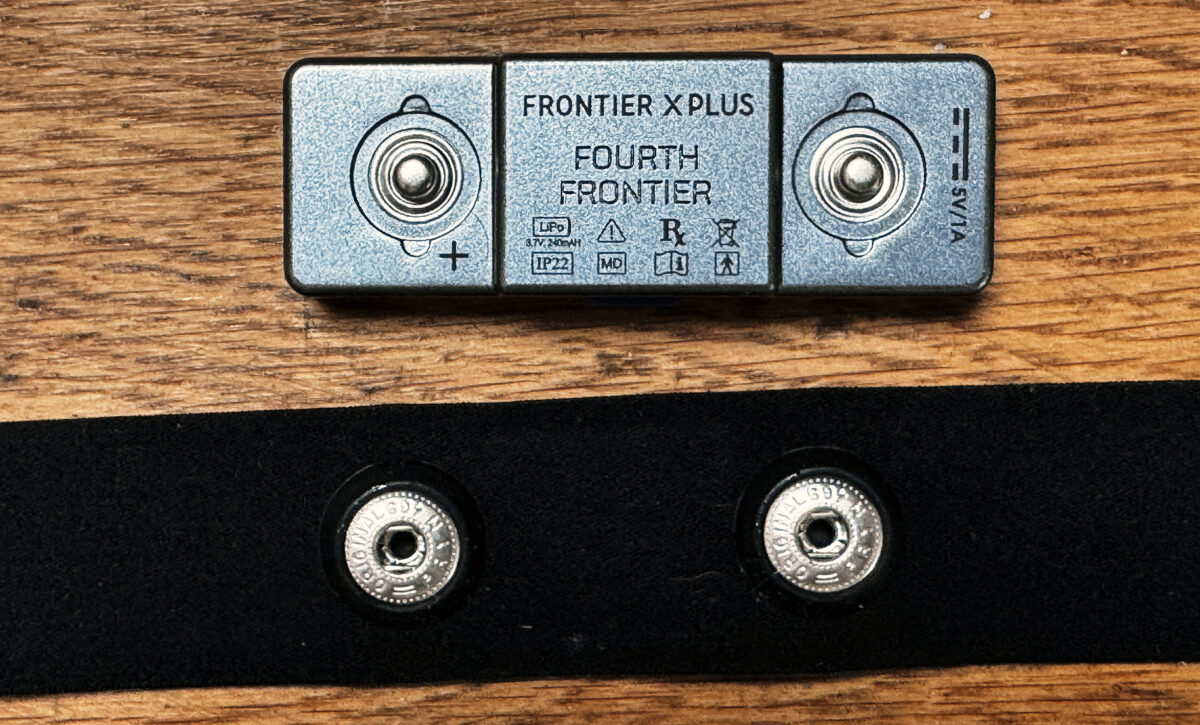
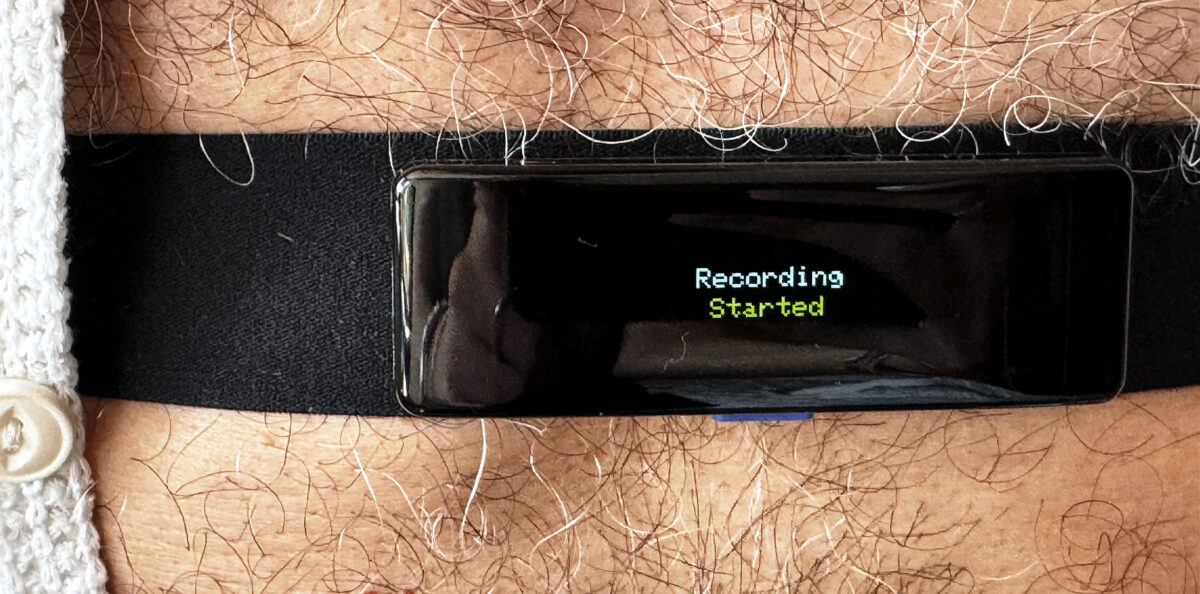
Because the pod is worn button-down, the display is upside down – odd when you look down to read it, but it still shows time, distance and shock score at a glance without the phone, same as the X2. There’s also a haptic motor that vibrates for real-time rhythm or heart rate alerts.
Accuracy
Test Results
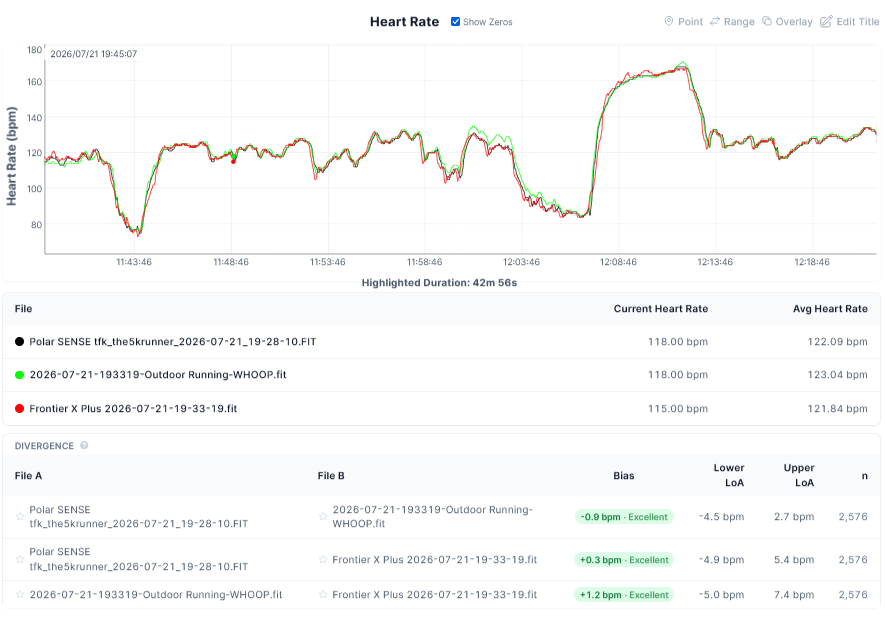
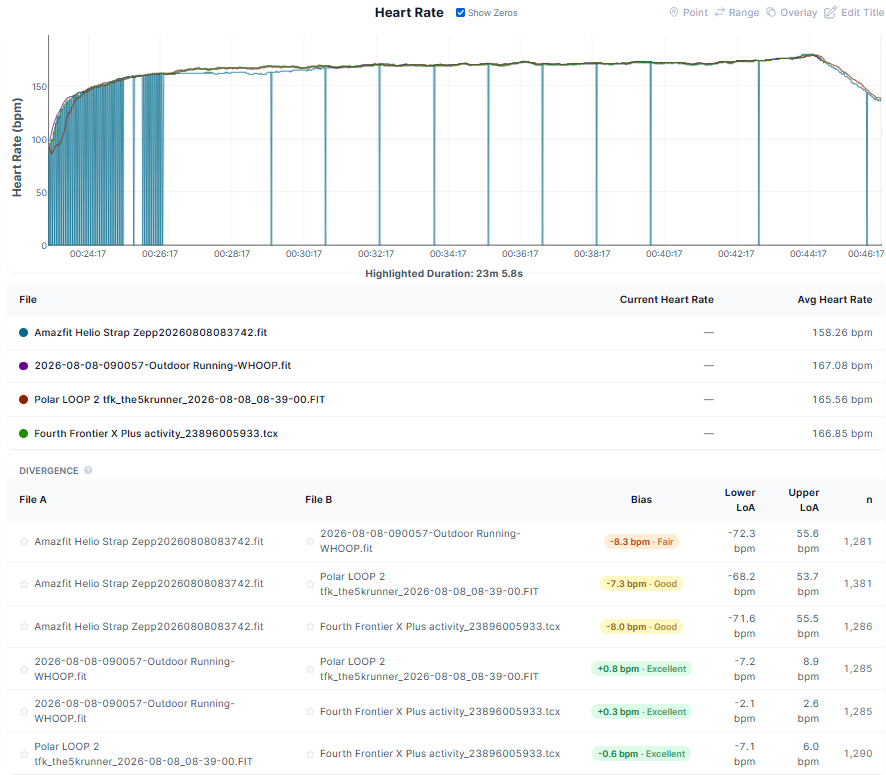
The table below covers four comparisons: a clinical 12-lead ECG against a single Frontier X trace; an outdoor cycling session against Polar SENSE; an outdoor run with a hard mile at the end against Polar SENSE and WHOOP MG; and a separate outdoor threshold run against WHOOP and Polar LOOP 2, also with a maximal finish.
| Session | Conditions | Devices compared | Bias | LoA | Verdict |
|---|---|---|---|---|---|
| 12-lead clinical ECG | Supine, at rest | Clinical 12-lead ECG | Rhythm classification agreed; no interval or axis data from the strap | n/a | Excellent rhythm agreement, limited to rhythm only |
| 1-hour outdoor ride | Steady effort | Polar SENSE | +0.1 bpm | -1.9 to +2.1 bpm | Excellent |
| Outdoor run, hard mile at the end | Mixed steady and high intensity | Polar SENSE, WHOOP MG | +0.3 bpm vs Polar SENSE; +1.2 bpm vs WHOOP MG | -4.9 to +5.4 bpm vs Polar SENSE; -5.0 to +7.4 bpm vs WHOOP MG | Excellent |
| Outdoor threshold run | High-intensity threshold effort | WHOOP, Polar LOOP 2 | +0.3 bpm vs WHOOP; -0.6 bpm vs Polar LOOP 2 | -2.1 to +2.6 bpm vs WHOOP; -7.1 to +6.0 bpm vs Polar LOOP 2 | Excellent |
Every session returned excellent agreement, including the hard finishes of the runs, following the same testing methodology used across this site.
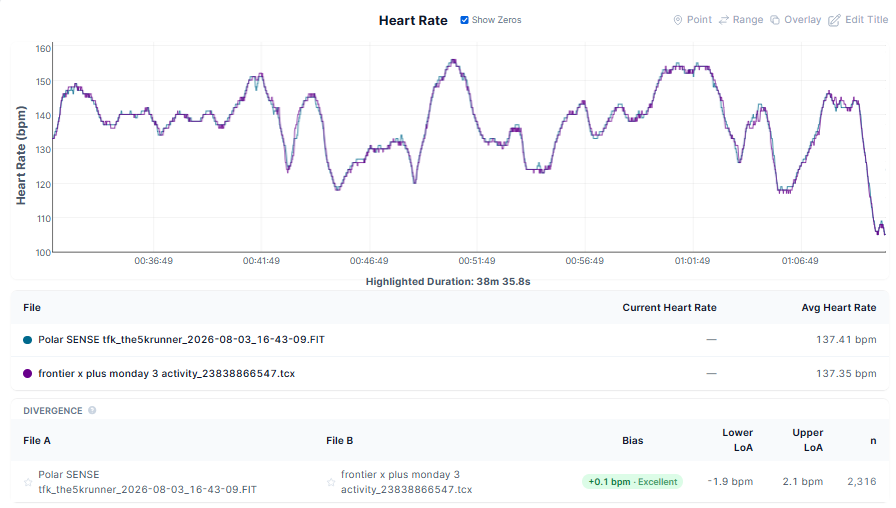
In this outdoor threshold running test, the Fourth Frontier X Plus showed excellent agreement with the reference devices. WHOOP and Polar LOOP 2 differed by only +0.8 bpm (Excellent). The Frontier X Plus recorded a bias of +0.3 bpm versus WHOOP (limits of agreement –2.1 to +2.6 bpm) and –0.6 bpm versus Polar LOOP 2 (–7.1 to +6.0 bpm), both rated Excellent across roughly 1,285–1,290 overlapping samples. By contrast, the Amazfit Helio Strap showed larger offsets, around –7 to –8 bpm, and much wider limits of agreement against all three devices, partly because of numerous dropouts. Overall, the Frontier X Plus tracked heart rate with high accuracy and consistency relative to WHOOP and Polar LOOP 2 in this run.
Clinical ECG in detail
HR and HRV between tests are not comparable.
Both recordings show regular sinus rhythm, with consistent spacing between beats and no pauses. The rhythm classification agrees. P waves are identifiable on both traces. On clinical lead II, they’re crisper and higher in amplitude. On the strap, they’re present but closer to the baseline, and in the first 20 seconds there appears to be a movement artefact. The QRS complexes on the strap are sharp and well defined, with a narrow dominant R wave that matches the clinical trace in character, if not in amplitude. That amplitude difference likely comes from electrode position: the chest strap views the heart from a different direction than standard lead II. T waves are present and readable on both.
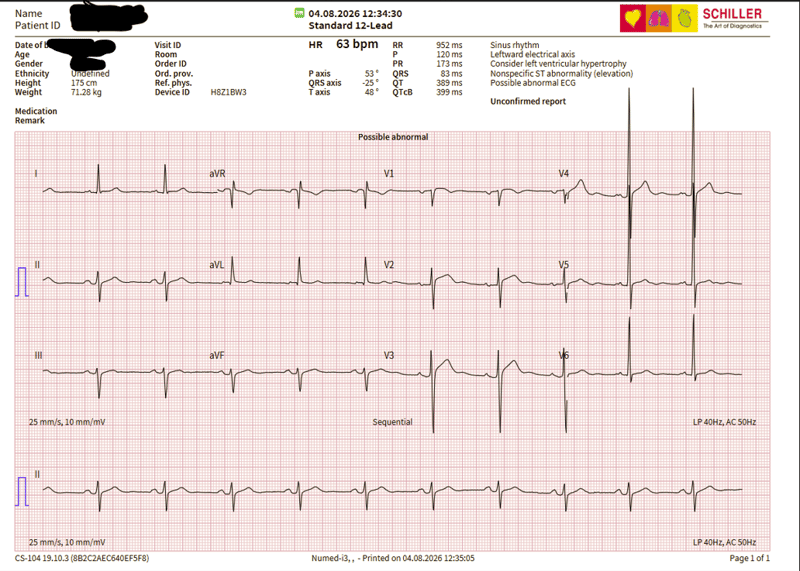
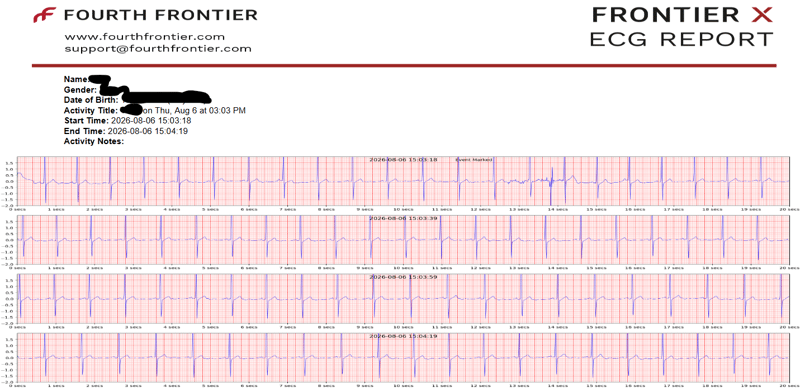
The Frontier X report contains no interval measurements. There is no PR, QRS, QT or QTc figure in the output. A clinical-grade machine produces all four automatically, along with P axis, QRS axis, and T axis. Measuring intervals by eye from a printout with a 20-second time axis wouldn’t produce numbers worth publishing.
The clinical trace flagged these three findings, which the Fourth Frontier cannot measure:
- A leftward electrical axis at minus 25 degrees.
- Possible left ventricular hypertrophy on voltage criteria.
- A nonspecific ST abnormality.
The strap records while it’s charged and worn, up to 24 hours per charge. The clinical machine records for ten seconds. For anyone tracking intermittent unusual beats (ectopy), a ten-second snapshot taken in a clinic at rest likely won’t find it, whatever the lead count.
Fourth Frontier’s own validation study, involving 832 patients and using a 12-lead ECG as the reference standard, reports 98.1% sensitivity and 97.9% specificity for AFib detection. Three independent cardiologists adjudicated the results. That’s a much larger sample than my single session for this review, but it’s the evidence behind the device’s FDA clearance.
What the X Plus is FDA-cleared to detect
The FDA clearance covers automated detection and display of five rhythm classifications: normal sinus rhythm, atrial fibrillation, bradycardia, tachycardia, and inconclusive or unreadable recordings. That’s the regulated scope, which itself is narrower than the range of rhythm patterns a trained human eye can spot.
What a clinician may additionally see on a trace
A physician may also discern these on the raw ECG:
- Atrial flutter. The sawtooth pattern is usually identifiable.
- Supraventricular and ventricular tachycardia. Narrow- or wide-complex tachycardia with sudden onset and termination, although distinguishing the two can sometimes require more leads.
- Sick sinus syndrome and sinus pauses. Continuous recording makes these easier to catch than a short clinical snapshot.
- Premature atrial and ventricular contractions. Visible on the trace, with the Weekly Report quantifying how much they occur over time.
- First, second and third-degree AV block. Visible when the device resolves P waves adequately.
What it’s explicitly not for
Fourth Frontier states plainly that the X Plus isn’t indicated for:
- Diagnosing cardiac ischemia.
- Diagnosing myocardial infarction.
- Diagnosing left ventricular hypertrophy.
It hasn’t been tested for use with pacemakers or ICDs, and it shouldn’t be worn near a defibrillator or high-frequency surgical equipment. The manufacturer also excludes:
- Users under 22.
- Pregnant women.
- Anyone with a known skin allergy to the device’s contact materials.
- Anyone with a potentially life-threatening arrhythmia that needs hospital-based monitoring.
The chest strap itself is RoHS2 and REACH compliant.
Weekly clinical reports
The base device provides continuous ECG recording, live streaming and rhythm classification. The Weekly Cardiac Rhythm Report is a separate subscription, at $30 a month or $240 a year. It’s exclusive to the X Plus and isn’t supported by the older X2. It has a 14-day trial in addition to the device’s return window.
The report goes beyond a simple trace export. It breaks the week down into:
- Time spent in normal rhythm, AFib, bradycardia and tachycardia.
- A beat-by-beat distribution separating typical beats from outliers.
- Hourly heart rate trend analysis.
- A written weekly summary.
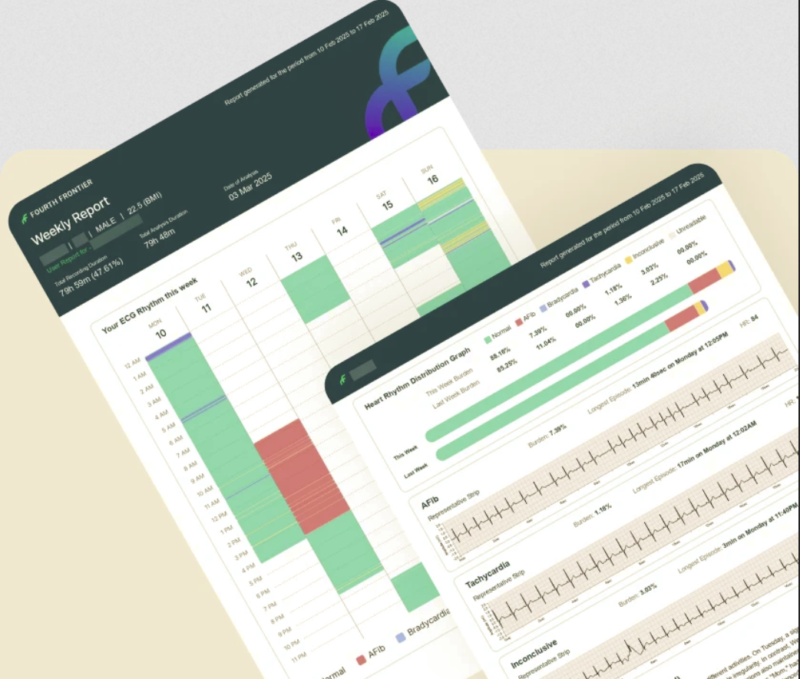
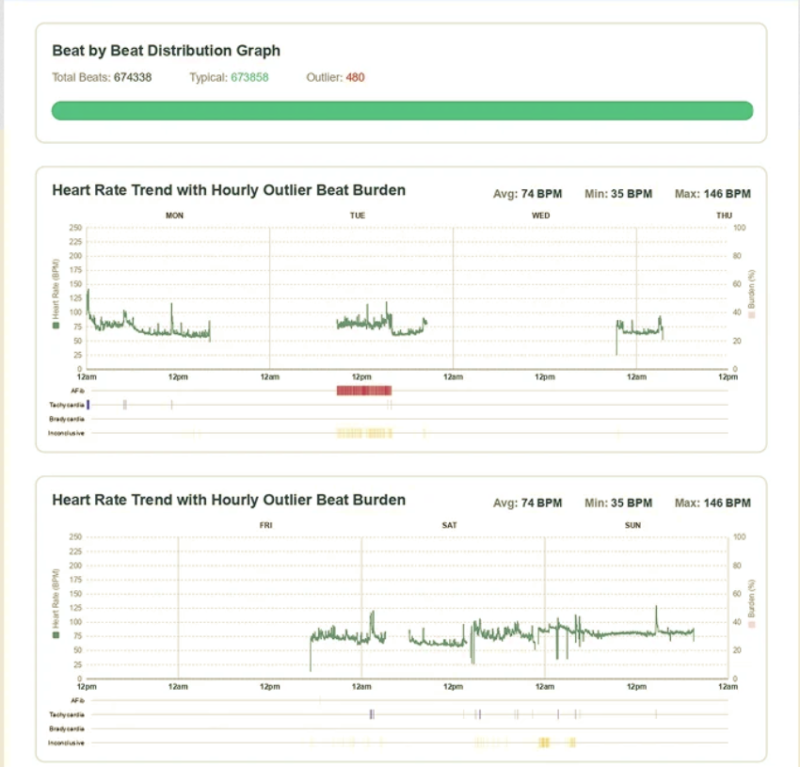
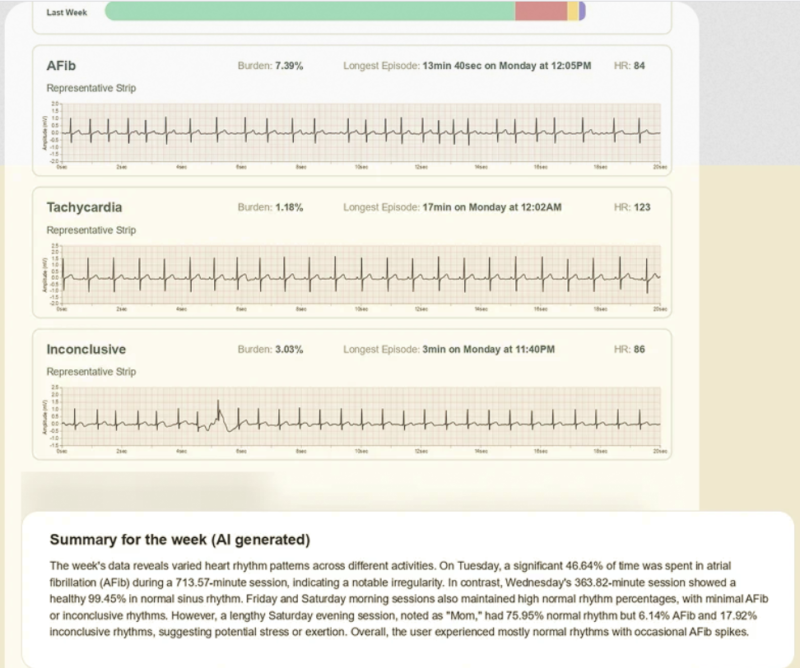
It also brings together data the base device already collects but doesn’t otherwise present as one picture, with each measure shown alongside the week’s arrhythmia burden:
- Heart rate zones and recovery.
- Resting heart rate.
- HRV.
- Sleep stage breakdown.
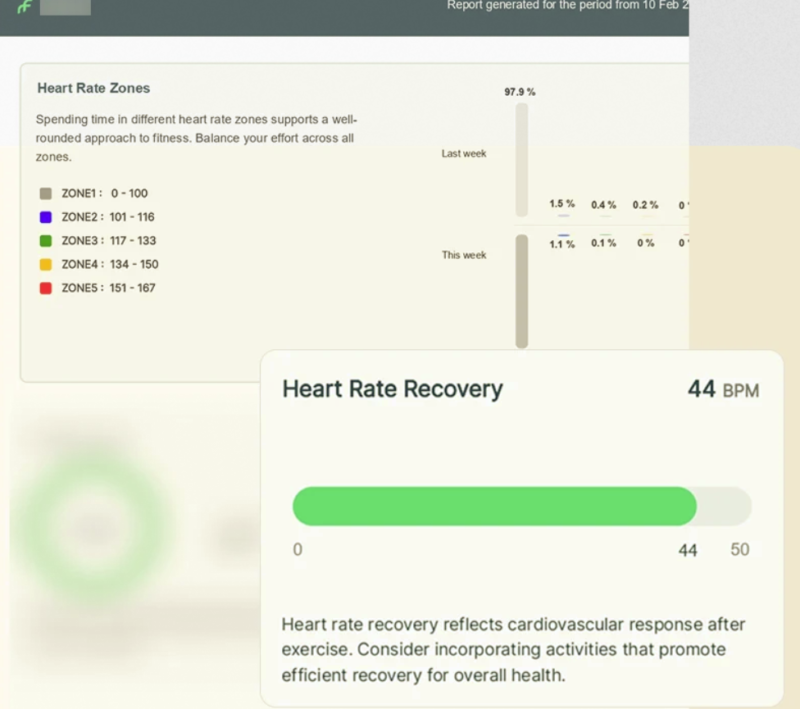
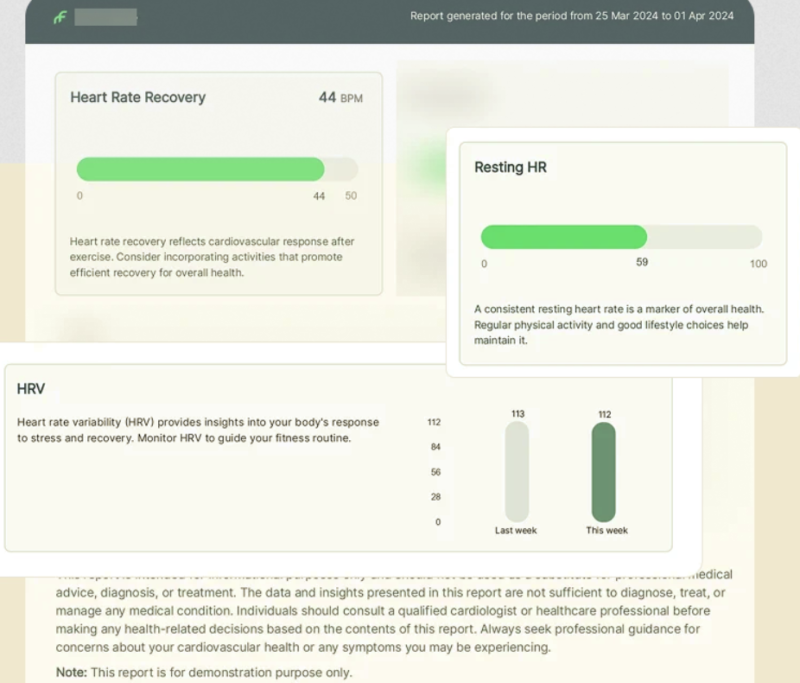
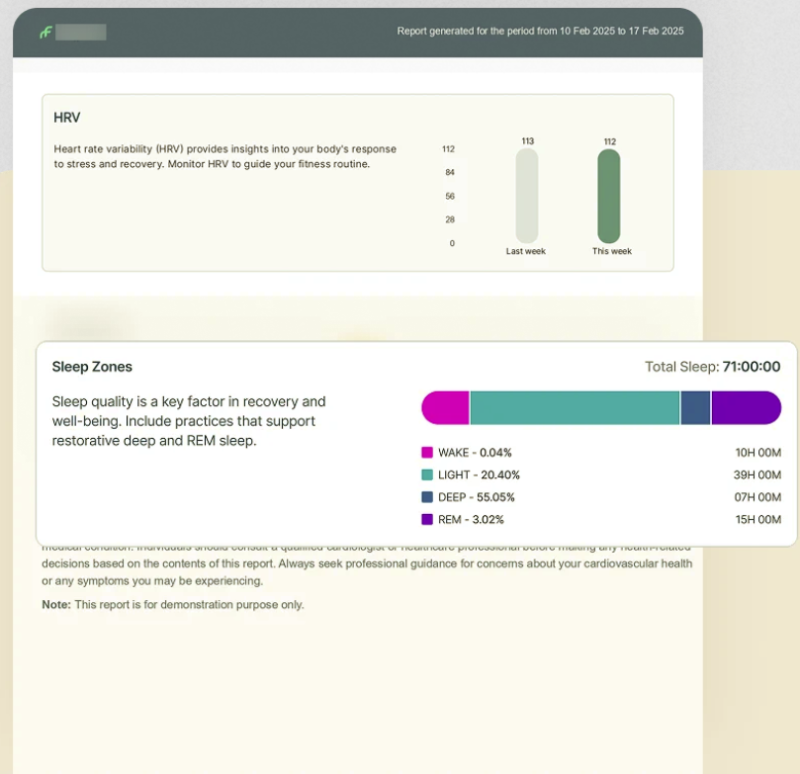
The report doesn’t replace a diagnosis and is not a substitute for clinical judgement. Several of the wellness metrics, including HRV, sleep stages and training load, are also flagged as informational rather than diagnostic. What it adds is a week of context, in a form a physician can easily review without having to work through the multiple raw data sources themselves.
For clinicians and anyone who wants the underlying data rather than just the report, Fourth Frontier’s professional platform exports raw ECG at 125Hz as CSV, derived heart rate, rhythm and HRV in 20-second intervals as a separate CSV, and full recordings in EDF format, plus selected segments as PDF. The 125Hz sampling rate is close to the Polar H10‘s 130Hz and well above 5Hz on a typical sports strap. That high frequency resolution is what gives you an actual ECG trace rather than just a heart rate number.
Who is it for
Fourth Frontier builds the X Plus around five situations:
- Known or suspected AFib.
- Unexplained palpitations.
- Recovery after a cardiac procedure such as ablation, angioplasty or bypass.
- Ongoing observation on a physician’s recommendation.
- Overnight rhythm changes that a daytime clinic visit won’t catch.
All five involve the same problem: symptoms that don’t reliably appear during a short clinic appointment.
It comes with a 14-day trial and a 1-year warranty. It’s HSA/FSA eligible, so it’s worth checking with your provider because that can offset part of the $649 cost. It requires clinical involvement to obtain and offers nothing for athletic training. Athletes without a diagnosed condition who want exercise-linked ECG monitoring are better served by the Fourth Frontier X2, which costs less and doesn’t require a prescription. It adds Heart Strain (ST-segment) monitoring, breath rate alerts and Body Shock injury-risk tracking, features the X Plus gives up. Fourth Frontier’s newer Zone strap offers similar sport features too, though it’s currently sold in the UK rather than the US.
Verdict
At $649 (currently around $485 with the 25% promo code 5KRUNNERX), the Fourth Frontier X Plus closely matched the clinical ECG for rhythm and waveform features, i.e rate, P wave presence and QRS morphology. It cannot reproduce the diagnostic information a 12-lead system provides. That’s the important nuance in my case: the rhythms agreed, but the diagnostic picture didn’t.
It also held up during hard exercise; both the cycling session and the runs with hard-to-max efforts returned excellent agreement against the reference devices.
Perhaps the key practical benefit is the continuous monitoring between clinical appointments.

Quick answers
Is the Fourth Frontier X Plus a medical device?
Yes. Unlike the Fourth Frontier X2 or Zone, the X Plus holds FDA 510(k) clearance and requires clinical involvement to obtain. It’s built for people who already have, or are being investigated for, a heart condition rather than for general fitness use.
What is the difference between the Fourth Frontier X Plus and the X2?
The X Plus holds FDA 510(k) clearance and offers an optional Weekly Cardiac Rhythm Report subscription ($30/month or $240/year) that the X2 doesn’t have. The X2 lacks FDA clearance but adds Heart Strain (ST-segment) monitoring, breath-based training load, Body Shock injury-risk tracking, and its own optional Frontier Premium subscription for VO2max, training readiness and sleep-stage metrics. Both are available in the US; Fourth Frontier’s newer Zone strap offers similar sport features but is currently sold in the UK.
How accurate is the Fourth Frontier X Plus compared to a clinical ECG?
In a direct comparison against a clinical 12-lead ECG, the X Plus matched rate, rhythm, P wave presence and QRS morphology. It doesn’t report interval measurements such as PR, QRS or QT, and it can’t calculate electrical axis or assess voltage criteria for hypertrophy. Those require multiple leads.
Do I need a prescription for the Fourth Frontier X Plus?
Yes, but you don’t need one before buying. If you already have a prescription, you upload it after checkout. If you don’t, Fourth Frontier routes you to its physician network to obtain one as part of the order process. Either way, the device ships only once a prescription is on file. It’s a US-only product and won’t function in the UK until Fourth Frontier updates the app on its side.
What can the Fourth Frontier X Plus diagnose?
Its FDA 510(k) clearance (K240794) covers automated detection of five rhythm classifications: normal sinus rhythm, atrial fibrillation, bradycardia, tachycardia, and inconclusive or unreadable recordings. A physician reviewing the continuous trace may also identify patterns such as atrial flutter, SVT, VT or AV block, but those are outside the device’s cleared automated classifications. Fourth Frontier states explicitly that it isn’t indicated for diagnosing cardiac ischemia, myocardial infarction or left ventricular hypertrophy, and it hasn’t been tested for use with pacemakers or ICDs.
What does the Weekly Cardiac Rhythm Report cost?
It’s a separate subscription from the device itself: $30 a month, or $240 a year. It’s exclusive to the X Plus and isn’t available on the X2. Fourth Frontier states that the report is supplemental and not a substitute for clinical diagnosis or treatment.
Sources and resources
- Fourth Frontier X2 review
- Fourth Frontier Zone review (UK only)
- Garmin HRM 600 review
- Fourth Frontier support and manual
Last Updated on 10 August 2026 by the5krunner
My favourite kit and nutrition
- Garmin Fenix 9 Pro — I’ve just bought one.
- Injinji – Runners protect your toes. Avoid discomfort and minor injury. Run more. Run faster. I use them.
- Garmin 90-degree charging adapter — A small keyring adapter you can use anywhere. Essential when away. I use one.
- Garmin charging puck — the fastest and most reliable way to top up your Garmin before a session. I use one.
- Ravemen FR300 — Front light that mounts directly under your Garmin or Wahoo head unit. Keeps your bars clean and your beam pointed where it matters. I use one.
- Body Glide – The blue anti-chafe stick that all swimmers and many runners use. I use it.
- Maurten — The race nutrition trusted by elite athletes. Gels and drink mixes engineered to be easy on the stomach. I use them.
- Garmin Varia RTL515 — A radar rear light that alerts you to vehicles approaching from behind. Pairs with your Edge or Wahoo. I use this model.
- Favero Assioma Pro RS2 — The power-meter pedals most serious cyclists choose. Accurate, easy to move between bikes. I use this model.
- Garmin Forerunner 970 — A serious choice for a pro-grade triathlon watch. I use this.
- Polar H10 — My daily driver for accurate, waking HRV readings.
- Wahoo ELEMNT Roam 3 — The bike computer that has the feature Garmin lacks: usability. I use mine on most rides.
Reader-Powered Content

This content is not sponsored. It’s mostly me behind the labour of love, which is this site, and I appreciate everyone who supports it.
Support the site: Follow (free, fewer ads) · Subscribe (paid, ad-free) · Buy Me A Coffee ❤️
All articles are written by real people, fact-checked, and verified for originality. See the Editorial Policy. FTC: Affiliate Disclosure — some links pay commission. As an Amazon Associate, I earn from qualifying purchases.
tfk is the founder and author of the5krunner, an independent endurance sports technology publication. With 20 years of hands-on testing of GPS watches and wearables, and competing in triathlons at an international age-group level, tfk provides in-depth expert analysis of fitness technology for serious athletes and endurance sport competitors. ID

Raw ECG export (CSV/EDF) is available in frontier zone??
edf/pdf, yes as per the article i think i mentioned that. also can live stream the ecg