Frontier Zone Review: ECG Chest Strap for Athletes
Let’s start this review with a short, true story.
Walking with my partner in over 30-degree heat last weekend (July 2026), we watched a man in his fifties collapse during the Richmond Riverside Half Marathon. He looked fit. We helped get the medic from 2Km away to the man, who eventually recovered in the hospital.
Why might this have happened? One plausible answer is that sweating causes dehydration and thicker blood, requiring the heart to work harder. Any lingering coronary problem might be pushed to the forefront. In exercise-induced collapses (ischaemia), ST-segment changes can be seen in an ECG before symptoms become severe. That is a specific event the Fourth Frontier Zone is designed to monitor.
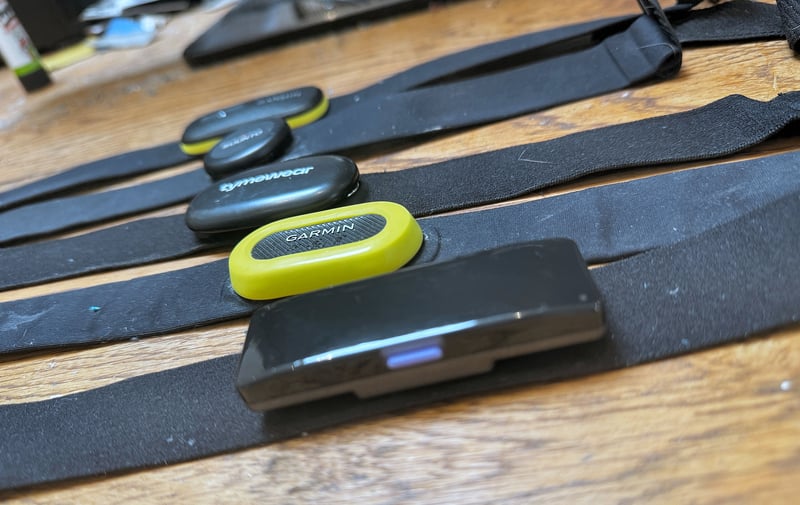
For exercise-induced cardiac strain, it may provide an early warning to act on. And as we get older, all our heart risks increase regardless of how fit we used to be.
The ECG trace from regular 24×7 use can also speed up doctor consultations, and its VO2max and ventilatory training zones provide useful insights to whatever app or sports device you pair the Zone heart rate monitor with.
Heads Up: This is a media loaner. Fourth Frontier did not pay for or approve this review.
Use code 5KRUNNER for 10% off at fourthfrontier.com (£179 with discount, RRP £199).
Fourth Frontier Zone — ECG Chest Strap for Athletes
The only consumer ECG strap that monitors cardiac strain in real time during exercise
The Fourth Frontier Zone does something no Garmin, Polar, or Wahoo chest strap does: it reads your ECG continuously during exercise and alerts you when the ST segment shifts beyond a safe threshold. At £179 (30% discount with code 5krunner), it costs less than half the price of its predecessor and offers better hardware. Tested across five sessions from a 108km sportive in 26-degree heat to a 150-minute Z2 ride, heart rate agreement was Good or Excellent in four of five sessions. The fifth was an inconclusive warm-up contact issue, not a sensor failure.
Pros
- Real-time ST segment strain monitoring with vibration alert — unique in consumer sports straps
- Continuous ECG recording exportable as PDF for clinical review
- Excellent heart rate accuracy as a reference device across multiple session types
- USB-C charging and 30-day HRM battery life — both improvements on the X2
- Works alongside any BLE sports watch or bike computer
- Breathing rate and VT1/VT2 ventilatory zones via premium subscription
Cons
- Bluetooth only — no ANT+ support
- No screen on the device
- ECG features and strain monitoring require the Fourth Frontier app
- Premium subscription needed for VO2 max, ventilatory zones, and readiness score
- Maximum 24 hours of continuous ECG per charge
- Strap orientation is critical — wearing it reversed invalidates the strain data
- No arrhythmia classification outside the app; no vibration alert for irregular beats during sport (just strain)
User Review
( votes)What is the Fourth Frontier Zone?
The Fourth Frontier Zone is a chest-worn ECG strap that continuously records your heart’s electrical activity during exercise and daily life. It connects to the Fourth Frontier app or to sports devices via Bluetooth, so you can view standard HR training metrics.
An ECG strap differs from most sports straps in that it records at tens of times per second to create the ECG trace you might sometimes see on hospital TV series. No regular sports watches or apps see that level of detail and typically only have up to 5 data points per second – never enough to recreate the ECG trace but enough to give you HRV insights.
Frontier Zone During Sport
The chest strap works like any other sports heart rate monitor and adds a configurable buzz or double-buzz, which occurs when you exceed any of these ranges for 20 seconds
- Heart rate: upper/lower zone threshold
- Breathing rate: upper/lower threshold
- Strain (ST segment): Above 0.3 mV (recommended), providing a margin above the 0.2 mV clinical threshold.
All beats are recorded continuously, but only heart rate, breathing rate, and ST segment strain receive live vibration alerts — irregular beats appear as ‘Other’ in the app in real time but do not trigger an alert, partly because extended periods of movement noise can produce false positives.
Frontier Zone During The Day
Several smartwatches and some Garmin watches do have a manual ECG feature. Their usefulness is limited, however, as they require you to consciously initiate a 30-second recording while the event is happening.
Frontier Zone works differently by creating a complete 24-hour ECG trace from a full charge. You start that with either a double-press of the button or via the smartphone app.
The entire day is continuously recorded, producing a long ECG trace. If there is ever a time of day when you are concerned about how your body feels, you press the button, which flags a 20-second section on the full ECG trace. This is simply a log of something happening to help you or your doctor find the event later.
Zone vs older Frontier X2: why is it now cheaper
The Frontier Zone is the cheaper, more modern replacement for the older X2 model. Most people will buy the Zone model, which contains the same ECG features.
Frontier Zone gains the following compared to X2
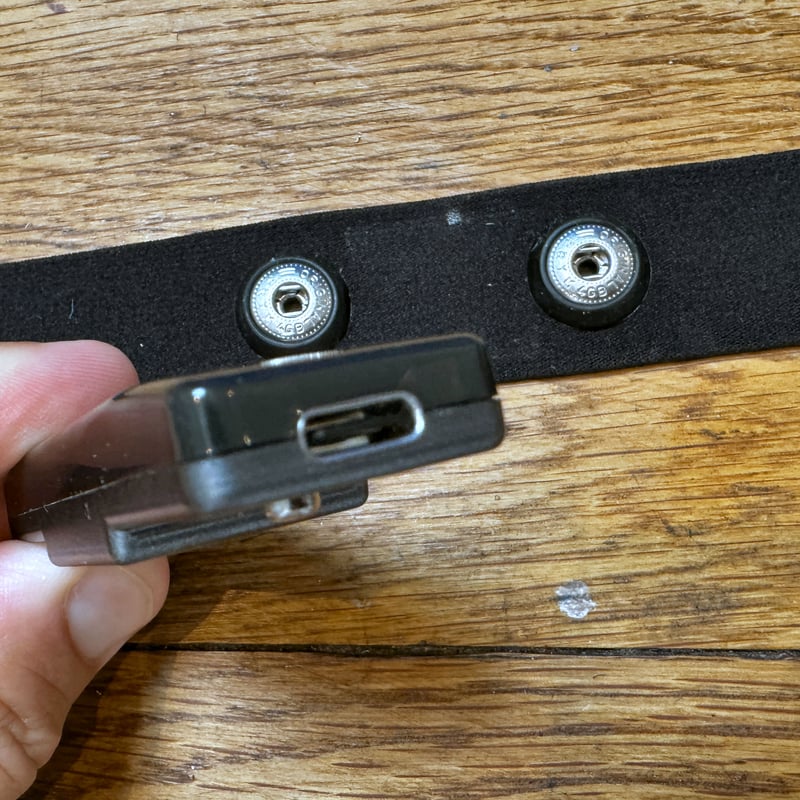
- Proper USB-C charging
- Battery life boost from 14 days to 30 days in HRM mode.
What you lose
- The small screen on the pod is gone, which removes the ability to glance at time, distance, or shock score without a phone. I was always unsure how you could see the screen during sport when wearing a t-shirt over it! This is no big loss.
What’s unchanged
- continuous recording,
- live streaming,
- ST segment strain monitoring,
- breathing rate,
- HRV,
- body shock, and
- Optional premium subscription tier.
At half the price, the Zone matches X2 on everything that matters for sport and heart safety.
Frontier Zone vs X-Plus
The X-Plus model is a prescription-grade product. You’ll likely already have a diagnosed condition and won’t plan to use this in sport.
X-Plus adds the following
- The X Plus holds FDA 510(k) clearance.
- The X Plus detects and quantifies arrhythmia burden, including PVC burden and AFib burden to clinical standards. The Zone flags irregular beats as “Other” without classifying or quantifying them.
- The X Plus generates structured weekly clinical reports for a cardiologist’s workflow. The Zone exports a PDF trace for discussion.
X-Plus lacks the following
- ST-segment strain monitoring
- Athlete-facing training metrics
- A meaningful water resistance rating: the X Plus is rated IP22 (splash-proof only)
- Multi-device Bluetooth: the X Plus connects to one device; the Zone connects to three simultaneously
X Plus costs $649 in the US and requires clinical involvement.
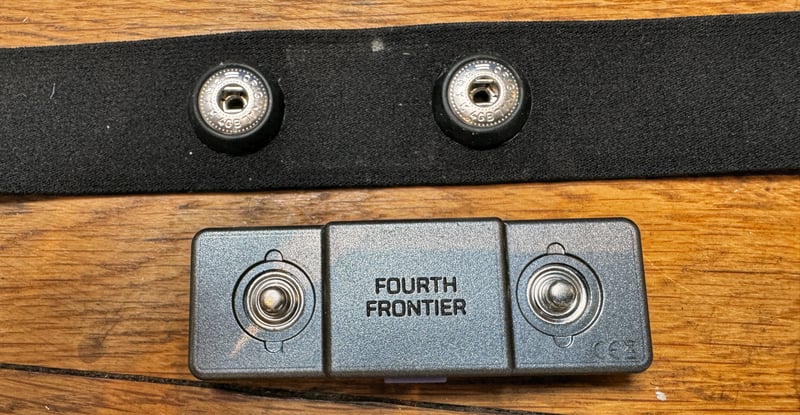
Design and fit
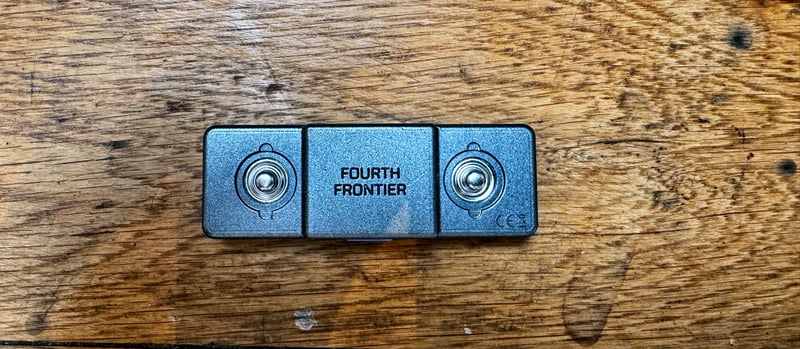
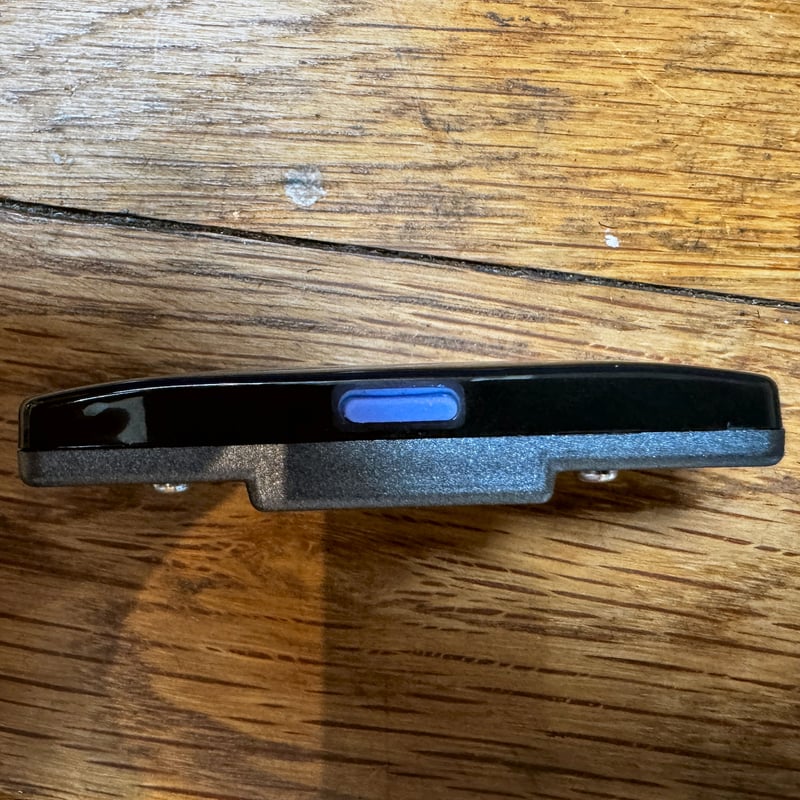
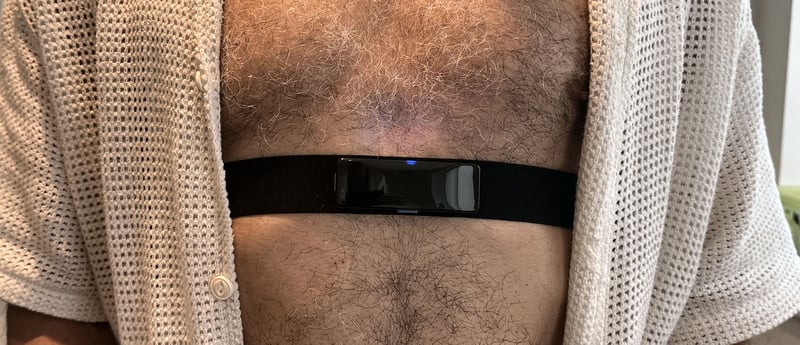
The pod clips onto a standard chest strap, and a longer one is also included. The pod itself is slightly larger than many sports HRMs but easily small enough to sit unnoticed under a jersey or base layer. Wearing and removing are simple, but orientation matters: the pod must be worn with the button facing down, or the ECG signal inverts and doesn’t work correctly.
Accuracy
Limitations: I have used Frontier Zones extensively, through many tens of hours of sports-grade tests, which regular readers here will have already seen in published test results comparing other products. However, I do not have a heart condition, which limited what I could test.
Test Protocols: Frontier Zone was used as a reference device alongside a highly accurate biceps PPG device, Polar SENSE, as the core of most tests. These two devices were then compared to one or more sports watches and sometimes also to a Whoop MG strap on the other biceps. I didn’t try to wear two chest straps at the same time. On previous occasions, I never managed to get that to work as one or both devices tend to be worn incorrectly when alongside another.
Test Results
The Zone has been used as the HR reference device across multiple published sessions. The table below summarises results from five tests; full data and charts are linked from each article.
| Session | Conditions | Devices compared | Bias | LoA | Verdict |
|---|---|---|---|---|---|
| 150-min Z2 endurance ride | Hills, steady effort | Whoop MG, Fitbit Air, Amazfit Helio Strap | +1.4 bpm vs Helio Strap (pre-alignment); +0.9 bpm vs Whoop MG (post-alignment) | ±4.5 bpm (post timestamp correction) | Excellent |
| Dartmoor Classic (108 km, 1,800 m, 26°C) | Outdoor cycling, heat | Amazfit Balance 3, Whoop MG, Apple Watch Ultra 3 | Balance 3: -0.1 bpm; Whoop MG: -0.2 bpm; AWU3: -0.8 bpm | Balance 3: -3.6 to +3.4 bpm | Excellent |
| Stockholm trail run (11 miles, urban) | Trail running, city environment | Amazfit Balance 3, Garmin FR970, Apple Watch Ultra 3, Polar Verity SENSE | Over-read at start; Polar SENSE used as reference instead | n/a | Inconclusive |
| Surrey Hills Z2-3 outdoor ride | Hilly cycling | Fitbit Air | -0.9 bpm | -4.8 to +3.0 bpm | Good |
| watchOS 27 multi-device session | Mixed sport | Whoop MG, Fitbit Air, Apple Watch Ultra 3, Amazfit Helio Strap, Polar Verity SENSE | Co-reference alongside Polar SENSE | See full article | Good |
The Stockholm session is the only outlier. The Zone over-read at the start of the run, which ruled it out as a reference for that session. The cause is consistent with a contact or warm-up issue rather than a structural accuracy problem; every other session returned Good or Excellent agreement.
The 150-minute ride session also produced a finding worth noting for anyone comparing devices. The Zone’s data arrived with a 15-second timestamp offset relative to the other three devices. Before correcting for it, the limits of agreement reached ±10 bpm. After alignment, they narrowed to ±4.5 bpm on the same data. The bias barely moved. It is a data alignment issue, not a measurement error, but it illustrates how published accuracy comparisons can misrepresent a device if timestamp offsets go unexamined.
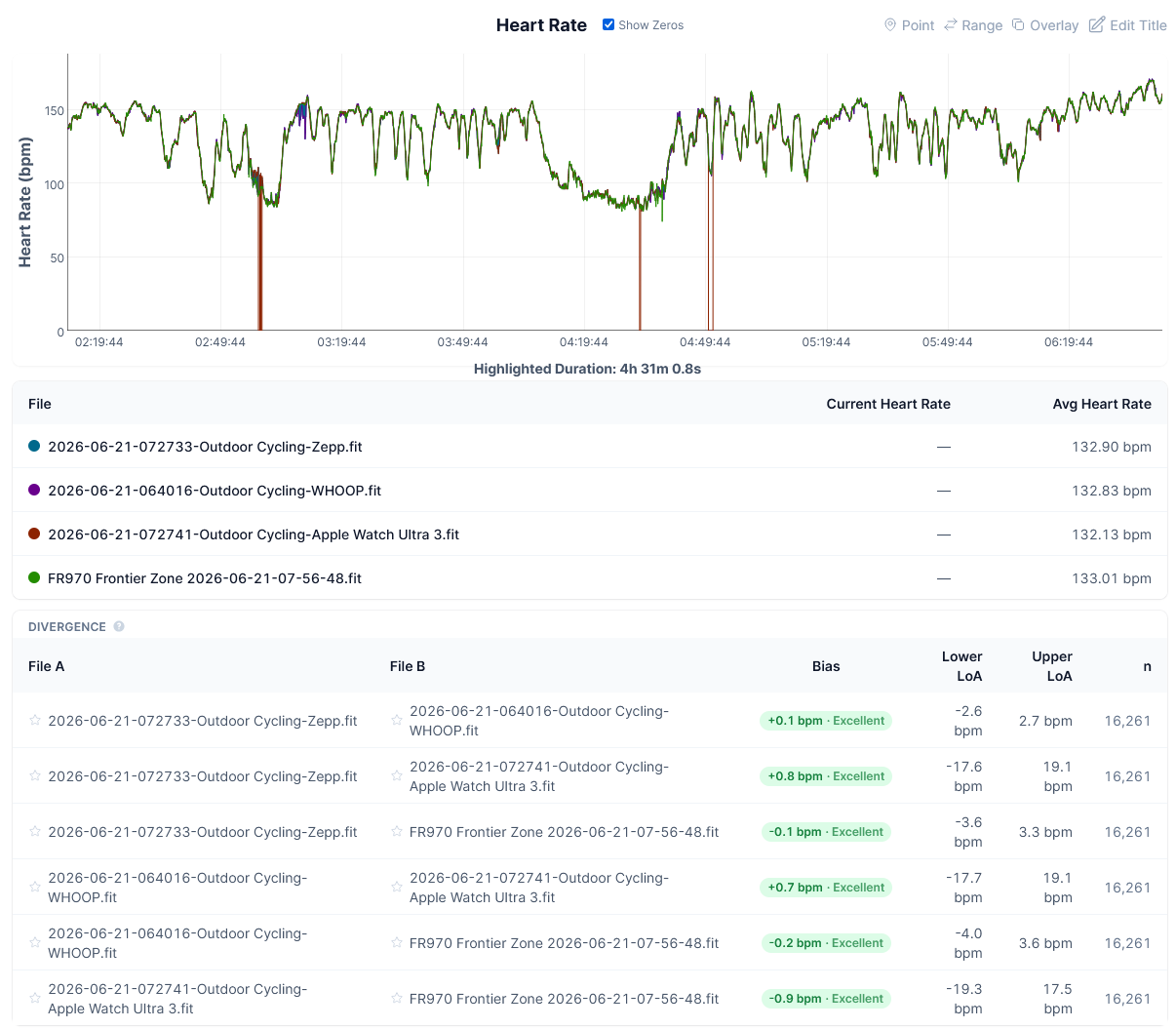
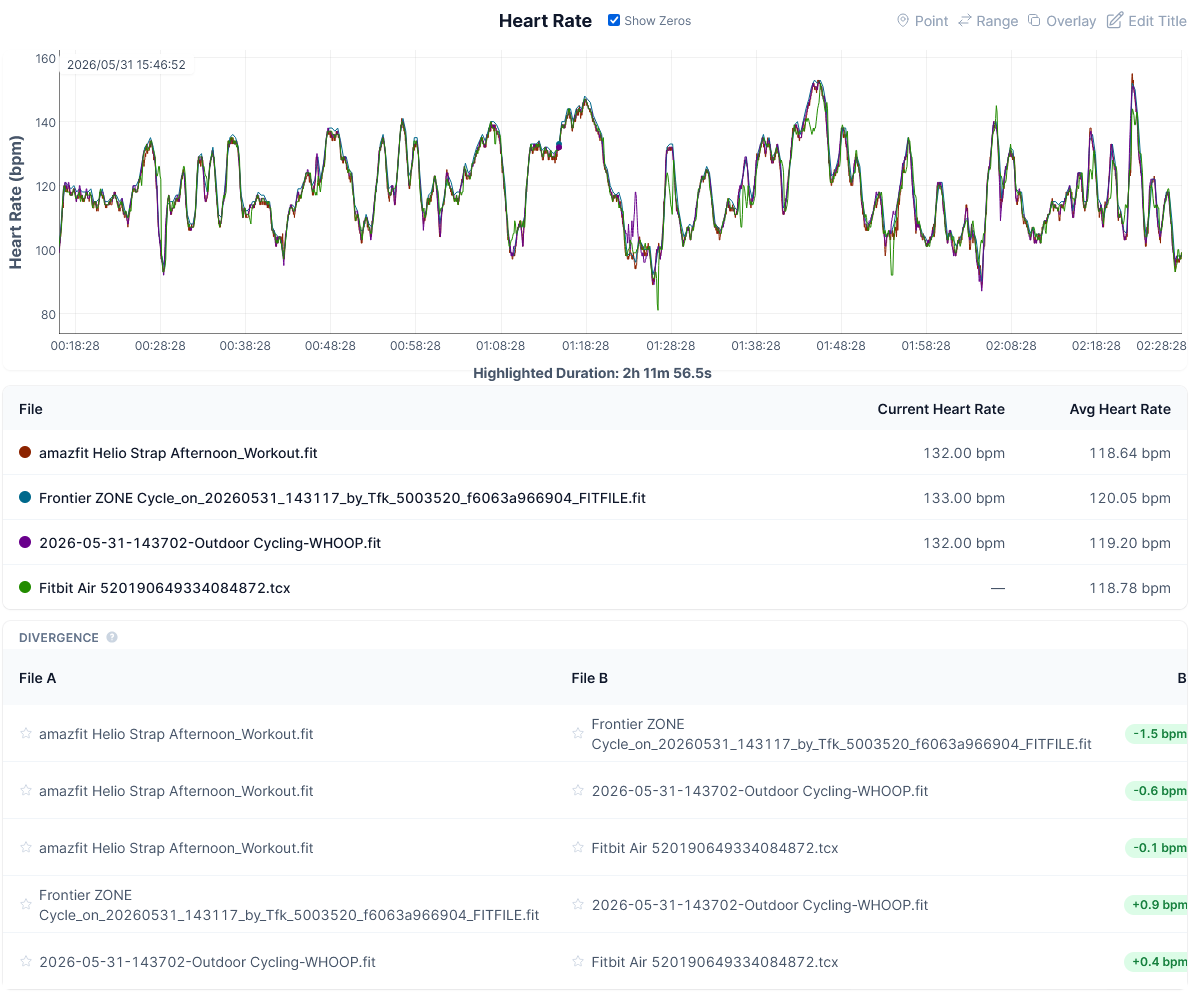
Full accuracy data: 150-minute ride test.
The Frontier X Web App
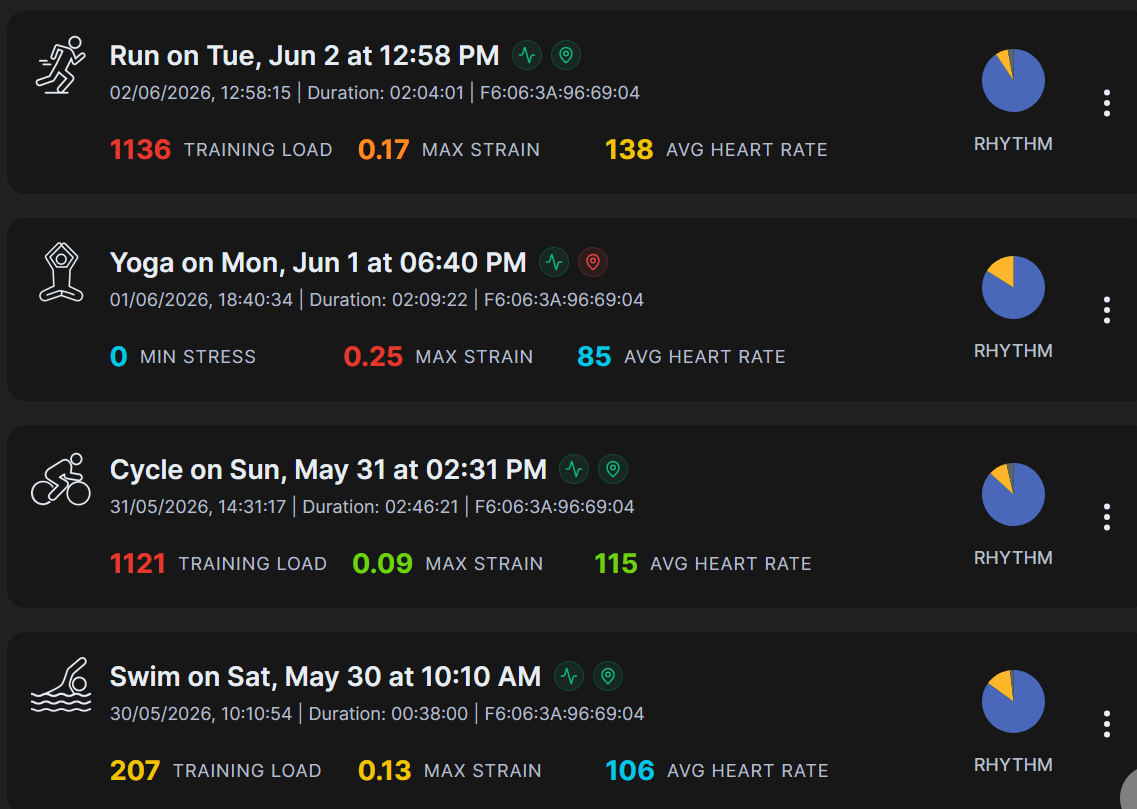
I want to take you through a few of the views of the data from some of my workouts. I have a nice combination here of swim, bike, run and yoga.
The yellow section from the blue pie chart on the right indicates how much of the rhythm is classified as ‘other’. In this context, it could be a cause for concern, but in my case, it is almost certainly just noisy data.
You can also see the higher training load figures for a 2-hour run and a 3-hour bike ride, as you would expect. However, you wouldn’t expect high heart strain from yoga, yet this is the highest-strain event of the four.
Digging into a specific session reveals considerably more detailed information. This is a 22-second section recorded at maximum exertion towards the end of a 2x 20-minute threshold bike ride. You can see low HRV, which is consistent with the difficulty of the effort, as well as heart strain, load, calories, and more.
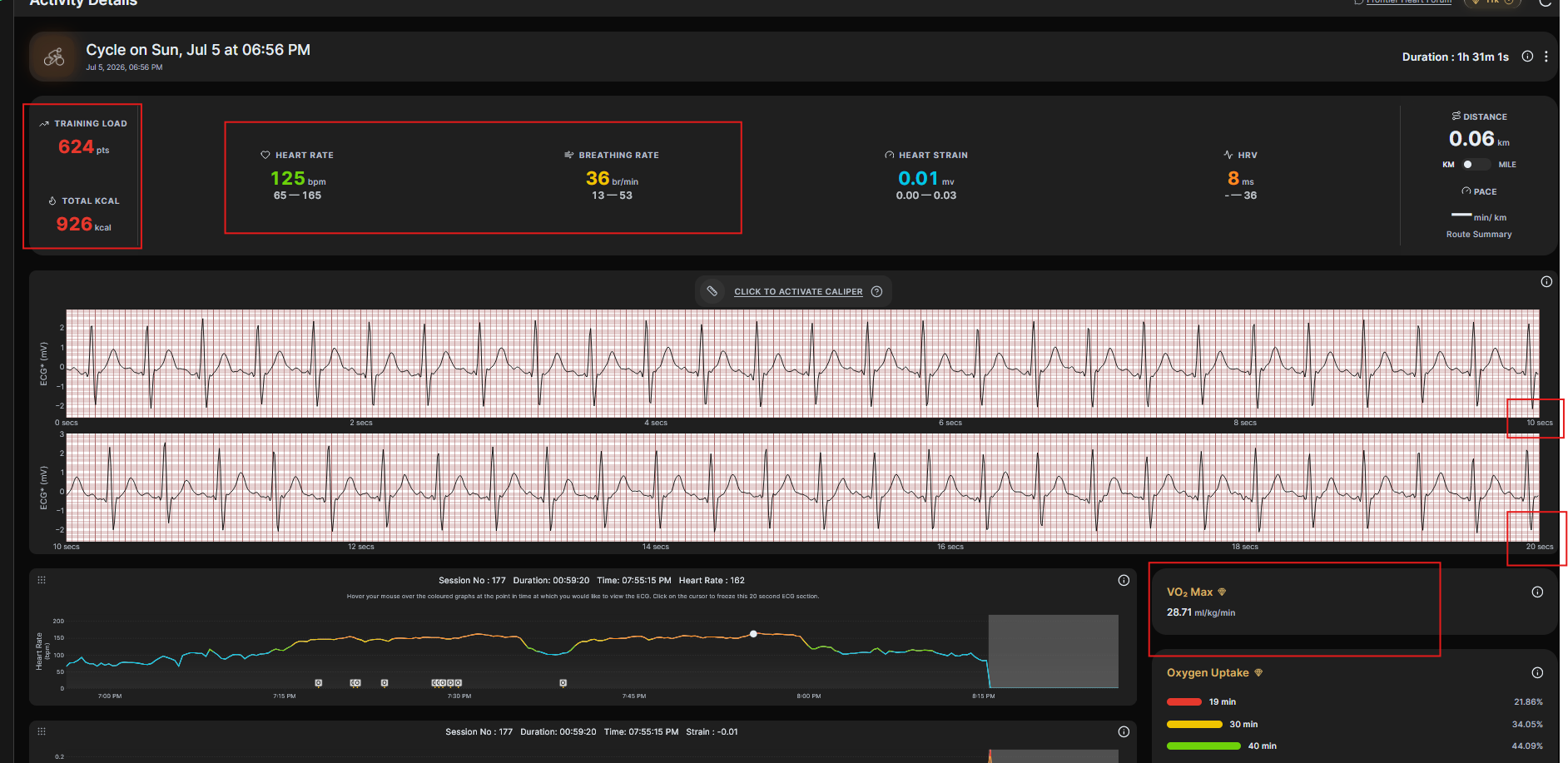
VO2max: This is also shown as incorrect (my VO2max is twice the stated level). A correct VO2max estimate requires either power when cycling or GPS when running, and the latter requires me to run with the app, which I haven’t done.
I know some cardiologists read this site, so maybe you might comment on this take by an AI chatbot analysing the 20 seconds of the ECG shown above.
- The rhythm runs at approximately 120-140 bpm throughout, broadly regular but with visible beat-to-beat variation consistent with the respiratory and mechanical demands of hard cycling.
- There are occasional beats in which the morphology deviates slightly from the dominant pattern, most visibly in the second strip, around 13-14 seconds and again around 17-18 seconds. These could represent isolated ectopics, but the deviation is subtle and transient contact variation during cycling cannot be excluded.
- There is no evidence of heart block, no prolonged pauses, and no runs of consecutive abnormal beats. The overall picture is organised sinus tachycardia at a rate appropriate for a hard threshold cycling effort, with a small number of morphologically variant beats that do not constitute a pattern.
- The QRS complexes are narrow, and the dominant morphology repeats consistently, with a sharp positive R wave peaking around 2 mV in the first strip and slightly lower in the second. The baseline between beats is relatively clean with no obvious artefact contamination.
- The T waves are visible following most QRS complexes, are positive and of moderate amplitude, and show no obvious inversion or gross ST deviation on this single lead. ST assessment on a single-lead wearable trace during exercise is unreliable, so that observation carries limited weight.
While you should definitely not use Frontier Zone for self-diagnosis, you can analyse your own ECG trace and then arrive armed with information and a background understanding before talking to a medical professional. A route likely to get you in front of the right experts more quickly.
ECG and heart strain
The app classifies my heartbeat as either normal (sinus rhythm) or one of several other categories. The small proportion flagged as “Other” is common and usually benign, covering ectopic beats, minor arrhythmias, and movement artefacts. If a proportion clusters at a specific point in a workout, or rises persistently over time, it is worth discussing with a doctor.
The strain metric is an ECG-only feature that sets Fourth Frontier apart from every other sports chest strap on the market. It measures ST-segment deviation in real time. The ST segment is the brief pause on the ECG trace between the heart contracting and beginning to recover. A deviation of 0.2 millivolts above baseline is the threshold used to interpret stress (myocardial oxygen deprivation). The Frontier Zone alerts the wearer via vibration at a configurable threshold, typically set at 0.3 millivolts to allow a margin above background noise.
As of July 2026, no other consumer sports chest strap offers real-time ST segment monitoring with vibration alerts during exercise. Garmin HRM 600, Coros HRM, and Polar H10 do not.
More detail on ST segments and what they indicate: ECG monitoring at the London Marathon.
Breathing rate and ventilatory zones
The Frontier Zone derives breathing rate from the ECG signal using two mechanisms: the chest wall moves with each breath, slightly shifting the electrode position and altering the electrical signal; and heart rate varies subtly in sync with respiration, a phenomenon known as respiratory sinus arrhythmia. Fourth Frontier’s premium subscription uses this breathing rate data to estimate VT1 and VT2, the ventilatory thresholds that define the boundaries between aerobic, threshold, and high-intensity effort. These are better intensity markers than heart rate zones based on lactate thresholds; most notably, they are more stable over long sessions, where cardiac drift makes HR-based zones progressively unreliable.
Some other points on breathing rates:
- Resting and overnight breathing rates are indicators for wellness and recovery metrics, e.g. a higher overnight breathing rate might indicate the onset of illness or recovery occurring
- Garmin uses a similar method to assess breathing rate, but has not done the extra work to compare it against VT1/VT2.
- An alternative product for ventilatory zones that adds a strain gauge to the strap is TymeWear VitalPro.
Premium subscription
The base device is fully functional without a subscription. The optional Frontier Premium tier ($14/month, $119/year, with a 7-day trial) adds VO2 max estimation, VT1/VT2 ventilatory zones, a readiness score based on nightly HRV deviation, sleep stage analysis, oxygen uptake zones, and a metabolic profile showing fat versus carbohydrate contributions during exercise. None of these features requires additional hardware. They are algorithmic outputs from the ECG data the device already collects.
The readiness metric, based on overnight readings, is comparable to all other brands in the space. It’s not a readiness measure per se but rather a measure of how well you are coping with the general stresses of everyday life. It is linked to sporting readiness, but there are better measures for this, namely a waking, seated 1-minute reading.
Who is it for
The Fourth Frontier Zone makes most sense for active people over 40 who train regularly, for anyone managing a known heart condition who wants continuous monitoring during sport, and for coaches or carers who want shareable ECG data for clinical review. The ability to export up to three hours of ECG trace as a PDF, reviewable by a cardiologist, is a genuine differentiator from anything else in the sports wearable market.
It makes less sense for athletes whose primary driver is a sports-focused ecosystem with advanced training features, GPS and power sensors, and structured workouts.
That said, Fourth Frontier Zone works seamlessly with Garmin, Apple Watch, Polar, Suunto, Amazfit, Coros, and other sports apps. You keep all the benefits of those ecosystems and add the ECG, strain and peace-of-mind metrics via the Zone.
Buyers whose clinical needs require arrhythmia detection validated to medical-grade standards should look at the Frontier X Plus, which carries FDA 510(k) clearance and requires a prescription.
Verdict
At £179 (10% discount code 5KRUNNER), the Fourth Frontier Zone is the most capable ECG sports strap available to a consumer without a prescription. It matches the Frontier X2 on every feature that matters for sport, improves on it in hardware, and costs less than half the price. The ST segment strain monitoring alone justifies the purchase for any athlete in a demographic where undiagnosed coronary artery disease is common and exercise-induced cardiac events go undetected until they happen in public, on a hot day, during a race.
Fourth Frontier Zone price: where to buy
The Fourth Frontier Zone RRP is £199. Use code 5KRUNNER for 10% off (£179) at fourthfrontier.com. The optional Frontier Premium tier is $14 a month or $119 a year, and the strap works without it.

Quick answers
Is the Fourth Frontier Zone a medical device?
No. The Fourth Frontier Zone is classified as a health and fitness product and is not intended for diagnostic or treatment purposes. Fourth Frontier’s medical-grade product is the Frontier X Plus, which holds FDA 510(k) clearance and requires a prescription.
What is the difference between the Frontier Zone and the Frontier X2?
The Zone uses USB-C charging instead of a proprietary port, offers up to 30 days of typical battery life versus 14 days on the X2, has no screen, and discounts to £179, compared with the X2’s £449. The core ECG feature set is identical on both devices.
What does the Frontier Zone's strain metric measure?
Strain on the Fourth Frontier platform refers to ST-segment deviation, not training load. The device measures how far the ST segment shifts from its baseline during exercise. A persistent ST deviation of 0.1 to 0.2 millivolts can be clinically significant, depending on the context and lead placement. Fourth Frontier sets the default vibration alert at 0.3 millivolts to reduce false alarms during exercise.
Does the Fourth Frontier Zone work without a smartphone?
The Zone can record data autonomously without a phone present during a session. Data syncs to the app and web dashboard afterwards. Live ECG streaming and real-time metric display require a connected phone. Vibration alerts function independently of the phone.
Can I share Fourth Frontier Zone ECG data with my cardiologist?
Yes. The web dashboard allows export of up to three hours of continuous ECG trace as a PDF. A cardiologist can review this in the same way they would a single-lead ambulatory ECG recording. The device is not a replacement for clinical investigation but the exported trace is a meaningful supplement to a clinical conversation, particularly if recorded during a hard effort when symptoms were present.
Does the Fourth Frontier Zone support ANT+?
No. The Zone uses Bluetooth Low Energy only and can connect simultaneously to up to three devices: one app and two external heart rate monitors. It does not support ANT+.
How does the Frontier Zone compare to the Polar H10 and Garmin HRM 600?
The Polar H10 and Garmin HRM 600 are accurate sports chest straps that transmit heart rate via ANT+ and Bluetooth. Neither records a continuous ECG trace nor monitors ST segment deviation, and neither provides breathing rate derived from ECG. The Frontier Zone does all three. The trade-off is that the Zone is Bluetooth only with no ANT+ support, costs more than a basic HRM, and requires its own app for ECG features. If you need ANT+ compatibility or the lowest possible cost, the H10 or HRM 600 is the correct choice. If you want ECG data and cardiac strain monitoring during exercise, neither device offers them.
How long does the Fourth Frontier Zone battery last?
Typical battery life in HRM mode is up to 30 days. Maximum continuous ECG recording is 24 hours per charge. A 48-hour ambulatory trace would require a sync and recharge midway, resulting in two separate sessions rather than a single unbroken recording.
What is the correct way to wear the Fourth Frontier Zone?
The pod must be worn with the button facing downward, positioned centrally on the chest just below the breastbone. Wearing it reversed inverts the ECG signal, biasing ST-segment readings in the wrong direction and rendering the strain metric unreliable. The correct orientation is marked on the device.
Does the Frontier Zone work with Garmin, Apple Watch, and other sports watches?
Yes. The Zone connects via Bluetooth Low Energy as a standard heart rate monitor to compatible devices including Garmin watches, Apple Watch, Wahoo bike computers, Peloton, Zwift, and most other BLE-capable fitness devices. ECG features, strain monitoring, and breathing rate are available only in the Fourth Frontier app. The external device receives only heart rate data.
What is the Fourth Frontier Premium subscription and is it worth it?
The optional Frontier Premium tier costs $14 per month or $119 per year, with a 7-day free trial. It adds VO2 max estimation, VT1 and VT2 ventilatory training zones, a readiness score based on nightly HRV deviation, sleep stage analysis, oxygen uptake zones, and a metabolic profile showing the fat-versus-carbohydrate contribution during exercise. None of these requires additional hardware. Whether it is worth it depends on how much you use the training zone and readiness features. The base device is fully functional without the subscription.
Sources and resources
- Fourth Frontier support and manual
- Fourth Frontier: the science behind continuous ECG
- 150-minute ride accuracy test
- ECG monitoring at the London Marathon
- Fourth Frontier X2 review
- Tymewear VitalPro review
- Garmin HRM 600 review
- Frontier Zone product page
Last Updated on 3 October 2026 by tfk the5krunner
Small things I always use
- Garmin 90-degree charging adapter: Charges your Garmin from any USB-C cable. Essential when travelling. I use one.
- Body Glide: The blue anti-chafe stick swimmers and runners carry. I use it.
- Speedo earplugs: Fewer ear infections and no cold-water dizziness. I use them.
- Dryrobe Advance: My winter changing robe for open-water swims. I use one. A cheaper option is the AONYIYI changing robe.
- Maurten: Race fuel that stays easy on the stomach. I use them.
- Garmin charging puck: The quickest way to top up before a session. I use one.
- Injinji: Toe socks that stop rubbing, so you run more. I use them.
- Ultimate toe protectors: Stop black toenails on long runs. They work. I use them.
- Compressport R2 v2 calf sleeves: My calf sleeves of choice. I use them.
- Cellucor C4: My pre-workout before hard sessions.
- TPU tubes: Schwalbe Aerothan, Tubolito and Pirelli SmarTube. Light, tiny spares. I use all three.
- G8 insoles: Adjustable insoles that are good. I use them.
- Cycplus Cube: A 97g electric pump that gets a road tyre rideable in two minutes. I carry one. 5% off with code THE5KRUNNER.
Watches and sensors
- Polar H10: My daily driver for waking HRV.
- Polar Verity Sense: My backup arm-worn HR sensor.
- Nomad bedside charger: Charges my iPhone and Apple Watch overnight. I use it, and many of their bands.
- Train.Red: The best muscle oxygen sensor I’ve used.
- Tymewear: Accurate heart rate and reliable ventilatory zones. I use it to pace endurance rides over an hour.
- Garmin Forerunner 970: A pro-grade triathlon watch. I use this.
- Apple Watch Ultra 4: My daily smartwatch. No phone needed on rides.
- Garmin Fenix 9 Pro: I’ve just bought one.
On the bike
- Continental GP5000 for everyday riding, and Aero 111 on the front for special occasions.
- Helmets: Specialized S-Works Evade 3 for road riding, and Rudy Project Wing for TT-style races. I use both.
- Ravemen FR300: A front light that mounts under your Garmin or Wahoo. I use one.
- Wahoo TRACKR Radar: I use it on one bike and Varia on the other. They perform the same.
- Garmin Varia RTL515: Radar that warns you of cars from behind. I use this model.
- Wahoo ELEMNT Roam 3: The bike computer that’s easy to use. I use mine on most rides.
- Favero Assioma Pro RS2: Accurate power pedals that swap easily between bikes. I use this model.
Home and indoor training
- NPE Runn: Makes my basic treadmill smart, sending more accurate speed and distance to my watch and Zwift. I use it.
- Google Wifi: Keeps Zwift connected in my pain cave. I use it.
- Apple TV 4K: Zwift on the big screen. I use two.
- Google Nest Doorbell (wired, 2nd gen): My video doorbell, running in both Google Home and Apple Home. I use it.
Health, recovery and sleep
- FreeStyle Libre 3 Plus: Shows how my blood sugar responds to diet.
- hDrop: Measures my sweat loss in summer and indoors.
- Fourth Frontier Zone: Checks my heart under load in hard sessions.
- Oura Ring 5: My partner’s recovery tracker of choice.
- Kineon MOVE+: Red light therapy for niggles. It works.
- Eight Sleep: A cooling mattress cover my partner and I use nightly.
Reader-Powered Content

This content is not sponsored. It’s mostly me behind the labour of love, which is this site, and I appreciate everyone who supports it.
Support the site: Follow (free, fewer ads) · Subscribe (paid, ad-free) · Buy Me A Coffee ❤️
Written by real people, with AI assistance. Fact-checked and verified for originality. See the Editorial Policy. FTC: Affiliate Disclosure — some links pay commission. As an Amazon Associate, I earn from qualifying purchases.
tfk is the founder and author of the5krunner, an independent endurance sports technology publication. With 20 years of hands-on testing of GPS watches and wearables, and competing in triathlons at an international age-group level, tfk provides in-depth expert analysis of fitness technology for serious athletes and endurance sport competitors. ID

My Frontier X2 died after several months. Because I bought it through a non recognised vendor there was no support. Frontier didn’t even want to have a look at the unit, though they did accept it was a genuine product. I suspect moisture was leaking into the unit somehow. I wore it mainly to track strain in ice hockey games. I paid around 500 AUD. For me the durability was unacceptable for that expense.
This article reads like advertorial. I appreciate that this website costs time but is there not a way to be paid without looking like you have sold your integrity?
George — the disclosure at the top notes this is a media loaner; Fourth Frontier did not pay for or approve the review. The opening story is true and I can verify it. The accuracy section includes real bias and limits-of-agreement data across five sessions, one of which I reported as inconclusive. If there is a specific claim you think is wrong or unsupported, I am happy to address it. As you can see from other comments here, I do not delete critical feedback.
Am I reading their website correctly that they do not ship to the US?
not yet,
VO2max: is your VO2Max or that sessions VO2Max?
Do you need to record in the application to get the result or can I record on the device, sync to the application after?
the former is the only real definition imho
I bought X2 couple of months ago. It was a mess. Constant dropouts while riding outdoors with my Edge 1050 and it also corresponded to the data not being recorded on the strap as well. I finally decided to return it after one 2h ride, when for more than 50% of the ride it had unreadable data.
Hopefully Zone is a better product…
do you mean HR dropouts or periods where the ecg couldn’t resolve.
the former would be surprising as the strap and skin contacts are standard. you can see from my results that I never experienced that.
The periods where no ecg is recorded or able to be determined, i think, to a degree is expected during sport and not necessarily a problem.
It was dropouts as Edge 1050 loosing connection with a device for while almost daily, sometimes it was paired with a device not recording anything during that time as well. On a rarer occasion, it had >50% of erroneous data that it could not read to classify ECG. I assumed that I’ve got a faulty device. And I was really pissed off that something like that is happening to 400 EUR device.