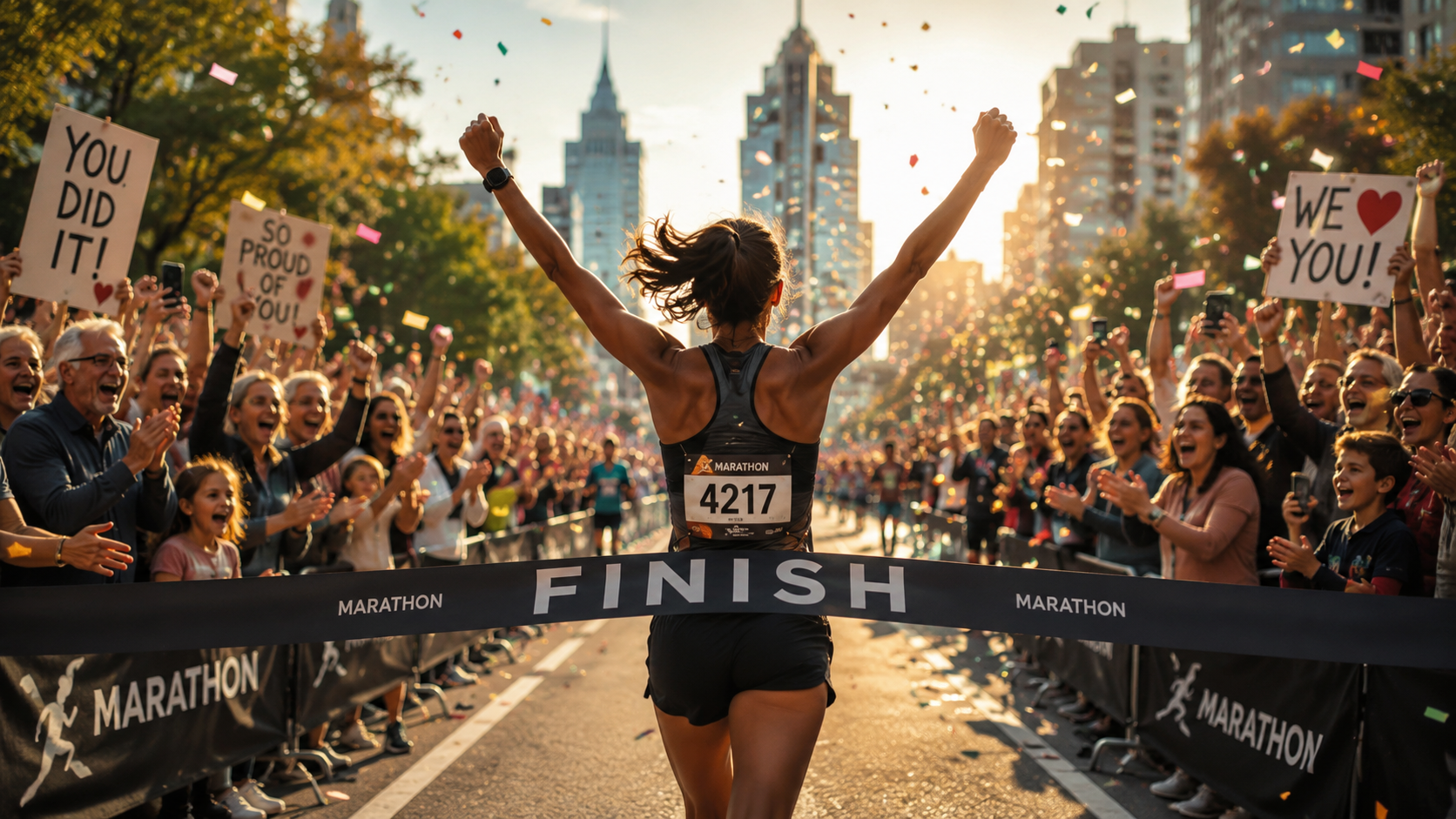
Running technology is very good at telling a runner what is happening. A watch can report pace, heart rate, cadence and predicted finish time. At kilometre 30 of a marathon, however, another performance metric may not be what the runner needs most.
Back My Run is designed for that moment. It lets runners collect voice notes from friends, family and supporters before an event, assign each recording to a chosen whole kilometre and hear it automatically during the run. The system combines background GPS, local audio files and one-time distance triggers so the experience can continue when the phone is locked and mobile coverage is poor.
The problem: race-day support is rarely where the struggle happens
Traditional race support is tied to a place or a live connection. A friend may be waiting at kilometre 12 when the runner actually struggles at kilometre 32. A text message may sit unread, a phone call is impractical and crowded race networks can make live communication unreliable.
Back My Run separates the message from the live connection. Supporters contribute before the event, while the runner decides which whole kilometre should trigger each recording. The purpose is to make a familiar voice available at a moment the runner selects in advance. It complements rather than replaces spectators, coaching and performance data.
How Back My Run works
TL;DR: supporters record in a browser, the runner assigns each voice note to a whole kilometre, the files are downloaded before the start, and background GPS triggers each recording once without requiring race-day mobile data.
The runner creates an experience in the Back My Run app and shares a unique web link. A supporter opens that link, records a voice note and submits it without installing an app or creating an account.
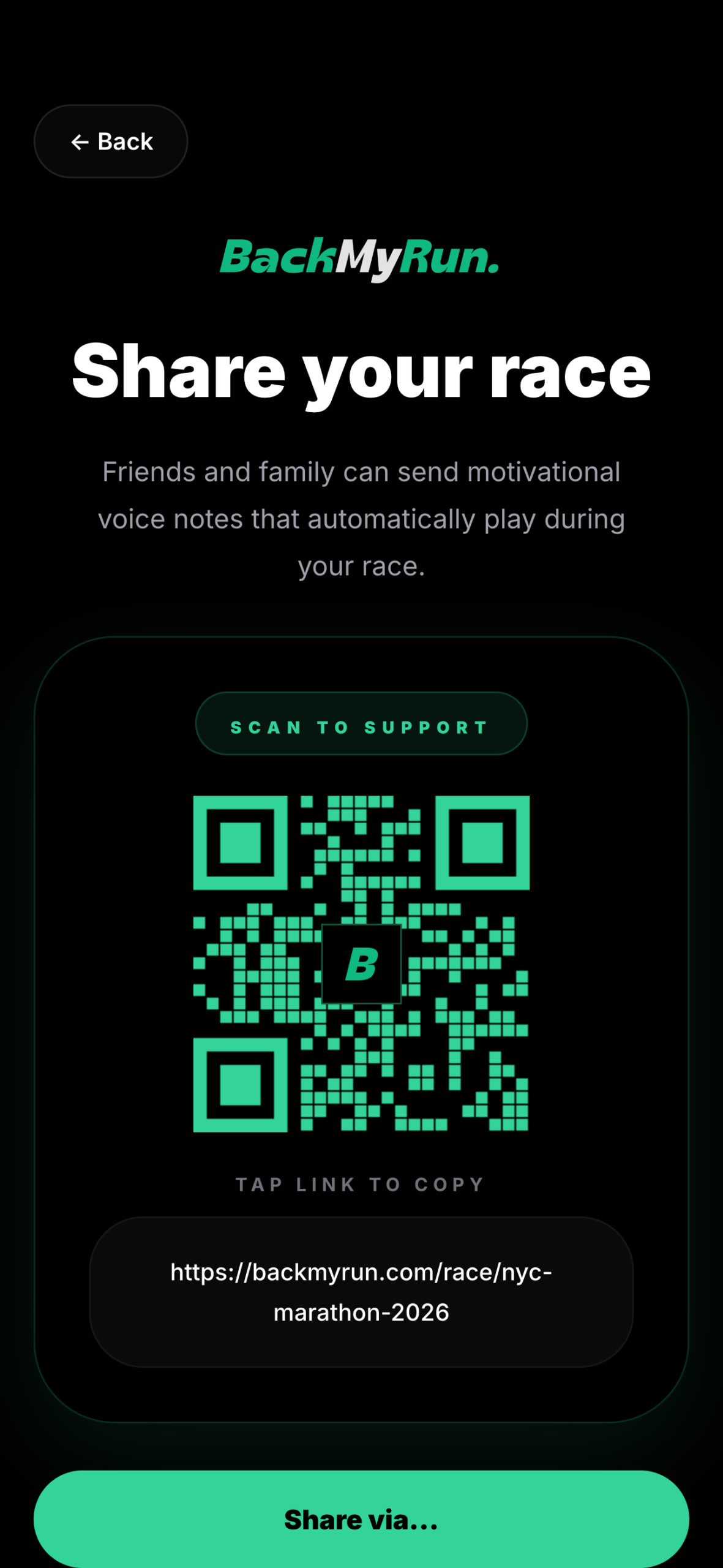
Before the event, the runner can see who has contributed and choose the kilometre at which each person’s message will play. The recording itself remains locked. The runner cannot listen to it before the race starts, preserving the surprise and emotional impact of hearing it for the first time on the course.
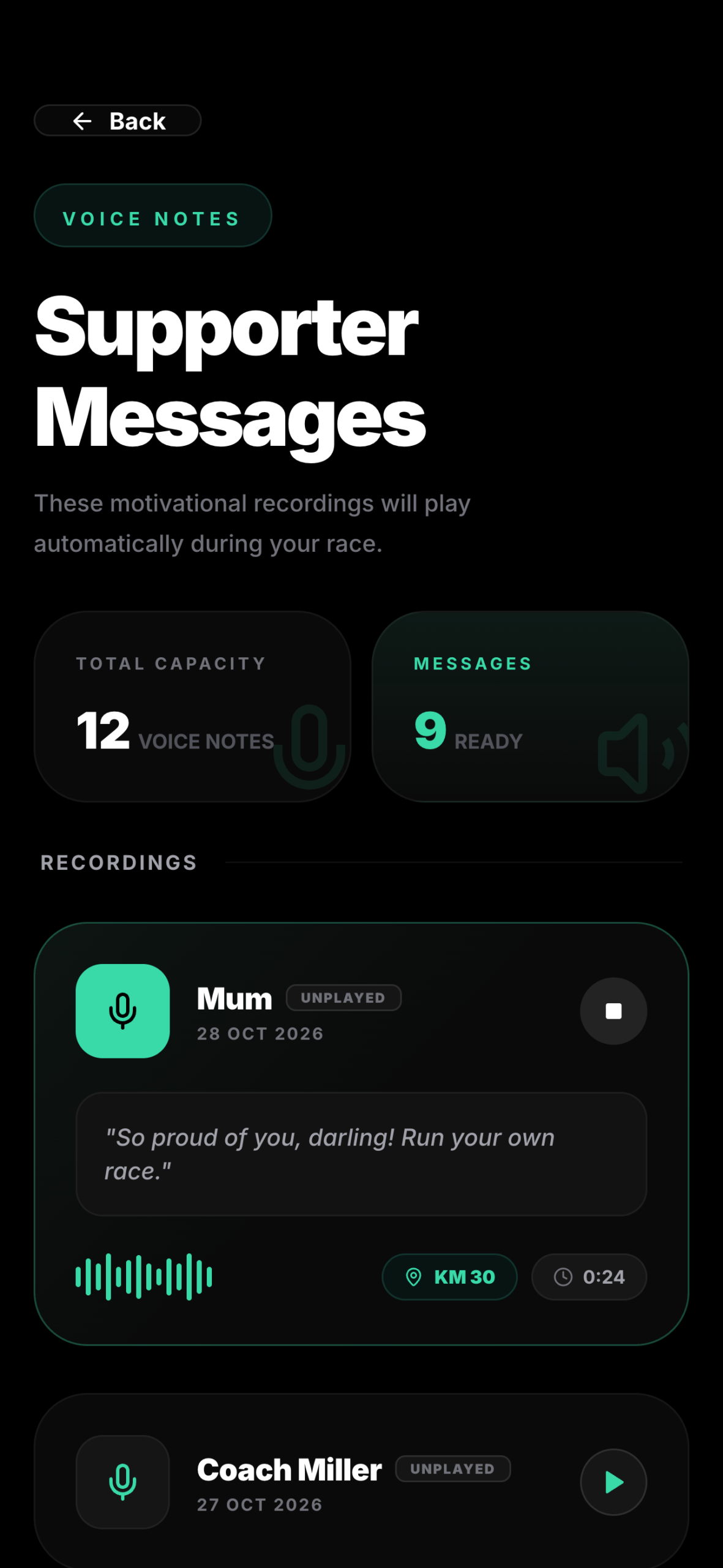
Each standard distance allows one potential voice note at every whole kilometre. A 5K can therefore contain up to five recordings, a 10K up to ten, a half marathon up to 21 and a marathon up to 42. The runner can use fewer and leave any unwanted kilometres empty.
When the experience is prepared, all assigned voice notes are downloaded to the phone. Starting the run activates background distance tracking. The app then monitors progress from the start of the session and checks the runner’s distance against the selected kilometre milestones.
The technical layer: background GPS, offline files and audio ducking
Back My Run is sometimes described in geofencing terms, but its trigger logic is based on distance travelled rather than fixed latitude and longitude points on a particular course. That distinction allows the same setup to work on an organised race route, a training loop or an unfamiliar course.
The phone continues tracking distance while it is locked and Back My Run is running in the background. When the measured distance reaches a kilometre assigned to an unplayed voice note, the app starts the locally stored recording through the active audio output.
If the runner is listening to music, the music volume is reduced while the voice note plays. When the recording finishes, the previous music level is restored. This audio ducking allows the message to be heard without requiring the runner to stop, unlock the phone or manually switch between apps.
Because the recordings are downloaded before the run, playback does not depend on streaming audio from a server. Mobile data can disappear without making the stored voice notes unavailable.
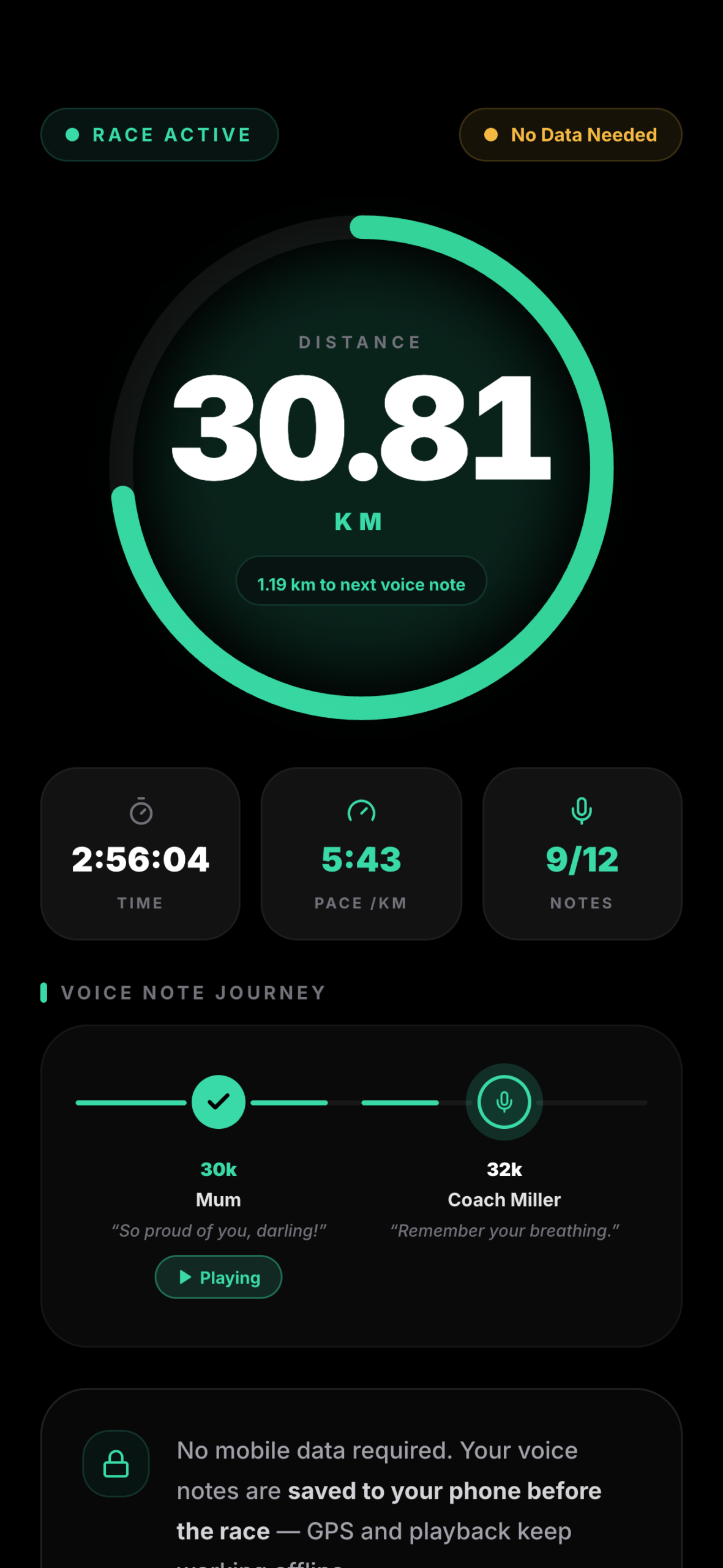
GPS accuracy can also deteriorate temporarily in tunnels, dense urban areas, stadiums or beneath heavy cover. If that happens around a selected milestone, the unplayed trigger remains pending. Once reliable distance tracking resumes and shows that the runner has crossed the kilometre, the message can play. The app also records that the milestone has been completed, preventing the same voice note from firing twice.
The combination addresses three separate race-day failure points: loss of mobile coverage, interruption to GPS accuracy and repeated triggering after location recovery.
A worked marathon example
A Marathon experience can contain up to 42 voice notes, one for every whole kilometre. That does not mean a runner has to fill all 42 positions. Consider a runner who chooses five recordings and assigns them to kilometres 10, 21, 30, 35 and 42.
Before the race, the runner can see that the five contributors include a friend, partner, parent, charity supporter and training partner, but cannot hear what any of them recorded. All five files are downloaded before the start.
At kilometre 10, the first distance threshold is crossed. If music is playing through Bluetooth headphones, the music ducks, the friend’s recording plays and the music returns to its previous level afterward. That message is then marked as played.
At kilometre 30, suppose the runner is inside a crowded stadium and has no usable mobile data. The third voice note still plays because the audio file is already on the phone. No server connection is required at the moment of playback.
Just before kilometre 35, GPS accuracy temporarily drops. The kilometre 35 message remains pending rather than being discarded. When a reliable reading returns and confirms that the runner has crossed the threshold, the recording plays once. It will not repeat if later GPS readings fluctuate around the same distance.
The final recording can then play at kilometre 42, when the runner is close to the finish but may be at the most emotionally and physically demanding point of the event.
Compatibility, capacity and pricing
Back My Run is available for iOS and Android. It is a phone-based experience and does not currently rely on Garmin, Apple Watch or Strava integration. Audio is delivered through the phone’s active output, including compatible wired or Bluetooth headphones.
Supporters use a standard web browser and do not need the mobile app. Runners need the app, the required location and background permissions, and enough local storage for the prepared recordings. A usable GPS signal is still required to measure distance, but mobile data is not required after the voice notes have downloaded.
The current US dollar pricing is: one free 5K experience per day with up to five voice notes; 10K for $7.99 with up to ten; Half Marathon for $12.99 with up to 21; Marathon for $17.99 with up to 42; Custom/Ultra for $22.99; and Unlimited access for $12.99 per month.
Runners should test the exact phone, permission, battery and headphone setup they intend to use before an important race. The free daily 5K provides a practical way to run a complete test without purchasing a race package.
Who Back My Run is for, and why it was built
The product is relevant to first races, personal-best attempts, charity challenges, comeback events, ultras and runs completed in memory of someone. Its strongest use cases are often races in which the finish line means more than a time.
The idea began during Daniel Moores’s training for his first marathon. His grandparents had already passed away, and he was preparing to run in their memory. During a difficult 30 kilometre training run, he imagined how meaningful it would be to hear a recorded voice from someone he loved at exactly the moment he needed it.
That thought became Back My Run. Moores later completed the Abu Dhabi Marathon in 4:12 in memory of his grandparents. The product remains a small, self-funded project built by Moores with a developer friend and without employees or outside investment.
The technical work exists to protect the human moment. Background tracking, offline storage, recovery from poor GPS and audio ducking are the mechanisms that let the right voice arrive without asking the runner to interact with the phone.
Summary
Back My Run uses background GPS, downloaded audio and one-time kilometre triggers to deliver recorded encouragement without relying on a live network. It gives supporters a simple browser-based way to contribute, keeps each message unheard until the run and allows the runner to choose exactly where each familiar voice will arrive.
Quick answers
Does Back My Run need mobile data during the race?
No. Once the experience is prepared, all assigned voice notes are downloaded to the phone. The app still needs usable GPS data to measure progress, but it does not need a live mobile-data connection to play the recordings.
Can a runner listen to the voice notes before starting?
No. The runner can see who has contributed and decide the kilometre for each recording, but the audio remains locked until the race has started and it reaches its assigned milestone.
Can Back My Run work with music and Bluetooth headphones?
Yes. When a voice note plays, the music volume is ducked so the recording can be heard. The music returns to its previous level when the voice note finishes. Runners should test their exact phone, music app and headphone combination before race day.
Related reading on the5krunner
- Beatrunner Pro: When Your Running Music Follows Your Pace: another indie iPhone and Apple Watch running-audio app, focused on real-time tempo matching rather than voice notes.
- Tooboo: Standalone Offline Outdoor Navigation on Apple Watch Ultra: another indie outdoor app built around offline operation and background GPS during long activities.
- Beatpace: Garmin Running Music That Plays Your Workout Structure: the Garmin side of the running-audio problem, structured tracks matched to session tempo.
Author: Daniel Moores, founder of Back My Run, edited by the5krunner.
The previous Indie Spotlight covered Cinder.
Last Updated on 21 August 2026 by tfk the5krunner
Small things I always use
- Garmin 90-degree charging adapter: Charges your Garmin from any USB-C cable. Essential when travelling. I use one.
- Body Glide: The blue anti-chafe stick swimmers and runners carry. I use it.
- Speedo earplugs: Fewer ear infections and no cold-water dizziness. I use them.
- Dryrobe Advance: My winter changing robe for open-water swims. I use one. A cheaper option is the AONYIYI changing robe.
- Maurten: Race fuel that stays easy on the stomach. I use them.
- Garmin charging puck: The quickest way to top up before a session. I use one.
- Injinji: Toe socks that stop rubbing, so you run more. I use them.
- Ultimate toe protectors: Stop black toenails on long runs. They work. I use them.
- Compressport R2 v2 calf sleeves: My calf sleeves of choice. I use them.
- Cellucor C4: My pre-workout before hard sessions.
- TPU tubes: Schwalbe Aerothan, Tubolito and Pirelli SmarTube. Light, tiny spares. I use all three.
- G8 insoles: Adjustable insoles that are good. I use them.
- Cycplus Cube: A 97g electric pump that gets a road tyre rideable in two minutes. I carry one. 5% off with code THE5KRUNNER.
Watches and sensors
- Polar H10: My daily driver for waking HRV.
- Polar Verity Sense: My backup arm-worn HR sensor.
- Nomad bedside charger: Charges my iPhone and Apple Watch overnight. I use it, and many of their bands.
- Train.Red: The best muscle oxygen sensor I’ve used.
- Tymewear: Accurate heart rate and reliable ventilatory zones. I use it to pace endurance rides over an hour.
- Garmin Forerunner 970: A pro-grade triathlon watch. I use this.
- Apple Watch Ultra 4: My daily smartwatch. No phone needed on rides.
- Garmin Fenix 9 Pro: I’ve just bought one.
On the bike
- Continental GP5000 for everyday riding, and Aero 111 on the front for special occasions.
- Helmets: Specialized S-Works Evade 3 for road riding, and Rudy Project Wing for TT-style races. I use both.
- Ravemen FR300: A front light that mounts under your Garmin or Wahoo. I use one.
- Wahoo TRACKR Radar: I use it on one bike and Varia on the other. They perform the same.
- Garmin Varia RTL515: Radar that warns you of cars from behind. I use this model.
- Wahoo ELEMNT Roam 3: The bike computer that’s easy to use. I use mine on most rides.
- Favero Assioma Pro RS2: Accurate power pedals that swap easily between bikes. I use this model.
Home and indoor training
- NPE Runn: Makes my basic treadmill smart, sending more accurate speed and distance to my watch and Zwift. I use it.
- Google Wifi: Keeps Zwift connected in my pain cave. I use it.
- Apple TV 4K: Zwift on the big screen. I use two.
- Google Nest Doorbell (wired, 2nd gen): My video doorbell, running in both Google Home and Apple Home. I use it.
Health, recovery and sleep
- FreeStyle Libre 3 Plus: Shows how my blood sugar responds to diet.
- hDrop: Measures my sweat loss in summer and indoors.
- Fourth Frontier Zone: Checks my heart under load in hard sessions.
- Oura Ring 5: My partner’s recovery tracker of choice.
- Kineon MOVE+: Red light therapy for niggles. It works.
- Eight Sleep: A cooling mattress cover my partner and I use nightly.
Reader-Powered Content

This content is not sponsored. It’s mostly me behind the labour of love, which is this site, and I appreciate everyone who supports it.
Support the site: Follow (free, fewer ads) · Subscribe (paid, ad-free) · Buy Me A Coffee ❤️
Written by real people, with AI assistance. Fact-checked and verified for originality. See the Editorial Policy. FTC: Affiliate Disclosure — some links pay commission. As an Amazon Associate, I earn from qualifying purchases.
tfk is the founder and author of the5krunner, an independent endurance sports technology publication. With 20 years of hands-on testing of GPS watches and wearables, and competing in triathlons at an international age-group level, tfk provides in-depth expert analysis of fitness technology for serious athletes and endurance sport competitors. ID
