Your watch knows you are running 6 by 3 minutes hard. Your headphones have no idea. Beatpace closes that gap: it builds a mix around the session you are actually running, beat-locked to your cadence block by block. Play it from your phone browser, or sync it to a Garmin watch and leave the phone at home.
Your watch has a plan. Your music doesn’t.
If you train with structure, you already live with a small daily annoyance. The watch holds the workout: warm-up, four minutes hard, three easy, repeat, cool down. The music holds nothing. You press play on a playlist and hope it roughly fits, then spend the session fighting it.
Three things go wrong every time:
- One tempo for the whole run. A flat-BPM playlist plays your warm-up, your threshold block, and your cool-down at the same pace. Your training needs three different ones.
- The 180 BPM playlist is not actually 180 BPM. Public BPM tags are notoriously mislabeled. Half the tracks in a “180 spm” list are not, and your cadence pays for it.
- The music does not know where the rep boundaries are. A mellow bridge lands in the middle of your hardest interval. A breakdown arrives just as you should be holding turnover.
Runners have patched around this for years: hand-built BPM playlists, pitch-shifted tracks, fixed-tempo mixes, a cadence app. Each solves a piece. None follows a structured session, holds an exact cadence, and runs on the watch without a phone.
How Beatpace works
TL;DR: Describe a session, or pick a template, and Beatpace builds a beat-locked mix where each block holds its own exact cadence. Run it from any browser, or sync it to a Garmin and leave the phone at home.
Beatpace does not generate music in real time while you run. It works with a large library of original tracks spanning the full training range, roughly 100 to 200 BPM, across a range of energy levels. For each block, it draws from the pool of tracks near your target tempo and energy, picking from several candidates rather than a single fixed answer, so the same session comes back as a fresh mix each time rather than the same playlist twice. It then time-stretches the selected tracks, the small remaining percentage to land exactly on target, pitch preserved. Because the starting tracks are already close, the stretch is gentle, and the audio stays clean. The tracks are crossfaded on the beat, resulting in a continuous mix built to match the workout.
The fastest start is to play something that already exists: Beatpace ships with crafted running mixes you can run straight away, and the community library adds more. When you want your own session, there are four ways to create one:
- Describe it. Type the session in plain words: “6 by 3 min at threshold, 90 sec easy between.” Beatpace builds the whole mix from that.
- Start from a template. Proven sessions are ready to go: tempo, threshold, VO2max, Norwegian 4×4, long run. Pick one, tweak it, generate.
- Clone from the library. Browse mixes built by other runners and Beatpace, then clone one and make it your own.
- Build block by block. Full control: set duration, BPM, energy, and genre for warm-up, work blocks, recoveries, and cool-down.
Once a mix is ready, run it however suits you: open it in your phone browser, lock the screen, and go, or sync it to a Garmin watch and leave the phone at home. Same mix, either path.
For the runs you did not plan, there is Forever Radio: set one tempo, hit play, and the music runs as long as you do. Change BPM or energy any time. It is the unstructured mode for when you head out without a session in mind.
A real session: the Norwegian 4×4, block by block
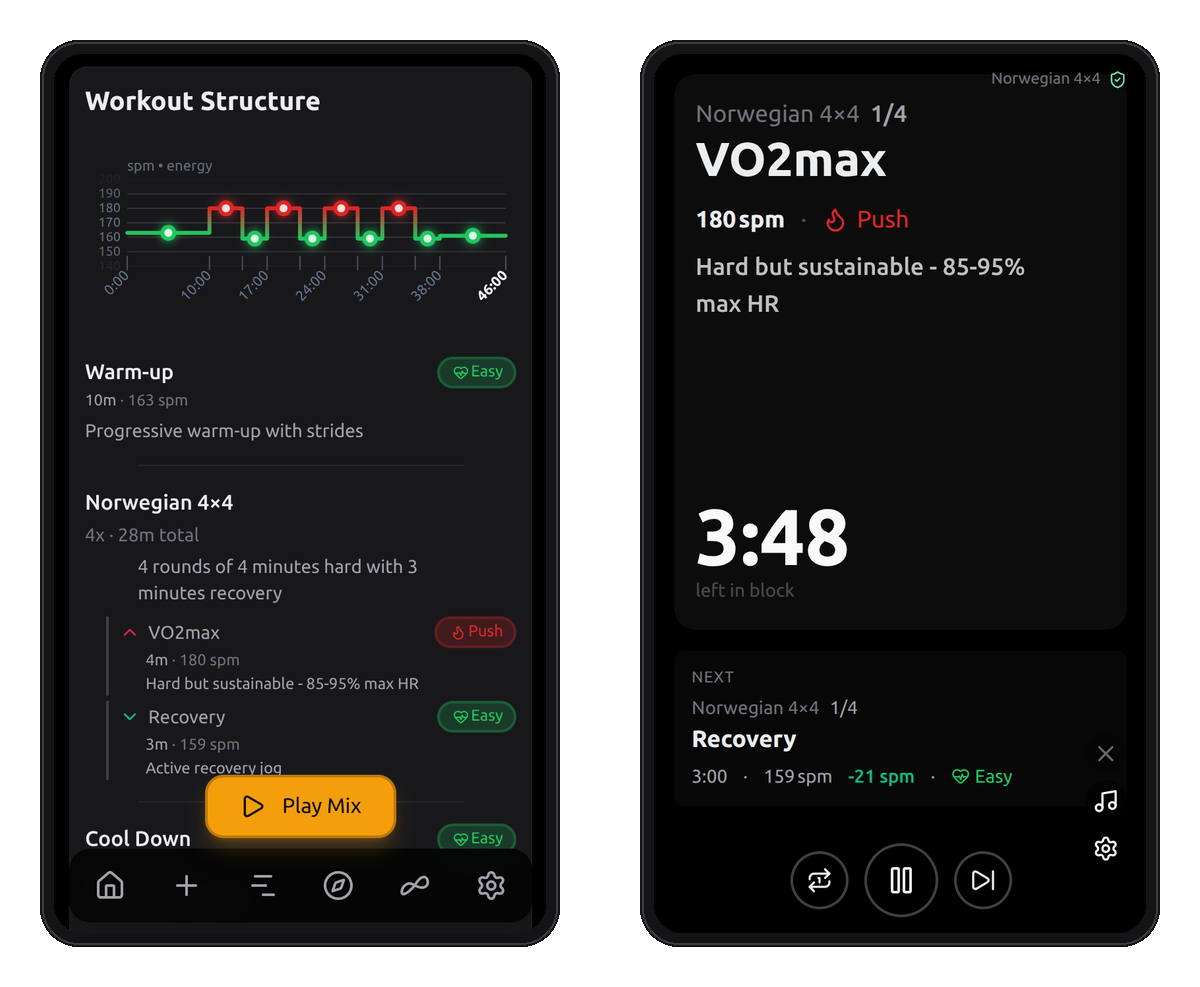
Here is what “the mix is the workout” means in practice: a Norwegian 4×4, four reps of four minutes hard with three minutes easy between, plus a warm-up and cool-down. For a runner whose hard cadence sits near 180 spm, each block holds its own exact tempo, the hard reps locked at 180 BPM and the recoveries dropping to 159, every transition landing on the beat. The builder lays it out block by block:
Running it natively on Garmin
This is the part that does not exist anywhere else. Beatpace is a Connect IQ music provider, listed alongside Spotify and Amazon Music in the watch’s music menu. The difference is what it plays: Spotify and Amazon play a catalogue, Beatpace plays a structure.
Setup is the standard Garmin flow: install Beatpace from the Connect IQ store, add it under Music, then Providers, pair by scanning a QR code, then sync a mix to the watch over Wi-Fi. On the run, the normal Garmin now-playing screen shows the block, BPM, and time remaining.
The music: Epic, beat-lock, and per-block genre
Let us be straight about what you are hearing. These are original AI-generated tracks made for Beatpace: no real artists, no scraped voices, and you will not find them on Spotify. That cuts both ways, so hear a sample before you decide. The bar is whether you would actually choose to run to it, not just whether the BPM is right.
What the tracks are built to do is hold a beat: no four-BPM drift by the chorus, no half-tempo bridge mid-rep, energy that shifts when the block shifts. The genres are Dance, Rock, and Epic, and the choice is per block, not per mix. That is what most playlists cannot touch: warm up to Dance, run threshold to Rock, let Epic carry the long climb, all inside one continuous beat-locked session. Or let Beatpace vary the genre block to block for you.
“Epic” is the one that runners tend not to expect: cinematic music with a steady, sustained beat, for the part of a long run where the legs start asking why. Normal cinematic tracks swell and fall, which breaks cadence lock the moment the drums drop out. Beatpace’s Epic keeps the bombast but holds the drive, which you will not find on a streaming service.
This is about precision, not just fast music. Your stride locks to a steady beat automatically: in one running study (Van Dyck et al., 2015), nudging the tempo by a few per cent shifted runners’ cadence without them noticing. A 139-study review (Terry, Karageorghis et al., 2020) found that tempo-matched music yields the strongest benefits for performance and perceived effort. Not magic, and the effect fades with very hard efforts, but the beat keeps your turnover steady when fatigue creeps in.
If you want the full breakdown with every study linked, it is in Beatpace’s deep dive on why exact BPM beats close enough.
Compatibility and pricing
On the watch side, the rule is simple: Beatpace runs on almost any reasonably modern music-capable Garmin, more than 100 watches across the Forerunner, Fenix, Epix, Enduro, Venu, Vivoactive, MARQ, Descent, Approach, Tactix, and D2 lines. If it runs Spotify or Amazon Music, it runs Beatpace.
No Garmin required to start, though: every mix also runs in any modern browser with the screen locked, so you can begin today and add the watch later.
Pricing is a free tier and a Pro tier. Free lets you stream any published mix, save and follow, and use Forever Radio for 20 minutes a day. Pro adds creating and generating your own mixes, unlimited Forever Radio, templates and the block-by-block editor, offline downloads, and publishing. Pro comes with a 14-day free trial, and current pricing is shown in US dollars on the runner page.
Things to note
In keeping with the spirit of this site, here is the honest list of what Beatpace does not do, so nobody is surprised.
- It is Beatpace’s own music, not yours. You cannot bring your own tracks, at least for now: every Beatpace track is pre-analysed and built to hold a steady beat so it can stretch to an exact BPM and crossfade cleanly, which a song from your own library is not. It is not something I have ruled out for the future.
- You choose the mix before you run, not during. On the watch, audio is synced ahead over Wi-Fi rather than streamed live, so you pick the session at home. The upside: it keeps playing through dead zones and bad reception.
- Three genres today. Dance, Rock, and Epic. The library is still growing, and more genres are on the way, but the range is narrower than a streaming catalogue.
Summary
For runners who train with structure, Beatpace closes the gap between the plan on the watch and the noise in the headphones. It builds a beat-locked mix around the actual session, holds an exact cadence in every block, and plays on a Garmin with no phone needed or in any browser. It will not replace your favourite playlist for easy days; it is what you reach for when the workout has a sha, pe, and you want the music to hold it. The AI music is the how, not the what, so try a sample and the 14-day trial and judge the sound for yourself.
It is made by Runner Twelve AB, a one-person studio in Sweden, by a long-distance runner who could not find music that matched his workouts, rather than just his mood. Spinning instructors picked it up first, and it is now looping back to the runners it was built for. The Garmin Connect IQ app went live in 2026.
Try it free at beatpace.io/runners, or install it directly from the Garmin Connect IQ store.
Quick answers
How is this different from a 180 BPM playlist or an app like RockMyRun?
A playlist matches a tempo. A Beatpace mix matches your training. Three differences: the BPM is actually right, because tracks are time-stretched to the exact target rather than tagged and hoped for; each block is the exact length you asked for, so four minutes hard is four minutes, not three forty-two because that was the song length; and the music shifts when your block shifts, with no drift, no half-tempo bridges, no breakdowns mid-threshold on top of that it runs natively on the watch, which the cadence apps do not.
Do I need to carry my phone, and which Garmins work?
No phone needed on a supported Garmin: sync the mix over Wi-Fi and leave the phone at home. Supported watches are covered above; the rule of thumb is that if it runs Spotify or Amazon Music, it runs Beatpace. Prefer to carry your phone? Every mix also runs in any browser with the screen locked, no watch required.
It is AI-generated music. Will it actually sound good enough to run to?
That is the right question to ask, and the honest answer is to listen first. The tracks are original, built specifically to hold a steady beat and shift energy on cue, which is exactly what a structured run needs and what recognisable hits often fail at when you stretch them to a target BPM. They are not going to give you the rush of your favourite song dropping at the right moment. There are samples on the runner page and a 14-day trial, so the cost of finding out is zero.
Author: David, founder of Beatpace, edited by the5krunner
If you enjoyed reading this, here is another in the Indie Spotlight series: Vero: On-Device Recovery and Readiness Scoring for the Watch You Already Wear.
Last Updated on 12 October 2026 by tfk the5krunner
Small things I always use
- Garmin 90-degree charging adapter: Charges your Garmin from any USB-C cable. Essential when travelling. I use one.
- Body Glide: The blue anti-chafe stick swimmers and runners carry. I use it.
- Speedo earplugs: Fewer ear infections and no cold-water dizziness. I use them.
- Dryrobe Advance: My winter changing robe for open-water swims. I use one. A cheaper option is the AONYIYI changing robe.
- Maurten: Race fuel that stays easy on the stomach. I use them.
- Beet It Sport nitrate shots: Beetroot shots I take in the days before a race. I use them.
- Garmin charging puck: The quickest way to top up before a session. I use one.
- Injinji: Toe socks that stop rubbing, so you run more. I use them.
- Ultimate toe protectors: Stop black toenails on long runs. They work. I use them.
- Compressport R2 v2 calf sleeves: My calf sleeves of choice. I use them.
- Cellucor C4: My pre-workout before hard sessions.
- TPU tubes: Schwalbe Aerothan, Tubolito and Pirelli SmarTube. Light, tiny spares. I use all three.
- G8 insoles: Adjustable insoles that are good. I use them.
- Cycplus Cube: A 97g electric pump that gets a road tyre rideable in two minutes. I carry one. 5% off with code THE5KRUNNER.
Watches and sensors
- Polar H10: My daily driver for waking HRV.
- Polar Verity Sense: My backup arm-worn HR sensor.
- Nomad bedside charger: Charges my iPhone and Apple Watch overnight. I use it, and many of their bands.
- Train.Red: The best muscle oxygen sensor I’ve used.
- Tymewear: Accurate heart rate and reliable ventilatory zones. I use it to pace endurance rides over an hour.
- Garmin Forerunner 970: A pro-grade triathlon watch. I use this.
- Apple Watch Ultra 4: My daily smartwatch. No phone needed on rides.
- Garmin Fenix 9 Pro: I’ve just bought one.
On the bike
- Continental GP5000 for everyday riding, and Aero 111 on the front for special occasions.
- Helmets: Specialized S-Works Evade 3 for road riding, and Rudy Project Wing for TT-style races. I use both.
- Ravemen FR300: A front light that mounts under your Garmin or Wahoo. I use one.
- Wahoo TRACKR Radar: I use it on one bike and Varia on the other. They perform the same.
- Garmin Varia RTL515: Radar that warns you of cars from behind. I use this model.
- Wahoo ELEMNT Roam 3: The bike computer that’s easy to use. I use mine on most rides.
- Favero Assioma Pro RS2: Accurate power pedals that swap easily between bikes. I use this model.
Home and indoor training
- NPE Runn: Makes my basic treadmill smart, sending more accurate speed and distance to my watch and Zwift. I use it.
- Google Wifi: Keeps Zwift connected in my pain cave. I use it.
- Apple TV 4K: Zwift on the big screen. I use two.
- Google Nest Doorbell (wired, 2nd gen): My video doorbell, running in both Google Home and Apple Home. I use it.
Health, recovery and sleep
- FreeStyle Libre 3 Plus: Shows how my blood sugar responds to diet.
- hDrop: Measures my sweat loss in summer and indoors.
- Fourth Frontier Zone: Checks my heart under load in hard sessions.
- Oura Ring 5: My partner’s recovery tracker of choice.
- Eight Sleep: A cooling mattress cover my partner and I use nightly.
Reader-Powered Content

This content is not sponsored. It’s mostly me behind the labour of love, which is this site, and I appreciate everyone who supports it.
Support the site: Follow (free, fewer ads) · Subscribe (paid, ad-free) · Buy Me A Coffee
Written by real people, with AI assistance. Fact-checked and verified for originality. See the Editorial Policy. FTC: Affiliate Disclosure — some links pay commission. As an Amazon Associate, I earn from qualifying purchases.
tfk is the founder and author of the5krunner, an independent endurance sports technology publication. With 20 years of hands-on testing of GPS watches and wearables, and competing in triathlons at an international age-group level, tfk provides in-depth expert analysis of fitness technology for serious athletes and endurance sport competitors. See the gear tfk uses. ID

So the 20min per day limit on the “free” option – does that mean I could be running along to my Amazon Music playlist for my warmup, then when I’m ready to do my 20min tempo, I could switch over to Beatpace at that point? It operates just like any other music app on the watch?
Hi BrianTR, David here, I’m the one building Beatpace. Good question, worth making this clearer. Two things on Free that work differently. The mixes are unlimited: stream and play any published mix as much as you want, no daily cap. And a single mix can run up to 2 hours with the warmup, tempo block, and cooldown all built in, so you may not even need to switch apps mid-run. Forever Radio is the separate piece, an endless cadence-matched station, and that’s the part capped at 20 minutes a day on Free. One note: the radio is a web and phone feature, not on the watch. On your Garmin everything is a mix, all free to play, no 20-minute limit anywhere. It sits in your watch’s music menu like any other provider, so switching to it mid-run works exactly as you’d expect.
Hi David – Thank you for the reply, very helpful. This sounds really neat, I’ll be trying it out for sure.
Hi, if I take the 14day trial and make some mixes, and find it’s not suitable, do the mixes I made disappear from my Garmin watch?
Hi,
No all you have created will stay even if you cancel your plan!
FYI Beatpace connects with Tredict now too. Your training plan in Tredict – created by yourself, a coach or AI – gets synced to Beatpace automatically. Beatpace is an fantastic idea that is actually very useful, before I had to take my metronome with me to practice a steady cadence. Not kidding!