Health Glance explained: what Huawei Watch D3’s one-tap health check actually measures
Huawei Watch D3 can return a report on up to 11 health indicators in about 60 seconds through a feature called Health Glance. A single tap compiles heart rate, blood pressure, SpO2, stress, skin temperature, ECG and arterial stiffness into one summary, instead of requiring separate menus for each measurement.
Smartwatches already collect a wide range of physiological data. Heart rate runs continuously, blood oxygen gets estimated through the day, sleep gets analysed overnight, and Watch D3 can record a one-lead ECG or measure blood pressure directly through its cuff. Collecting the numbers has never been the hard part. Interpreting several of them together, at the same moment, has been.
What Health Glance measures
Health Glance is not exclusive to Watch D3. Huawei built it into the TruSense sensor platform it introduced across its watch range from 2024, and Watch D3’s own specification page confirms an 11-item report, more than any earlier device in the range has listed. To use it, a wearer opens Health Glance from the app list and stays still while the watch works through its sensors in turn.
Within that roughly 60-second window, Watch D3 can report on:
- Heart rate, through the optical sensor
- ECG, via the side electrode
- SpO2 (blood oxygen saturation)
- Stress level
- Skin temperature
- Arterial stiffness
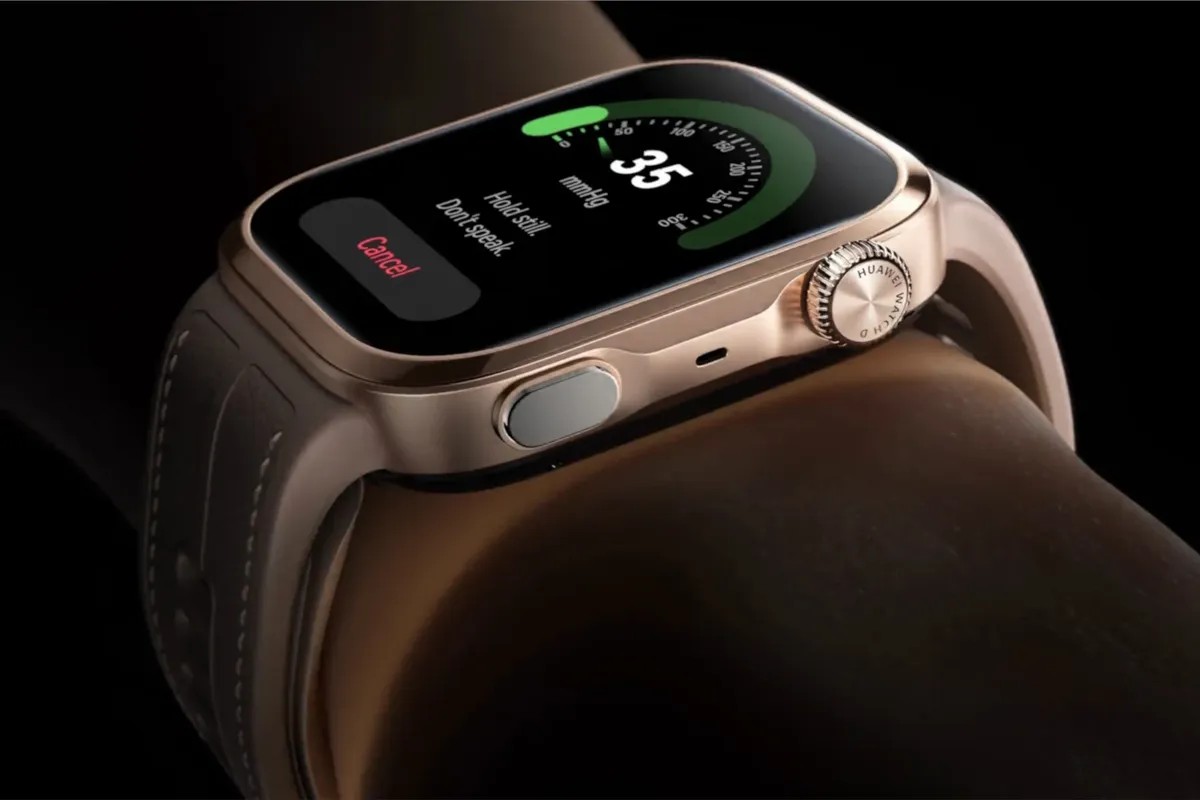
- Blood pressure, through Huawei’s mechanical airbag strap
Which indicators appear depends on region and software version, since not every measurement is cleared for every market.
How the one-tap measurement works
The PPG (photoplethysmography) optical sensor runs first, using reflected light to detect changes in blood volume and derive heart rate and SpO2.
For ECG, the wearer holds a finger on the side electrode, completing the circuit needed to capture a one-lead trace.
For blood pressure, the strap’s mechanical airbag tightens against the wrist and uses the oscillometric method, the same principle behind a clinical upper-arm cuff, rather than estimating pressure from the optical pulse alone. The same airbag and pressure sensor also carry Watch D3’s separate 24-hour ambulatory blood pressure mode, which is CE-MDR certified in Europe.
Watch D3 can also compare the timing between the electrical signal from ECG and the optical pulse from PPG. That gap, known as pulse transit time, provides an estimate of arterial stiffness. TruSense processes all of these signals together, filtering out motion noise and combining the readings into the Health Glance summary.
The measurements are not a diagnosis. Watch D3 can report blood pressure and estimated arterial stiffness, but neither reading on its own identifies hypertension or arterial disease. Huawei’s own guidance describes Health Glance results as being for reference only.
Why Huawei is combining readings into one report
A wearer who wakes to separate alerts for a higher resting heart rate, less deep sleep and a lower HRV reading has three numbers and no obvious next step. A single combined reading gives one reference point instead of three to reconcile.
Individual physiological measurements are often hard to interpret without something to compare them against. Health Glance addresses that by presenting several readings from the same short window together, rather than leaving the wearer to open separate screens for heart rate, ECG, SpO2 and blood pressure and judge each in isolation.
The trade-off between speed and context
The advantage of Health Glance is that it takes under a minute and needs no interpretation of separate graphs. The limitation is that a single 60-second reading, taken at one moment, cannot account for everything that affects the body. Caffeine, recent exercise, stress and ambient temperature can all shift blood pressure and stress readings temporarily.
A single snapshot is enough for a general wellness check. For managing a diagnosed condition such as hypertension, a trend built from multiple readings over days or weeks carries more weight than one 60-second report, which is why Watch D3 also offers 24-hour ambulatory blood pressure monitoring alongside Health Glance rather than in place of it.
Where this fits in Huawei’s health strategy
Huawei has invested heavily in wrist-based blood pressure measurement since the original Watch D, which multiple published validation studies have tested against reference sphygmomanometer readings under the AAMI/ESH/ISO Universal Standard, finding the airbag-based approach comparable to a traditional cuff. Watch D3 carries that same mechanical airbag design forward, paired with the TruSense system, and its blood pressure measurement mode holds CE-MDR medical device certification in Europe.
Watch D3 launched globally on 2 September 2026, with a slimmer 11.3mm case than the Watch D2 and UK pricing confirmed at £399.99. Health Glance sits alongside the watch’s other new health modes, including pre- and post-exercise blood pressure checks and a Health Community feature that shares alerts with family members.
What Health Glance does not tell you
Health Glance is not a diagnostic tool. Huawei’s own documentation states plainly that results should not be used to diagnose conditions such as hypertension, sleep apnoea or heart disease, and that a wearer who feels unwell should seek medical attention regardless of what the watch reports.
Context still matters for reading the numbers. A raised stress reading might reflect a hard training session, a poor night’s sleep or a stressful day rather than an underlying health issue, and Health Glance has no way to tell the difference on its own.
Huawei Watch D3
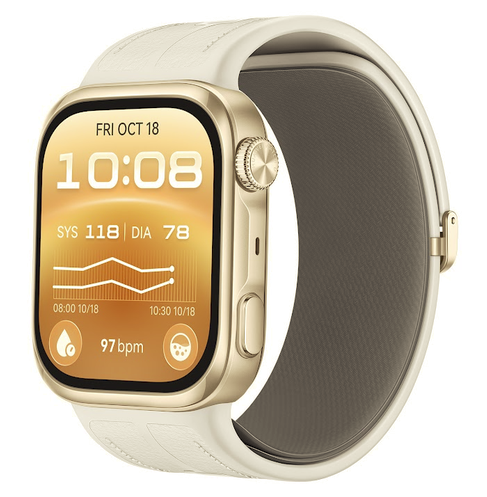
Micro-pump inflatable cuff, 24-hour ambulatory blood pressure monitoring. Measures pressure directly, no optical calibration required.

Quick answers
What does Huawei Watch D3's Health Glance measure?
Health Glance returns a report on up to 11 health indicators in about 60 seconds, including heart rate, ECG, SpO2, stress, skin temperature, arterial stiffness and blood pressure.
Is Health Glance a medical diagnosis?
No. Huawei’s own guidance describes the results as for reference only. Health Glance can flag a reading worth discussing with a doctor, but it does not diagnose conditions such as hypertension or heart disease.
Is Health Glance new to the Watch D3?
No. It is part of Huawei’s TruSense platform, introduced across the watch range from 2024. Watch D3 is the first device to confirm an 11-item report.
Last Updated on 16 September 2026 by the5krunner
My favourite kit and nutrition
- Garmin Fenix 9 Pro — I’ve just bought one.
- Injinji – Runners protect your toes. Avoid discomfort and minor injury. Run more. Run faster. I use them.
- Garmin 90-degree charging adapter — A small keyring adapter you can use anywhere. Essential when away. I use one.
- Garmin charging puck — the fastest and most reliable way to top up your Garmin before a session. I use one.
- Ravemen FR300 — Front light that mounts directly under your Garmin or Wahoo head unit. Keeps your bars clean and your beam pointed where it matters. I use one.
- Body Glide – The blue anti-chafe stick that all swimmers and many runners use. I use it.
- Maurten — The race nutrition trusted by elite athletes. Gels and drink mixes engineered to be easy on the stomach. I use them.
- Garmin Varia RTL515 — A radar rear light that alerts you to vehicles approaching from behind. Pairs with your Edge or Wahoo. I use this model.
- Favero Assioma Pro RS2 — The power-meter pedals most serious cyclists choose. Accurate, easy to move between bikes. I use this model.
- Garmin Forerunner 970 — A serious choice for a pro-grade triathlon watch. I use this.
- Polar H10 — My daily driver for accurate, waking HRV readings.
- Wahoo ELEMNT Roam 3 — The bike computer that has the feature Garmin lacks: usability. I use mine on most rides.
Reader-Powered Content

This content is not sponsored. It’s mostly me behind the labour of love, which is this site, and I appreciate everyone who supports it.
Support the site: Follow (free, fewer ads) · Subscribe (paid, ad-free) · Buy Me A Coffee ❤️
All articles are written by real people, fact-checked, and verified for originality. See the Editorial Policy. FTC: Affiliate Disclosure — some links pay commission. As an Amazon Associate, I earn from qualifying purchases.

Shradha Puri is a tech writer covering fem tech, wearables, consumer technology and AI-powered gadgets. With a background in marketing and editorial strategy, her work focuses on how emerging technology is influencing health, fitness and everyday consumer experiences. She closely follows the tech space, with a particular interest in sleep, recovery and health tracking wearables.
