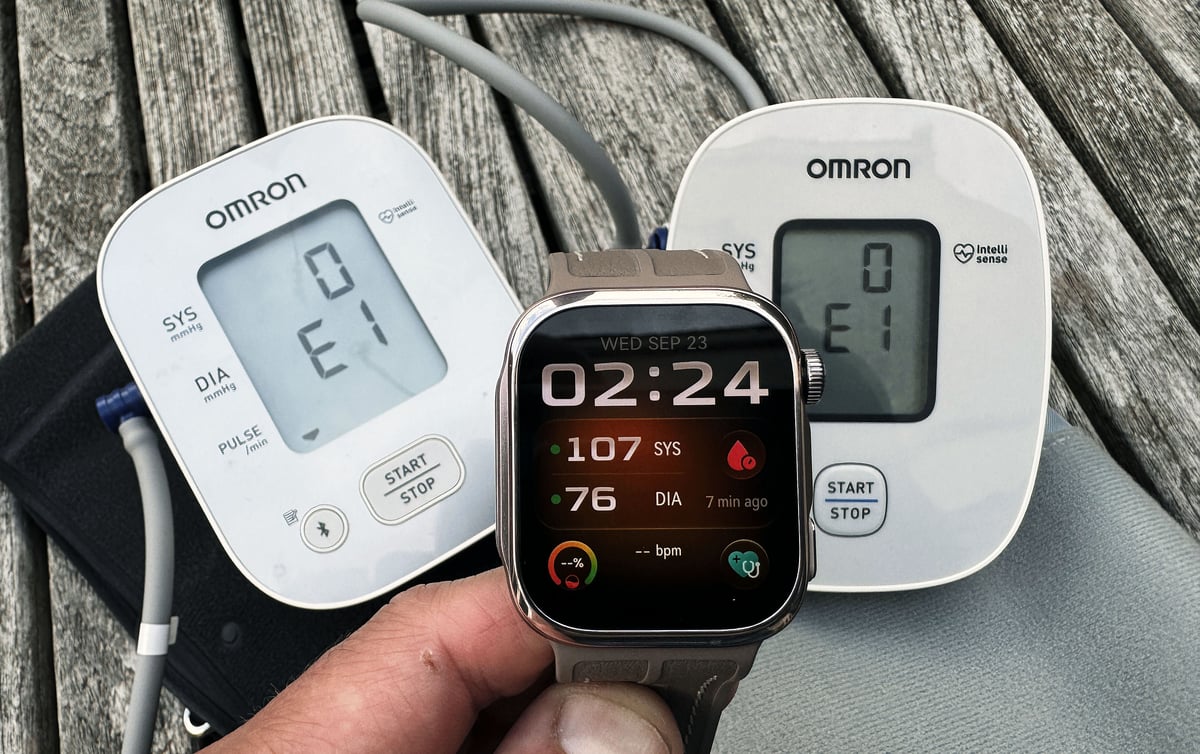
Huawei Watch D3 review: blood pressure watch accuracy tested
Huawei Watch D3 is Huawei’s latest blood pressure watch, a smartwatch built around one job: measuring blood pressure with a real inflatable cuff hidden in the strap. I did a deep dive into the blood pressure features and accuracy against a competitor watch and a validated upper-arm monitor, leaving most of the smartwatch extras alone.
Heads Up: I used a media loaner from Huawei. It is not sold in the US.
Huawei Watch D3 review
Verdict
If you want blood pressure readings anywhere, anytime, this is the watch to get. Tested side by side on the same wrist against an Omron arm cuff, it scored 95 per cent to the Wellue BPW1’s 87, and it is a full sports watch and smartwatch on top. At worst, it reads about 10 points lower on the top number, so it is for trends, not for diagnosis.
Pros
- Real cuff measurement
- 95 per cent side-by-side accuracy
- Near-silent inflation
- Motion detection during readings
- Automatic overnight readings
- Full smartwatch.
Cons
- Reads low
- Misses the 5 mmHg medical standard
- Not sold in the US (alternative: Wellue)
- No swimming
- GBP399.99 (list price)
Listen to the discussion
Huawei Watch D3 price and where to buy
The Watch D3 costs £399.99 in the UK and went on sale on 23 September 2026 through the Huawei Store and Amazon. Huawei includes a free three-month Huawei Health+ membership.
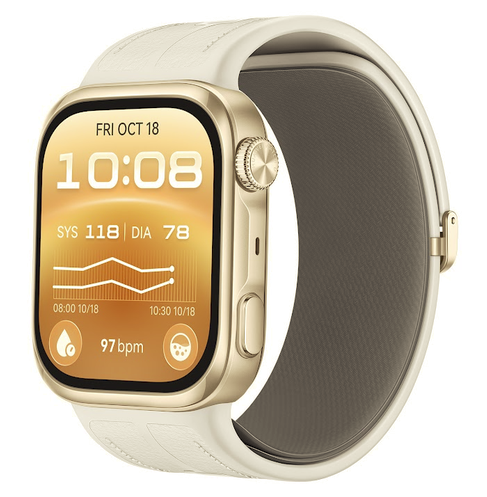
Huawei Watch D3
Micro-pump inflatable cuff, 24-hour ambulatory blood pressure monitoring. Measures pressure directly, no optical calibration required.

In the US, the nearest alternative is the Wellue BPW1, which uses the same inflatable-cuff method for $179, or $161 with code THEWATCH at Wellue – its accuracy is lower side-by-side, and its smart and sport features are extremely basic.
Who should buy the Watch D3, and who shouldn’t
This watch is for someone with high blood pressure who wants frequent readings without an arm cuff, not for anyone who needs an exact number.
Who should buy this
- Someone monitoring high blood pressure who wants frequent readings without reaching for an arm cuff
- Someone who needs to see day-to-night variation and wants the watch to take readings automatically, including overnight
- A Watch D2 owner who finds the older watch too bulky to sleep in
Who should avoid this
- Anyone in the US, where it is not sold: the Wellue BPW1 is the nearest alternative there
- Anyone wanting a sports watch that swims: Huawei’s usage guidance warns against showering, swimming or immersing it
- Anyone with arrhythmias such as atrial fibrillation, arteriosclerosis, diabetes or kidney disease, without asking a doctor first: Huawei says these conditions can affect accuracy.
- Pregnant users: Huawei says the device has not been validated for use in pregnancy
- Wrists under 13cm or over 21cm, where Huawei says accuracy may be affected
- Anyone who needs an exact reading rather than a trend: in my testing, the top number read low against an arm cuff on every subject
Huawei Watch D3 vs D2: what’s new
The measurement is unchanged. The Watch D3 uses the same micro-pump, airbag, and pressure-sensor principle as the D2, and Huawei makes no claim of better accuracy. The changes are a thinner case, a brighter screen and new software modes.
- A new pre- and post-exercise blood pressure mode for running, walking and cycling
- 24-hour monitoring, which the D2 also has, now follows European Society of Hypertension interval guidelines, with quieter inflation at night
- Pulse Wave Arrhythmia Analysis (irregular heartbeat detection) and a Beat-by-Beat ECG app
- Case: 11.3mm at its thinnest, down from 13.3mm, with a 46.5 x 41mm footprint (D2: 48 x 38mm)
- Strap: 25.5mm wide, down from 26.5mm
- Display: 1.92-inch, up from 1.82 inches, and brighter, so easier to read outdoors
The discounted D2 at £350 takes the same measurement for £50 less. Huawei Watch D3 vs D2 covers that decision in detail.
How the inflatable cuff works
A micro-pump inflates an airbag inside the strap, squeezing the wrist artery. As the airbag inflates, a pressure sensor reads the pulses in the artery wall and calculates the top and bottom numbers. This is the same method used by home upper-arm monitors, applied at the wrist with readings taken on inflation rather than deflation.
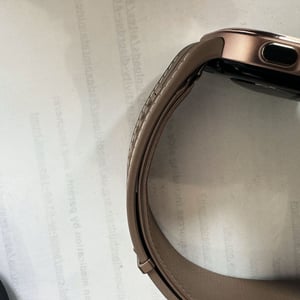
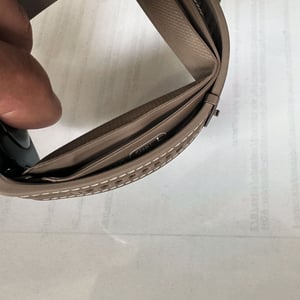
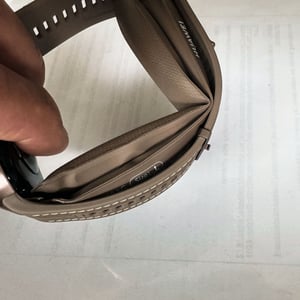
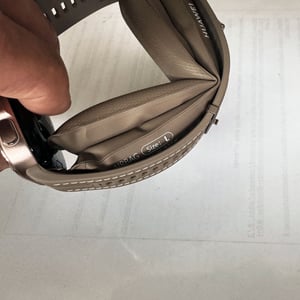
In practice, the D3 does not inflate in one smooth ramp the way an arm cuff does. It rises in stages, pauses, then deflates quickly once it has a result.
Apple, Samsung, Google Pixel, Oura and Whoop take a different and far less precise route. They estimate blood pressure trends, or flag a risk pattern, from the pulse signal picked up by their optical sensor, and they have to be calibrated against a real cuff first. The Huawei blood pressure watch skips that step because it has a built-in cuff. Blood Pressure Watches 2026 explains which wearables measure pressure and which estimate it.
Huawei Watch D3 blood pressure accuracy: how close is it to an arm cuff?
How I tested
I tested four people who approximated the target audience for this watch, aged 55 to 65. Each took five readings, seated, first with an Omron arm cuff, then with the watch. To confirm the cuff’s reliability, I checked it against a second Omron cuff. The two agreed within 2 points. For each person, I dropped the highest and lowest reading and averaged the middle three, the same method as in the Wellue BPW1 review. I tested one subject twice on separate days: -4/-7 the first time, -5/-7 the second. The second session is in the table below; the first, which included the Wellue, is in the side-by-side table further down. Here is my broader testing methodology.
Results
| Subject | Reference cuff (mmHg) | Watch D3 (mmHg) | Top number difference | Bottom number difference | Top number accuracy | Bottom number accuracy |
|---|---|---|---|---|---|---|
| Subject 1 | 146/95 | 141/88 | -5 | -7 | 97 per cent | 93 per cent |
| Subject 2 | 116/75 | 108/77 | -8 | +2 | 93 per cent | 97 per cent |
| Subject 3 | 115/76 | 102/59 | -13 | -17 | 89 per cent | 78 per cent |
| Subject 4 | 139/90 | 125/82 | -14 | -8 | 90 per cent | 91 per cent |
| Average | 92 per cent | 90 per cent |
The watch read low on 18 of the 20 top-number readings and 16 of the 20 bottom-number readings. The worst was Subject 3’s bottom number, 27 points below the cuff on one reading. I don’t know why.
The highest-pressure subject got the most accurate result, and the weakest result came from one of the two lowest-pressure subjects, but the other low-pressure subject was fine. Four people can’t establish a pattern. The Quantified Scientist, a YouTube reviewer who tests wearables against reference devices, found the opposite in his own testing: the top number struggled most at elevated pressure. Both findings stand.
Medically approved cuffs must average within 5 points of a reference reading. The D3 averaged 10 points low on the top number and 8 on the bottom. Use it to watch trends, not for diagnosis.
Check it against your own cuff
The top-number error ranged from 5 to 14 points across four people, so no single correction factor applies. If you buy one, take five readings on your own arm cuff and five on the watch, a minute apart, on the same morning, drop the highest and lowest of each, and compare the averages. That tells you how far out the watch is on you.
How that compares
The D2’s cuff mechanism has independent support. A 2025 study in Hypertension Research found it met the AAMI/ESH/ISO Universal Standard, the international accuracy test for blood pressure monitors, both at rest against a mercury reference monitor and over 24 hours against a cuff-based ambulatory monitor. The D3 has not yet been studied independently.
In my earlier testing, the Wellue BPW1 averaged 92 per cent on the top number across four subjects, the same as the D3, and 93 per cent on the bottom, compared with the D3’s 90. Different people, five months apart, so that old test is not a like-for-like comparison with the Huawei test.
For further cross-device comparison, in one sitting I compared Omron, Huawei and Wellue for one person, with two watches worn in turn on the same wrist, both against the same Omron cuff:
| Device | Reading (mmHg) | Top number | Bottom number | Overall |
|---|---|---|---|---|
| Omron arm cuff | 151/91 | reference | reference | |
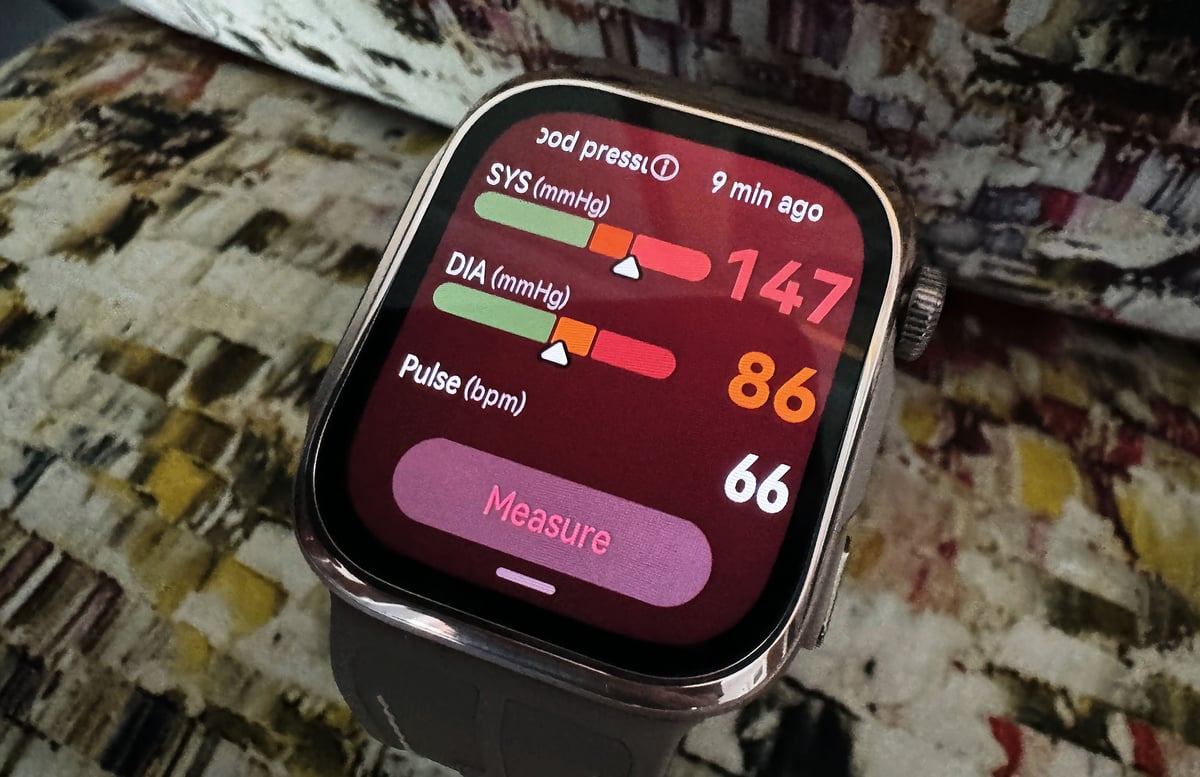
| Huawei Watch D3 | 147/84 | -4, 97 per cent | -7, 92 per cent | 95 per cent |
| Wellue BPW1 | 126/82 | -25, 83 per cent | -9, 90 per cent | 87 per cent |
That is one person on one day, so it carries less weight than the four-person figures, but it is the only direct comparison between the watches, and the D3 won it clearly.
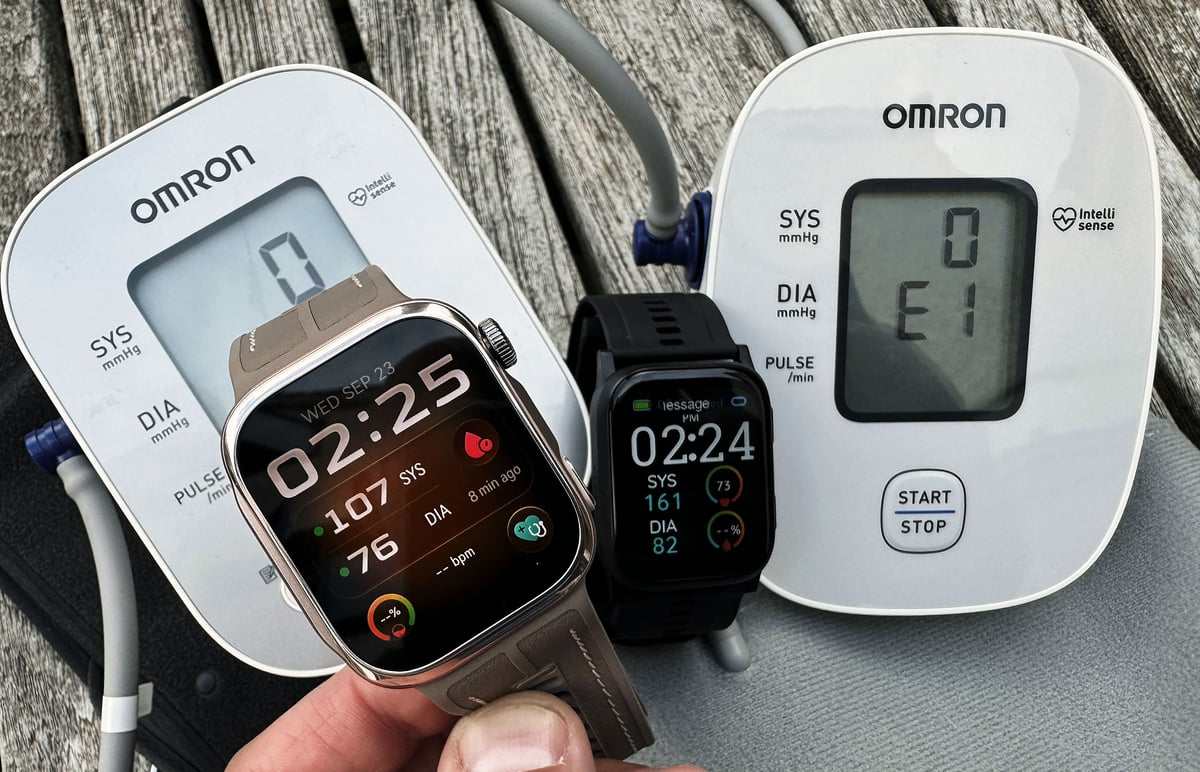
The Quantified Scientist tested the D3 on himself. He also found the top number less reliable. On the bottom number, his watch read too high, and mine read too low.
24-hour and overnight monitoring
Huawei’s 24-hour ambulatory mode follows European Society of Hypertension guidelines: readings every 15 to 30 minutes, with at least 70 per cent successful and a minimum of 20 daytime and 7 night-time measurements.
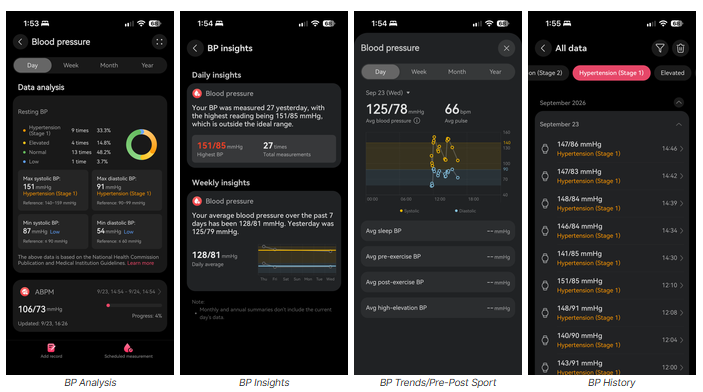
Overnight readings run automatically while you sleep, without the seated, arm-at-heart-level posture Huawei asks for during the day, and the Huawei Health app produces a 24-hour report you can share with your GP. Huawei says the airbag inflates near-silently at night. Based on Huawei’s 15-minute interval test, battery life drops to one day with the mode enabled.
Taking a reading
A reading takes a couple of screen taps and about a minute of sitting still. The box includes a wrist circumference ruler and two airbag straps, M for 13 to 16cm wrists and L for 16.1 to 21cm. Huawei’s posture guidance for a single reading is strict:
- Sit stably and relaxed, with your feet flat and uncrossed
- Support your elbow and keep the watch level with your heart
- Keep your wrist and palm naturally extended, without pressing on the airbag
- Stay quiet and still until the result appears
The watch asks you to pick a strap hole and cuff size based on your wrist circumference: holes 5 to 11 for the M strap, 12 to 20 for the L. Inflation is nearly silent, unlike the Wellue’s audible buzz; the only sound is a faint valve release on deflation. Move your wrist or fingers, or let the watch press against your chest, and the reading aborts with a squeak and a “Measurement failed” screen. You then start the full cycle again from the beginning.
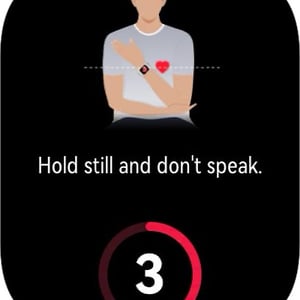
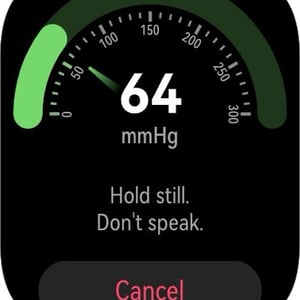
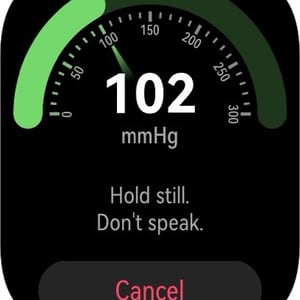
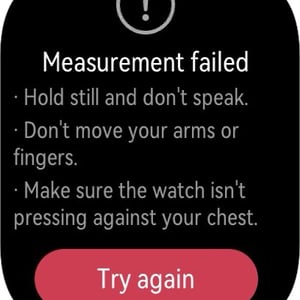
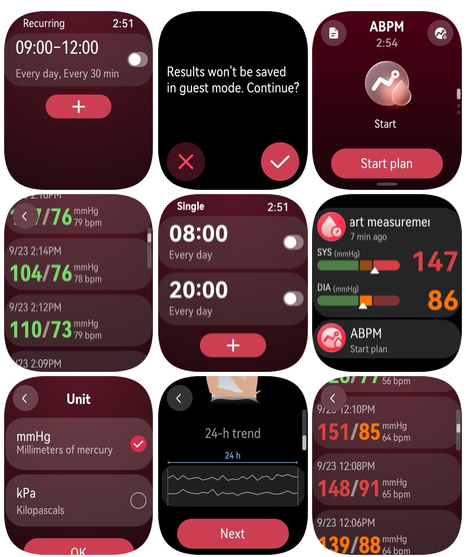
Each result shows the top and bottom numbers with heart rate, a timestamp to the minute, and a 24-hour trend graph on the watch. Readings can be scheduled at fixed times, for example 08:00 and 20:00, or in a recurring window, for example every 30 minutes from 09:00 to 12:00. A guest mode takes readings without saving them.
Q: Why is the hand rested on the chest?
A: This keeps the watch at the same height as the heart. Just as wearing a cuff on the biceps keeps it at the same height as the heart. A straight arm would increase pressure.
Pre- and post-exercise mode
The new mode takes a reading before a run, walk or ride and another within two minutes of finishing, and alerts you if the pre-exercise reading is above Huawei’s thresholds.
My pre-exercise reading was elevated. Afterwards, it fell by roughly 15 points on the top number and 10 on the bottom, which is physiology rather than the device. The most likely explanation is nervous excitement before running, then blood pressure falling after exercise as the arteries temporarily widen (vasodilation, which is good).
Huawei Watch D3 specs, build and fit
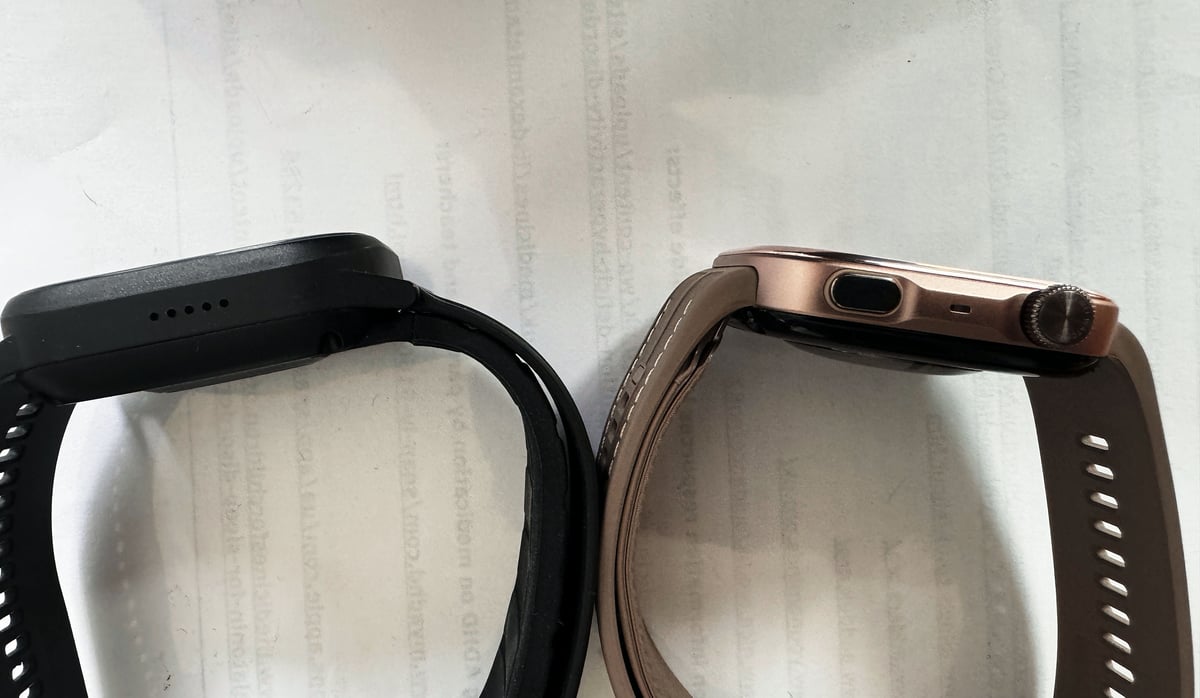
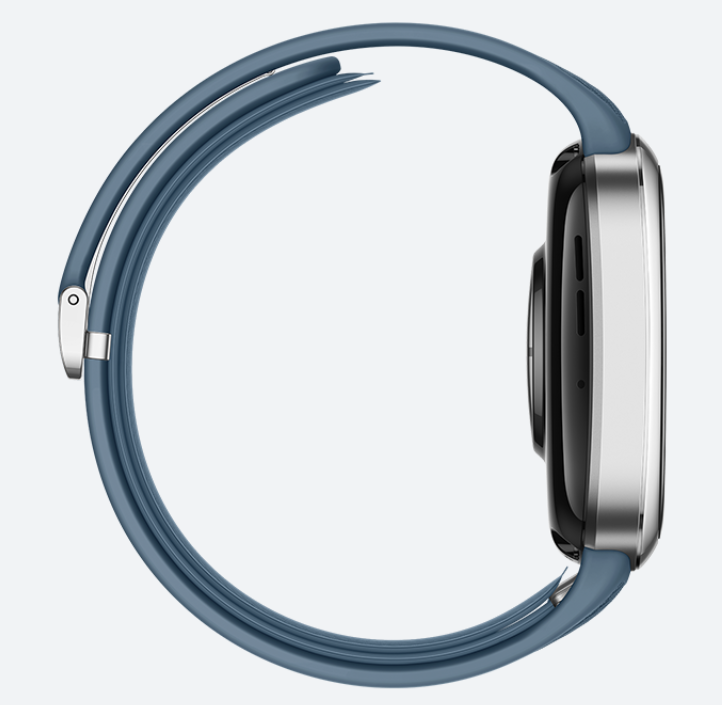
The case is aluminium alloy and weighs about 40g without the strap, and Huawei says the strap is 7.5g lighter than the D2’s. It comes in Mocha Gold, Gold, and Black, with sand composite leather, white composite leather, and black rubber (HNBR) straps, respectively. The 1.92-inch AMOLED display reaches a claimed 3,000 nits, and controls are a rotating crown plus a function and ECG button. Huawei’s UK product pages give no water rating, but its Chinese product pages list IP68 with a caveat: the airbag exchanges air with the outside during a reading, so the watch is not suitable for swimming, showering, hot springs or saunas, and liquid damage is not covered by the warranty. The UK page gives the same warnings and asks you to wipe the watch dry before a reading if it gets wet, to avoid failed measurements or slow airbag deflation.
The case, buttons and screen are good for the price. The strap is the unusual part, and it looks and feels well made. I compared it with the much cheaper Wellue BP strap, which was a tad comfier but didn’t look as good or feel like it would last as long. Strap longevity matters more than on a normal watch, since a replacement isn’t a standard, widely available purchase.
Huawei Watch D3 battery life: how long does it last?
Charging is wireless, through a proprietary cradle with a USB-C lead, and a full charge takes about 75 minutes.
iPhone and Android
Yes, it works with both plus HarmonyOS.
Huawei’s UK specification lists iOS 13.0 and Android 8.0 or later, but its notes say several features need Android 9.0 or later, so treat Android 9.0 as the practical minimum. Everything runs through the Huawei Health app. I used the iOS app, and it works well and has plenty of features. The interface is a tad cumbersome but OK once you become familiar with where everything is. Setup needed only two approvals, but this wasn’t my first time using this app, and you may find that it requires a significant number of approvals.
Medical certification
The blood pressure function carries CE-MDR certification, the EU’s medical device approval. Watch D3 is not FDA-cleared. Huawei’s UK product page describes the watch as CE-MDR-certified as a medical device, but also says readings are for reference only, should not be used as a basis for diagnosis or treatment, and should never be used to adjust medication without a doctor.
What I didn’t test
I tested blood pressure and basic day-to-day use only. The features below are Huawei’s claims, and I have verified them on other Huawei watches but not this model:
- ECG and Pulse Wave Arrhythmia Analysis for A-fib alerts
- Heart rate, SpO2 and skin temperature monitoring
- Sleep tracking, HRV and the Physical Readiness Score
- Health Glance, an 11-item health check in a few moments
- Health Community, which shares blood pressure, heart rate, step and sleep alerts with family members
- GPS tracking
- Maps
- More than 100 workout modes, some arriving by software update
- Bluetooth calling, NFC payments through Curve Pay, and an Emotional Wellbeing app
Huawei’s product page says some of these features will arrive via software updates rather than at launch. GPS does not appear on Huawei’s official specification page but is working.
Watch D3 versus the alternatives
| Model | Price | Main difference from Watch D3 |
|---|---|---|
| Huawei Watch D2 | £350 (discounted, while stock lasts) | The same cuff measurement in a thicker case, without the exercise mode or arrhythmia analysis |
| Wellue BPW1 | $179 ($161 with code THEWATCH) | Cheaper and sold in the US, with a basic app and no smartwatch features |
| Validated upper-arm cuff | £20/$25 and upwards | The best choice if you only need a morning and evening reading |
Huawei Watch D2
Micro-pump inflatable cuff, 24-hour ambulatory blood pressure monitoring. Measures pressure directly, no optical calibration required.
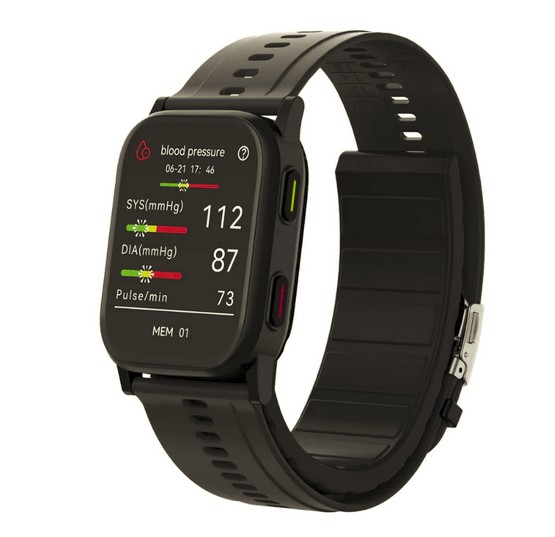
Wellue Blood Pressure Watch
Smart Blood Pressure Micro Cuff BPW1
+other retailersFull specifications are on the Huawei Watch D3 specifications page, and the rest of the range is on the Huawei specifications index. The launch details are in Huawei Watch D3 launches with new blood pressure features.
Final verdict
If you want blood pressure readings on your wrist, anywhere, any time, this is the watch to get. It reads about 10 points low, so use it for trends and confirm anything that matters on an arm cuff.
The Wellue BPW1 does the blood pressure job more cheaply, with a basic app and nothing else. The older Huawei D2 does the same job for £50 less in a thicker case. The D3 adds a proper smartwatch on top: fitness tracking, notifications and calls, close to what you get from an Apple Watch, but short of Apple’s deeper iPhone integration.
Worn in turn on my wrist against the same arm cuff, the D3 scored 95 per cent to the Wellue’s 87.
Huawei Watch D3
Micro-pump inflatable cuff, 24-hour ambulatory blood pressure monitoring. Measures pressure directly, no optical calibration required.
Quick answers
Is the Huawei Watch D3 accurate?
Worn on the same wrist and checked against the same Omron arm cuff, it was 95 per cent accurate, while the Wellue BPW1, the other inflatable-cuff watch, was 87 per cent. Across four people, it was 92 per cent accurate on the top number and 90 per cent on the bottom, and it usually read low. The D2 uses the same measurement method and met the AAMI/ESH/ISO Universal Standard in a 2025 independent study, but the D3 has not yet had its own.
How many points out is the Huawei Watch D3?
Across four people, it read about 10 points low on the top number and 8 points low on the bottom, against an Omron arm cuff. The range was 5 to 14 points on the top number, so check it against your own cuff.
Is the Huawei Watch D3 more accurate than the D2?
Not according to Huawei. It measures blood pressure the same way, and Huawei claims no improvement in accuracy. I have not tested the D2. The D3 is 2mm thinner, has a brighter 1.92-inch screen, and adds a pre- and post-exercise blood pressure mode and arrhythmia analysis. The D2 costs £50 less while stock lasts.
Can you sleep in the Huawei Watch D3?
Yes. It takes readings automatically overnight for its 24-hour report. I wore it overnight several times, and neither the strap nor the inflation affected my sleep.
Does the Huawei Watch D3 work with an iPhone?
Yes. It works with iOS 13.0 or later through the Huawei Health app. On Android, Huawei lists Android 8.0 or later, but several features require Android 9.0.
Can I buy the Huawei Watch D3 in the US?
No. It is sold in the UK and selected European markets. The Wellue BPW1 is the nearest inflatable-cuff alternative on sale in the US.
How long does the Huawei Watch D3 battery last with automatic readings?
In my testing, 36 to 40 manual readings used 14 per cent of the battery, which works out at roughly 250 to 285 readings a charge. Huawei claims up to 6 days of typical use, including six blood pressure readings a day, and one day with 24-hour ambulatory monitoring enabled.
Can the Huawei Watch D3 replace a home blood pressure cuff?
No. The top number read low against an Omron arm cuff on every person I tested, by up to 27 points on one reading. Use it to track trends and check anything that matters on a validated cuff. Huawei’s own guidance says never to diagnose, treat yourself or adjust medication based on its readings.
Is the Huawei Watch D3 waterproof?
Not for swimming or showering. Huawei’s Chinese specification lists IP68, but both the UK and Chinese pages say to remove it before swimming, showering, saunas or hot springs, and liquid damage is not covered by the warranty. Wipe it dry before taking a blood pressure reading if it gets wet.
Last Updated on 24 September 2026 by the5krunner
My favourite kit and nutrition
- Garmin Fenix 9 Pro — I’ve just bought one.
- Injinji – Runners protect your toes. Avoid discomfort and minor injury. Run more. Run faster. I use them.
- Garmin 90-degree charging adapter — A small keyring adapter you can use anywhere. Essential when away. I use one.
- Garmin charging puck — the fastest and most reliable way to top up your Garmin before a session. I use one.
- Ravemen FR300 — Front light that mounts directly under your Garmin or Wahoo head unit. Keeps your bars clean and your beam pointed where it matters. I use one.
- Body Glide – The blue anti-chafe stick that all swimmers and many runners use. I use it.
- Maurten — The race nutrition trusted by elite athletes. Gels and drink mixes engineered to be easy on the stomach. I use them.
- Garmin Varia RTL515 — A radar rear light that alerts you to vehicles approaching from behind. Pairs with your Edge or Wahoo. I use this model.
- Favero Assioma Pro RS2 — The power-meter pedals most serious cyclists choose. Accurate, easy to move between bikes. I use this model.
- Garmin Forerunner 970 — A serious choice for a pro-grade triathlon watch. I use this.
- Polar H10 — My daily driver for accurate, waking HRV readings.
- Wahoo ELEMNT Roam 3 — The bike computer that has the feature Garmin lacks: usability. I use mine on most rides.
Reader-Powered Content

This content is not sponsored. It’s mostly me behind the labour of love, which is this site, and I appreciate everyone who supports it.
Support the site: Follow (free, fewer ads) · Subscribe (paid, ad-free) · Buy Me A Coffee ❤️
All articles are written by real people, fact-checked, and verified for originality. See the Editorial Policy. FTC: Affiliate Disclosure — some links pay commission. As an Amazon Associate, I earn from qualifying purchases.
tfk is the founder and author of the5krunner, an independent endurance sports technology publication. With 20 years of hands-on testing of GPS watches and wearables, and competing in triathlons at an international age-group level, tfk provides in-depth expert analysis of fitness technology for serious athletes and endurance sport competitors. ID
