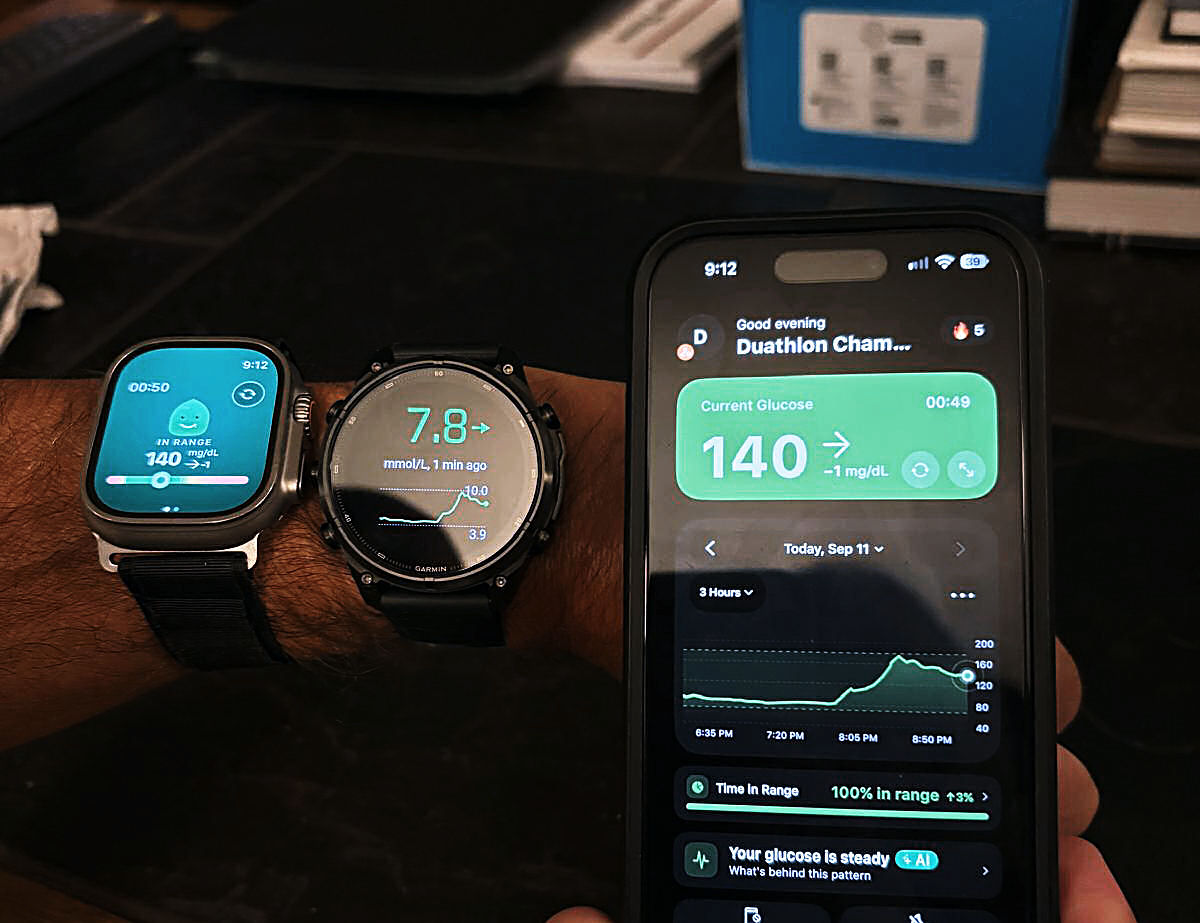
Blood Sugar on Garmin Fenix 9 Pro and Apple Watch Ultra 4 with Sugar Sense and FreeStyle Libre
I recently shared some information about the Sugar Sense Connect IQ app on the Indie Spotlight section of this site. Here are a few more thoughts on my wider personal experience with it and the FreeStyle Libre 3 Plus sensor.
More: Buy Libre Freestyle on Amazon
Background
Abbott used to supply Supersapiens with one of its sensors for resale alongside its niche, athlete-focused app. The supply dried up, and the app stopped. That was a shame, as I found its information occasionally useful and often insightful.
The sensors are invasive: a tiny needle pricks the skin and periodically samples fluid from your interstitial tissue. Essentially, it measures blood glucose to all intents and purposes.
You can see which foods spike your blood sugar, and this varies from person to person and even by the order in which you eat foods in a given meal. You can see whether crashes follow any spikes, or whether certain times of day coincide with cravings and crashes. You can even see if you can maintain steady levels throughout sleep. You understand a lot more about motivation to eat, and how, what, and when to eat.
From a sports perspective, to some degree, you can see if your body is supplying enough glucose to the muscle – fuel is pretty important for workouts, right!? You can even do basic tests to see how long it takes from eating a gel to it registering in the app (just over 20 minutes for me at rest).
FreeStyle Libre 3 Plus
More: Buy Libre Freestyle on Amazon
This is the small-format Libre 3 Plus sensor, about the size of a UK £1 coin and Abbott’s smallest CGM sensor to date, smaller than the older Libre 2 patch. Typical UK pricing runs to about GBP80-90 per sensor, and roughly EUR60-100 in the EU depending on the pharmacy. In the US it’s prescription-only, though I’ve kept the Amazon link above in case that changes. Each sensor lasts two weeks and is best worn with a protective cover (not included), as if you accidentally knock them off, they can’t be reattached.
Getting them to work
Initially, getting the FreeStyle Libre 3 app installed and working is a bit of a nightmare. You then have to share your own readings with yourself using LibreLinkUp, the separate ‘sharing’ app.
Sugar Sense or other apps can then link in via LibreLinkUp and read relatively live data, and that part was straightforward.
Connect IQ and watchOS 27
As you can see in the image, I got these working on Apple Watch and Garmin Fenix 9 Pro. That was pretty easy in both cases.
Problems and downsides
The Libre sensor only shares data with apps on your phone, so your phone must be nearby to receive any data. If you are not nearby, it caches the data until you are.
If you want an instant reading, you can tap the top of your phone on the sensor to get info directly with NFC. I found that to be very unreliable.
The second downside is that for your Garmin or Apple Watch to show the data, it must be linked by Bluetooth to the same phone that is also linked to the sensor. If you always carry your phone and watch, this will be fine; if not, you have to wait until all are within range for the data to transfer.
Overall
The Sugar Sense app is pretty basic but shows core sugar-level data nicely. It has low-level alerts which also work properly. Unlike the now-discontinued Supersapiens app, it offers far fewer analytics and much less compatibility with sporting devices.
If you are a diabetic or pre-diabetic, this type of sensor will probably have already been recommended or prescribed to you for frequent use.
For everyone else, these are good one-off purchases to help you understand how your body processes macros into glucose and then how your muscles consume that. You need to be fairly committed to spend some time logging and understanding all of this. I’d suggest doing that for two weeks, then adjusting your life for a month or so before monitoring again; otherwise, it gets expensive quickly.
Interestingly, the UCI also weighed in this week with its definitive take on supplements, and it also commented on CGMs. Continuous glucose monitors did not fare well. The UCI statement points to a 10–15 minute lag against actual blood glucose, inconsistent readings around meals and high-intensity efforts, and results that vary depending on whether the sensor sits on the arm or the leg.
Quick answers
Can you use a FreeStyle Libre if you're not diabetic?
Yes. Non-diabetic and pre-diabetic athletes wear CGM sensors to see how food, sleep, and training affect their blood glucose. However, anyone with a diagnosed condition should confirm sensor use with their diabetes team first.
How much does the FreeStyle Libre 3 Plus cost and how long does it last?
Typical UK pricing runs to about GBP80-90 per sensor, and roughly EUR60-100 in the EU depending on the pharmacy. Each sensor lasts around two weeks, so keeping one on year-round adds up quickly.
Does FreeStyle Libre still work if your phone isn't nearby?
Yes. The sensor keeps sampling and caches new readings even when your phone is out of range, then sends the backlog through once you’re back within Bluetooth distance, so no data is lost.
Is the NFC scan on FreeStyle Libre 3 Plus reliable?
Not especially. Tapping the sensor with a phone over NFC is meant to give an instant reading without opening the app, but in practice it can be inconsistent, so the live app-based reading remains the more dependable option.
What happened to Supersapiens?
Supersapiens built a business around reselling Abbott’s Libre Sense biosensor with its own fuelling-focused app and Garmin integration, then shut down in 2024, taking the sensor, the app and its Connect IQ field with it. Newer Connect IQ tools like Sugar Sense are now filling that gap.
Could you see glucose data on an Apple Watch before Sugar Sense?
Yes. Supersapiens shipped an Apple Watch app back in 2023 that mirrored its iPhone readings onto the wrist, though it still needed the phone in range and only worked with its own biosensor rather than a standard FreeStyle Libre or Dexcom sensor.
How long after eating a gel does blood sugar rise show up on a CGM?
It varies by person, sensor lag and what else you’ve eaten, but in one basic test it took just over 20 minutes at rest for a gel to register as a rise in the app.
Last Updated on 21 September 2026 by the5krunner
My favourite kit and nutrition
- Garmin Fenix 9 Pro — I’ve just bought one.
- Injinji – Runners protect your toes. Avoid discomfort and minor injury. Run more. Run faster. I use them.
- Garmin 90-degree charging adapter — A small keyring adapter you can use anywhere. Essential when away. I use one.
- Garmin charging puck — the fastest and most reliable way to top up your Garmin before a session. I use one.
- Ravemen FR300 — Front light that mounts directly under your Garmin or Wahoo head unit. Keeps your bars clean and your beam pointed where it matters. I use one.
- Body Glide – The blue anti-chafe stick that all swimmers and many runners use. I use it.
- Maurten — The race nutrition trusted by elite athletes. Gels and drink mixes engineered to be easy on the stomach. I use them.
- Garmin Varia RTL515 — A radar rear light that alerts you to vehicles approaching from behind. Pairs with your Edge or Wahoo. I use this model.
- Favero Assioma Pro RS2 — The power-meter pedals most serious cyclists choose. Accurate, easy to move between bikes. I use this model.
- Garmin Forerunner 970 — A serious choice for a pro-grade triathlon watch. I use this.
- Polar H10 — My daily driver for accurate, waking HRV readings.
- Wahoo ELEMNT Roam 3 — The bike computer that has the feature Garmin lacks: usability. I use mine on most rides.
Reader-Powered Content

This content is not sponsored. It’s mostly me behind the labour of love, which is this site, and I appreciate everyone who supports it.
Support the site: Follow (free, fewer ads) · Subscribe (paid, ad-free) · Buy Me A Coffee ❤️
All articles are written by real people, fact-checked, and verified for originality. See the Editorial Policy. FTC: Affiliate Disclosure — some links pay commission. As an Amazon Associate, I earn from qualifying purchases.
tfk is the founder and author of the5krunner, an independent endurance sports technology publication. With 20 years of hands-on testing of GPS watches and wearables, and competing in triathlons at an international age-group level, tfk provides in-depth expert analysis of fitness technology for serious athletes and endurance sport competitors. ID
