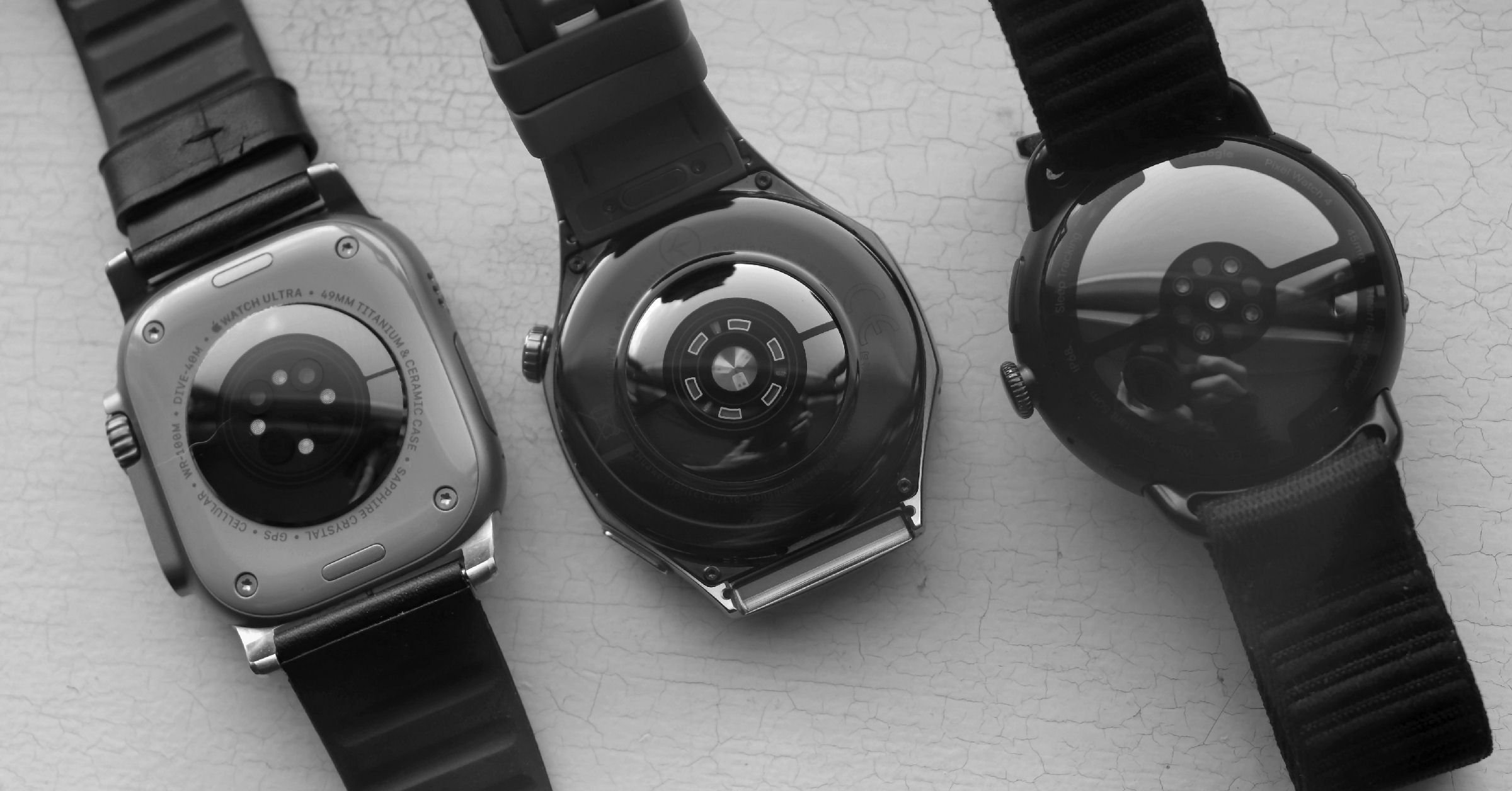
No Apple Watch measures blood glucose on its own. It can show readings from a separate glucose sensor worn on the arm, but the optical sensor on its back has never measured blood sugar, and the annual rumour that the next model will has never come true. A Mayo Clinic review, published in the journal Life on 15 September 2026, explains why. It draws on 96 references to show what photoplethysmography, the optical technology behind wrist heart rate sensors, could read beyond heart rate and SpO2. Combined with a 2022 systematic review of 205 human studies, that research gives 40 signals, states and conditions. Each is ranked here by evidence, with the watches that ship it. Glucose is the furthest from reality of all 40, and that ranking is this site’s, not the Mayo authors’.
The sensor records how much light comes back from the skin, and the pulsing part of that signal follows blood volume rising and falling with each heartbeat. Heart rate is calculated from the timing of that pulse, and SpO2 from how oxygenated and deoxygenated haemoglobin absorb red and infrared light. Most other readings, from an HRV score to a blood pressure trend, are derived from the timing, height, and shape of the wave, often with data from other sensors. The further a metric sits from the pulse itself, the more assumptions it relies on. Apple Watch is the example here because it is the watch most people ask about. The same sensor and the same physics sit in Garmin Fenix, Samsung Galaxy Watch, Google Pixel Watch and Huawei Watch, although the wavelengths, sensor layouts and algorithms differ.
The chain of inference
Every inferred metric comes through one of four body processes.
- The autonomic nervous system changes both beat timing and the tone of the small blood vessels. The vagus nerve releases acetylcholine, which slows the heart and makes beat timing more variable, and sympathetic nerves release noradrenaline, which speeds the heart and narrows the vessels. Heart rate variability reflects autonomic modulation of the heartbeat, and vessel tone shows in the height and shape of the pulse. Stress and readiness scores, the deceleration capacity metric Honor ships as a cardiac risk score, and the sleep-stage estimate all sit on this process, with sleep staging also needing movement data from the accelerometer.
- Next comes the heart itself. Atrial fibrillation produces an irregular ventricular response, so the gaps between pulses at the wrist become irregular. Researchers have also tried to estimate stroke volume and cardiac output from pulse shape, size, and timing, sometimes with extra calibration or a second sensor.
- Blood vessel mechanics come third. Cuffless blood pressure estimates use features such as pulse timing and shape, which are influenced by arterial stiffness, vessel tone and other cardiovascular factors. Age-related stiffening changes pulse wave velocity and wave reflection, and researchers extract those features to estimate arterial stiffness or a statistical vascular age. Diseases such as preeclampsia, diabetes and peripheral artery disease change vessel tone and waveform shape in patterns that algorithms attempt to detect.
- Blood volume is the last. Breathing modulates the baseline, pulse height, and beat-to-beat timing, which gives respiration rate. Dehydration and blood loss reduce stroke volume and trigger vessel narrowing, which changes the pulse shape. Sleep apnoea appears as a drop in oxygen followed by a surge in heart rate.
The proposed routes run through light scattering, blood viscosity or vessel behaviour, all without a settled mechanism. The largest study, on 699,072 PPG segments from 6,388 hospital patients, reached an error of 19.7 mg/dL with 76.6 per cent of readings in the most accurate zone of the standard glucose error grid. An earlier attempt that expanded testing to 2,538 people watched its accuracy fall to 60.6 per cent in that zone as the population grew. The nearest any watch gets is Huawei’s opt-in diabetes risk study on the Watch 6, which gives a risk level, rather than a glucose value. Huawei’s consumer chief He Gang said at a Peking University recruitment event this week that a blood sugar testing device took four years to reach a standard the company considers ready for industrialisation, without giving a date or a method. Garmin holds a patent for tracking long-term glucose trends optically yet has shipped nothing.
What to trust on the wrist today
The wrist is a hard place to get a clean optical signal. Motion swamps the signal, sensor fit and skin properties change the returning light, and the pulse arrives at the wrist after a variable delay from the heart. Validation studies have also largely ignored darker skin. A 2026 scoping review of 186 consumer wearable PPG studies found the median share of participants in the two darkest Fitzpatrick skin tone groups was zero per cent, a gap covered on this site in Wrist HR Accuracy: Dark Skin and Small Wrists Explained.
In a 31-patient study of a wrist PPG monitor against ECG after surgery, the relative error was 9.1 per cent for SDNN, the overall spread of beat intervals, but 34.3 per cent for RMSSD, the beat-to-beat measure most watches sell as overnight HRV. Both come from the same beats. RMSSD depends on the fast changes that wrist timing error corrupts. That applies directly to Garmin HRV Status on the Fenix 9 Pro and every other Fenix, and it matches the 62-device Garmin ECG comparison, the Forerunner 265 student study and this site’s own Fitbit Air and watchOS 27 HRV test.
In the Apple Heart Study, an irregular pulse notification had a positive predictive value of 84 per cent against a simultaneous ECG patch, and the Huawei Heart Study reported 91.6 per cent with more frequent sampling. The EQUAL study later found Apple Watch caught atrial fibrillation in 10 per cent of at-risk patients, compared with 2 per cent with conventional monitoring, and a meta-analysis found continuous PPG catches intermittent episodes that an on-demand ECG misses. Garmin takes the on-demand route: the ECG App on the Fenix 8 and other watches with the Elevate Gen 5 sensor records 30 seconds with a finger on the bezel, and Garmin has no passive PPG rhythm alert, no blood pressure feature and no sleep apnoea feature.
Optical blood pressure estimates can look right at rest and still understate real changes, as the blood pressure watch guide covers in detail. Apple’s hypertension notification reached 41 per cent sensitivity and 92 per cent specificity in the JAMA analysis. Samsung ships the most inference from the wrist: a cuff-calibrated blood pressure reading, a sleep apnoea screen, a Vitals alert when several overnight metrics move together, and Vascular Load, which it withdrew from US watches in July 2026 and replaced with a cuff-calibrated Blood Pressure Trend. The Hilo Band, formerly Aktiia, is a PPG wristband calibrated monthly with a cuff, and it has FDA clearance for over-the-counter use. However, the American Heart Association warns that clearance does not prove a cuffless device tracks real changes. Google’s Pixel Watch carries the consumer version of the blood-volume physiology below: Loss of Pulse Detection, cleared by the FDA in February 2025, uses the optical sensor with red and infrared confirmation to detect a stopped heart and call for help. It sits outside the table because it is a safety alert built on several signals. Huawei’s Watch D3 measures blood pressure with an inflating cuff, which is why it appears in the D3 review as a real measurement and not in this table.
The table below lists all 40, with the process behind each, the level of evidence, where it ships, and a study to cite. Last reviewed 30 September 2026.
How the 40 are counted
A signal, state or condition counts if it is inferred from the PPG waveform in at least one peer-reviewed human study. We exclude composite scores where PPG supplies only heart rate, such as VO2 max and calorie estimates. We exclude methods such as camera-based PPG, as well as uses that measure nothing physiological, such as identifying the wearer.
Evidence has five levels:
- Established: independent validation against a reference, and shipping on consumer watches.
- Consumer estimate: shipping on consumer watches, with the underlying physiology validated but the product’s own number rarely tested.
- Validated research: more than one human study, at least one with external validation or a large sample.
- Early research: small studies with no external validation.
- Conceptual: no settled physiological pathway.
The table runs from most to least mature by this site’s judgement. Glucose sits last because it combines the largest error, no settled mechanism and a result that weakened as the sample grew.
Process key: N = autonomic nerves, H = heart timing and output, V = vessel mechanics, B = blood volume, C = optical chemistry.
All 40 signals, states and conditions
| Metric | Process | Evidence | Where it exists | Key study |
|---|---|---|---|---|
| Heart rate | H | Established | Most consumer watches | Biswas 2019 |
| Blood oxygen (SpO2) | C | Established | Most consumer watches | Kirszenblat 2021 |
| Respiration rate | B | Established | Apple, Garmin, Samsung, Fitbit, Whoop | Charlton 2017 |
| Atrial fibrillation | H | Established | Apple, Samsung, Fitbit, Huawei (passive PPG) | Perez 2019, Apple Heart Study |
| Heart rate variability | N | Consumer estimate | Many mid-range and high-end watches | Rinne 2022 |
| Sleep stages (with movement data) | N | Consumer estimate | Many watches with sleep tracking | Korkalainen 2020 |
| Sleep apnoea screening | B | Consumer estimate | Samsung | Papini 2020 |
| Blood pressure trends | V | Consumer estimate | Samsung (cuff calibrated), Hilo Band (FDA cleared, cuff calibrated), Apple (notification only) | Elgendi 2019 |
| Vascular stiffness (Vascular Load) | V | Consumer estimate | Samsung Vascular Load outside the US | Takazawa 1998 |
| Stress score | N | Consumer estimate | Garmin, Fitbit, Samsung, Whoop | Charlton 2018 |
| Deceleration capacity | N | Consumer estimate | Honor | Coverage and sources |
| Compensatory reserve | B | Validated research | FDA-cleared clinical devices, no consumer watch | Convertino 2022 |
| Perfusion index | B | Validated research | Clinical pulse oximeters | Allen 2007 |
| Vascular age | V | Validated research | Research only | Shin 2022, via Mayo review section 7 |
| Menstrual cycle phase | N | Validated research | Ava fertility bracelet; watches use temperature instead | Shilaih 2017 |
| Pulmonary hypertension screening | V | Validated research | Research only | Fadilah 2024 |
| Diabetes detection (smartphone PPG) | V | Validated research | Huawei opt-in risk study, not a diagnosis (Watch 6, Watch GT 6 Pro) | Avram 2020 |
| Cardiac output | H | Early research | Research only | Wang 2010 |
| Stroke volume | H | Early research | Research only | Wang 2010 |
| Left ventricular ejection time | H | Early research | Research only | Wearable cardiac ejection, 2022 |
| Heart failure detection | H | Early research | Research only | Baldoumas 2019 |
| Hypertrophic cardiomyopathy | H | Early research | Research only | Green 2019 |
| Heat stress | B | Early research | Research only | Elgendi 2015 |
| Hydration | B | Early research | Research only, PPG plus other sensors | Wearable hydration sensor, 2022 |
| Fluid overload in cirrhosis | B | Early research | Research only | Mazumder 2022 |
| Jugular venous pulse | B | Early research | Research only | Amelard 2017 |
| Muscle activity from wrist PPG | V | Early research | Research only | Okamoto 2023 |
| Preeclampsia risk | V | Early research | Research only | Chen 2023 |
| Ankle-brachial index | V | Early research | Research only | Perpetuini 2020 |
| Metabolic syndrome risk | V | Early research | Research only | Tabara 2016 |
| Anxiety | N | Early research | Research only | Perpetuini 2021 |
| Depression signal | N | Early research | Research use of Garmin Vivoactive 4s | Coverage and sources |
| Fainting (syncope) assessment | N | Early research | Research only | Nader-Kawachi 2020 |
| Analgesia depth under anaesthesia | N | Early research | Research only | Park 2020 |
| Diabetic nerve damage | N | Early research | Research only | Wei 2020 |
| Dementia monitoring | N | Early research | Research only | Kourtis 2019 |
| Multiple sclerosis monitoring | N | Early research | Research only | Chitnis 2019 |
| Haemoglobin | C | Conceptual | Research only | Optical haemoglobin, 2012 |
| Testosterone | C | Conceptual | Research only | Mayo review, section 11.5 |
| Glucose | C | Conceptual | No cleared consumer product | Zeynali 2025 |
The research that has not reached your watch
Compensatory reserve shows how much information a pulse can hold. It scores how far the body can compensate for lost blood volume before blood pressure collapses, from 1 down to 0, and the algorithm reads it from the pulse shape. In experiments that simulated blood loss by drawing blood into the legs with suction, heart rate, blood pressure, and SpO2 changed too little or too late to show the full extent of compensation, while the reserve index fell steadily. In 89 trauma patients, it predicted the need for transfusion or surgery with better sensitivity than blood pressure. In 63 dengue shock patients, it predicted a relapse into shock about two hours ahead with an AUC of 0.84. The Mayo review says the algorithm underpins two FDA-cleared clinical devices, and a deep learning version works from ten-second clips of the waveform with no personal data. The same physiology is behind dehydration and heat collapse in sport, and no mainstream sports watch shows it as a metric.
Preeclampsia is the strongest pregnancy finding.
- In one study, beat timing and pulse wave features separated women who later developed it from women with normal blood pressure with more than 80 per cent sensitivity, and the same features were much weaker at separating preeclampsia from other kinds of high blood pressure.
- A second study found a measure of vessel elasticity called falling scaled slope was lower weeks before symptoms appeared, 0.19 against 0.24.
- One 2024 study that combined PPG with electrical heart signals reached an AUC of 0.93 for pulmonary hypertension, with 87 per cent sensitivity and 83 per cent specificity (Nemati 2024), and
- a 2024 meta-analysis of machine learning screening reported pooled sensitivity of 85 per cent and specificity of 80 per cent.
The liver work is the most preliminary, and no study directly measures portal pressure. A finger PPG recorded during a Valsalva manoeuvre detected fluid overload in 39 cirrhosis patients about as well as a standard blood test, and the ratio of pulse amplitude to pulse pressure tracked artery compliance during liver transplant surgery with correlations of 0.80 to 0.86.
Where this leaves the wrist
The Mayo authors close their survey by ordering the evidence:
- atrial fibrillation and blood pressure have the most studies and the largest samples;
- sleep apnoea and vascular ageing follow with inconsistent methods;
- pulmonary hypertension and preeclampsia are promising with little external validation; and
- portal hypertension is exploratory.
Every application shares the same barriers, which the review lists as motion, differences between sensors and body sites, skin pigmentation, weak external validation and no agreed standards for reporting error.
The problem that limits all of it is that many things produce the same change in the pulse. A narrowing vessel can mean stress, cold, dehydration, blood loss or pain. The waveform shows the narrowing, but several causes look the same. The picture improves when other sensors sit alongside the light, which is why the muscle oxygen, core temperature and hydration sensors in the Garmin next-sensor analysis matter, and why the metrics that need no guessing, resting heart rate and an irregular rhythm, are the ones that work. The heart rate guide covers the sensor itself and the chest straps that avoid the problem.
Quick answers
Can an Apple Watch measure blood glucose?
No. No Apple Watch measures blood glucose with its optical sensor, and no smartwatch has regulatory clearance to do so. Apple Watch can display readings from a separate continuous glucose monitor worn on the arm, which is a different thing. The Mayo Clinic review rates the optical mechanism as unproven, and the largest study reached an error of 19.7 mg/dL with 76.6 per cent of readings in the most accurate zone.
Does Garmin Fenix measure blood pressure or sleep apnoea?
No. Fenix 9 Pro and earlier Fenix watches have no blood pressure feature and no sleep apnoea screen. Fenix 8 and other Garmin watches with the Elevate Gen 5 sensor offer an on-demand 30-second ECG for atrial fibrillation, but Garmin has no passive rhythm alert from the optical sensor.
Which watch metrics from the optical sensor are most accurate?
Resting heart rate, SpO2, respiration rate and atrial fibrillation alerts have the strongest independent validation. Optical blood pressure estimates can look right at rest after cuff calibration, but they can understate real changes. Overnight HRV based on RMSSD is the least reliable of the common wrist-based metrics.
Is Garmin HRV Status accurate?
Garmin HRV Status is built on RMSSD from the wrist optical sensor. In a study comparing wrist PPG with ECG, RMSSD was off by 34.3 per cent, while SDNN was within 9.1 per cent; independent tests of 62 Garmin devices and a Forerunner 265 found the same weakness. Resting heart rate on the same watches is accurate. A chest strap gives a reliable HRV reading.
Which smartwatch brand is furthest ahead with optical sensing?
Samsung ships the most inferred metrics: cuff-calibrated blood pressure, a sleep apnoea screen and overnight vitals alerts. Google Pixel Watch has FDA-cleared Loss of Pulse Detection. Huawei offers an opt-in PPG-based diabetes risk study and says a blood sugar testing device is coming, without a date. Apple has the largest validation evidence for atrial fibrillation alerts, and Garmin has the fewest health inferences of the five.
