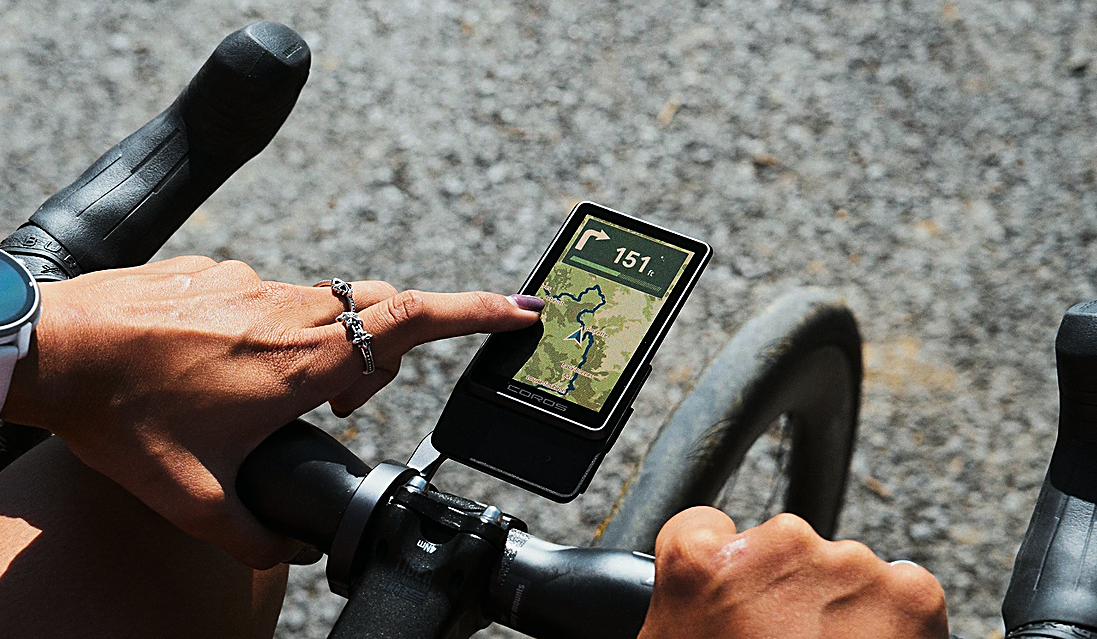
Dura 2 Solar and Garmin Edge 1040 Solar are the only two bike computers with solar charging and long battery life, but they do it differently. COROS rates the Dura 2 Solar at 120 hours of GPS recording, with up to 2 hours added per hour of direct sun. Garmin rates the Edge 1040 Solar at 70 hours in battery saver, or 100 hours with solar, with the sun adding up to 42 minutes per hour.
Dura 2 Solar is 34g lighter and costs £41 / $151 less with a mount at Garmin’s current list prices. Edge 1040 Solar plans routes and renavigates without a phone, carries Garmin’s full training suite and has been on sale since June 2022, so it is often discounted.
Full figures are on the Dura 2 Solar specifications and Edge 1040 Solar specifications pages.
The differences at a glance
| COROS Dura 2 Solar | Garmin Edge 1040 Solar | |
|---|---|---|
| Launched | October 2026 | June 2022 |
| List price | £479 / $549 with mount; £429 / $499 without | £519.99 / $699.99 (launched at £629.99 / $749.99) |
| Battery, longest mode, before solar | 120 hours, multi-constellation (COROS’s All Systems mode) | 70 hours, battery saver |
| Battery, dual-frequency GPS, before solar | 70 hours | 35 hours, demanding use (dual-frequency GPS, four sensors, LiveTrack and a course on the map) |
| Battery with solar, Garmin’s figures | Not published | 100 hours battery saver, 45 hours demanding use |
| Solar gain per hour of sun | Up to 2 hours of riding | Up to 42 minutes in battery saver, 20 minutes in demanding use |
| Screen | 3.5-inch MIP touchscreen, 336 x 620 | 3.5-inch transflective touchscreen, 282 x 470 |
| Weight | 99g | 133g |
| Voice control | Yes, but early reviews found it does not work at launch | No |
| Rerouting | Through the COROS app on a paired phone | On the device |
| Storage | Not stated by COROS | 64GB |
| Water rating | IP67 | IPX7 |
| Apps | None | Connect IQ |
| © the5krunner. Link required. | ||
Battery and solar
Dura 2 lasts longer on paper in every mode, and its solar panel claims to add more for each hour of sun.
| COROS Dura 2 Solar | Garmin Edge 1040 Solar | |
|---|---|---|
| Longest mode, no solar | 120 hours | 70 hours |
| Dual-frequency GPS, no solar | 70 hours | 35 hours |
| Solar gain per hour of direct sun | Up to 2 hours of riding | Up to 42 minutes (longest mode), 20 minutes (dual-frequency) |
| With solar, maker’s figure | Not published | 100 hours and 45 hours |
| What the figures assume | All Systems mode or Dual-Frequency mode; sensors and backlight not stated | Battery saver, or demanding use: dual-frequency GPS, four sensors, phone, LiveTrack and a course on the map |
The two shorter figures are not quite like-for-like. Garmin’s 35 hours include sensors, a phone, and LiveTrack; COROS doesn’t say what its 70 hours include. Both computers have dual-frequency GPS (Garmin calls it dual-band), so accuracy isn’t what separates them. Expect the real gap in that mode to be smaller than 70 against 35.
Both solar claims assume 75,000 lux, a clear summer day. A British winter cuts both to a fraction of that.
On the road, the gap narrows further. Garmin’s battery saver mode dims the screen and reduces recording, and my testing of the first Dura gave about 40 hours with maximum backlight and dual-frequency GPS, against a claim of 70. Either computer will see a rider through a week without a charger. Dura 2 Solar should go further, and the Edge 1040 Solar can also be charged mid-ride from a Garmin Charge power pack mounted on the bike.
Navigation
This is where Edge 1040 Solar wins outright. Miss a turn, and it calculates a new route on the device, with no phone involved. It also offers ride-type routing for road, gravel and mountain, Trailforks trail data and ClimbPro.
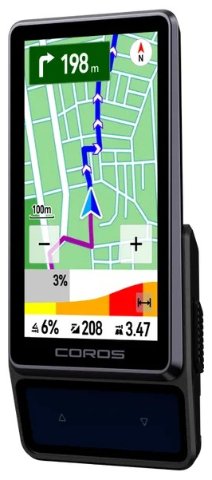
Dura 2 Solar cannot reroute on its own. When a rider leaves the course, the COROS app on a paired phone calculates the new route and sends it to the computer. The phone doesn’t need a mobile signal for this, provided the map region was downloaded beforehand, but it does need to be with you and switched on. With no phone, Dura 2 Solar shows only a straight line back to the course.
The Dura’s maps have improved: street and trail names now appear on the map, and climb alerts work without a loaded route. But for anyone who wants the computer to handle navigation unaided, the Edge’s on-device rerouting is the single biggest difference between them for the enduro bikepacker.
Screen and controls
Both use a 3.5-inch touchscreen that is easy to read in direct sun and easier on the battery than the bright LCD in Edge 1060. Early reviews found Dura 2 Solar hard to read in shade and dappled light. Its 336 x 620 panel is sharper than the Edge’s 282 x 470 and runs edge to edge. Dura 2 Solar adds voice control via a windproof microphone, used by holding the left button, a good feature that early reviews found does not work at launch, plus a lap button on the left, a start and stop button on the right, and two pressure-sensitive buttons on the solar panel. The Edge 1040 Solar has a touchscreen and buttons, but no microphone or speaker.
Training, safety and the rest
Both cover the core set: FTP, structured workouts, training load, Strava Live Segments, power meter dynamics and electronic shifting. Edge 1040 Solar goes further with real-time stamina, Power Guide pacing, Cycling Ability and Course Demands, Connect IQ apps, inReach satellite messaging through a paired device, and Garmin Cycling Coach and GroupRide, which arrived in beta this week. Dura 2 Solar’s extras include a bike bell (double tap only, with no Di2 or other handlebar button option), action-camera control, and automatic heart rate from a paired COROS watch. Both offer crash detection, live tracking, group tracking and radar support.
Price and age
Edge 1040 Solar now lists at £519.99 / $699.99 (it launched at £629.99 / $749.99) and is more than four years old, so it is regularly discounted below that and will keep getting Garmin’s new features late and only where its hardware allows. The Dura 2 Solar is new at £479 / $549 with a mount, or £429 / $499 without one, and COROS rarely discounts. If Garmin replaces the 1040 Solar in 2027, the gap on paper closes.
Note: Black Friday 2025 saw the Edge 1040 Solar fall to $570.96
Which to buy
- Buy the Dura 2 Solar for the longest battery life, the lightest unit, and voice control once COROS fixes it (early reviews found it does not work at launch), especially if you already train with a COROS watch.
- Buy the Edge 1040 Solar for riding off-grid, where on-device rerouting matters more than an extra day of battery, and if you want Garmin’s training and safety tools or can find it on sale.
For Garmin’s brighter and shorter-lived options, see Edge 1060 vs 850 vs 550, and for the wider field, the best cycling computer guide. What changed from the first COROS model is in Dura 2 Solar vs Dura.
COROS Dura 2 Solar
Solar bike computer that rides 120 hours between charges, with a big touchscreen, maps and voice control
RRP from $499 *
from £429 / €499 *
- use code:
Get it nowOrder now – COROS Dura 2 Solar Also sold direct by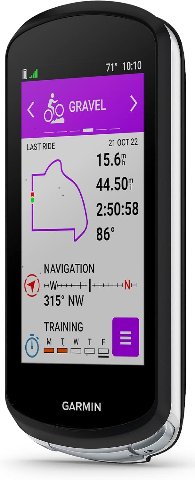
Quick answers
Which lasts longer, COROS Dura 2 Solar or Garmin Edge 1040 Solar?
Dura 2 Solar on paper. Before solar, COROS rates it at 120 hours in multi-constellation GPS and 70 hours in dual-frequency GPS; Garmin rates Edge 1040 Solar at 70 hours in battery saver and 35 hours in demanding use, which includes dual-frequency GPS, four sensors and LiveTrack. With solar, Garmin’s figures rise to 100 and 45 hours.
Which has the better solar charging?
Dura 2 Solar. COROS claims up to two hours of riding per hour of direct sun; Garmin claims up to 42 minutes in battery saver mode and 20 minutes in demanding use. Both assume 75,000 lux.
Can the COROS Dura 2 Solar reroute without a phone like the Edge 1040 Solar?
No. Edge 1040 Solar calculates new routes on the device. Dura 2 Solar reroutes through the COROS app on a paired phone, which works without a mobile signal when the map region is downloaded.
Is the COROS Dura 2 Solar cheaper than the Garmin Edge 1040 Solar?
At list price, yes. Dura 2 Solar costs £479 / $549 with a mount, or £429 / $499 without one. Edge 1040 Solar lists at £519.99 / $699.99 and is often discounted below that.
Last Updated on 27 October 2026 by tfk the5krunner
2026 Seasonal Gifts
- Garmin CIRQA: Garmin’s screenless band, which uses your phone as the display. I tested it and sometimes use it as a backup on the site.
- HoloSwim 3 Pro: Swim goggles with GPS and your pace in the lens, so you can swim without a watch. Code THE5KRUNNER takes 10% off. I tested them.
- Kineon MOVE+: Red and infrared light for sore knees, Achilles and other joints after hard training. I use it.
- Fitbit Air: A screenless band for steps, sleep and heart rate, with no subscription needed. It was closest to a manual 9,000-step test. I use it as a backup sometimes.
Small things I always use
- Garmin 90-degree charging adapter: Charges your Garmin with any USB-C cable. Essential when travelling. I use one.
- Body Glide: The blue anti-chafing stick swimmers and runners carry. I use it.
- Speedo earplugs: Fewer ear infections and no cold-water dizziness. I use them.
- Dryrobe Advance: My winter changing robe for open-water swims. I use one. A cheaper option is the AONYIYI changing robe.
- Maurten: Race fuel that stays easy on the stomach. I use them.
- Beet It Sport nitrate shots: Beetroot shots I take in the days before a race. I use them.
- Garmin charging puck: The quickest way to top up before a session. I use one.
- Injinji: Toe socks that stop rubbing, so you run more. I use them.
- Ultimate toe protectors: Stop black toenails on long runs. They work. I use them.
- Compressport R2 v2 calf sleeves: My calf sleeves of choice. I use them.
- Cellucor C4: My pre-workout before hard sessions.
- TPU tubes: Schwalbe Aerothan, Tubolito and Pirelli SmarTube. Light, tiny spares. I use all three.
- G8 insoles: Adjustable arches, perfect position. I use them.
- Cycplus Cube: A 97g electric pump that gets a road tyre rideable in two minutes. I carry one. 5% off with code THE5KRUNNER.
Health, recovery and sleep
- FreeStyle Libre 3 Plus: Shows how my blood sugar responds to diet. Occasional use.
- hDrop: Measures my sweat loss in summer and indoors. I use it.
- Fourth Frontier Zone: Checks my heart under load in hard sessions.
- Oura Ring 5: My partner’s recovery tracker of choice.
- Eight Sleep: A cooling mattress cover my partner and I use nightly (see next).
- Chilipad 2.0: Cools or heats your side of the bed on a schedule, with no subscription. US only. I am testing it; it seems pretty good.
Watches and sensors
- Polar H10: My daily driver for waking HRV.
- Polar Verity Sense: My backup arm-worn HR sensor.
- Nomad bedside charger: Charges my iPhone and Apple Watch overnight. I use it, and many of their bands.
- Train.Red: The best muscle oxygen sensor I’ve used. Occasional use.
- Tymewear: Accurate heart rate and reliable ventilatory zones. I use it to pace endurance rides over an hour.
- Garmin Forerunner 970: A pro-grade triathlon watch. I use this.
- Apple Watch Ultra 4: My daily smartwatch. No phone needed on rides.
On the bike
- Continental GP5000 for everyday riding, and Aero 111 on the front for special occasions. I use both.
- Helmets: Specialized S-Works Evade 3 for road riding, and Rudy Project Wing for TT-style races. I use both.
- Ravemen FR300: A front light that mounts under your Garmin or Wahoo. I use one.
- Ravemen FR1000: The light and the computer mount in one unit, so nothing else goes on the bars. Better than mine.
- Ravemen FR1500SE: 1,500 lumens hanging under your Garmin, for proper night rides.
- Ravemen FR1100SE: 1,100 lumens under your Garmin, and up to 46 hours on slow flash.
- Ravemen FR500: A brighter FR300 with the same mount.
- Wahoo TRACKR Radar: I use it on one bike and Varia on the other. They perform the same.
- Garmin Varia RTL515: Radar that warns you of cars from behind. I use this model.
- Wahoo ELEMNT Roam 3: The bike computer that’s easy to use. I use mine on most rides.
- Favero Assioma Pro RS2: Accurate power pedals that swap easily between bikes. I use this model.
Home and indoor training
- NPE Runn: Makes my basic treadmill smart, sending more accurate speed and distance to my watch and Zwift. I use it.
- Google Wifi: Keeps Zwift connected in my pain cave. I use it.
- Apple TV 4K (4th generation): Zwift on the big screen. I use two.
- Google Nest Doorbell (wired, 2nd gen): My video doorbell, running in both Google Home and Apple Home via Starling. I use it.
Reader-Powered Content

This content is not sponsored. It’s mostly me behind the labour of love, which is this site, and I appreciate everyone who supports it.
Support the site: Follow (free, fewer ads) · Subscribe (paid, ad-free) · Buy Me A Coffee
Written by real people, with AI assistance. Fact-checked and verified for originality. See the Editorial Policy. FTC: Affiliate Disclosure — some links pay commission. As an Amazon Associate, I earn from qualifying purchases.
tfk is the founder and author of the5krunner, an independent endurance sports technology publication. With 20 years of hands-on testing of GPS watches and wearables, and competing in triathlons at an international age-group level, tfk provides in-depth expert analysis of fitness technology for serious athletes and endurance sport competitors. See the gear tfk uses. ID

The price for the Garmin 1040 is wrong. It’s currently listed at £519 on their UK site.
To me, the Dura 1 made sense. It was cheap and cheerful. The bugs they had on launch had been resolved and the rerouting problem wasn’t a show stopper given that’s generally forbidden in ultras. It was light and although the battery life claims were moot and arguably about the same as the Garmin in a similar mode on a cloudy day it was significantly better in the sun. Overall it was a sensible choice for a multi-day ultra.
Not so the Dura 2. It’s now more expensive than the 1040 Solar at market prices. The latter comes with multiple high quality mounts and a way better screen. The Garmin is 4 years old but still more advanced than the new Coros. Also, judging from the relative size of the screen and the solar panel, and the way it’s angled towards the rider, the solar performance of the Dura 2 is likely to be less good. Early reviews suggest it’s buggy as well which more or less rules it out as a sensible choice for an ultra or anywhere remote.