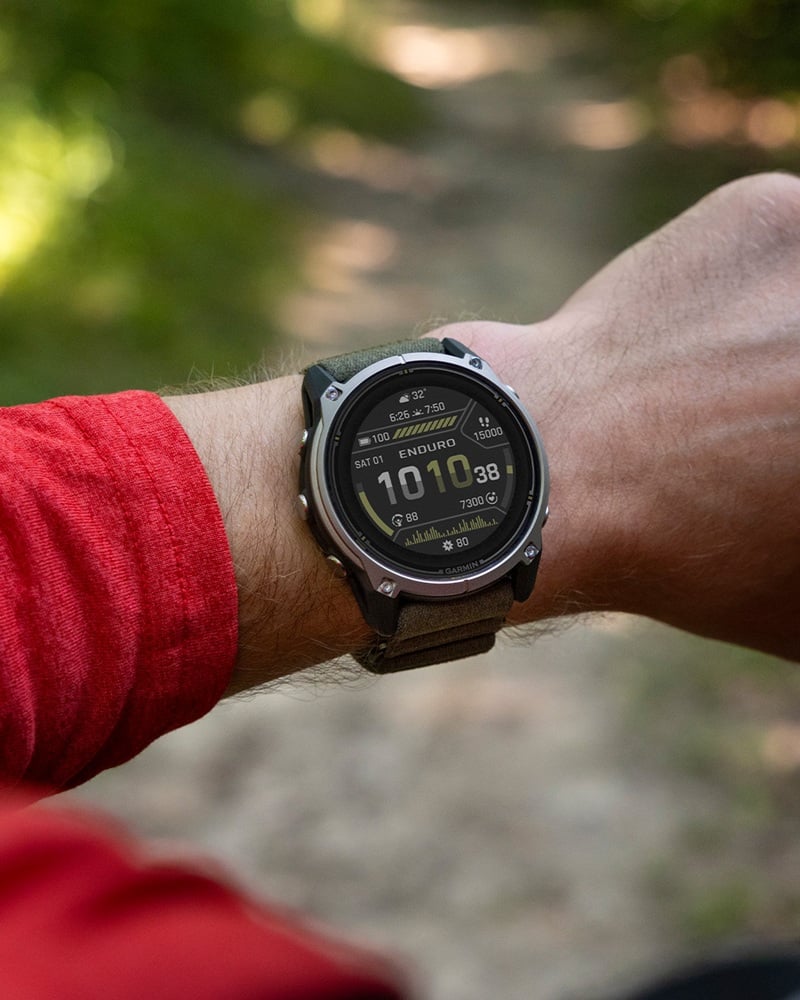
Garmin will keep its MIP watch screens only until OLED battery life catches up, says co-COO Brad Trenkle. But he gave no date. Garmin’s own info shows that with GPS running, the newest MIP Fenix now outlasts its OLED twin by a wider margin than any previous generation. By some measures, the gap is increasing, not narrowing, so this site is not sure sure about what Garmin officially says.
What Garmin said
Unsurprisingly, Trenkle noted that battery life is the reason MIP survives. “There are definitely different things that are enabled for our customers if we stay with a transflective colour MIP display. The most significant right now is battery life,” he said, pointing to Enduro, where an OLED’s “inherently higher power drain because it’s emitting versus being reflective” counts against it.
He said the gap is shrinking but has not gone: “We do see that gap closing. It’s closed a lot, which is why you’ve seen battery life on our OLED products continue to increase generation over generation. But that gap has not completely converged, and I think until it does, we definitely don’t think that MIP will completely go away.”
Where MIP survives
No current Forerunner has MIP. The screen now lives on in Garmin’s solar adventure watches:
- Fenix 9 Pro Solar, in 47mm and 51mm, alongside AMOLED Fenix 9 Pro models in three sizes.
- Enduro 4, which comes only with a solar MIP screen and is Garmin’s longest-lasting watch.
- Instinct 3 Solar, sold alongside an Instinct 3 AMOLED.
The battery gap, generation by generation
The table sets each MIP watch against its OLED sibling from the same year, using Garmin’s figures without solar charging.
| Year | MIP | OLED | Smartwatch (days) | GPS (hours) | MIP’s GPS lead |
|---|---|---|---|---|---|
| 2022 | Fenix 7 47mm (2023 Pro is the same) | Epix Gen 2 47mm | 18 vs 16 | 57 vs 42 | 36% |
| 2024 | Fenix 8 Solar 47mm | Fenix 8 AMOLED 47mm | 21 vs 16 | 67 vs 47 | 43% |
| 2025 | Instinct 3 Solar 45mm | Instinct 3 AMOLED 45mm | 28 vs 18 | 40 vs 32 | 25% |
| 2026 | Fenix 9 Pro Solar 47mm | Fenix 9 Pro AMOLED 47mm | 21 vs 18 | 54 vs 32 | 69% |
Garmin renamed its GPS modes for Fenix 9, so compare the hours within a row.
As a smartwatch, Trenkle is right. Fenix MIP led by five days in 2024 and leads by three today, so most owners would barely notice the difference between charges. With GPS on, the gap has reversed, from 36% in 2022 to 69% on the Fenix 9 Pro. Part of that is the case: the 47mm Solar is 2mm thicker than the AMOLED, at 15.8mm against 13.8mm, which leaves room for a bigger battery, and the AMOLED now reaches 3,000 nits. For long GPS days, which is what MIP is for, OLED is further behind than it was four years ago.
Solar is still the blocker
Garmin has used two kinds of solar cells. One is a transparent layer over the screen, which Trenkle likens to “polarised sunglasses” and which would dim an OLED. The other is a ring of opaque crystalline cells around the screen, as Instinct 3 Solar already uses. Trenkle says the ring would work with OLED: “In that case, you don’t get any degradation or loss, whether it’s reflectivity or [image quality]. Yes, it would be a way to counter that.”
Every Garmin with solar charging today has MIP. A solar ring around an OLED display is the combination that takes away MIP’s last advantage. The Garmin solar technology deep dive explains how the two cell types differ.
What it means for buyers who need or want long battery lives
Buy MIP if you record long GPS days: multi-day ultras, expeditions, long hikes and anyone who wants weeks between charges. Enduro 4 is the extreme case, and the Enduro 4 vs Fenix 9 Pro Solar comparison covers which to pick. MIP also stays clear in direct sun without any backlight, while an OLED must brighten to compete.
For everyone else, AMOLED’s smartwatch battery is now within a few days of MIP’s, and it brings a brighter, sharper screen. The Fenix 9 vs Fenix 8 buying guide covers every display option, and the sports watch battery life hub explains how far to trust Garmin’s figures.
Our Analysis
Enduro is a recording device, not a wrist watch. With the increasing battery life gap between MIP and Solar in GPS recording modes, MIP technology appears to be here to stay. No doubt to the satisfaction of most readers who have got this far.
The fly in the ointment would be if Garmin decides to put a solar ring around a pesky OLED panel. Sure, that gives the much-hated ‘wide bezel’ effect, but that is there anyway on the MIP displays.
Quick answers
Is Garmin discontinuing MIP displays?
Not yet. Co-COO Brad Trenkle says MIP will not completely go away until OLED battery life matches it, and he gave no date.
Which Garmin watches still have a MIP display?
The latest are Fenix 9 Pro Solar, Enduro 4 and Instinct 3 Solar. No current Forerunner has MIP.
Is MIP better than AMOLED for battery life?
Yes, mainly with GPS on. The 47mm Fenix 9 Pro Solar is rated for 54 hours in its normal activity mode against 32 for the AMOLED, but only 21 days against 18 as a smartwatch.
Can a Garmin AMOLED watch have solar charging?
Not yet. Trenkle says a ring of solar cells around the screen, as on Instinct 3 Solar, would work with OLED without dimming it.
Source and original research by: the5krunner and a TechRadar interview.
Last Updated on 5 November 2026 by tfk the5krunner
Small things I always use
- Garmin 90-degree charging adapter: Charges your Garmin from any USB-C cable. Essential when travelling. I use one.
- Body Glide: The blue anti-chafe stick swimmers and runners carry. I use it.
- Speedo earplugs: Fewer ear infections and no cold-water dizziness. I use them.
- Dryrobe Advance: My winter changing robe for open-water swims. I use one. A cheaper option is the AONYIYI changing robe.
- Maurten: Race fuel that stays easy on the stomach. I use them.
- Beet It Sport nitrate shots: Beetroot shots I take in the days before a race. I use them.
- Garmin charging puck: The quickest way to top up before a session. I use one.
- Injinji: Toe socks that stop rubbing, so you run more. I use them.
- Ultimate toe protectors: Stop black toenails on long runs. They work. I use them.
- Compressport R2 v2 calf sleeves: My calf sleeves of choice. I use them.
- Cellucor C4: My pre-workout before hard sessions.
- TPU tubes: Schwalbe Aerothan, Tubolito and Pirelli SmarTube. Light, tiny spares. I use all three.
- G8 insoles: Adjustable insoles that are good. I use them.
- Cycplus Cube: A 97g electric pump that gets a road tyre rideable in two minutes. I carry one. 5% off with code THE5KRUNNER.
Watches and sensors
- Polar H10: My daily driver for waking HRV.
- Polar Verity Sense: My backup arm-worn HR sensor.
- Nomad bedside charger: Charges my iPhone and Apple Watch overnight. I use it, and many of their bands.
- Train.Red: The best muscle oxygen sensor I’ve used.
- Tymewear: Accurate heart rate and reliable ventilatory zones. I use it to pace endurance rides over an hour.
- Garmin Forerunner 970: A pro-grade triathlon watch. I use this.
- Apple Watch Ultra 4: My daily smartwatch. No phone needed on rides.
- Garmin Fenix 9 Pro: I’ve just bought one.
On the bike
- Continental GP5000 for everyday riding, and Aero 111 on the front for special occasions.
- Helmets: Specialized S-Works Evade 3 for road riding, and Rudy Project Wing for TT-style races. I use both.
- Ravemen FR300: A front light that mounts under your Garmin or Wahoo. I use one.
- Ravemen FR1000: The light and the computer mount in one unit, so nothing else goes on the bars. Better than mine.
- Ravemen FR1500SE: 1,500 lumens hanging under your Garmin, for proper night rides.
- Ravemen FR1100SE: 1,100 lumens under your Garmin, and up to 46 hours on slow flash.
- Ravemen FR500: A brighter FR300 with the same mount.
- Wahoo TRACKR Radar: I use it on one bike and Varia on the other. They perform the same.
- Garmin Varia RTL515: Radar that warns you of cars from behind. I use this model.
- Wahoo ELEMNT Roam 3: The bike computer that’s easy to use. I use mine on most rides.
- Favero Assioma Pro RS2: Accurate power pedals that swap easily between bikes. I use this model.
Home and indoor training
- NPE Runn: Makes my basic treadmill smart, sending more accurate speed and distance to my watch and Zwift. I use it.
- Google Wifi: Keeps Zwift connected in my pain cave. I use it.
- Apple TV 4K: Zwift on the big screen. I use two.
- Google Nest Doorbell (wired, 2nd gen): My video doorbell, running in both Google Home and Apple Home. I use it.
Health, recovery and sleep
- FreeStyle Libre 3 Plus: Shows how my blood sugar responds to diet.
- hDrop: Measures my sweat loss in summer and indoors.
- Fourth Frontier Zone: Checks my heart under load in hard sessions.
- Kineon MOVE+: Red and infrared light for sore knees, Achilles and other joints after hard training. I use it.
- Oura Ring 5: My partner’s recovery tracker of choice.
- Eight Sleep: A cooling mattress cover my partner and I use nightly.
Reader-Powered Content

This content is not sponsored. It’s mostly me behind the labour of love, which is this site, and I appreciate everyone who supports it.
Support the site: Follow (free, fewer ads) · Subscribe (paid, ad-free) · Buy Me A Coffee
Written by real people, with AI assistance. Fact-checked and verified for originality. See the Editorial Policy. FTC: Affiliate Disclosure — some links pay commission. As an Amazon Associate, I earn from qualifying purchases.
tfk is the founder and author of the5krunner, an independent endurance sports technology publication. With 20 years of hands-on testing of GPS watches and wearables, and competing in triathlons at an international age-group level, tfk provides in-depth expert analysis of fitness technology for serious athletes and endurance sport competitors. See the gear tfk uses. ID
