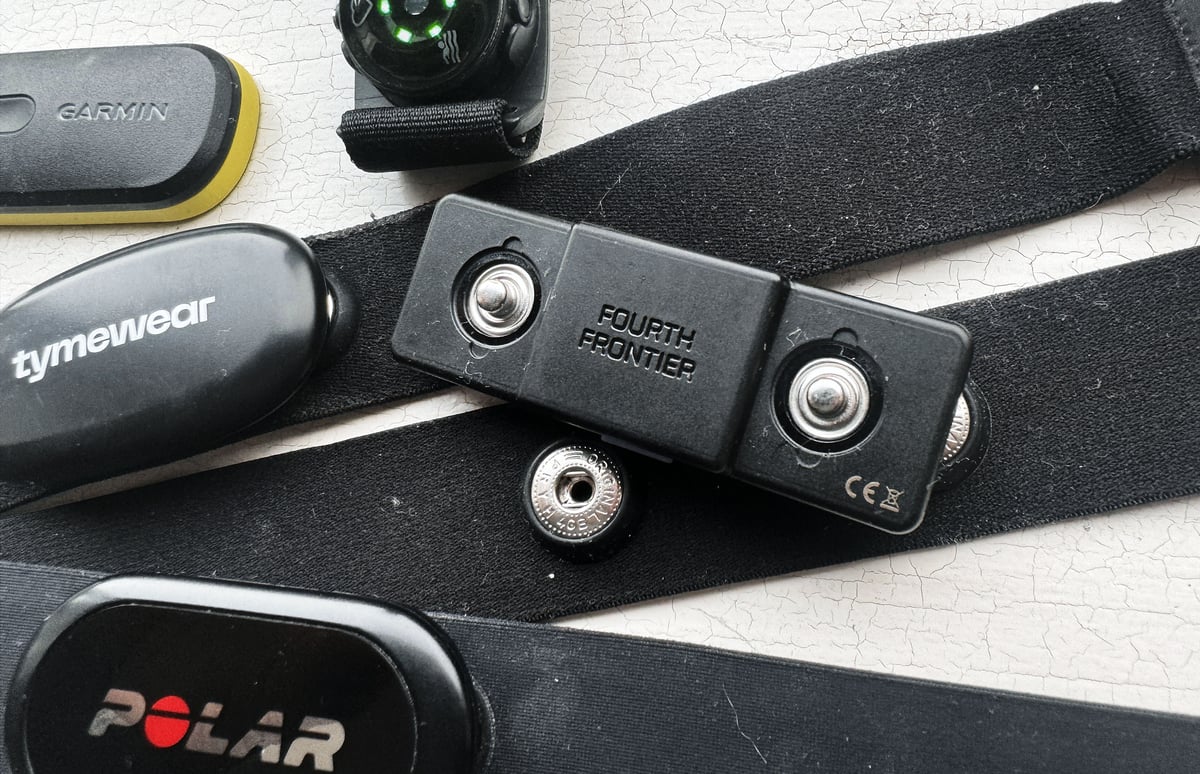
Frontier X3 averaged within 2 bpm of my Polar SENSE across more than 10 sessions over two months, yet it is sold as a strap that never lets you see the ECG it reads.
Frontier X3 is a chest strap that reads your heart’s electrical signal and turns it into training zones, strain, recovery and sleep data, then keeps that signal to itself. That is the deliberate trade-off Fourth Frontier made to sell it as a wellness product in the US, and it is the reason to choose it, or to look at the Zone, X2 or X Plus instead.
This review covers how X3 performed in training, how long the battery really lasts, and what you get with and without the Frontier Premium subscription. If you want the medical side, with a clinical 12-lead comparison and rhythm detection, I cover that in my Fourth Frontier X Plus review.
Heads up: This is an unpaid review, and I received a loan device from Fourth Frontier.
Frontier X3 costs $649, or $454 with code 5KRUNNERX3 for 30% off at fourthfrontier.com. It is sold in the US only.
Fourth Frontier X3: chest-strap accuracy, four-month battery
For a possible heart concern, not a diagnosed one
Strain monitoring is the reason to buy X3, and heart rate tracked my Polar SENSE closely in every test session. Overnight HRV matched my other devices, but very long recordings could take several attempts to sync.
Pros
- One charge lasted about three months of daily training.
- Strain, Body Shock and breathing rate add data a standard strap cannot give.
- Zone vibration alerts let you hold an effort without checking a screen.
- Three Bluetooth connections cover a phone, a watch and a bike computer at once.
- Every test session rated Excellent against my Polar SENSE.
- Peak breathing rate matched my Tymewear VitalPro exactly.
Cons
- Officially, you never see the ECG trace, even though the strap records it.
- VO2 max, ventilatory zones, sleep and Garmin Connect sync need a subscription.
- There is no ANT+ for older bike computers.
- It is sold in the US only.
- Very long sessions sometimes needed several attempts to sync.
- Body Shock read low on most runs, even hard efforts and trails.
- The price is high for a wellness strap.
What Frontier X3 is
X3 is Fourth Frontier’s training strap for the US market. It samples a single-lead ECG and uses it to calculate heart rate, HRV, breathing rate, strain, training load and Body Shock. It is a general wellness device without FDA clearance, so it does not show the trace, classify heart rhythm or claim to detect any condition.
Fourth Frontier quotes up to 4 months between charges at about an hour of use a day, or up to 7 days of round-the-clock recording. That is the longest battery life of any strap in its range. The full specifications are on the Frontier X3 specifications page, and my Frontier X3 launch guide covers the announcement.
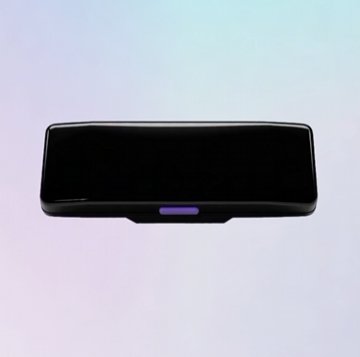
The X3 pod is the same size as the Zone pod, at 73.6 x 25.1 x 14mm, and Fourth Frontier says its strap is more breathable than the X2’s.
In use, the button, LEDs and strap snaps all feel the same as the Zone’s, although Fourth Frontier has probably made small changes since the first version.
Frontier X3 vs Zone, X2 and X Plus
All four straps read a single-lead ECG from the chest, close to the V5 position on a hospital 12-lead ECG. What separates them is what each one lets you see, where it is sold and how long it runs between charges.
| Frontier X3 | Frontier Zone | Frontier X2 | Frontier X Plus | |
|---|---|---|---|---|
| Sold in | US | UK and Europe | US, UK and Europe | US, prescription only |
| Price | $649 | £199 | $579 / £449 | $649 |
| Screen on the pod | No | No | Yes | Yes |
| ECG trace shown to you | No | Yes, with Frontier Premium | Yes | Yes |
| Rhythm classification (AFib and others) | No (officially) | No | No | Yes, FDA cleared |
| Strain monitoring | Yes, same as X2 | Yes, ST-segment | Yes, ST-segment | No |
| Body Shock and breathing rate | Yes | Yes | Yes | No |
| Battery, typical use | Up to 4 months | Up to 30 days | Up to 14 days | Up to 14 days |
| Battery, continuous recording | Up to 7 days | Up to 7 days | About 24 hours | About 24 hours |
| Charging | USB-C | USB-C | Micro-USB | Micro-USB |
| Bluetooth connections | 3 (1 phone, 2 devices) | 3 (1 phone, 2 devices) | 3 (1 phone, 2 devices) | 1 (its own app only) |
| ANT+ | No | No | No | No |
| Streams heart rate to watches and apps | Yes | Yes | Yes | No |
| Bluetooth version | 6.0 | 6.0 | 5.0 | 5.0 |
| ECG sampling rate | 125Hz | 125Hz | 250Hz | 500Hz |
| Water resistance | IP67 | IP67 | IP67 | IP22 |
| Pod size | 73.6 x 25.1 x 14mm | 73.6 x 25.1 x 14mm | 73 x 24 x 13mm | 73 x 24 x 13mm |
| Weight | About 23g | About 23g | 25g | 25g |
X3 and the Zone are the closest pair. X3 adds a much longer battery life and drops the ECG trace. The Frontier Zone review shows what that trace looks like during exercise, and the Frontier X2 review covers the older strap with a screen. All four are compared on the Fourth Frontier specifications page.
Wearing it for training and sleep
The pod weighs about 23g and has no screen, so it sits flat under a jersey or base layer. Fourth Frontier rates it IP67, which covers sweat, rain and a brief dunk in fresh water, but not seawater or regular swimming.
It is as comfortable as any other chest strap I have worn. I haven’t swum with it.
Heart rate accuracy
TL;DR: Frontier X3 averaged within 2 bpm of my Polar SENSE across 10+ sessions over two months.
My reference device is the Polar SENSE armband. WHOOP and Apple Watch Ultra 4 were extra checks, not the reference. I compared Frontier X3 with the Polar SENSE, following the same testing methodology used across this site.
| Session | Conditions | Devices compared | Bias | LoA | Verdict |
|---|---|---|---|---|---|
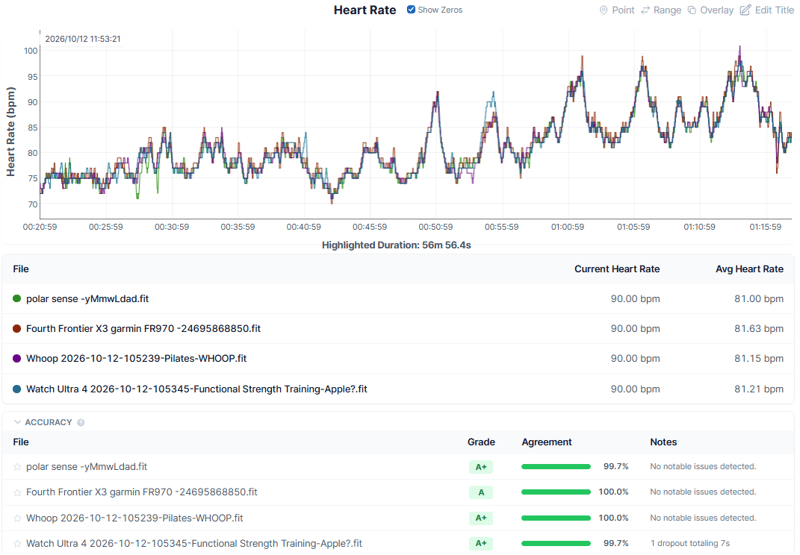
| Pilates and strength, 70 minutes | Indoor, average 81 bpm | Polar SENSE, WHOOP, Apple Watch Ultra 4 | +0.7 bpm vs Polar SENSE | -1.4 to +2.7 bpm | Excellent |
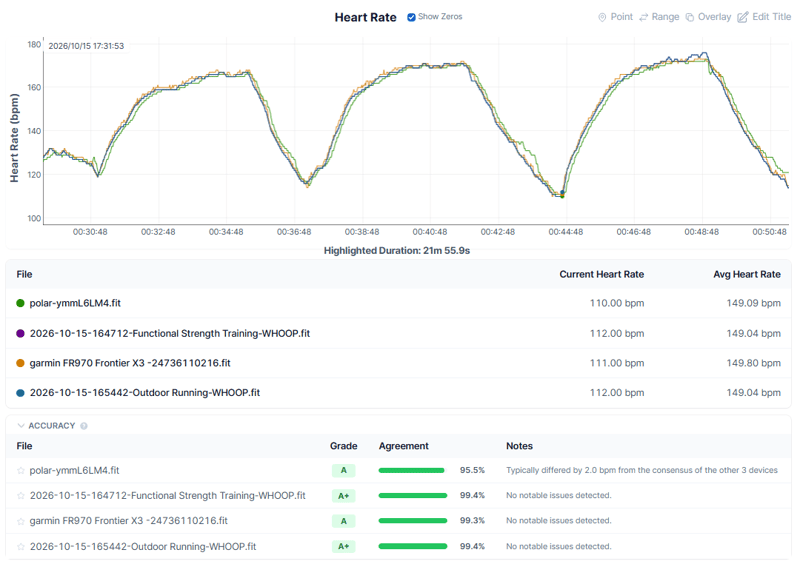
| Intervals within an outdoor run, 22 minutes | Average 149 bpm | Polar SENSE, WHOOP | +0.7 bpm vs Polar SENSE | -4.7 to +6.1 bpm | Excellent |
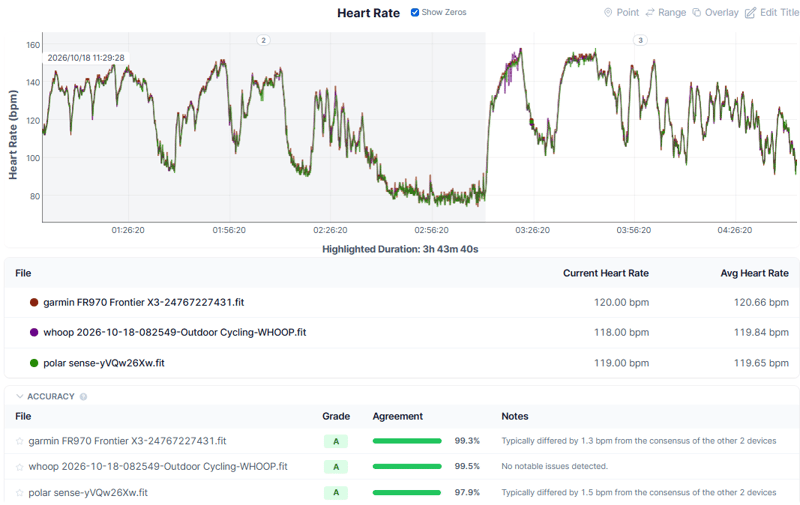
| Outdoor ride, 3 hours 45 minutes | Average 120 bpm | Polar SENSE, WHOOP | +1.0 bpm vs Polar SENSE | -3.0 to +5.0 bpm | Excellent |
X3 read slightly high in all three sessions, by 0.7 to 1.0 bpm against Polar SENSE, and every comparison was rated Excellent. It recorded no dropouts. The widest spread came on the 22 minutes of run intervals, where 95% of single readings fell between 4.7 bpm below and 6.1 bpm above the Polar SENSE, while the average difference stayed at +0.7 bpm.
Strain, Body Shock and breathing
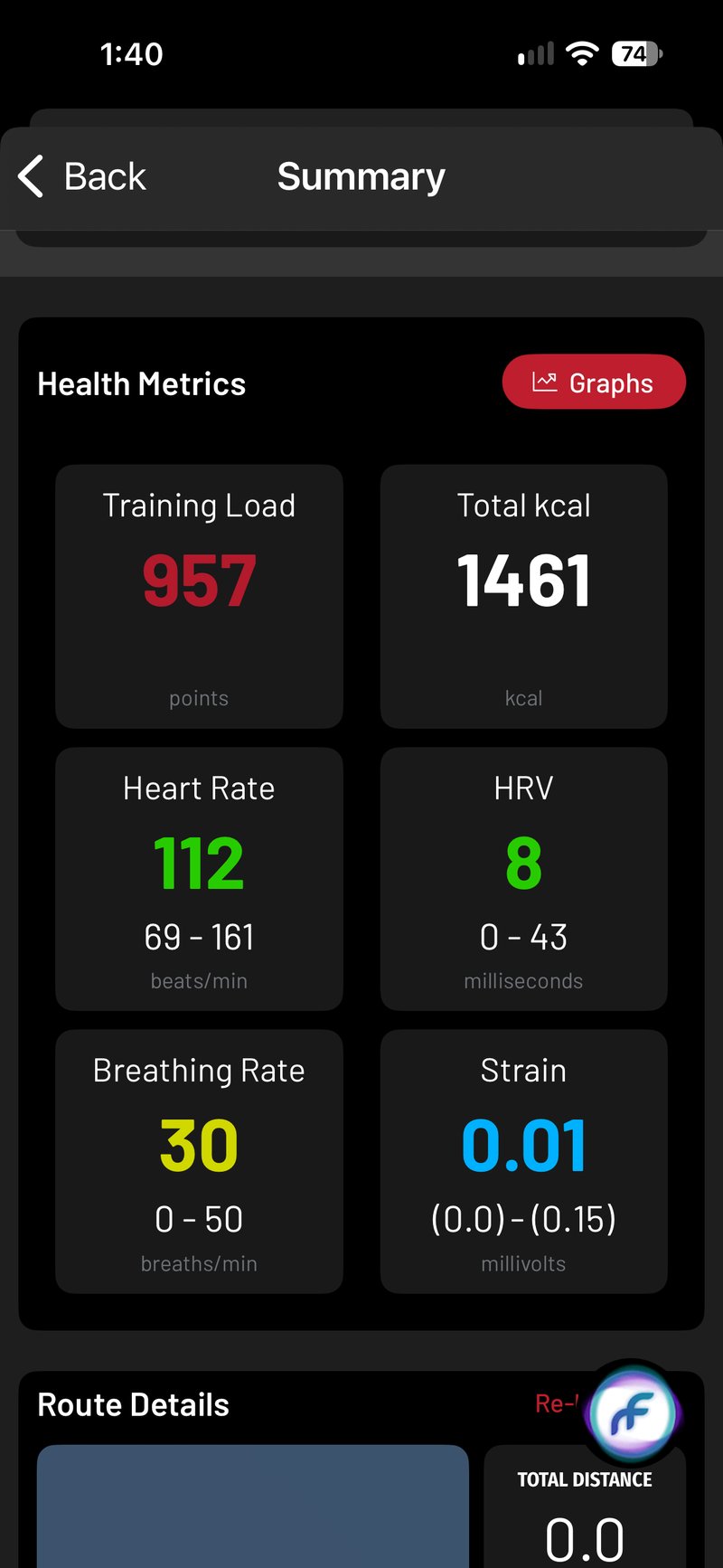
These metrics set the Fourth Frontier straps apart from a standard heart rate strap such as the Garmin HRM 600. On the Zone and X2, Strain measures shifts in the ST segment of the ECG during exercise and can warn you with a vibration before cardiac strain becomes dangerous.
Fourth Frontier says X3 calculates strain the same way as the X2, and the pod can vibrate when heart rate, breathing rate or strain crosses a threshold you set, without a phone nearby.
No strain alert fired during my testing. The strain figure moved in line with my effort, apart from a few sessions where it was higher at the start of a workout. I may not have warmed up enough on those days, because I do find it hard to get going sometimes.
Breathing rate looked right. It is hard to check against other devices in the same session, but at rest X3 read lower than my Garmin’s wrist estimate, which I have long found reads too high. During hard efforts, X3 recorded a maximum of 47 to 50 breaths a minute, exactly matching the highest figures from my Tymewear VitalPro.
I’m not convinced by Body Shock. It reads lower than on Fourth Frontier’s earlier straps, and it was almost always low on my runs, even on harder efforts and trails where I would expect it to rise.
Zones, alerts and pairing with your watch
The pod vibrates when you leave a chosen heart rate zone, so you can hold an effort without looking at a screen. With Frontier Premium, it can set zones from your first and second ventilatory thresholds, which avoids the drift that makes fixed heart rate zones unreliable on long efforts. My guide to pacing by ventilatory thresholds explains the method.
X3 broadcasts heart rate over Bluetooth to up to two devices alongside your phone. It does not support ANT+, so older bike computers and some Garmin setups will not see it.
I usually paired X3 with a Garmin Forerunner 970 and a Wahoo ELEMNT ROAM 3. Both paired alongside the app, although the app wasn’t connected during workouts, so in practice I ran two connections at once. The zone vibration alerts were easy to feel mid-run. I don’t think HRV or RR data reaches the watch, but I couldn’t confirm it.
I couldn’t check the VT1 and VT2 zones against my Tymewear VitalPro thresholds. Tymewear measures breathing volume while Fourth Frontier uses breaths per minute, so the two methods don’t compare directly.
Recovery, sleep and VO2 max
Overnight wear adds HRV, resting heart rate, stress and cardiac age trends. Frontier Premium adds sleep stages, a daily readiness score and VO2 max trends. These are trend tools, best read over weeks.
Overnight HRV was broadly in line with my Garmin and Eight Sleep readings.
Battery life and charging
Fourth Frontier quotes up to 4 months at about an hour a day and up to 7 days of continuous recording, with a full USB-C charge in about an hour.
I used X3 for about three months at roughly an hour a day and charged it only once, which fits Fourth Frontier’s claim. I didn’t time the recharge, but it is certainly not fast charging like some watches offer. That is fine for a strap that needs charging this rarely.
The app and Frontier Premium
Without a subscription, X3 records heart rate, HRV, strain, breathing rate and training load. Frontier Premium, at $14.99 a month, adds VO2 max, ventilatory zones, readiness, sleep staging and Garmin Connect sync. At $649, the strap is a lot to pay before you add a subscription for its most distinctive training features.
I used the iOS app, which was generally responsive over Bluetooth 6.0. Very long syncs were the exception. When a single session held more than 12 hours of recording on the pod, the transfer sometimes failed to complete, and one 16-hour recording took several attempts to copy across.
| Feature on X3 | Free | Frontier Premium |
|---|---|---|
| Heart rate, HRV and breathing rate | Yes | Yes |
| Strain, training load and Body Shock | Yes | Yes |
| Vibration alerts | Yes | Yes |
| VO2 max and oxygen uptake analysis | No | Yes |
| Ventilatory thresholds (VT1 and VT2) and Zone 2 zones | No | Yes |
| Daily readiness score | No | Yes |
| Sleep stage analysis | No | Yes |
| Garmin Connect sync | No | Yes |
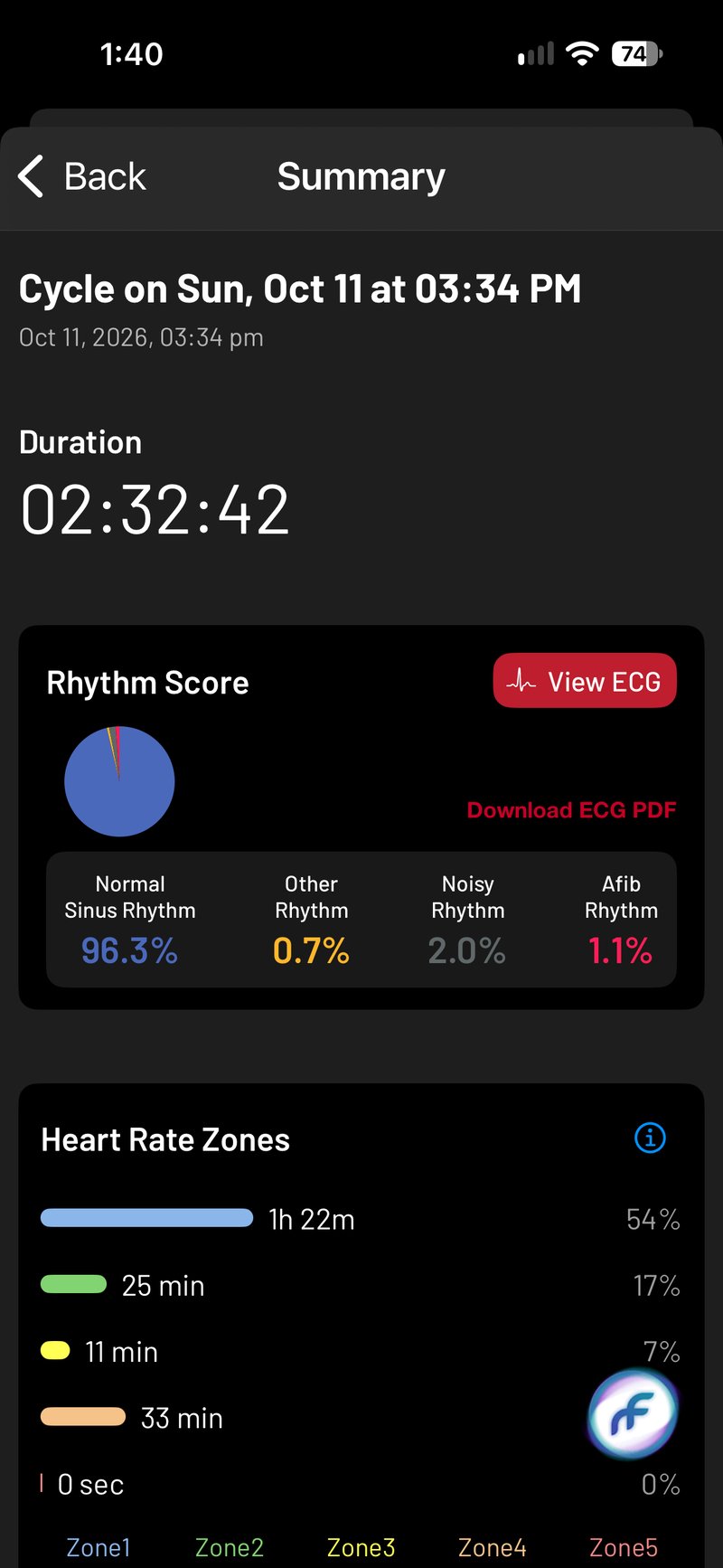
| Live ECG streaming and ECG PDF download | No | No |
Premium does not unlock the ECG trace on X3. That differs from the rest of the range: the X2 includes live ECG streaming and PDF downloads as standard, and the Zone adds them with Premium. Premium costs $14.99 a month or $119.99 a year in the US, and £13.99 a month or £109.99 a year in the UK, with a 7-day free trial.
Quick answers
Does the Fourth Frontier X3 show an ECG?
Not officially. X3 samples an ECG inside the pod to calculate its metrics, and Fourth Frontier says it does not show, stream or export the trace. Fourth Frontier keeps the trace for its FDA-cleared Frontier X Plus. During my testing, the web dashboard did show the trace for X3 sessions, which is an oversight.
Is the Fourth Frontier X3 accurate for heart rate?
Yes. In my testing it averaged within 2 bpm of my Polar SENSE reference across more than 10 sessions.
Does the Fourth Frontier X3 work with Garmin?
Yes. X3 broadcasts heart rate over Bluetooth to Garmin watches and bike computers, and it can connect to two devices alongside your phone. It does not support ANT+, and syncing workouts to Garmin Connect requires Frontier Premium.
Can you swim with the Fourth Frontier X3?
X3 is rated IP67, which covers immersion in fresh water to about 1 metre for 30 minutes. It is not rated for salt water, and Fourth Frontier advises wearing it under a tight suit when swimming.
What is the difference between the Frontier X3 and the Frontier Zone?
X3 lasts up to 4 months between charges compared with up to 30 days for the Zone. The Zone shows and exports the ECG trace with a Frontier Premium subscription, which X3 officially cannot do. X3 is sold in the US, and the Zone in the UK and Europe.
Where can I buy the Fourth Frontier X3?
Fourth Frontier sells the X3 through its US store. Code 5KRUNNERX3 takes 30% off. It is not sold through Fourth Frontier’s UK and Europe store.
Who should buy Frontier X3
Frontier X3 suits US athletes who want chest-strap accuracy, recovery and sleep data, and a strap they rarely need to charge.
- If you want to see the ECG trace and live in the UK or Europe, buy the Frontier Zone with Frontier Premium instead.
- If you want a screen on the pod and ECG streaming without a subscription, buy the Frontier X2.
- If you have, or are being investigated for, a heart condition, the Frontier X Plus is the strap your doctor can use, with a prescription.
- If you have no concerns about your heart health, you don’t need X3. A regular chest strap such as the Polar H10 or Garmin HRM 600 is fine and costs far less.
Verdict
On the heart health concern spectrum, X3 sits in the middle. It’s overkill for someone with no concerns and inadequate for someone with a diagnosed heart condition. For anyone else with a real or potential concern, the key win is the heart strain metric, which might save your life by alerting you to an undiagnosed condition that has no symptoms yet.
Around that core feature, the brand has built a good ecosystem on the app and web platform.
The pod is slightly larger than a normal chest HRM because sampling the ECG 125 times a second uses more power, so it needs a physically bigger battery to last for months.
Fourth Frontier seems to have nailed the ECG side of its products.
Fourth Frontier X3 price: where to buy
Frontier X3 is $649, or $454 with code 5KRUNNERX3 for 30% off at fourthfrontier.com. This code always beats Fourth Frontier’s own sale price. It is sold in the US only. Frontier Premium is optional at $14.99 a month.
Fourth Frontier X3
Screen-free heart rate strap with USB-C charging, US only.
RRP $649
30% off - use code: 5KRUNNERX3
Get it nowOrder now – Fourth Frontier X3 Also sold direct bySources and resources
Last Updated on 10 November 2026 by tfk the5krunner
Small things I always use
- Garmin 90-degree charging adapter: Charges your Garmin from any USB-C cable. Essential when travelling. I use one.
- Body Glide: The blue anti-chafe stick swimmers and runners carry. I use it.
- Speedo earplugs: Fewer ear infections and no cold-water dizziness. I use them.
- Dryrobe Advance: My winter changing robe for open-water swims. I use one. A cheaper option is the AONYIYI changing robe.
- Maurten: Race fuel that stays easy on the stomach. I use them.
- Beet It Sport nitrate shots: Beetroot shots I take in the days before a race. I use them.
- Garmin charging puck: The quickest way to top up before a session. I use one.
- Injinji: Toe socks that stop rubbing, so you run more. I use them.
- Ultimate toe protectors: Stop black toenails on long runs. They work. I use them.
- Compressport R2 v2 calf sleeves: My calf sleeves of choice. I use them.
- Cellucor C4: My pre-workout before hard sessions.
- TPU tubes: Schwalbe Aerothan, Tubolito and Pirelli SmarTube. Light, tiny spares. I use all three.
- G8 insoles: Adjustable insoles that are good. I use them.
- Cycplus Cube: A 97g electric pump that gets a road tyre rideable in two minutes. I carry one. 5% off with code THE5KRUNNER.
Watches and sensors
- Polar H10: My daily driver for waking HRV.
- Polar Verity Sense: My backup arm-worn HR sensor.
- Nomad bedside charger: Charges my iPhone and Apple Watch overnight. I use it, and many of their bands.
- Train.Red: The best muscle oxygen sensor I’ve used.
- Tymewear: Accurate heart rate and reliable ventilatory zones. I use it to pace endurance rides over an hour.
- Garmin Forerunner 970: A pro-grade triathlon watch. I use this.
- Apple Watch Ultra 4: My daily smartwatch. No phone needed on rides.
- Garmin Fenix 9 Pro: I’ve just bought one.
On the bike
- Continental GP5000 for everyday riding, and Aero 111 on the front for special occasions.
- Helmets: Specialized S-Works Evade 3 for road riding, and Rudy Project Wing for TT-style races. I use both.
- Ravemen FR300: A front light that mounts under your Garmin or Wahoo. I use one.
- Ravemen FR1000: The light and the computer mount in one unit, so nothing else goes on the bars. Better than mine.
- Ravemen FR1500SE: 1,500 lumens hanging under your Garmin, for proper night rides.
- Ravemen FR1100SE: 1,100 lumens under your Garmin, and up to 46 hours on slow flash.
- Ravemen FR500: A brighter FR300 with the same mount.
- Wahoo TRACKR Radar: I use it on one bike and Varia on the other. They perform the same.
- Garmin Varia RTL515: Radar that warns you of cars from behind. I use this model.
- Wahoo ELEMNT Roam 3: The bike computer that’s easy to use. I use mine on most rides.
- Favero Assioma Pro RS2: Accurate power pedals that swap easily between bikes. I use this model.
Home and indoor training
- NPE Runn: Makes my basic treadmill smart, sending more accurate speed and distance to my watch and Zwift. I use it.
- Google Wifi: Keeps Zwift connected in my pain cave. I use it.
- Apple TV 4K: Zwift on the big screen. I use two.
- Google Nest Doorbell (wired, 2nd gen): My video doorbell, running in both Google Home and Apple Home. I use it.
Health, recovery and sleep
- FreeStyle Libre 3 Plus: Shows how my blood sugar responds to diet.
- hDrop: Measures my sweat loss in summer and indoors.
- Fourth Frontier Zone: Checks my heart under load in hard sessions.
- Kineon MOVE+: Red and infrared light for sore knees, Achilles and other joints after hard training. I use it.
- Oura Ring 5: My partner’s recovery tracker of choice.
- Eight Sleep: A cooling mattress cover my partner and I use nightly.
Reader-Powered Content

This content is not sponsored. It’s mostly me behind the labour of love, which is this site, and I appreciate everyone who supports it.
Support the site: Follow (free, fewer ads) · Subscribe (paid, ad-free) · Buy Me A Coffee
Written by real people, with AI assistance. Fact-checked and verified for originality. See the Editorial Policy. FTC: Affiliate Disclosure — some links pay commission. As an Amazon Associate, I earn from qualifying purchases.
tfk is the founder and author of the5krunner, an independent endurance sports technology publication. With 20 years of hands-on testing of GPS watches and wearables, and competing in triathlons at an international age-group level, tfk provides in-depth expert analysis of fitness technology for serious athletes and endurance sport competitors. See the gear tfk uses. ID
