| Manufacturer | Google (Fitbit) |
|---|---|
| Type | Screenless activity tracker |
| Released | May 2026 |
| Price at launch | £84.99 / $99.99 |
| Band size | Textile/polyurethane: one size, 130mm to 210mm. Silicone: small 130mm to 175mm, large 165mm to 210mm |
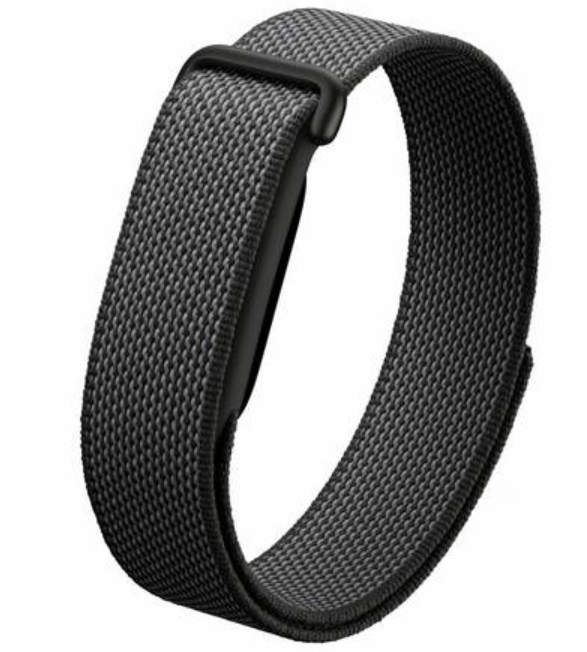
| Colours | Obsidian Band with Matte Black stainless steel buckle, Berry Band with Polished Champagne Gold buckle, Lavender Band with Polished Silver buckle, Fog Band with Polished Silver buckle |
Specifications and features as at launch.
Expert opinion | How it compares | Specifications | Battery life | Features | Sensors and health features | Further reading
Expert opinion
The Fitbit Air delivers on its core promise as a $99 screenless tracker. The 7-day battery claim holds up in testing, a 5-minute fast charge covers a full day, and 24/7 wear genuinely goes unnoticed at 12g. The Gemini-powered Health Coach is the standout feature of the package, and steady-state heart rate tracking on the wrist is reliable for running and cycling at constant effort.
The limitations show up under load. Wrist heart rate degrades during intervals, weights and gym work, and testing found a cadence-lock failure on the treadmill. There is no screen, no on-device GPS, no manual ECG, and no bicep band at launch, the accessory that fixes the Air’s wrist accuracy problems on rival devices. It suits casual wellness buyers, existing Pixel Watch owners and first-time wearable buyers who resist subscription-only models. Serious athletes wanting training-grade data are still better served by Whoop or a proper sports watch.
Full testing, including bicep-worn accuracy and a multi-sport heart rate breakdown, is in the Fitbit Air review.

How it compares
The Air enters the screenless tracker category alongside Whoop, Polar Loop and the Amazfit Helio Strap, plus the ring-format Oura Ring 4. It undercuts all of them on price and is the only one with no subscription requirement for core features.
| Device | Price | Subscription | Battery life | Bicep option |
|---|---|---|---|---|
| Fitbit Air | $99.99 | Optional ($99/year) | 7 days | No (at launch) |
| Whoop 5.0 | From $199/year | Mandatory, hardware included | 14 days | Yes |
| Polar Loop | $199 | None | 8 days | No |
| Amazfit Helio Strap | $99.99 | Optional ($69.99/year) | 10 days | Yes |
| Oura Ring 4 | From $349 | Mandatory ($69.99/year) | 8 days | Ring format, not applicable |
Whoop leads on battery life and its band and bicep accessory ecosystem. The Fitbit Air’s advantage is the Google Health app and the Gemini-based Health Coach, which is more developed at launch than the equivalent tools from Polar or Amazfit.
Specifications
| Physical | |
|---|---|
| Dimensions (pebble, without band) | 34.9mm (L) x 17mm (W) x 8.3mm (H) |
| Weight | 5.2g without band, 12g with band |
| Materials | Recycled polycarbonate and PBT housing, textile band with stainless steel buckle |
| Water resistance | 50 metres (5 ATM, ISO 22810:2010) |
| Sensors and positioning | |
| Positioning | None on-device. Uses connected GPS from a paired phone |
| Heart rate | Optical heart rate sensor, sampled at 2-second intervals |
| Motion | 3-axis accelerometer and gyroscope |
| Blood oxygen | Red and infrared SpO2 sensors |
| Skin temperature | Device temperature sensor, variation shown in the Google Health app |
| Other | Vibration motor. No display, no buttons, no altimeter, no NFC |
| Connectivity and storage | |
| Radio | Bluetooth 5.0 |
| Sync range | Up to 30ft (9m) |
| On-device storage | 7 days of minute-by-minute motion data, 1 day of workout data, 30 days of daily totals, heart rate at 2-second intervals |
Battery life
| Mode | Battery life |
|---|---|
| Typical use | Up to 7 days |
| Full charge, 0 to 100% | 90 minutes |
| Quick charge | 5 minutes for 1 day of use |
Battery type is lithium-polymer. The charger is magnetic and bidirectional, using a USB-C cable, a different format to the Pixel Watch charger. The device must come off the wrist to charge, unlike Whoop’s on-wrist battery pack.
Features
The Air pairs with the Google Health app and requires a Google account. There is no screen, so all data lives in the app; a single status LED communicates charging, low battery and firmware states through pulse patterns.
- Activity tracking covers steps, calories, distance, Cardio Load and Daily Readiness.
- Sleep tracking includes Sleep Score, sleep schedule, duration and stages, plus a Smart Wake vibration alarm timed to the optimal point in the sleep cycle.
- Health tracking covers heart rate, HRV, breathing rate and SpO2.
- Manual logging covers weight, nutrition, water intake, mood and menstrual cycles.
- Automatic detection covers running, walking, cycling, rowing and elliptical training. Roughly 40 other activity types can be started manually from the app, with more than 140 available for retrospective logging.
- Three months of Google Health Premium are included at launch, unlocking the Gemini-powered Health Coach, adaptive fitness plans and detailed sleep insights. It renews at $9.99 a month or $99 a year after the trial.
- Health Guardian features, covering blood pressure trends, insulin resistance trends and sleep breathing quality trends, are listed as coming soon and require Google Health Premium.
Sensors and health features
The Air has no manual ECG app. Instead, background AFib detection, FDA certified, monitors heart rhythm continuously and flags irregular rhythms without the wearer needing to trigger a reading, though it is not intended for users under 22 or those with other known arrhythmias. The SpO2 and skin temperature sensors are not available in all countries and are not intended for medical diagnosis.
Heart rate is sampled at 2-second intervals, but independent testing found the exported data records at roughly 5-second intervals during exercise, with a gated confidence mechanism discarding lower-confidence readings. Wrist accuracy is reliable for steady-state cardio but degrades during intervals, weights and treadmill sessions.
