Jump to: What’s new vs PW2 | Specifications | Battery | Features | Quick answers | Further reading
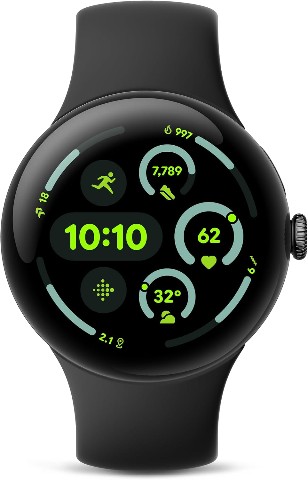
Google Pixel Watch 3
The first Pixel Watch in two sizes, with a brighter screen and Fitbit running tools for pace, load and readiness.
Expert opinion
The Pixel Watch 3 added a larger 45mm size and a much brighter screen that is easier to read outdoors. Fitbit’s training tools grew with it: Cardio Load and Target Load measure the day’s training stress against a goal set from recent fitness, Daily Readiness guides recovery, and custom running workouts give pace and heart rate cues during the run. Loss of Pulse Detection can call emergency services if the watch finds no pulse, in countries where it is approved.
Both sizes are rated at 24 hours with the always-on display, or 36 hours in Battery Saver mode, so most owners still charge it daily. Google guarantees Wear OS updates until October 2027, and the watch received Wear OS 7 in June 2026.
Specifications and features as at launch, with later software updates noted.
What’s new versus Pixel Watch 2
Hardware
- A second, 45mm size alongside the 41mm
- Actua display with up to 2,000 nits peak brightness, up from 1,000 nits, on an LTPO panel that runs from 1-60Hz
- Larger screens with smaller bezels: Google quotes 10% more screen on the 41mm and 40% more on the 45mm
- Bluetooth 5.3, dual-band Wi-Fi 6 (2.4/5GHz) and Ultra-Wideband
- 420mAh battery on the 45mm, and a Battery Saver mode rated at up to 36 hours
- Faster charging: about 24 minutes to 50% on the 41mm, against about 30 minutes before
Software
- Wear OS 5.0 at launch
- Cardio Load and Target Load to track daily training stress
- Custom running workouts with real-time pace and heart rate guidance
- Loss of Pulse Detection in approved countries
Specifications
Every figure comes from Google’s official Pixel Watch specifications.
| Feature | 41mm | 45mm |
|---|---|---|
| Case diameter | 41mm (small) | 45mm (medium) |
| Height | 12.3mm | 12.3mm |
| Weight (without band) | 31g | 37g |
| Case material | 100% recycled aluminium | Identical |
| Display | Actua, 320ppi AMOLED LTPO, DCI-P3 colour, up to 2,000 nits peak, 1 nit minimum (AOD), 1-60Hz, custom 3D Gorilla Glass 5 | Identical |
| Processor | Qualcomm Snapdragon W5 Gen 1 + Cortex-M33 co-processor | Identical |
| Storage and memory | 32GB eMMC, 2GB SDRAM | Identical |
| OS | Wear OS 5.0 at launch, updated to Wear OS 7 in June 2026 | Identical |
| GPS | GPS, Galileo, GLONASS, plus BeiDou and QZSS outside the US | Identical |
| Connectivity | Bluetooth 5.3, Wi-Fi 802.11 a/b/g/n/ac/ax (2.4/5GHz), NFC, Ultra-Wideband, 4G LTE (LTE models) | Identical |
| Sensors | Multi-path optical heart rate, ECG, blood oxygen (red and infrared), cEDA skin conductance, skin temperature, barometer, altimeter, compass, magnetometer, accelerometer, gyroscope, ambient light | Identical |
| Interaction | Side button, haptic crown, premium haptics | Identical |
| Audio | Microphone, speaker | Identical |
| Water resistance | 5ATM, IP68 | 5ATM, IP68 |
| Band (included) | Active Band, fluoroelastomer, small and large sizes | Identical |
| Band fit | Small 130-175mm, large 165-210mm | Small 150-185mm, large 165-215mm |
| Android compatibility | Android 10.0 or newer (not Android Go, no iPhone) | Identical |
| Warranty | Two years (UK, EEA, Switzerland, Australia), one year (US, Canada, Japan, Taiwan) | Identical |
| Software support | Guaranteed updates until October 2027 | Identical |
| © the5krunner. Link required. | ||
| In box | Watch, Active Band (small and large), USB-C fast charging cable | Identical |
| Announced | 13 August 2024 | 13 August 2024 |
| On sale | 10 September 2024 | 10 September 2024 |
| Predecessor | Pixel Watch 2 (October 2023) | Pixel Watch 2 (October 2023) |
| Successor | Pixel Watch 4 (October 2025) | Pixel Watch 4 (October 2025) |
| UK price at launch (Wi-Fi / LTE) | £349 / £449 | £399 / £499 |
| US price at launch (Wi-Fi / LTE) | $349.99 / $449.99 | $399.99 / $499.99 |
Battery life
| Mode | 41mm | 45mm |
|---|---|---|
| Always-on display | Up to 24 hours | Up to 24 hours |
| Battery Saver | Up to 36 hours | Up to 36 hours |
| Capacity | 307mAh | 420mAh |
| Charge to 50% | ~24 minutes | ~28 minutes |
| Charge to 80% | ~35 minutes | ~50 minutes |
| Charge to 100% | ~60 minutes | ~80 minutes |
| © the5krunner. Link required. | ||
Key features
Training load
Cardio Load scores each day’s training stress from heart rate, and Target Load sets a daily goal from recent fitness and readiness. Together they show whether a week is building fitness or tipping into fatigue. Daily Readiness, Sleep Score and Active Zone Minutes come through Google’s health app, formerly Fitbit.
Running
Custom running workouts let a runner build intervals, tempo sessions and pace targets, with cues on the wrist when pace or heart rate drifts out of range. GPS records the route without a phone.
Safety
Loss of Pulse Detection uses the heart rate sensor to spot a sudden loss of pulse and, if the wearer does not respond, calls emergency services, in countries where regulators have approved it. Safety Check, emergency location sharing, fall detection and Emergency SOS carry over.
Screen
The Actua display reaches 2,000 nits, twice the Pixel Watch 2, which makes data easier to read in direct sun. The LTPO panel drops to 1Hz and 1 nit for the always-on display to save battery.
Running form and guidance
Workout Builder lets you set distance, time, pace, heart rate and interval goals for a run, and real-time guidance gives haptic and audio cues as you go. Form Analysis reports cadence, stride and ground contact time after a run, and the running dashboard in the Google health app tracks pace, form and personal records. Google says this watch has the most accurate running heart rate of the first three Pixel Watches. Google lists step-by-step workouts as rolling out now to the Pixel Watch 3 and newer.
Health checks and trends
Morning Brief gathers last night’s sleep, your readiness and your goals in one summary, and Bedtime Mode detects sleep and silences notifications. The ECG app and Irregular Rhythm Notifications check for signs of atrial fibrillation in approved countries, and high and low heart rate alerts warn you about unusual readings. Blood oxygen and sleeping skin temperature are tracked overnight. Blood pressure trends, insulin resistance trends and sleep breathing quality trends went live in the Google Health app on 24 September 2026. They are free on the Pixel Watch 3, 4 and 5, and give you pattern insights rather than clinical readings.
More safety features
Car Crash Detection can call emergency services after a severe crash, you can call an emergency contact straight from the watch, and Medical Info shows your details on a locked watch.
Smart features
Your wrist becomes a remote for the Google TV Streamer, with pause, volume and channel control, and you can check a Google Home camera feed or doorbell. Pixel Recorder captures voice notes with transcription that syncs to your phone, and Call Assist uses Google AI to screen spam calls and hold calls for you. Ultra-Wideband lets you unlock a Pixel phone with a swipe, and the watch can act as a digital car key with select BMW and MINI models in some markets. Google’s November 2026 Pixel Drop also lists unlocking the watch with your phone as coming soon on the Pixel Watch 3, 4 and 5. Google says Gemini is rolling out to Wear OS 4 and later watches. It does not name individual Pixel Watches, and Raise to Talk is limited to the Pixel Watch 4 and 5.
What the Pixel Watch 4 adds
Dual-frequency GPS, Satellite SOS on LTE models, Raise to Talk and the double-pinch gesture are limited to the Pixel Watch 4 and later.
Software support
The watch launched on Wear OS 5.0 and received Wear OS 7 in June 2026. Google guarantees updates until October 2027.
Google Pixel Watch 3
The first Pixel Watch in two sizes, with a brighter screen and Fitbit running tools for pace, load and readiness.
Quick answers
When was the Google Pixel Watch 3 released?
Google announced the Pixel Watch 3 on 13 August 2024, and it went on sale on 10 September 2024. Launch prices started at GBP 349 or USD 349.99 for the 41mm Wi-Fi model.
Is the Pixel Watch 3 waterproof?
The Pixel Watch 3 has a 5ATM water rating and an IP68 dust and water rating, so it can be worn swimming in a pool.
What sizes does the Pixel Watch 3 come in?
The Pixel Watch 3 comes in 41mm and 45mm sizes, both 12.3mm high. The 41mm weighs 31g and the 45mm weighs 37g without the band.
What is the Pixel Watch 3 battery life?
Google quotes up to 24 hours with the always-on display on both sizes, and up to 36 hours in Battery Saver mode.
Does the Pixel Watch 3 have dual-frequency GPS?
No, the Pixel Watch 3 uses single-frequency GPS, Galileo and GLONASS, plus BeiDou and QZSS outside the US. Dual-frequency GPS arrived with the Pixel Watch 4.
How long will the Pixel Watch 3 get updates?
Google guarantees Wear OS updates for the Pixel Watch 3 until October 2027, and it received Wear OS 7 in June 2026.
Further reading
- Pixel Watch 2 specifications: the predecessor
- Pixel Watch 4 specifications: the successor
- Pixel Watch (1st Gen) specifications
- Google Pixel Watch 4 review: GPS and heart rate accuracy data, sleep comparison and Gemini
- Google Fitbit specifications: every Pixel Watch and Fitbit model
- Pixel Watch upgrade guide: whether to move to a newer Pixel Watch
- Google Fitbit and Wear OS hub
Explore the full resource library
This site covers endurance sport technology across a range of dedicated reference sections. Each one collects the most relevant articles, tests, and analysis on its topic in one place.
Buyer guides
- Best sports watch: tested recommendations by sport and athlete type (triathlon, running, marathon, cycling, hiking, and women)
- Best Garmin watch: Forerunner versus Fenix by series, sport, and budget
- Best wearables: fitness trackers, recovery trackers, heart rate monitors, running power meters, and female athlete tech
- Best cycling products: computers, smart trainers, indoor cycling apps, power meters, and cycling heart rate monitors
- Buying guides: every upgrade guide and product comparison in one place, by brand, for owners deciding whether to move to the newest model
- Gear I use: the watches, bikes, sensors, fuel and sleep kit tfk actually trains and races with, and what his partner uses
Brand and product guides
- Amazfit: the full Amazfit range from Balance to Cheetah to T-Rex, accuracy tests, HYROX partnership, and Zepp Health analysis
- Apple Watch: athlete-first coverage of Apple Watch across running, cycling, and triathlon
- COROS: watches, features, and firmware across the full COROS range
- Garmin: the company, the platform and the full range, and the starting point for choosing across every Garmin product line
- Garmin Edge: bike computers from entry-level navigation to flagship endurance and mountain biking
- Bike computers: Garmin, Wahoo, Hammerhead, COROS and the value brands compared
- Bryton: the Rider range compared, from basic GPS units to the S810 with maps
- Garmin Fenix: every model, feature, and firmware development for Garmin's flagship outdoor watch
- Garmin Fenix 8 Series: which variant to buy, upgrade advice, accuracy data, and the full Fenix 8 review and firmware coverage
- Garmin Forerunner: the full Forerunner line covered from entry level to triathlon flagship
- Garmin Instinct: rugged GPS watches for endurance and adventure athletes
- Garmin Features Explained: how Garmin's metrics work, from Training Load and Body Battery to Race Predictor and HRV Status
- Garmin Connect IQ charts: the most popular watch faces, apps, data fields and music services on the Connect IQ Store, updated monthly
- Google Fitbit: Fitbit Edge, Fitbit Air, Google Health, Pixel Watch and the Wear OS platform
- Magene: which Magene bike computer to buy, from the C506 to the C706, with tested verdicts
- Polar: watches, sensors, Polar Flow and training science across the full Polar range
- Runna: coach-written running plans that adapt as you train
- Suunto: Race, Vertical, Run and the SuuntoPlus ecosystem
- Strava: features, privacy, segments, and how Strava fits into a serious training setup
- Ride with GPS: route planning, navigation and how it works alongside Strava
- Wahoo: KICKR trainers, ELEMNT bike computers, and the Wahoo ecosystem
- WHOOP: strain, recovery, sleep and the full WHOOP ecosystem
Specifications database
- Full Specifications Database: detailed spec sheets, battery life, sensor lists and generation-on-generation comparisons for current Garmin, COROS, Amazfit, Samsung, Google Fitbit, Huawei, Polar, Suunto, Wahoo and Apple Watch models
Glossary
- Sports Technology Glossary: non-branded terminology across running, cycling, swimming, triathlon, hiking, strength training, HYROX, sensors, ecosystems, and brands
Sport and topic guides
- Running Watches: how to choose by discipline (road racing, trail, track, beginner, and multisport)
- Triathlon and Multisport Technology: watches, sensors, and race-day tools for swimmers, cyclists, and runners
- HYROX: training science, race analysis, and technology for the functional fitness race format
- parkrun: technology, training, and performance for the weekly 5K
- Hiking Technology: navigation, safety, and trail tech for walkers and hikers
- Heart Rate Monitoring: optical sensors, chest straps, accuracy comparisons, and how to set training zones
- Optical Sensors (PPG): the 40 things a wrist optical sensor could measure, from heart rate to glucose, ranked by evidence
- GPS Accuracy: how satellite systems perform across brands, terrains, and conditions
- Sports Watch Battery Life: battery claims, real-world tests, and how to manage battery life across Garmin, Apple, Amazfit and COROS
- Recovery Trackers: WHOOP, Oura, and the science of readiness scoring
- Muscle Oxygen Sensors: SmO2 and NIRS explained, Train Red and Moxy compared, and the category from BSX and Humon to Garmin and WHOOP
- Female Athlete Tech: wearables, physiology, and performance for female endurance athletes, covering cycle-synced training, RED-S, HR accuracy, and VO2max
- Sports Science: peer-reviewed research on HRV, VO2max, lactate threshold, running power, wearable accuracy, and supplementation
- Testing Methodology: how this site tests GPS accuracy, heart rate, battery life, and other performance claims
Content series
- Release Radar: confirmed launches, leaks, and rumours across Garmin, Apple, COROS, Polar, Suunto, and Wahoo
- Deep Dive Feature Files: weekly firmware feature updates across all brands (bug fixes excluded)
- Fix Files: weekly firmware bug fix tracking across all brands
Small things I always use
- Garmin 90-degree charging adapter: Charges your Garmin from any USB-C cable. Essential when travelling. I use one.
- Body Glide: The blue anti-chafe stick swimmers and runners carry. I use it.
- Speedo earplugs: Fewer ear infections and no cold-water dizziness. I use them.
- Dryrobe Advance: My winter changing robe for open-water swims. I use one. A cheaper option is the AONYIYI changing robe.
- Maurten: Race fuel that stays easy on the stomach. I use them.
- Beet It Sport nitrate shots: Beetroot shots I take in the days before a race. I use them.
- Garmin charging puck: The quickest way to top up before a session. I use one.
- Injinji: Toe socks that stop rubbing, so you run more. I use them.
- Ultimate toe protectors: Stop black toenails on long runs. They work. I use them.
- Compressport R2 v2 calf sleeves: My calf sleeves of choice. I use them.
- Cellucor C4: My pre-workout before hard sessions.
- TPU tubes: Schwalbe Aerothan, Tubolito and Pirelli SmarTube. Light, tiny spares. I use all three.
- G8 insoles: Adjustable insoles that are good. I use them.
- Cycplus Cube: A 97g electric pump that gets a road tyre rideable in two minutes. I carry one. 5% off with code THE5KRUNNER.
Watches and sensors
- Polar H10: My daily driver for waking HRV.
- Polar Verity Sense: My backup arm-worn HR sensor.
- Nomad bedside charger: Charges my iPhone and Apple Watch overnight. I use it, and many of their bands.
- Train.Red: The best muscle oxygen sensor I’ve used.
- Tymewear: Accurate heart rate and reliable ventilatory zones. I use it to pace endurance rides over an hour.
- Garmin Forerunner 970: A pro-grade triathlon watch. I use this.
- Apple Watch Ultra 4: My daily smartwatch. No phone needed on rides.
- Garmin Fenix 9 Pro: I’ve just bought one.
On the bike
- Continental GP5000 for everyday riding, and Aero 111 on the front for special occasions.
- Helmets: Specialized S-Works Evade 3 for road riding, and Rudy Project Wing for TT-style races. I use both.
- Ravemen FR300: A front light that mounts under your Garmin or Wahoo. I use one.
- Ravemen FR1000: The light and the computer mount in one unit, so nothing else goes on the bars. Better than mine.
- Ravemen FR1500SE: 1,500 lumens hanging under your Garmin, for proper night rides.
- Ravemen FR1100SE: 1,100 lumens under your Garmin, and up to 46 hours on slow flash.
- Ravemen FR500: A brighter FR300 with the same mount.
- Wahoo TRACKR Radar: I use it on one bike and Varia on the other. They perform the same.
- Garmin Varia RTL515: Radar that warns you of cars from behind. I use this model.
- Wahoo ELEMNT Roam 3: The bike computer that’s easy to use. I use mine on most rides.
- Favero Assioma Pro RS2: Accurate power pedals that swap easily between bikes. I use this model.
Home and indoor training
- NPE Runn: Makes my basic treadmill smart, sending more accurate speed and distance to my watch and Zwift. I use it.
- Google Wifi: Keeps Zwift connected in my pain cave. I use it.
- Apple TV 4K: Zwift on the big screen. I use two.
- Google Nest Doorbell (wired, 2nd gen): My video doorbell, running in both Google Home and Apple Home. I use it.
Health, recovery and sleep
- FreeStyle Libre 3 Plus: Shows how my blood sugar responds to diet.
- hDrop: Measures my sweat loss in summer and indoors.
- Fourth Frontier Zone: Checks my heart under load in hard sessions.
- Kineon MOVE+: Red and infrared light for sore knees, Achilles and other joints after hard training. I use it.
- Oura Ring 5: My partner’s recovery tracker of choice.
- Eight Sleep: A cooling mattress cover my partner and I use nightly.
Reader-Powered Content

This content is not sponsored. It’s mostly me behind the labour of love, which is this site, and I appreciate everyone who supports it.
Support the site: Follow (free, fewer ads) · Subscribe (paid, ad-free) · Buy Me A Coffee
Written by real people, with AI assistance. Fact-checked and verified for originality. See the Editorial Policy. FTC: Affiliate Disclosure — some links pay commission. As an Amazon Associate, I earn from qualifying purchases.
