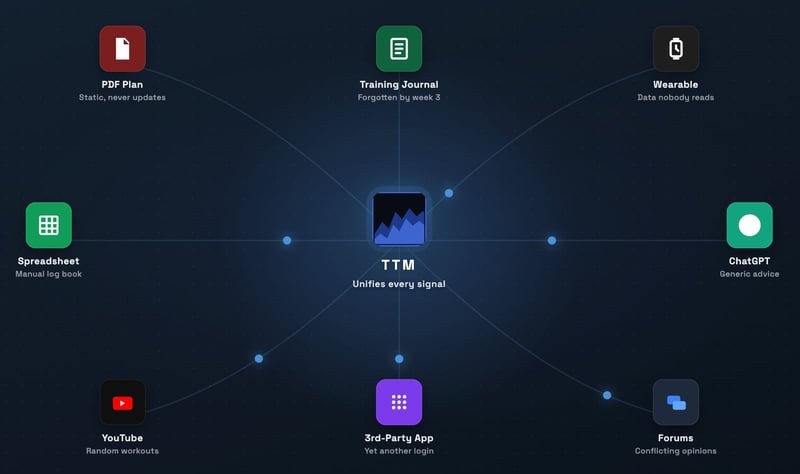
Most endurance athletes can tell you their VO2 max, their weekly training load, and their resting heart rate. Ask them whether they are ready for a specific mountain and the honest answer is usually a shrug. The tools that track running, cycling and triathlon assume a flat, repeatable world. A mountain does not work that way, and athletes heading for 3,000 to 5,000m (9,800 to 16,400 ft) peaks have been left borrowing plans that were never built for them. Train to Mountain, a new app from Slovenian alpinist Jakob Ulcnik and technical co-founder Gino Kok, is built to answer the one question that keeps climbers up the night before a trip: are you actually ready, or just hoping?
The gap: endurance plans are not built for mountains
A training-load number from a running or cycling watch is built around steady, rhythmic effort. A summit day is the opposite. It is hours of sustained climbing, a long and punishing descent that loads the legs in a way flat training never does, thin air that makes every step cost more, a pack on your back, and often a second hard day straight after the first. Generic endurance plans, and the load scores that come with them, do not model any of that. An athlete can look strong on paper and still turn around below the summit because they trained for the wrong demands.
What Train to Mountain is
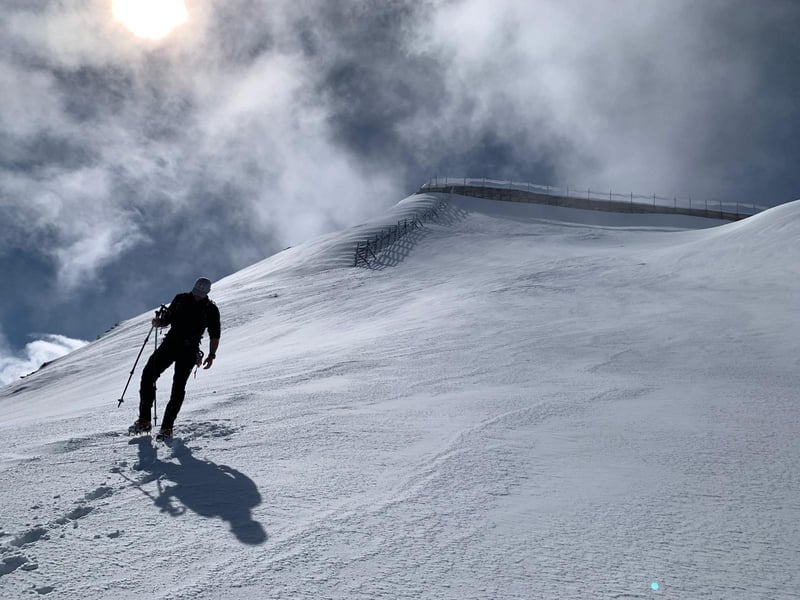
Train to Mountain is an adaptive mountaineering training app for the 3,000 to 5,000m (9,800 to 16,400 ft) range. Ulcnik built it with Kok after training hard for his own first big peak and still arriving unsure whether he was ready, having pieced together PDF plans, videos, and conflicting advice that sometimes aligned. The app runs on established training-science models, including the fitness-fatigue model used across endurance sport, plus a proprietary model developed in-house that adapts to the individual athlete.
How it works
TL;DR: Train to Mountain models your Physical Readiness for a specific mountain, tracks the mountaineering demands a generic plan ignores, and recalibrates your plan week to week as your body responds.
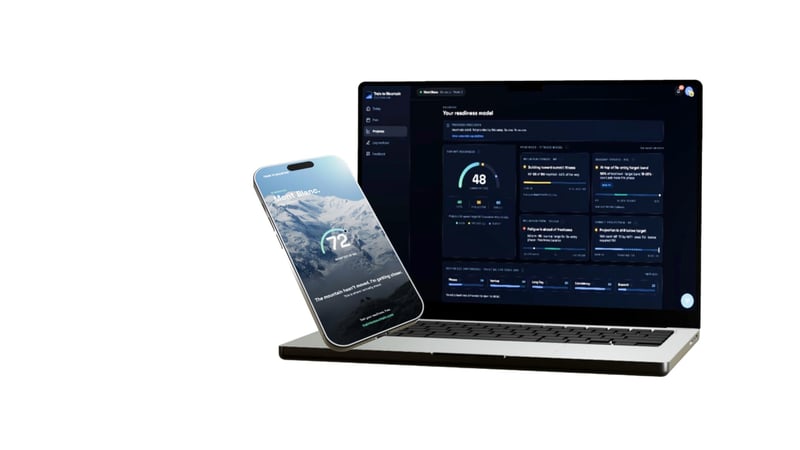
At its core is a simple idea from exercise physiology: readiness is fitness minus fatigue. The app builds your fitness with a structured plan, watches how much fatigue you accumulate, and reads the two together to tell you where you actually stand rather than how many sessions you logged.
What sets it apart is what it measures. Alongside general fitness, it tracks a Mountain Fitness score against the specific demand of your chosen peak, a descent-load figure for the eccentric punishment of going down, time on feet for long-day endurance, consistency, and altitude readiness, with heart-rate zones anchored to your lactate threshold rather than a generic percentage of maximum. Heart-rate variability and sleep from your watch feed the fatigue side of the picture. Together these roll up into a single Physical Readiness figure for your chosen peak.
That figure measures exactly what its name says, physical preparation. It does not stand in for technical skill, altitude response, or mountain conditions, so the app steers athletes toward a qualified guide’s sign-off before they commit.
A worked example: one week’s review for a Mont Blanc plan
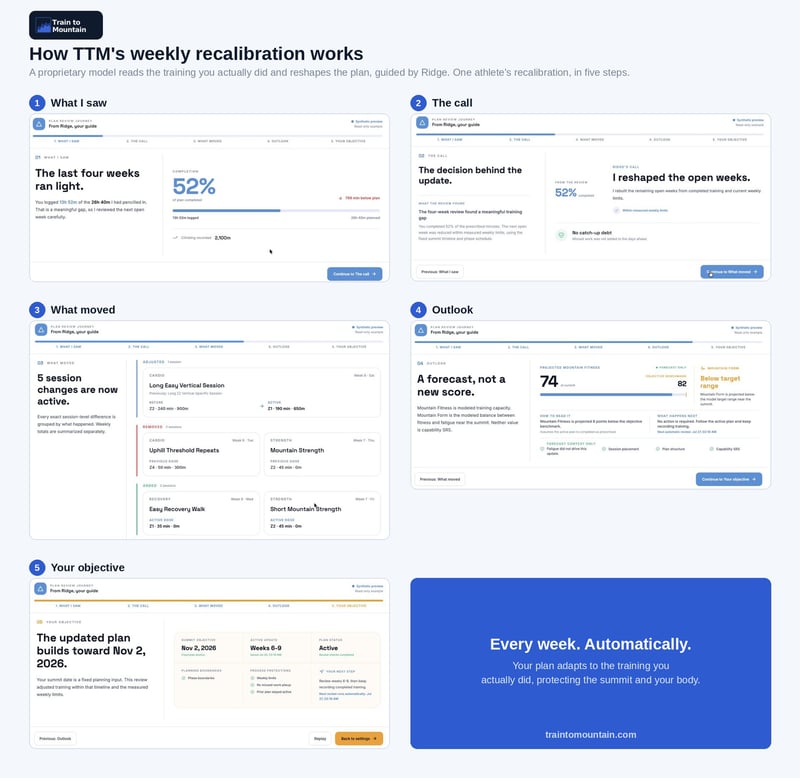
Say an athlete building toward Mont Blanc, 4,808m (15,774 ft), hits a rough stretch. Their last four weeks ran light: they logged 13 hours 52 minutes of the 26 hours 40 minutes planned, 768 minutes below plan, roughly half the prescribed work. This is where most plans fail you. A static plan ignores the gap and marches on, or it dumps the missed sessions onto the days ahead and buries you. Train to Mountain does neither.
Every week the app runs a review, guided by Ridge, the in-app coach. It reads what actually happened and reshapes the open weeks within your measured weekly limits, with no catch-up debt, so missed work is never stacked onto the days ahead. It shows exactly what moved, session by session: a long vertical session eased from Z2 to Z1, two hard sessions removed, two lighter ones added. All five changes are explained.
Then it gives an honest forecast, not a new score. It projects Mountain Fitness of 74 at the summit against the objective’s benchmark of 82, and flags that form is tracking just below the target range near the top. It does not hide the eight-point gap. It tells the athlete plainly that no action is needed beyond following the reshaped plan, that the fixed summit date still holds, and when the next automatic review will run.
That is the core of it. A generic plan is blind to the week you actually had. Train to Mountain adjusts to it, every week, protecting both the summit timeline and your body instead of letting one of them take the hit.
Integrations and how you train with it
Train to Mountain runs as an app, with a web companion for the wider planning view. It connects directly to Garmin, Suunto, Coros, Apple and Polar, pulling activities, heart-rate variability and sleep. The team is also exploring further connections, including Strava, so an athlete’s data can flow freely and no progress is lost when moving between tools.
Training does not need a mountain on your doorstep. Sessions combine real climbs where possible with vertical work on a treadmill incline or stair machine, loaded carries and targeted strength, so an urban athlete can still build mountain-specific fitness.
Pricing and what is next
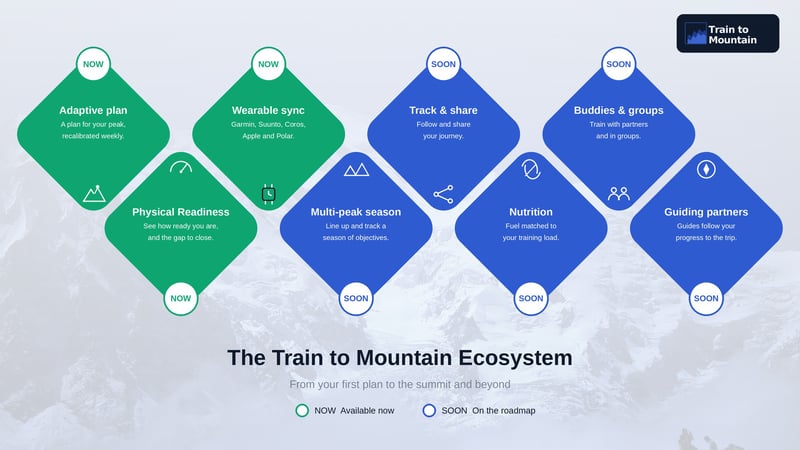
A Physical Readiness assessment is free, so athletes can see where they stand before paying anything. The full adaptive plan, built around a target summit, is EUR 90 per month or EUR 600 per year prepaid. For athletes between objectives, a maintenance package at EUR 59 per year delivers weekly workouts without a target summit, so fitness does not slide in the off-season.
Ulcnik describes the app as the start of an ecosystem rather than a single plan. On the roadmap are multi-peak selection to line up and track a season of objectives, and tools to follow and share your journey. The team is also exploring features to round the ecosystem out, including nutrition, a training-buddy system, group training, and links to guiding companies so a guide can follow a client’s progress. That last piece closes a real gap: today a climber books a trip, trains alone for months, and the guide only learns how ready they are at the mountain, often too late to fix a shortfall that ends the summit.
Summary
Train to Mountain brings the data discipline endurance athletes already live by to a sport that has lacked it. By modelling Physical Readiness, descent load and altitude, and recalibrating week to week, it answers the question a generic plan cannot: whether you are ready for the mountain ahead. Readers can try the free Physical Readiness check at traintomountain.com/summit_simulator#readiness.
Quick answers
when is it live?
The app launches in July 2026 with a waitlist before then.
Do I need mountains nearby to train for one?
No. Train to Mountain builds mountain-specific fitness with treadmill-incline or stair work, loaded carries and strength, alongside real climbs when you can get them, so urban athletes can prepare properly.
Which watches and apps does it work with?
It connects directly to Garmin, Suunto, Coros, Apple and Polar, reading activities, heart-rate variability and sleep, with further integrations such as Strava being explored so your data moves with you.
What does it cost, and can I try it first?
The Physical Readiness assessment is free on the web. The full adaptive plan, built around a target summit, has a free trial, with the plan being generated. Using the full functionality of Train to Mountain is EUR 90 per month or EUR 600 per year. A maintenance training package at EUR 59 per year gives you weekly workouts without a target summit.
Related reading on the5krunner
- Tooboo: Standalone Offline Outdoor Navigation on Apple Watch Ultra: another indie outdoor app for long-distance hiking and trail running, with the iPhone left in the pack.
- Awesome Maps: Ordnance Survey and Satellite Maps for Garmin CIQ: a small Connect IQ shop delivering premium hiking mapping to older Garmin watches on a one-time-purchase model.
- IntervalCoach: AI Training That Adapts to Your Recovery Each Day: another adaptive training app for endurance athletes, working from recovery data rather than a static plan.
Author: Jakob Ulcnik, co-founder of Train to Mountain, edited by the5krunner.
If you enjoyed reading this, here is another in the Indie Spotlight series: Tooboo Turns Apple Watch Ultra Into a Standalone Offline Outdoor Navigator.
Last Updated on 12 October 2026 by tfk the5krunner
Small things I always use
- Garmin 90-degree charging adapter: Charges your Garmin from any USB-C cable. Essential when travelling. I use one.
- Body Glide: The blue anti-chafe stick swimmers and runners carry. I use it.
- Speedo earplugs: Fewer ear infections and no cold-water dizziness. I use them.
- Dryrobe Advance: My winter changing robe for open-water swims. I use one. A cheaper option is the AONYIYI changing robe.
- Maurten: Race fuel that stays easy on the stomach. I use them.
- Beet It Sport nitrate shots: Beetroot shots I take in the days before a race. I use them.
- Garmin charging puck: The quickest way to top up before a session. I use one.
- Injinji: Toe socks that stop rubbing, so you run more. I use them.
- Ultimate toe protectors: Stop black toenails on long runs. They work. I use them.
- Compressport R2 v2 calf sleeves: My calf sleeves of choice. I use them.
- Cellucor C4: My pre-workout before hard sessions.
- TPU tubes: Schwalbe Aerothan, Tubolito and Pirelli SmarTube. Light, tiny spares. I use all three.
- G8 insoles: Adjustable insoles that are good. I use them.
- Cycplus Cube: A 97g electric pump that gets a road tyre rideable in two minutes. I carry one. 5% off with code THE5KRUNNER.
Watches and sensors
- Polar H10: My daily driver for waking HRV.
- Polar Verity Sense: My backup arm-worn HR sensor.
- Nomad bedside charger: Charges my iPhone and Apple Watch overnight. I use it, and many of their bands.
- Train.Red: The best muscle oxygen sensor I’ve used.
- Tymewear: Accurate heart rate and reliable ventilatory zones. I use it to pace endurance rides over an hour.
- Garmin Forerunner 970: A pro-grade triathlon watch. I use this.
- Apple Watch Ultra 4: My daily smartwatch. No phone needed on rides.
- Garmin Fenix 9 Pro: I’ve just bought one.
On the bike
- Continental GP5000 for everyday riding, and Aero 111 on the front for special occasions.
- Helmets: Specialized S-Works Evade 3 for road riding, and Rudy Project Wing for TT-style races. I use both.
- Ravemen FR300: A front light that mounts under your Garmin or Wahoo. I use one.
- Wahoo TRACKR Radar: I use it on one bike and Varia on the other. They perform the same.
- Garmin Varia RTL515: Radar that warns you of cars from behind. I use this model.
- Wahoo ELEMNT Roam 3: The bike computer that’s easy to use. I use mine on most rides.
- Favero Assioma Pro RS2: Accurate power pedals that swap easily between bikes. I use this model.
Home and indoor training
- NPE Runn: Makes my basic treadmill smart, sending more accurate speed and distance to my watch and Zwift. I use it.
- Google Wifi: Keeps Zwift connected in my pain cave. I use it.
- Apple TV 4K: Zwift on the big screen. I use two.
- Google Nest Doorbell (wired, 2nd gen): My video doorbell, running in both Google Home and Apple Home. I use it.
Health, recovery and sleep
- FreeStyle Libre 3 Plus: Shows how my blood sugar responds to diet.
- hDrop: Measures my sweat loss in summer and indoors.
- Fourth Frontier Zone: Checks my heart under load in hard sessions.
- Oura Ring 5: My partner’s recovery tracker of choice.
- Eight Sleep: A cooling mattress cover my partner and I use nightly.
Reader-Powered Content

This content is not sponsored. It’s mostly me behind the labour of love, which is this site, and I appreciate everyone who supports it.
Support the site: Follow (free, fewer ads) · Subscribe (paid, ad-free) · Buy Me A Coffee
Written by real people, with AI assistance. Fact-checked and verified for originality. See the Editorial Policy. FTC: Affiliate Disclosure — some links pay commission. As an Amazon Associate, I earn from qualifying purchases.
tfk is the founder and author of the5krunner, an independent endurance sports technology publication. With 20 years of hands-on testing of GPS watches and wearables, and competing in triathlons at an international age-group level, tfk provides in-depth expert analysis of fitness technology for serious athletes and endurance sport competitors. See the gear tfk uses. ID
