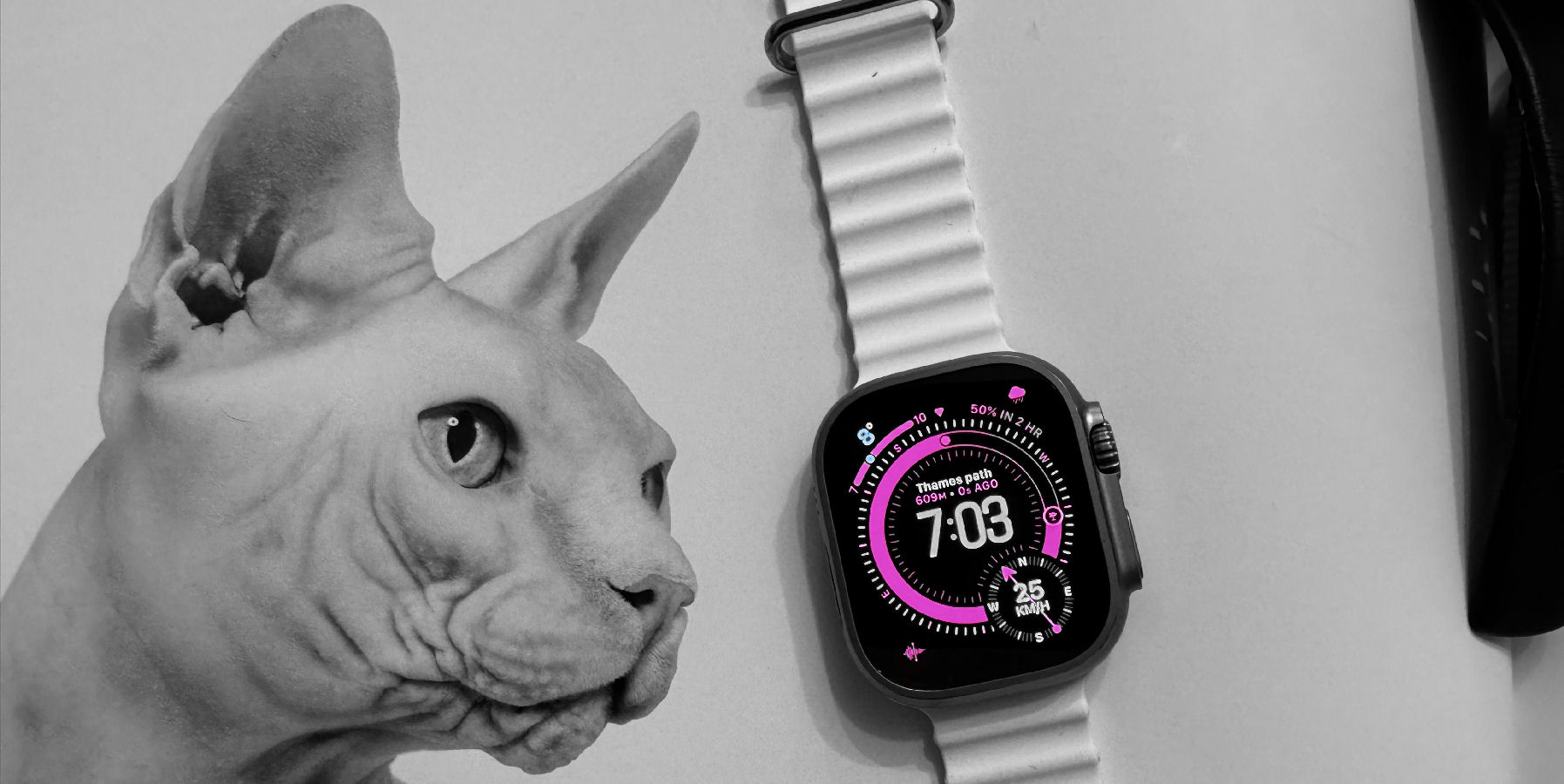
I expect three things from Wednesday: a new AI Siri co-processor, a meaninglessly brighter AMOLED, and one solitary hour of extra battery life.
Update 9 September 2026: Apple has now confirmed the Ultra 4. See the Apple Watch Ultra 4 full specifications and the Ultra 4 vs Ultra 3 comparison for the confirmed details.
How accurate were the predictions?
Design: correct. Same 49mm case, same display, no redesign. S11 chip: correct, new chip confirmed. Battery: better than predicted. I called 15 to 17 hours of GPS recording; Apple confirmed 18 hours, which is the first time the Ultra clears a full Ironman without Low Power Mode. That is a more meaningful jump than I expected. No new GNSS chip: correct, and Apple actually removed GLONASS from the constellation list, which on testing improves accuracy rather than reducing it. GLONASS is the least accurate of the major constellations. Touch ID: correct, not this year. Optical HR sensor: the new Health Sensing System on Series 12 is a significant hardware change, though this post was focused on Ultra; Ultra 4’s sensor position relative to Ultra 3 has not yet been tested. Price: correct, $799 unchanged.
If you want to get excited, trust that Apple’s new CEO will certainly announce exciting new tech. Sadly, that’s probably more likely to be AI-related than Watch-related. But…you never know! Readers here might get lucky.
Here’s a leak summary and my take.
Design: Gurman wins
Ultra 3 already got its refresh last year: thinner bezels, a larger display area, and the move to LTPO3. Don’t expect the exterior to change.
- Gurman/Bloomberg: no major overhaul this cycle, bigger redesign pushed to 2027 or later.
- Ultra’s footprint has held at 49mm by 44mm across three straight generations. Apple’s current spec page lists the depth as 12mm, down from the 14.4mm figure quoted at launch and still shown on most spec trackers, suggesting a remeasurement rather than an actual hardware change.
- Expect the same titanium case, flat display, Digital Crown and Action Button.
- The display panel is the same story: LTPO3 arrived with Ultra 3 last year, and every current report has Ultra 4 keeping the same panel generation. MicroLED remains cancelled or delayed well past 2026. The one plausible display change is a brightness bump, with current reporting pointing to somewhere around 3,200 to 3,500 nits, up from 3,000.
Chip: new number, same story
This year’s chip should be an S11, Apple’s next number after skipping a refresh on Series 11 and Ultra 3.
- Series 9 and Series 10 both used Sawtooth cores derived from the A16 Bionic, the same core generation rather than literally the same chip.
- Ultra 3 and Series 11 repeated the S10 chip in 2025, the second straight year on that chip after Series 10 introduced it in 2024, and the third straight year on the underlying Sawtooth core architecture counting S9 in 2023.
- That’s the longest unchanged run of any Apple Watch chip generation.
- A new chip name for Ultra 4 is close to certain.
- Expect the real gain in on-device AI processing for Siri and health-data analysis, not raw speed.
Optical HR sensor: better at its job, not a new job
A new Apple OHR sensor is unlikely to sense any new metric (other than EDA/stress). Rumours of live blood pressure readings or non-invasive blood glucose rank as highly as the discovery that fairies are real. But accuracy could improve with a long-overdue hardware refresh; for example, better HR/HRV precision could lead to more acute BP trend info and proper overnight HRV averages for ‘recovery’.
- Unchanged since Series 6 in 2020, five years and six chip generations.
- The longest-standing unrefreshed component on the watch.
- Reviews across that period rate Apple’s HR accuracy as competitive during sustained effort.
- Expect better accuracy and lower power draw if it’s refreshed.
- Apple has used most optical HR refreshes to improve accuracy rather than add a new measurement type, though the Series 6 refresh was the exception, adding blood oxygen monitoring.
Touch ID: not this year
Gurman’s reporting has been consistent enough here to treat it as close to settled.
- Gurman has downplayed this repeatedly.
- A side-button or Digital Crown biometric sensor is a bigger mechanical change than a design-stable year supports.
- Expect it to be held back again.
GNSS chipset: no new chip, and Apple would be a follower on tri-band
If Apple ever moves to tri-band, it would mean switching away from Broadcom to an already-released chipset from a generic GNSS supplier such as Airoha, since nothing from Broadcom itself supports that move this generation. New firmware-level GNSS behaviour, the kind Garmin’s Fenix 9 investigation uncovered, wouldn’t prove new silicon on its own.
- Apple’s GNSS silicon comes from Broadcom, not an in-house design.
- Broadcom’s last publicly announced dual-frequency wearable chip is the BCM4778, launched in September 2021.
- Nothing in Broadcom’s current wearable lineup matches tri-band.
- Huawei’s Watch GT Runner 2 already ships tri-frequency GNSS on an in-house chip.
Would an in-house GNSS chip fix the Ultra’s battery problem?
It wouldn’t fix it, but it would help.
- Apple has insourced several radio blocks it used to buy in: the W-series wireless chip, the U-series UWB chip, the C1 modem replacing Qualcomm in the iPhone.
- GNSS from Broadcom is one of the last major radio blocks left on that list, so an in-house design fits Apple’s direction. If nothing else, doing GNSS in-house would lower Apple’s bill of materials (costs).
- No leak or filing currently claims this for Ultra 4.
- Broadcom’s BCM4778 draws 4mW on L1 alone, 6mW with L1 and L5 both active.
- Against Ultra 3’s 2.313 Wh battery and its 14-hour full-precision workout rating, that’s roughly 3.6% of total system power.
- Halving it saves under 2% of total draw, worth adding roughly 15 minutes of per-second GNSS recording.
- Display, optical HR and the processor account for the overwhelming majority of the draw, which is why Low Power Mode trades those down rather than touching GNSS.
- Any real battery gain has to come from S11-generation efficiency across the whole chip package, not the GPS chip specifically.
Battery: modest, and the Ultra name still overstates it
I’d hope for 15 hours of proper GNSS recording.
- Watch Ultra 3: Existing 14 hours of continuous GNSS-and-HR workout recording at full precision. At best, expect Ultra 4 to hit 15 to 17 hours, thanks to chip efficiency, display gains, and a refreshed optical HR sensor.
- Ignore the 48 to 72-hour figures circulating in unnamed-source leaks. Those describe smartwatch standby time, not workout recording.
- Even at 17 hours, a watch branded Ultra falls short of what some ultra-distance races demand, often past 24 hours of continuous GPS tracking. Battery dgradation is also a factor to consider.
- Nothing about the GNSS chip specifically closes that gap this generation. Only a broader S11-class efficiency gain across the whole chip package could move the needle.
Price and release
Shipping is likely towards the latter half of September.
- No credible source has the Ultra rising above $799 for a fourth generation.
- Apple has confirmed the September 9 event.
watchOS 27 already did the work for sport and health
Beyond carrying that software forward, expect little new for sport from the Ultra 4 hardware itself.
- On-watch Workout Buddy, no iPhone required nearby.
- More accurate treadmill distance tracking through improved motion algorithms.
- Expanded coaching insights tied to pace, distance and duration.
Also rumoured are a RECOVERY app and improved strength training features.
What’s overdue, and why none of it is actually broken
Age alone doesn’t justify a change when the component still performs.
- Optical HR sensor: 5 years old, no accuracy complaints.
- Accelerometer and gyroscope: 5 years at current tier, since Series 7, no accuracy complaints.
- Chip architecture: 3 years on the same Sawtooth cores, longer than any prior generation, no performance complaints.
- GNSS chip: 2021 Broadcom part, no successor, still competitive with Garmin’s best dual-frequency watches on accuracy testing.
- Ultra case: same dimensions for 3 straight generations, no durability complaints.
Every one of these components is old by Apple’s own standards. None of them is fundamentally broken. The chip refresh happens because Apple always ships a new chip. The rest stays because it works.
Quick answers
Will the Apple Watch Ultra 4 get a new design?
No major redesign is expected this cycle. The Ultra 3 already got a case and display refresh last year, so Gurman’s reporting points to the same case dimensions holding for this generation. A bigger redesign is expected in 2027 or later.
Will the Apple Watch Ultra 4 have a new GPS chip?
No new GNSS chip is expected. Apple’s supplier, Broadcom, hasn’t announced a successor to its 2021 BCM4778 chip, and Broadcom currently has no tri-band GNSS chip available for Apple to adopt.
Will the Apple Watch Ultra 4 have Touch ID?
No. Gurman has repeatedly downplayed the odds, and a biometric sensor built into the side button or Digital Crown is a bigger mechanical change than this year’s design-stable cycle supports.
Last Updated on 9 September 2026 by tfk the5krunner
Small things I always use
- Garmin 90-degree charging adapter: Charges your Garmin from any USB-C cable. Essential when travelling. I use one.
- Body Glide: The blue anti-chafe stick swimmers and runners carry. I use it.
- Speedo earplugs: Fewer ear infections and no cold-water dizziness. I use them.
- Dryrobe Advance: My winter changing robe for open-water swims. I use one. A cheaper option is the AONYIYI changing robe.
- Maurten: Race fuel that stays easy on the stomach. I use them.
- Beet It Sport nitrate shots: Beetroot shots I take in the days before a race. I use them.
- Garmin charging puck: The quickest way to top up before a session. I use one.
- Injinji: Toe socks that stop rubbing, so you run more. I use them.
- Ultimate toe protectors: Stop black toenails on long runs. They work. I use them.
- Compressport R2 v2 calf sleeves: My calf sleeves of choice. I use them.
- Cellucor C4: My pre-workout before hard sessions.
- TPU tubes: Schwalbe Aerothan, Tubolito and Pirelli SmarTube. Light, tiny spares. I use all three.
- G8 insoles: Adjustable insoles that are good. I use them.
- Cycplus Cube: A 97g electric pump that gets a road tyre rideable in two minutes. I carry one. 5% off with code THE5KRUNNER.
Watches and sensors
- Polar H10: My daily driver for waking HRV.
- Polar Verity Sense: My backup arm-worn HR sensor.
- Nomad bedside charger: Charges my iPhone and Apple Watch overnight. I use it, and many of their bands.
- Train.Red: The best muscle oxygen sensor I’ve used.
- Tymewear: Accurate heart rate and reliable ventilatory zones. I use it to pace endurance rides over an hour.
- Garmin Forerunner 970: A pro-grade triathlon watch. I use this.
- Apple Watch Ultra 4: My daily smartwatch. No phone needed on rides.
- Garmin Fenix 9 Pro: I’ve just bought one.
On the bike
- Continental GP5000 for everyday riding, and Aero 111 on the front for special occasions.
- Helmets: Specialized S-Works Evade 3 for road riding, and Rudy Project Wing for TT-style races. I use both.
- Ravemen FR300: A front light that mounts under your Garmin or Wahoo. I use one.
- Wahoo TRACKR Radar: I use it on one bike and Varia on the other. They perform the same.
- Garmin Varia RTL515: Radar that warns you of cars from behind. I use this model.
- Wahoo ELEMNT Roam 3: The bike computer that’s easy to use. I use mine on most rides.
- Favero Assioma Pro RS2: Accurate power pedals that swap easily between bikes. I use this model.
Home and indoor training
- NPE Runn: Makes my basic treadmill smart, sending more accurate speed and distance to my watch and Zwift. I use it.
- Google Wifi: Keeps Zwift connected in my pain cave. I use it.
- Apple TV 4K: Zwift on the big screen. I use two.
- Google Nest Doorbell (wired, 2nd gen): My video doorbell, running in both Google Home and Apple Home. I use it.
Health, recovery and sleep
- FreeStyle Libre 3 Plus: Shows how my blood sugar responds to diet.
- hDrop: Measures my sweat loss in summer and indoors.
- Fourth Frontier Zone: Checks my heart under load in hard sessions.
- Oura Ring 5: My partner’s recovery tracker of choice.
- Eight Sleep: A cooling mattress cover my partner and I use nightly.
Reader-Powered Content
This content is not sponsored. It’s mostly me behind the labour of love, which is this site, and I appreciate everyone who supports it.
Support the site: Follow (free, fewer ads) · Subscribe (paid, ad-free) · Buy Me A Coffee
Written by real people, with AI assistance. Fact-checked and verified for originality. See the Editorial Policy. FTC: Affiliate Disclosure — some links pay commission. As an Amazon Associate, I earn from qualifying purchases.
tfk is the founder and author of the5krunner, an independent endurance sports technology publication. With 20 years of hands-on testing of GPS watches and wearables, and competing in triathlons at an international age-group level, tfk provides in-depth expert analysis of fitness technology for serious athletes and endurance sport competitors. See the gear tfk uses. ID

Things I would like: (1) native broadcast of HR; (2) native maps within the workout app; (3) better battery; (4) smart alarm; (5) flashlight; (6) native gym workout tracking by excercise, reps, etc . Most of them are software updates, but I doubt any of these will come in this version. ¿Thoughts?
1,2,3 yes
4 might come
5 apple woudl argue is there
6 apple would say to get an app that does it
good list tho
I hope they finally add the ability to correct/adjust treadmill distance and add some fitness features on par with Garmins.