An Apple Watch records heart rate second by second through every run and ride, along with pace, power, and cadence. Apple Health keeps all of it. What it doesn’t do is say what the numbers add up to: where the lactate threshold sits, what the critical power is, whether this week’s load is heavier than the body is used to, or what a marathon might take right now.
Somvia is an iPhone app that answers those questions from the data already there. It reads Apple Health, estimates the scores on the phone with published sport-science models, and shows for every score which readings it came from. It also has a second face: with a switch turned on, any AI agent that speaks MCP can read the same scores and training details, so an athlete can ask Claude or ChatGPT about last month’s long runs and get an answer from their own data.
What Somvia estimates
TL;DR: Every morning, Somvia produces a recovery score, a sleep score, HRV status, recovery time and training status. Every workout gets a load, a training effect, a performance deviation and heart-rate drift. From the history, it works out threshold pace and heart rate, critical power for rides, and race predictions from 5 km to the marathon.
The morning scores come from the night before: overnight HRV, resting heart rate, sleep stages and the previous day’s load. Each score opens to a list of the readings it used and how far each sits from the athlete’s usual, so you can trace a low recovery score to a specific number rather than take it on trust.
Load follows Bannister’s training impulse and Coggan’s stress scores, the same family of models most training platforms use. Long-term load is the six-week trend, recent load the one-week trend, and training status compares the two. Somvia’s own labels are plain: long-term load and recent load, not CTL and ATL.
Threshold is where Somvia differs from most Apple Watch recovery apps. It searches the athlete’s history for sustained efforts, using the 20-minute and 30-minute field methods, and takes threshold pace and heart rate from those. Rides with a power meter get a critical power from Monod and Scherrer’s model. Race times follow Daniels and Gilbert. A 12-minute effort qualifies alongside longer ones, so a hard 5K counts. Athletes who know their max heart rate or thresholds from a lab can enter them, and typed values take precedence.
Cardio-fitness percentiles use the 2022 FRIEND reference standards, which is why they can differ from the Health app’s, which uses the 2015 set. All of this is listed with sources at somvia.app/training-science.
A worked example
The numbers below come from the sample profile Somvia ships for its store screenshots: a runner with a year of Apple Watch history so that you can check every figure against the screenshots below.
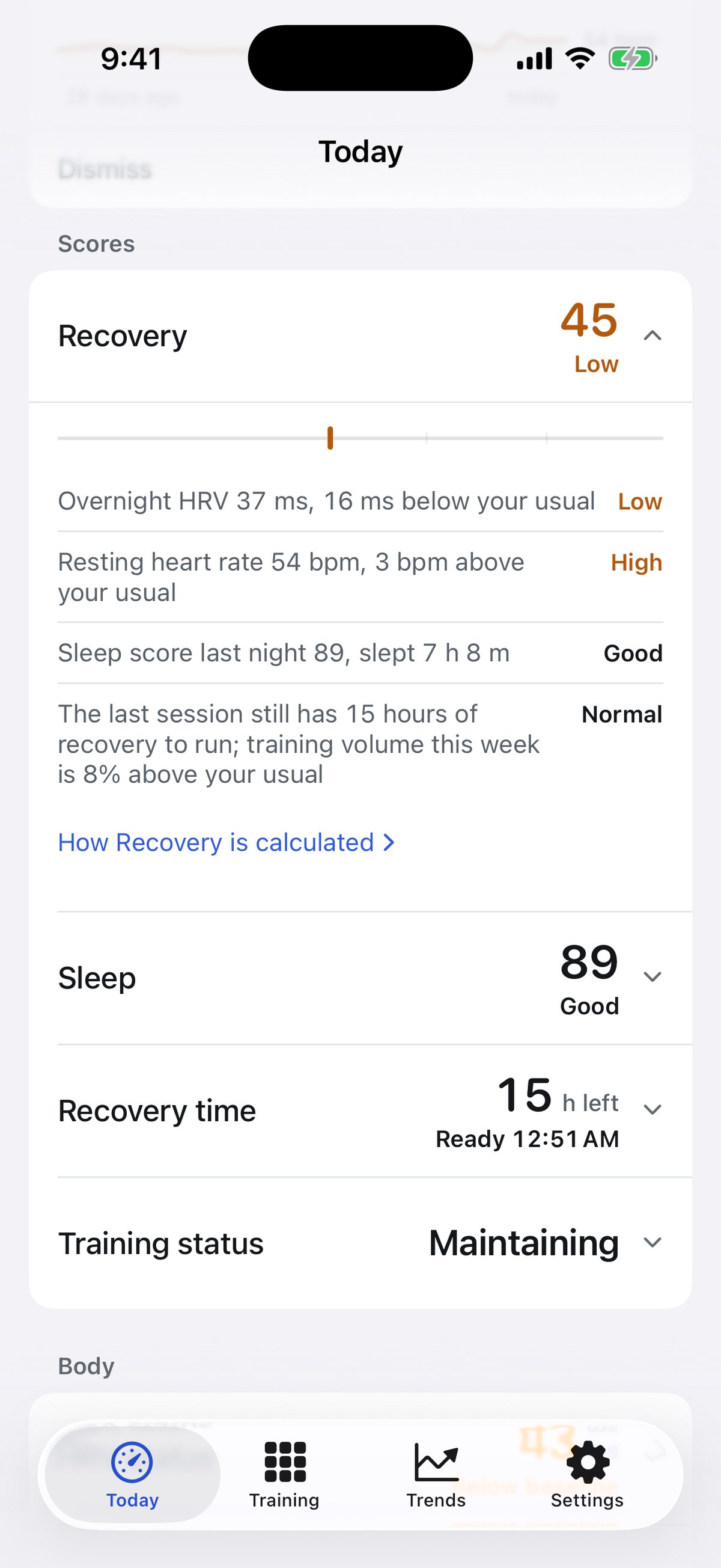
On the Today page, the sample profile shows a recovery score of 45, marked Low, because overnight HRV came in at 37 ms, 16 ms below this runner’s usual, and resting heart rate at 54 bpm, 3 bpm above usual. Sleep score was 89 after 7 hours 8 minutes. The previous session still had 15 hours of recovery to run, and the week’s training volume sat 8% above usual. Training status read Maintaining.
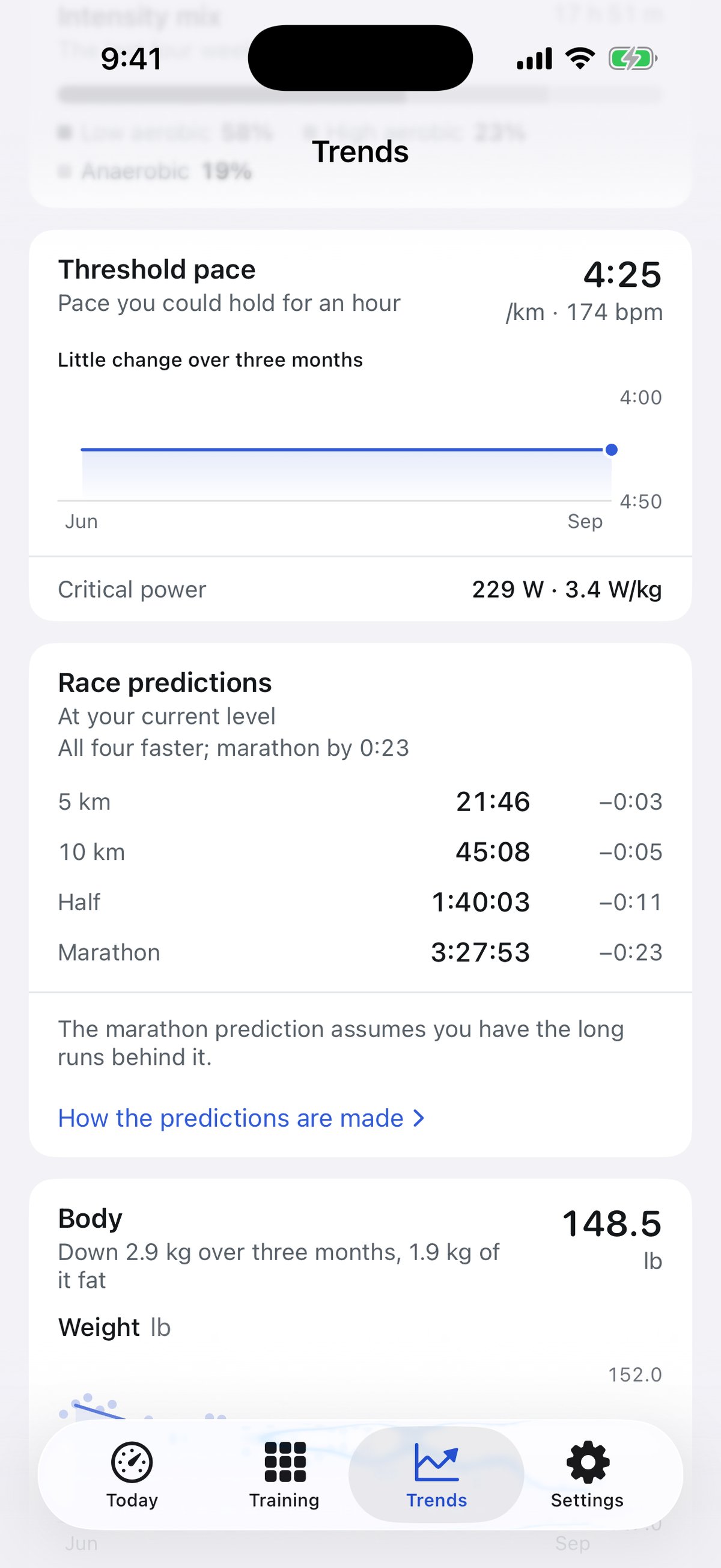
On the Trends tab, threshold pace sits at 4:25 per km at 174 bpm, with little change over three months. Critical power reads 229 W, or 3.4 W/kg. Race predictions at the current fitness level:
| Distance | Predicted time |
|---|---|
| 5 km | 21:46 |
| 10 km | 45:08 |
| Half marathon | 1:40:03 |
| Marathon | 3:27:53 |
All four are faster than three months earlier, the marathon by 23 seconds, though the marathon figure assumes the long runs are already logged.
Every workout, with its segments
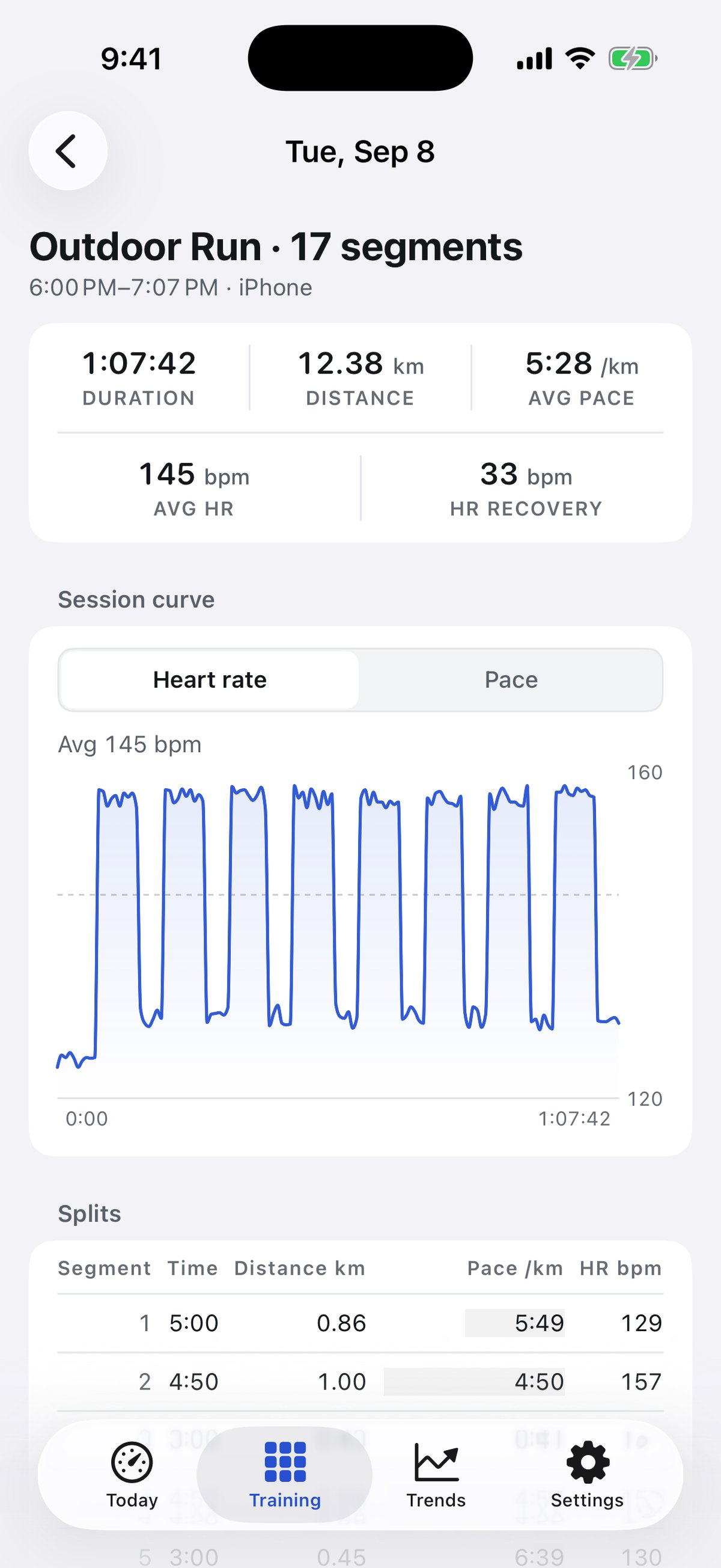
Each session gets a load, a training effect, a performance deviation against what the threshold predicted, and heart-rate drift over the second half. Splits and the full heart-rate curve are there, and interval sessions keep their segments the way the watch recorded them. Runs, walks and rides are labelled indoor or outdoor as Apple records them. A year of sessions sits on one heatmap with hours per month, with nothing logged by hand.
For the athlete’s own agent
The second face of Somvia is that an AI agent can read everything the app shows. Upload is a switch, off by default; the app works in full without it, and the scores stay on the phone. When turned on, Somvia sends the categories the athlete picks, encrypted, to its own server and exposes them over MCP, the open protocol most agents now speak. That covers Claude and ChatGPT, and it equally covers agents people run themselves, such as OpenClaw or Hermes, or anything built on a framework that supports MCP, which is where the platforms’ own Apple Health integrations stop. The agent gets the scores, daily readings, and per-workout detail down to the heart-rate curve, so a question about why recovery was low on a given day, or how a month of long runs went, gets answered from the athlete’s own numbers. A memory stores goals, injuries, medication and preferences so the next agent, or the same one next month, knows them too. Access tokens are stored as hashes; any agent’s access can be revoked, and the server-side data can be deleted while keeping the account.
What it needs
A wearable that writes overnight heart rate, HRV and sleep to Apple Health. Apple Watch does all three. Some third-party watches write sleep but not HRV; in that case, the recovery score doesn’t appear, but load, thresholds, and race predictions still work from the workouts. Recovery scores need 14 nights of readings before they show.
Pricing and availability
Somvia costs $4.99 a month, $29.99 a year or $149 once, after a three-day trial. It’s the work of one developer.
Download: on the iOS App Store, https://apps.apple.com/app/id6786936154.
Related reading
- Cinder: An Apple Watch Recovery App That Shows Its Calculations
- Correlate: Recovery Scores From the Apple Watch You Already Wear
- Vero: On-Device Recovery and Readiness Scoring for the Watch You Already Wear
Quick answers
Does Somvia need an Apple Watch?
It needs a wearable that writes overnight heart rate, HRV and sleep to Apple Health. Apple Watch does all three; some other watches write sleep but not HRV, and in that case the recovery score doesn’t appear, though load, thresholds, and race predictions still work from the workouts.
Where is the data processed?
Data is processed on the iPhone, and nothing leaves the phone unless the upload switch is turned on, and then only the chosen categories.
Which agents can read it?
Any agent that speaks MCP can read it, including Claude, ChatGPT, and self-hosted agents such as OpenClaw and Hermes.
Does it need a power meter?
It needs a power meter only for critical power; running thresholds and race predictions come from pace and heart rate alone.
Is there a free tier?
There’s a three-day free trial, then a subscription or a one-time purchase; there’s no permanent free tier.
Which models does it use?
It uses Bannister and Coggan for load, the 20- and 30-minute field methods for thresholds, Monod and Scherrer for critical power, Daniels and Gilbert for race times, and the 2022 FRIEND standards for cardio-fitness percentiles, all listed at somvia.app/training-science.
Last Updated on 15 September 2026 by the5krunner
My favourite kit and nutrition
- Garmin Fenix 9 Pro — I’ve just bought one.
- Injinji – Runners protect your toes. Avoid discomfort and minor injury. Run more. Run faster. I use them.
- Garmin 90-degree charging adapter — A small keyring adapter you can use anywhere. Essential when away. I use one.
- Garmin charging puck — the fastest and most reliable way to top up your Garmin before a session. I use one.
- Ravemen FR300 — Front light that mounts directly under your Garmin or Wahoo head unit. Keeps your bars clean and your beam pointed where it matters. I use one.
- Body Glide – The blue anti-chafe stick that all swimmers and many runners use. I use it.
- Maurten — The race nutrition trusted by elite athletes. Gels and drink mixes engineered to be easy on the stomach. I use them.
- Garmin Varia RTL515 — A radar rear light that alerts you to vehicles approaching from behind. Pairs with your Edge or Wahoo. I use this model.
- Favero Assioma Pro RS2 — The power-meter pedals most serious cyclists choose. Accurate, easy to move between bikes. I use this model.
- Garmin Forerunner 970 — A serious choice for a pro-grade triathlon watch. I use this.
- Polar H10 — My daily driver for accurate, waking HRV readings.
- Wahoo ELEMNT Roam 3 — The bike computer that has the feature Garmin lacks: usability. I use mine on most rides.
Reader-Powered Content
This content is not sponsored. It’s mostly me behind the labour of love, which is this site, and I appreciate everyone who supports it.
Support the site: Follow (free, fewer ads) · Subscribe (paid, ad-free) · Buy Me A Coffee ❤️
All articles are written by real people, fact-checked, and verified for originality. See the Editorial Policy. FTC: Affiliate Disclosure — some links pay commission. As an Amazon Associate, I earn from qualifying purchases.
tfk is the founder and author of the5krunner, an independent endurance sports technology publication. With 20 years of hands-on testing of GPS watches and wearables, and competing in triathlons at an international age-group level, tfk provides in-depth expert analysis of fitness technology for serious athletes and endurance sport competitors. ID
