The Garmin Instinct 3 Solar is the cheapest watch here and the battery champion, but only because it strips away almost everything. The Amazfit T-Rex Dual Solar is much more of a modern watch, with a bright AMOLED touchscreen and offline maps, but it costs nearly twice as much and cannot come close to the Instinct’s ability to go on almost forever. These are two watches answering the brief for a rugged watch in totally different ways.
You’re probably here for battery life, though. That is the Instinct’s whole argument, so it is worth understanding what you need to lose to save money.
Two watches, opposite priorities
One watch stays minimal to go the distance. The other packs in hardware and leans on solar for long adventures.
- The Instinct is built around battery life first. Garmin gives it a basic monochrome screen, no touch and no maps, then turns those low demands into battery figures the Amazfit cannot match.
- The Amazfit is built around a great display and features first, with maps and a touchscreen, then adds two solar panels to claw back some of the energy those features cost.
Why the Instinct’s battery is unlimited, and the Amazfit’s is not
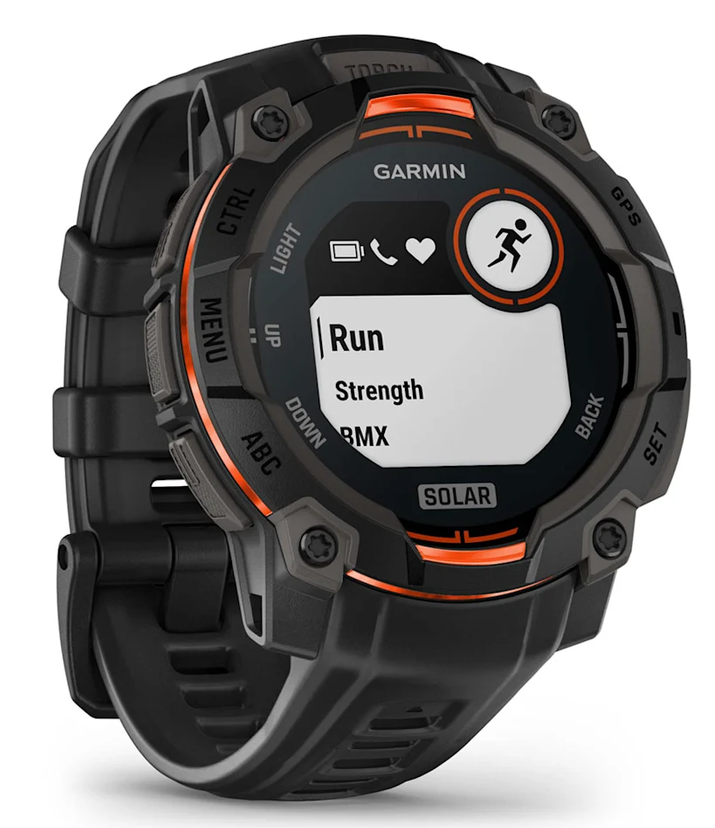
The Instinct 3 Solar uses a monochrome MIP transflective display at 176x176px, controlled by buttons. It is dim and basic, but it uses so little power that a small Power Glass solar ring can keep pace with the drain. Garmin claims the 45mm can run with unlimited battery in smartwatch mode given about three hours a day of sun at 50,000 lux.
The Amazfit keeps a bright 1.32-inch AMOLED at 466 x 466 and a super bright 3,000 nits. It looks far better, but that screen draws much more power, so its front solar ring does much less for it, lifting typical use from 25 to 34 days; Amazfit also added a larger rear panel that charges only when the watch is off your wrist. The screen’s power draw matters as much as the solar hardware in determining how far solar goes.
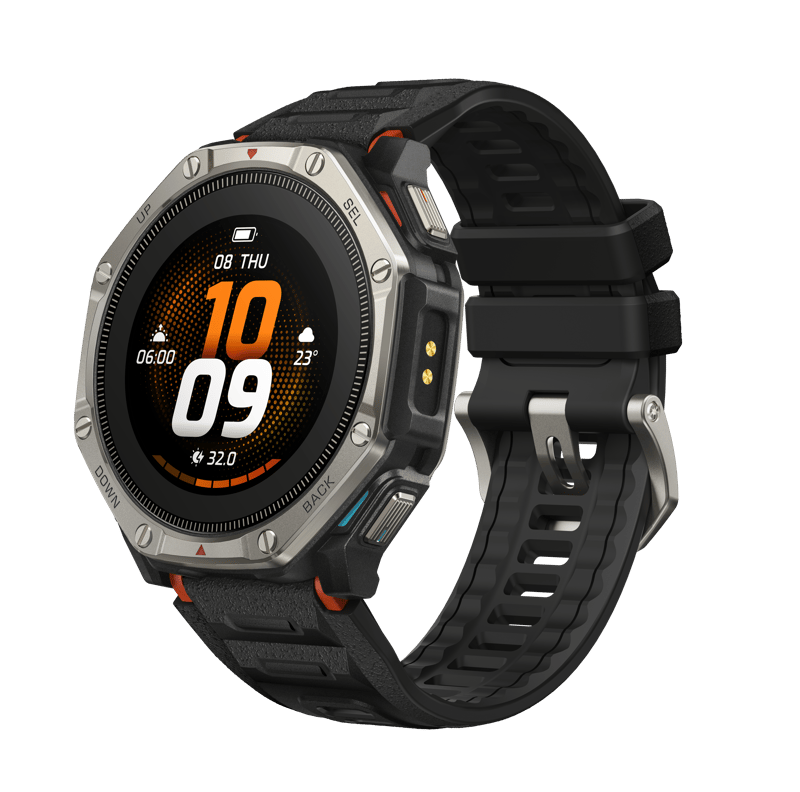
Specifications compared
The figures below are for the 45mm Instinct 3 Solar, the cheapest and most direct rival. The 50mm is larger, heavier and lasts longer.
| Specification | Amazfit T-Rex Dual Solar | Garmin Instinct 3 Solar (45mm) |
|---|---|---|
| Display type | AMOLED, 3,000 nits, touchscreen | Monochrome MIP, buttons only |
| Display size and resolution | 1.32 inch, 466 x 466 | 0.9 inch, 176 x 176 |
| Solar | Front ring plus rear caseback panel (rear works off-wrist only) | Front Power Glass ring, works while worn |
| Maps | Offline colour maps | No maps, breadcrumb and course navigation |
| Case | 51.4 x 16.9mm | 45 x 45 x 14.9mm |
| Weight | 69g | 52g |
| Lens and case | Sapphire lens, Grade 5 titanium bezel | Power Glass, polymer case, metal-reinforced bezel |
| Smartwatch battery | Up to 25 days (up to 51 with rear solar, off-wrist) | Up to 28 days (unlimited with solar) |
| GPS battery | GPS accuracy up to 41 hours | Up to 40 hours (up to 130 with solar) |
| Positioning | Dual-band, six satellite systems | Multi-band GNSS, SatIQ |
| Extras | Wi-Fi, mic and speaker, NFC, 64GB, diving to 50m | ANT+, Garmin Pay, no Wi-Fi, mic or speaker |
| Launch price | GBP 649.90 / USD 649.99 | GBP 349.99 / USD 399.99 (50mm from GBP 379.99) |
Battery life
The gap is large and one-sided.
- The 45mm Instinct 3 Solar is rated for up to 28 days in smartwatch mode, or unlimited under Garmin’s solar conditions, and up to 40 GPS hours, rising to 130 with solar. The 50mm lasts up to 40 days, again unlimited with solar, and up to 260 GPS hours with solar.
- The Amazfit lasts up to 25 days, or up to 51 with its rear panel used off the wrist, and up to 41 GPS hours. Amazfit’s 180-day headline applies only to its Outdoor Extreme power-saving mode with continuous rear-panel sun. With GPS running both gain from solar, but the Instinct goes far further with solar, up to 130 GPS hours against the Amazfit’s 57.
What you give up on the Instinct
The battery comes at a cost. The Instinct 3 Solar has no offline maps, only breadcrumb and course navigation, no touchscreen, no Wi-Fi, and no microphone or speaker. Its screen is monochrome and low resolution. The Amazfit has the smartwatch hardware the Instinct lacks: colour maps you can read at a glance, a touchscreen, Wi-Fi, calls through a mic and speaker, 64GB of storage, and recreational diving to 50 metres. Both watches carry the core outdoor sensors, a barometric altimeter and compass, and an LED flashlight, and both have their own training and recovery tools.
The Amazfit also behaves more like a full smartwatch back home and off the trail.
Looks
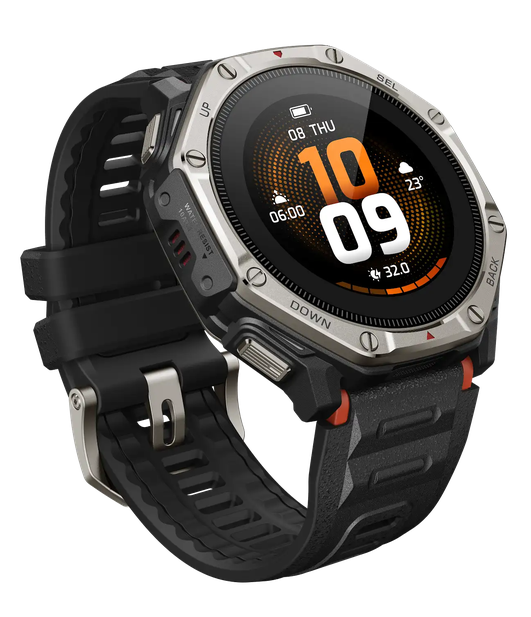
The Instinct has its own look. Its chunky, polymer, G-Shock-style case is a deliberate rugged aesthetic that many buyers choose for, and others avoid. At 52g in the 45mm size, it is much lighter than the 69g Amazfit. The Amazfit is the more conventional premium watch, with a sapphire lens and a titanium bezel, but it is larger, heavier and has an unusual octagonal case shape. This one is more about style than quality.
Price
The Instinct 3 Solar starts at GBP 349.99 / USD 399.99 for the 45mm and GBP 379.99 / USD 449.99 for the 50mm.
The Amazfit T-Rex Dual Solar is GBP 649.90 / USD 649.99, nearly twice the price of the 45mm Instinct.
The verdict
These are two honest answers to the same question.
- The Instinct 3 Solar wins on battery, price and its distinctive rugged look, but you accept a basic monochrome screen, no maps and few smartwatch features.
- The Amazfit T-Rex Dual Solar wins on screen, maps, features and everyday usability, but costs nearly twice as much, and its solar is mostly a bonus rather than a real battery solution.
If battery life and price come first, buy the Instinct. If you want the nicer screen, maps and a proper smartwatch, buy the Amazfit. The T-Rex Dual Solar hasn’t been tested for accuracy or real-world battery life yet.
Quick answers
Is the Amazfit T-Rex Dual Solar better than the Garmin Instinct 3 Solar?
It depends on what you want. The Amazfit has a far better screen, offline maps and more smartwatch features, but costs nearly twice as much. The Instinct 3 Solar is cheaper, lighter, and lasts far longer on battery, with a basic screen and no maps.
Which has the better battery?
The Garmin, by a wide margin. Garmin claims the Instinct 3 Solar can run with unlimited battery in smartwatch mode given enough sun, because its low-power screen uses very little energy. The Amazfit reaches up to 51 days, and only with its rear panel used off the wrist.
Does the Garmin Instinct 3 Solar have maps?
No. It offers breadcrumb and course navigation but no onboard maps. The Amazfit T-Rex Dual Solar has full offline colour maps.
Why does the Instinct last so much longer?
Its monochrome, low-resolution screen and lack of touch, Wi-Fi, and speaker mean it draws very little power, so a small solar input keeps up. The Amazfit’s bright AMOLED and extra hardware use far more.
Which is cheaper?
The Instinct 3 Solar, at GBP 349.99 for the 45mm, is a little over half the price of the Amazfit at GBP 649.90.
Which should I buy?
For battery life, price and a rugged look, the Instinct. For a bright screen, offline maps and full smartwatch features, the Amazfit.
Full details are on the Amazfit T-Rex Dual Solar specifications and Garmin Instinct 3 Solar specifications pages, in our T-Rex Dual Solar launch coverage, and alongside the pricier Fenix 9 Pro Solar comparison.

More: Amazfit coverage, Garmin coverage, and the Release Radar.
Last Updated on 22 September 2026 by the5krunner
My favourite kit and nutrition
- Garmin Fenix 9 Pro — I’ve just bought one.
- Injinji – Runners protect your toes. Avoid discomfort and minor injury. Run more. Run faster. I use them.
- Garmin 90-degree charging adapter — A small keyring adapter you can use anywhere. Essential when away. I use one.
- Garmin charging puck — the fastest and most reliable way to top up your Garmin before a session. I use one.
- Ravemen FR300 — Front light that mounts directly under your Garmin or Wahoo head unit. Keeps your bars clean and your beam pointed where it matters. I use one.
- Body Glide – The blue anti-chafe stick that all swimmers and many runners use. I use it.
- Maurten — The race nutrition trusted by elite athletes. Gels and drink mixes engineered to be easy on the stomach. I use them.
- Garmin Varia RTL515 — A radar rear light that alerts you to vehicles approaching from behind. Pairs with your Edge or Wahoo. I use this model.
- Favero Assioma Pro RS2 — The power-meter pedals most serious cyclists choose. Accurate, easy to move between bikes. I use this model.
- Garmin Forerunner 970 — A serious choice for a pro-grade triathlon watch. I use this.
- Polar H10 — My daily driver for accurate, waking HRV readings.
- Wahoo ELEMNT Roam 3 — The bike computer that has the feature Garmin lacks: usability. I use mine on most rides.
Reader-Powered Content

This content is not sponsored. It’s mostly me behind the labour of love, which is this site, and I appreciate everyone who supports it.
Support the site: Follow (free, fewer ads) · Subscribe (paid, ad-free) · Buy Me A Coffee ❤️
All articles are written by real people, fact-checked, and verified for originality. See the Editorial Policy. FTC: Affiliate Disclosure — some links pay commission. As an Amazon Associate, I earn from qualifying purchases.

tfk is the founder and author of the5krunner, an independent endurance sports technology publication. With 20 years of hands-on testing of GPS watches and wearables, and competing in triathlons at an international age-group level, tfk provides in-depth expert analysis of fitness technology for serious athletes and endurance sport competitors. ID
