Garmin Has Acquired Moxy Monitor, Source Says
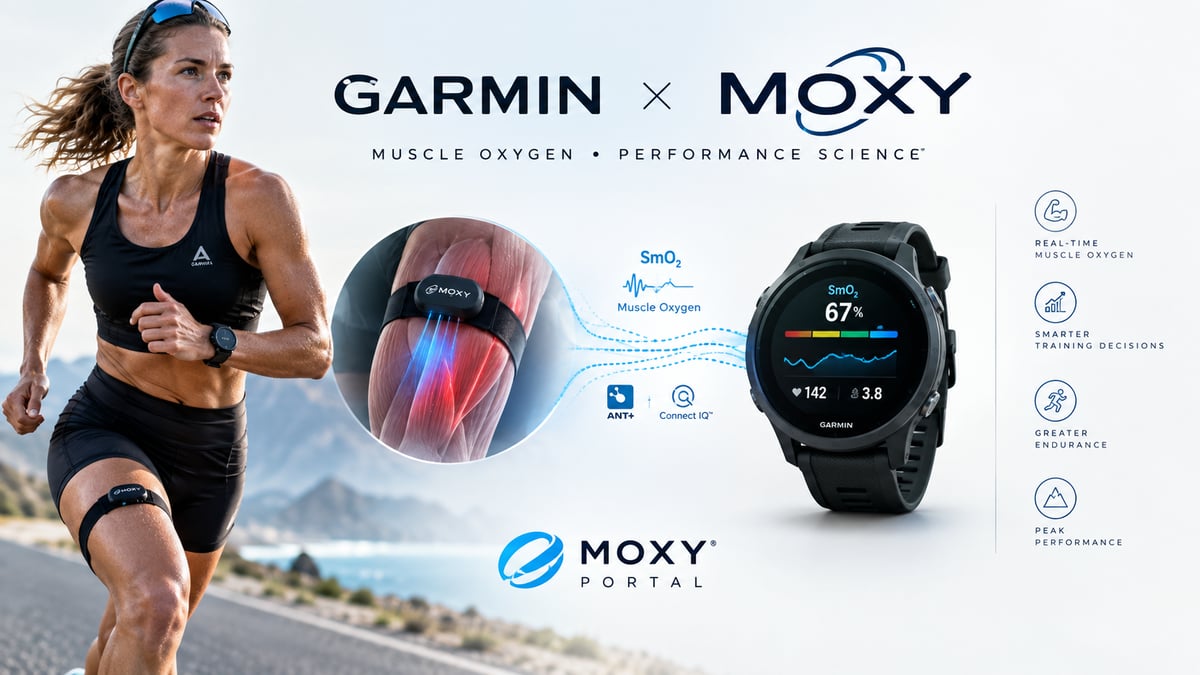
the5krunner has learned that Garmin has acquired Moxy Monitor, the muscle oxygen sensor company, according to a source with direct knowledge of the transaction. Neither company has announced the deal, and the5krunner has not independently confirmed it with Garmin or Moxy.
The source said the acquisition was disclosed to a small industry gathering earlier in September. Neither side has issued a press release, trade filing, or public statement.
Why hasn’t Garmin said anything?
Garmin is a roughly $55 billion company. Moxy Monitor is a small, privately held business selling a specialist sensor into a niche endurance and rehabilitation market. An acquisition at that scale sits well below the thresholds that force a public company to disclose a deal immediately.
Under SEC rules, a completed acquisition only triggers a Form 8-K filing if it is significant relative to the acquirer. Garmin has form here. In January 2016, it acquired PulsedLight, a small optical sensing company, without a press release. The deal only surfaced months later, in a single line of Garmin’s 2015 annual report, flagged as “not material.” DeLorme, a larger acquisition completed the same year, was treated similarly.
The trademark that pointed this way
Garmin filed a trademark for Muscle Battery in April 2026, describing an algorithm built around muscle oxygen saturation, or SmO2, data. the5krunner reported at the time that the filing all but confirmed new Garmin hardware, since SmO2 cannot be measured at the wrist and requires a dedicated near-infrared spectroscopy (NIRS) sensor worn directly on the target muscle(s).
At that point, the most likely route seemed to be licensing. Train Red’s parent company, Artinis Medical Systems, holds decades of laboratory-grade NIRS expertise, and the5krunner suggested Garmin would probably license optics from an established manufacturer rather than build a sensor from scratch. Acquiring Artinis outright looked unlikely, given the sensor’s use well beyond sport, which would unnecessarily inflate its value for Garmin.
Moxy was always the more plausible acquisition target. It is smaller, sport-focused, privately held, and the longest-established name in the category, with the only consumer NIRS device carrying published scientific validation.
What Garmin gains
Garmin already reads SmO2 data from third-party sensors, including Moxy and Train Red, over the ANT+ muscle oxygen profile. It has never had its own hardware, its own calibration data, or control over the sensor experience that Muscle Battery would need to work reliably. Moxy brings validated optics, years of field data across elite and age-group athletes, and a manufacturing relationship Garmin wouldn’t have to build from scratch.
It also removes a competitor from a market the5krunner has previously flagged as one of Garmin’s most likely new sensor categories. Whoop has already patented its own pressure-sensing muscle oxygen strap, and Train Red has just shipped a second-generation FYER sensor with onboard storage and a new app.
Not part of Elevate 6, and not a single purchase
This will not ship as part of Elevate 6, Garmin’s wrist-based optical sensor. SmO2 has to be read directly over the target muscle, shielded from ambient light, and held in a consistent position from one session to the next. A wrist sensor cannot do this, whatever generation of Elevate it runs.
Because SmO2 is site-specific, a sensor on one quadriceps says nothing about the other, the hamstrings, or the calves. A serious athlete or team wanting a full picture will often need more than one sensor worn at once, the same pattern Train Red already supports with ten or more FYER units on a single account. A Garmin muscle oxygen product looks more like a multi-sensor purchase aimed at professional and serious age-group athletes.
What an SmO2 reading actually shows
There are two metrics to know.
- The absolute level is the percentage of haemoglobin currently carrying oxygen in that muscle.
- The rate of change, whether the level is rising or falling and how fast, shows whether the muscle is replenishing oxygen or consuming it faster than blood flow can deliver.
A few simple use cases follow directly. A falling level during a steady effort marks the point where oxygen demand has outrun supply, useful for finding a real-world threshold without a lab test. A level that keeps dropping between reps points to incomplete recovery, a cue to extend rest rather than follow a fixed interval time. Comparing left and right readings on the same muscle across a session flags an asymmetry that heart rate or power cannot show.
Our take
Muscle oxygen is a strong, but minor strategic fit for Garmin. It gives Garmin a physiological metric no rival has shipped at scale, a natural extension of the Advanced Strength and Muscle Battery work already trademarked, and a premium, multi-sensor product with built-in repeat-purchase potential.
Moxy’s optics are proven but not without limits. Published validation and years of field use both point to placement sensitivity and calibration friction as the main practical complaints, the same issues that have kept every SmO2 device in this category, Moxy included, from reaching a mass audience. If Garmin has acquired Moxy, the more likely near-term work is refining the sensor itself rather than simply rebadging it. Garmin’s own Elevate development history, six generations of iterative optical sensor engineering, is exactly the kind of capability that would let it do that.
What happens next
Existing Moxy customers and the ANT+ compatibility they currently rely on are the more immediate question than any new Garmin product. Garmin has kept acquired brands running standalone before, and it has folded others directly into its own product lines. Muscle Battery points toward the second outcome, since it was trademarked as an algorithm layer built to sit on proprietary hardware, not as a commitment to keep reading third-party sensors indefinitely.
This report will be updated if Garmin or Moxy respond to a request for comment.
Quick answers
Has Garmin confirmed acquiring Moxy Monitor?
No. This report is based on a source with direct knowledge of the deal. Neither Garmin nor Moxy has made a public statement, and the5krunner has not independently confirmed the transaction with either company.
Why hasn't Garmin announced an acquisition like this?
Garmin must disclose an acquisition immediately only if it is significant relative to its size under SEC Form 8-K rules. Moxy Monitor is a small, privately held company next to a roughly $55 billion Garmin, so the deal would likely fall well under that threshold. Garmin has previously completed similarly small acquisitions, such as PulsedLight in 2016, without a press release, disclosing them only later as immaterial in a routine SEC filing.
Why would Garmin want to acquire Moxy Monitor?
Garmin filed a Muscle Battery trademark in April 2026 that requires a dedicated muscle oxygen sensor Garmin does not currently make. Moxy is the longest-established name in that market and the only consumer device with published scientific validation for absolute SmO2 measurement, giving Garmin proven hardware and years of field data rather than building a sensor from scratch.
Does Garmin already support Moxy sensors?
Yes. Garmin watches and Edge computers already read SmO2 data from Moxy and Train Red sensors over the ANT+ muscle oxygen profile. An acquisition would give Garmin its own hardware and calibration data rather than relying on third-party sensors.
Will this work through Garmin's Elevate 6 wrist sensor?
No. SmO2 has to be read directly over the target muscle, not the wrist, so it cannot run through Elevate 6 or any wrist-based Garmin sensor. It would ship as a separate, strap-mounted accessory, and monitoring more than one muscle group would mean buying more than one sensor.
Is this the CIRQA Pro sensor?
Possibly, though unlikely as a direct swap-in. A Moxy-derived sensor built straight into CIRQA Pro would have needed a long development and validation cycle to reach a shipping product this soon, and the5krunner has already discounted CIRQA Pro carrying a muscle oxygen sensor as its primary new feature, given the placement problem covered above. The timing still fits the wider picture. Moxy was likely already working with Garmin in some form before the deal, and the acquisition looks aimed at Moxy’s intellectual property and engineering team, including its leadership, rather than starting a relationship from scratch.
What does an SmO2 reading actually tell you?
Two things: the absolute oxygen saturation percentage in the muscle at that moment, and the rate at which it rises or falls. A falling level during steady effort marks a real-world threshold. A level that fails to recover between reps signals incomplete rest.
Last Updated on 22 September 2026 by the5krunner
My favourite kit and nutrition
- Garmin Fenix 9 Pro — I’ve just bought one.
- Injinji – Runners protect your toes. Avoid discomfort and minor injury. Run more. Run faster. I use them.
- Garmin 90-degree charging adapter — A small keyring adapter you can use anywhere. Essential when away. I use one.
- Garmin charging puck — the fastest and most reliable way to top up your Garmin before a session. I use one.
- Ravemen FR300 — Front light that mounts directly under your Garmin or Wahoo head unit. Keeps your bars clean and your beam pointed where it matters. I use one.
- Body Glide – The blue anti-chafe stick that all swimmers and many runners use. I use it.
- Maurten — The race nutrition trusted by elite athletes. Gels and drink mixes engineered to be easy on the stomach. I use them.
- Garmin Varia RTL515 — A radar rear light that alerts you to vehicles approaching from behind. Pairs with your Edge or Wahoo. I use this model.
- Favero Assioma Pro RS2 — The power-meter pedals most serious cyclists choose. Accurate, easy to move between bikes. I use this model.
- Garmin Forerunner 970 — A serious choice for a pro-grade triathlon watch. I use this.
- Polar H10 — My daily driver for accurate, waking HRV readings.
- Wahoo ELEMNT Roam 3 — The bike computer that has the feature Garmin lacks: usability. I use mine on most rides.
Reader-Powered Content

This content is not sponsored. It’s mostly me behind the labour of love, which is this site, and I appreciate everyone who supports it.
Support the site: Follow (free, fewer ads) · Subscribe (paid, ad-free) · Buy Me A Coffee ❤️
All articles are written by real people, fact-checked, and verified for originality. See the Editorial Policy. FTC: Affiliate Disclosure — some links pay commission. As an Amazon Associate, I earn from qualifying purchases.
tfk is the founder and author of the5krunner, an independent endurance sports technology publication. With 20 years of hands-on testing of GPS watches and wearables, and competing in triathlons at an international age-group level, tfk provides in-depth expert analysis of fitness technology for serious athletes and endurance sport competitors. ID
